Category: Arrival & Luggage

Getting your bags to the hotel, and what to do before check-in.

  • Checking In Late at a Japanese Hotel

    Checking In Late at a Japanese Hotel

    Check-in time reads like a start time. The room is yours from 3 p.m., and if you walk in at 1 a.m. the hotel still has your booking and your card. Super Hotel’s English FAQ reads differently: “check-in time is from 15:00 to 24:00, and your reservation will be canceled after 24:00”. Richmond Hotels’ terms put the line at 10 p.m. (22:00) if you gave no arrival time. Tokyu Stay’s front desk is staffed 24 hours, and its FAQ still asks for contact by midnight and says the booking may be canceled without it.

    As of October 2026, from Super Hotel: FAQ.
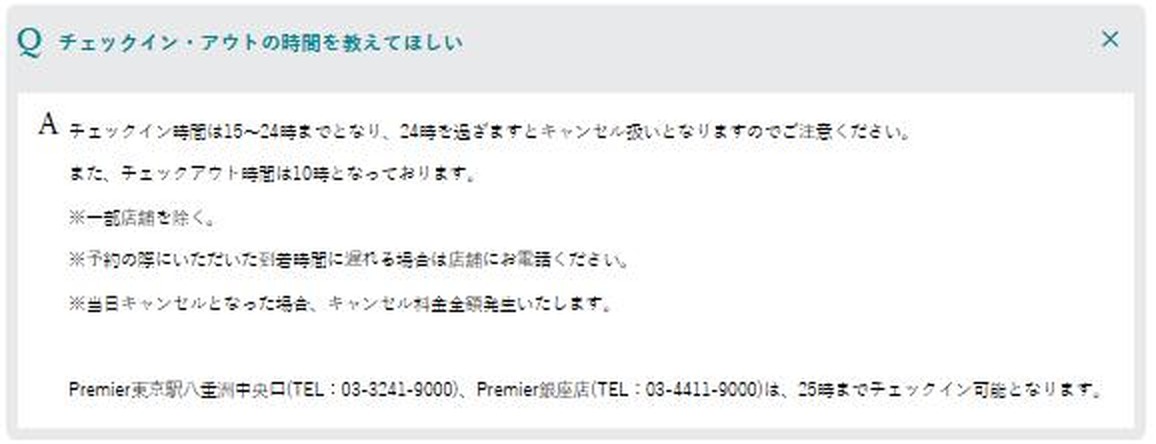
    Screenshot of the Super Hotel FAQ in Japanese. The answer to the check-in and check-out question says check-in is from 15:00 to 24:00, that the booking is treated as canceled after 24:00, that a guest who will be late for the arrival time given at booking should phone the hotel, that a same-day cancellation incurs the full fee, and that two Premier hotels allow check-in until 25:00.
    Super Hotel FAQ, check-in and check-out answer (in Japanese). Screenshot.

    These rules come from hotel, ryokan and booking-site pages. They show what a rule can look like, not how many hotels follow it.

    Last checked: October 4, 2026. Hotel policies change, so the hotel’s own page on the day you book outranks anything here.

    The arrival time you pick is also a deadline

    Super Hotel’s terms word the rule more precisely. Article 5 says the hotel may treat the contract as canceled if the guest “does not appear without any advance notice by midnight on the accommodation date (or 2 hours after the estimated time of arrival if such estimated time was expressly informed beforehand)”. A guest who gave 6 p.m. and has not been in touch could be treated as canceled at 8 p.m. instead of midnight. For a stated time after 10 p.m. the FAQ and the terms differ, so ask.

    As of October 2026, from Super Hotel: terms.

    The lines differ by chain.

    Chain When the terms say a booking may be canceled What it asks you to do
    Toyoko Inn The expected time of arrival passes with no advance notice (terms, Article 6, revised September 29, 2026) Contact the hotel in advance if you’ll be later than planned (guide). The FAQ asks for a phone call if arrival will be after 24:00 (FAQ, in Japanese)
    Super Hotel After 24:00 if you haven’t told the hotel (FAQ), or 2 hours after the stated arrival time (terms, Article 5) Call the hotel if you’ll be significantly late for the time you filled in at booking
    Richmond Hotels 10 p.m., or 2 hours after the stated arrival time (terms, Article 6, in Japanese) Contact the hotel. The clause covers a guest who neither arrives nor makes contact
    Route Inn The arrival time on the day passes with no contact (terms, Article 5, in Japanese, applied from October 1, 2015) Contact the hotel
    Tokyu Stay No word by 24:00 that day (FAQ, in Japanese) Call the front desk if arrival will be after 22:00. Midnight is the deadline for that contact

    The table shows three different clocks. Toyoko Inn and Route Inn use the time you gave. Super Hotel and Richmond add two hours to it and keep a fixed backstop for guests who gave none, midnight at one and 10 p.m. at the other. Tokyu Stay names midnight. The verb in all five is “may”, and Sotetsu Hotels’ English guide suggests the door isn’t always shut: “If you are late and unable to contact us in advance, please explain the situation to the front desk upon arrival.” The same guide says “The latest check-in time varies from hotel to hotel. Some hotels accept check-ins until midnight, or even 24 hours a day, while others may cancel your reservation if you arrive after a certain time”.

    As of October 2026, from Sotetsu Hotels: English guide.

    Check-in starts at 15:00 at Toyoko Inn, Super Hotel, Tokyu Stay, Dormy Inn and one Route Inn hotel. Dormy Inn gives 15:00 and 11:00 for check-out and adds that a facility’s or plan’s own times can differ. The last check-in is 23:00 or 24:00 at most hotels, according to Jalan’s news column. That fits the chains above, with Richmond’s 22:00 at the early end.

    As of October 2026, from Dormy Inn (in Japanese): FAQ. From Jalan News (in Japanese): column.

    Who is at the desk after midnight

    A staffed desk and a check-in deadline are separate facts. Tokyu Stay’s answer says 「フロントは24時間営業しております」, the front desk is open 24 hours, in the same paragraph as the midnight line. Toyoko Inn’s English guide says “The hotel operates 24 hours a day”. One Route Inn hotel’s facilities page lists 「24時間フロント常駐」, a front desk staffed around the clock.

    Other pages close the counter. Super Hotel’s FAQ has a question about “the hours when the front desk is closed (0:00 to 7:00)” and answers that in an emergency you use the intercom next to the elevator or phone a call center at night. The Japanese FAQ adds that after 24:00 you enter the building by unlocking it with the passcode for your room. That fits the 24:00 check-in line: you check in while the counter is open, and the passcode handles the door afterward.

    As of October 2026, from Route Inn and Super Hotel (in Japanese): Route Inn facilities page, Super Hotel FAQ.

    Richmond sits between the two. A notice from one Richmond hotel says staff are there 24 hours and that the entrance is locked after 1 a.m. for security, so you ring the intercom. It also asks guests to tell the hotel in advance when their arrival time changes.

    As of October 2026, from Richmond Hotel Musashi-Kosugi (in Japanese): notice.

    I have checked in at Japanese hotels both between 10 p.m. and midnight and after midnight. In my experience, at hotels and ryokan alike, after 10 p.m. or after midnight you mostly need your room’s card key to get through the lobby door.

    Machines, passcodes and hotels with no desk

    A machine at a staffed hotel changes who hands you the key. Toyoko Inn’s guide says “Please check-in either at the reception or by using our self-check-in machine”, on the same page as its late-arrival rule.

    Dormy Inn’s 快速チェックイン (quick check-in) lets you register in the hotel’s app and hold a QR code to a machine at the hotel to get your key. Pre-registration opens at 6:00 a.m. on the day of the stay, late-night use varies by facility, and same-day or changed bookings can’t use it. Those go to the staffed front counter. For a late arrival, check your hotel’s page first, and expect the counter if you book on the road the same day.

    As of October 2026, from Dormy Inn (in Japanese): quick check-in page.

    Two pages describe the fully unmanned kind. Hotel Watari says “Our hotel is completely unmanned.” Check-in is done on your own phone from 4 p.m., after you arrive, using a pre-check-in link from the confirmation email, and a 4-digit passcode is displayed for the smart lock on the front door. If you haven’t completed the advance procedure, you’ll enter your guest information on the spot, and a phone number is listed for questions. At a place like that, the confirmation email with the link is what to have open when you reach the door.

    Hotel B4T Iwaki uses a different design: a Suica card touched at a kiosk on arrival, at the security entrance and at the room door, with staff reachable around the clock by text or video chat, except for cabin-type rooms.

    As of October 2026, from Hotel Watari: self check-in page. From Japan Today: unmanned hotel in Iwaki.

    Ryokan: dinner is the deadline

    At a ryokan, a traditional inn, the clock that matters is the kitchen’s. The Japan Tourism Agency says “You can usually check in starting at 15:00 or 16:00” and “dinner is usually served during a set time window, and if you arrive too late, you may miss it. If it does seem like you’ll arrive significantly later than the designated check-in time, let the ryokan know”. Here are the hours at four inns.

    As of October 2026, from the Japan Tourism Agency: ryokan page.

    Page What it says about arriving late
    Kishigon Ryokan (FAQ, in Japanese) Dinner plans: last check-in 18:00. Without dinner: 20:00. Dinner starts at 18:00 or 18:30, last start 19:00. No contact may mean cancellation
    Satoyama Jujo (guest information, in Japanese) Check-in from 15:00. Last check-in for dinner guests is 18:30
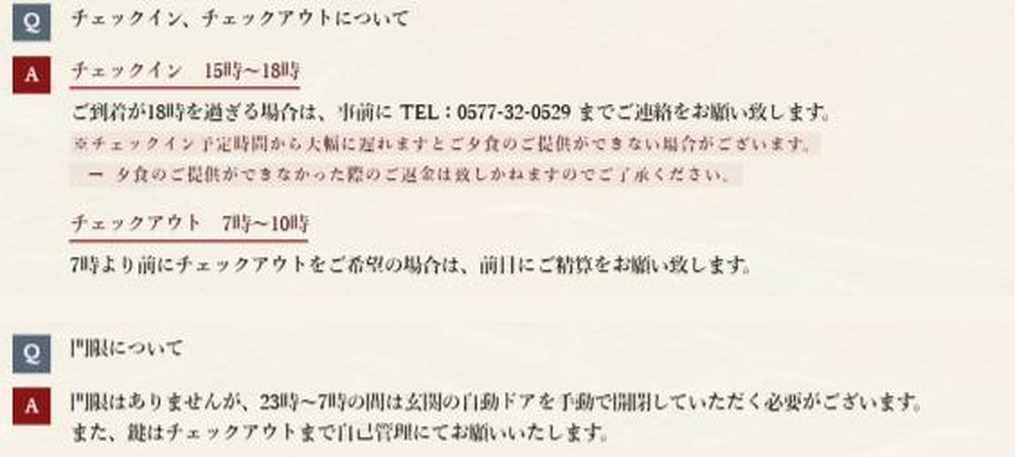
    Tanabe Ryokan (FAQ, in Japanese) Check-in 15:00 to 18:00, with a call asked for if you’ll be after 18:00. Dinner may not be served if you’re well behind, and it says there is no refund for dinner not served. No curfew, but from 23:00 to 7:00 you open and close the automatic front door by hand
    Ryokan Matsushima (FAQ, in Japanese) Earliest dinner 18:30. After 20:00 dinner may not be prepared. A call is requested if you’ll be well past the planned time
    Screenshot of a ryokan FAQ in Japanese. Check-in is 15:00 to 18:00, guests arriving after 18:00 are asked to phone ahead, dinner may not be served if the guest is far behind the planned check-in time with no refund for it, and between 23:00 and 7:00 the automatic front door has to be opened and closed by hand.
    Tanabe Ryokan FAQ, check-in and curfew answer (in Japanese). Screenshot.

    At Kishigon, dropping dinner moves the last check-in from 18:00 to 20:00. A family-run inn’s blog asks guests arriving after 5 p.m. to call that day, even from the road, because dinner starts at a set time.

    As of October 2026, from Kadoya (in Japanese): blog post.

    Three English-language terms sheets put the no-show line in numbers. Nishimuraya Honkan’s terms say the inn may treat the stay as canceled if the guest “does not appear by 7:00 pm of the accommodation date (or, two hours after the expected arrival time if the Ryokan has been notified)”, and the cancellation table that follows Article 11 lists a no-show at 100% of the reservation rate. Yunokuni Tensyo and Hotel Iyaonsen use the same form with 8 p.m.

    As of October 2026, from the inns’ English terms: Nishimuraya Honkan, Article 5, Yunokuni Tensyo, Article 6 and Hotel Iyaonsen, Article 6.

    The door is its own question. The Japan Tourism Agency says “Most ryokan do have a curfew”, with some inns that have none, some that keep staff at the desk after curfew, and some that hand you a key. Tanabe’s answer shows what “no curfew” can mean in practice. If you’ll arrive after 18:00, ask the inn before you book, including about the door.

    As of October 2026, from the Japan Tourism Agency: curfew page.

    What the booking sites say about arrival times

    The hotel’s terms set the clock, and the booking site is the way you reach the hotel. Each site draws its line in a different place.

    Rakuten Travel. Its help page on same-day changes says: 「原則、予約時に指定したチェックイン時間を厳守してください」, keep to the check-in time you specified when booking. If you can’t, contact the number the hotel shows, quickly. After the check-in time the hotel may treat the booking as canceled. If you hadn’t contacted the hotel by then and couldn’t stay, Rakuten Travel takes no responsibility and sends you to the hotel about the fee. Rakuten doesn’t pass requests to accommodations, domestic or overseas, and the hotel’s phone number is on the reservation confirmation page.

    As of October 2026, from Rakuten Travel (in Japanese): same-day change help and help on contacting the hotel.
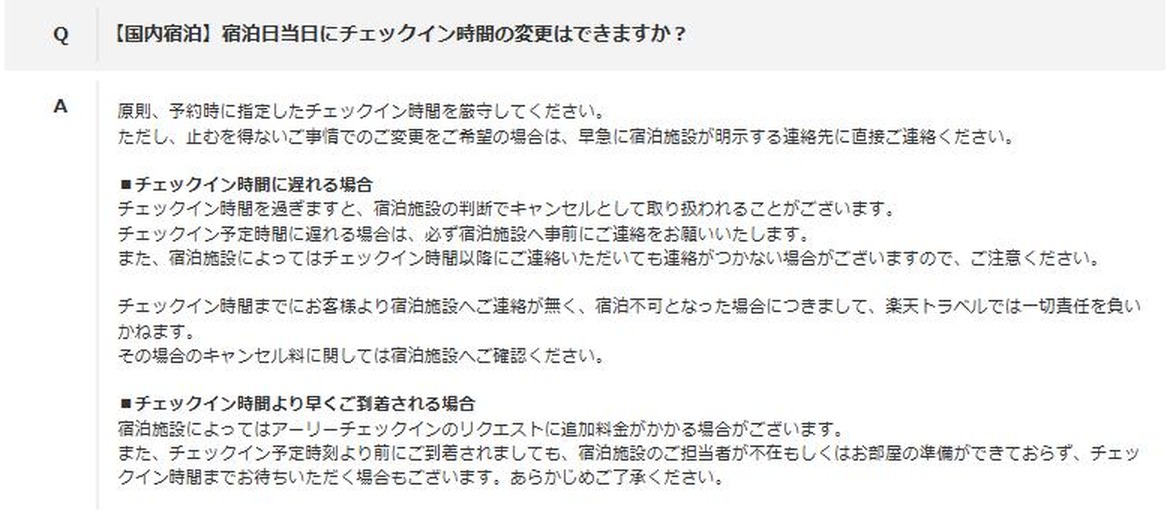
    Screenshot of a Rakuten Travel help page in Japanese about changing the check-in time on the day of the stay. It says to keep to the check-in time given at booking, that the hotel may treat the booking as canceled after the check-in time, and that Rakuten Travel takes no responsibility if the guest did not contact the hotel by the check-in time.
    Rakuten Travel help page on same-day check-in changes (in Japanese). Screenshot.

    Jalan. Its reservation help lists the check-in time, planned check-in time included, among the items you can change on the reservation page, and says the phone number on the booking confirmation page reaches the property. Jalan’s news column adds that a large delay can be treated as a cancellation under a hotel’s terms, and that with a meal plan you should call even for a small delay because the kitchen prepares for your arrival time.

    As of October 2026, from Jalan (in Japanese): reservation help.

    Booking.com. Its FAQ has a question titled “I will be arriving earlier/later than the stated check-in time. Can I still check in?” and answers “This depends on the property who will do their best to meet your needs but can’t guarantee your request.” It lists three routes: give your expected arrival time while booking, manage the reservation online to ask for check-in outside the standard hours, or contact the property with the details in your confirmation email. Its terms add “If you think you’re not going to arrive on time, contact your Service Provider and tell them when they can expect you”.

    As of October 2026, from Booking.com: FAQ and terms, section A9.

    Agoda. A hotel can report a no-show “if your guest doesn’t arrive by midnight on the check-in date” and should first check whether the guest sent a “Late Check-in” request or made direct arrangements. That midnight is the point for reporting to Agoda, and a hotel’s own terms can set an earlier line, as Richmond’s 10 p.m. does. Special requests are by default “not confirmed and are subject to availability at the property upon arrival”.

    As of October 2026, from Agoda Partner Hub: no-show page and special requests page.

    For how the sites differ on price, see Two Prices for One Room: How Japanese Booking Sites Build the Number They Show You.

    What a no-show costs

    Toyoko Inn’s cancellation table lists a no-show at 100% of the basic accommodation charge, regardless of guest type or booking size. Super Hotel’s Japanese FAQ says a same-day cancellation incurs the full cancellation fee. Tanabe’s FAQ says dinner that couldn’t be served because of a big delay isn’t refunded.

    Two pages carry relief. Toyoko Inn’s FAQ says that if you booked with online card payment, you needn’t call about arriving past your planned time, but you do need to tell the hotel if you won’t come at all. Super Hotel’s terms, Article 5 paragraph 3, say the fee “shall not be charged” if “it is proven that the Guest failed to arrive by midnight on the accommodation date (or 2 hours after the estimated time of arrival if such estimated time was informed beforehand) or to provide an advance notice thereof to the Hotel due to the delay of railway, airline or any other public transportation, or other circumstances not attributable to the Guest”. The wording is “if it is proven”, so a delay notice or ticket record is worth keeping.

    As of October 2026, from Toyoko Inn: terms and FAQ (in Japanese). From Super Hotel: terms, and the FAQ (in Japanese).

    Rakuten’s wording above leaves the fee to the hotel. Booking.com’s terms say “It’s your responsibility to ensure you’re on time, and if you aren’t, we aren’t responsible for any associated costs (e.g. the cancellation of your booking, or any fees the Service Provider may charge).” For the fee ladder before the day of stay, see Japanese Hotel Cancellation Policies Explained.

    How to tell the hotel

    1. Enter the time you can really make. Under the Super Hotel and Richmond wording the stated time starts a two-hour clock, and under Toyoko Inn’s and Route Inn’s it is the line, so an optimistic entry shortens your margin. I enter the time I actually expect to arrive.
    2. Change it on the site if the site lets you. Jalan’s reservation help lists the planned check-in time among the changeable items, and Booking.com’s FAQ describes managing the reservation online to ask for later check-in.
    3. Phone for anything after midnight, or close to the hotel’s line. The hotel’s phone number is on the booking confirmation page.
    4. If you can’t reach anyone, explain at the desk. Treat that as a fallback, since the terms above still give hotels the right to cancel.

    A short line like this works for email or a booking-site message, not for a phone call. The English is for your own reference:

    〇月〇日に予約しております(お名前)です。到着が予定より遅れ、〇時ごろになりそうです。予約番号は〇〇です。よろしくお願いいたします。

    This is (your name), booked for (date). My arrival will be later than planned, around (time). My reservation number is (number). Thank you.

    When the train is already late

    If the delay has already happened and the night is still ahead of you, these can help.

    • Same-night booking on Rakuten Travel. Members can book a same-night stay until 29:00, which means 5 a.m., by picking the previous day’s date as the check-in date and a time of 24:00 or later. A hotel may not yet have registered a last-minute booking, so show the booking screen and say it came through Rakuten Travel.
    • Plans that take check-in after midnight. Jalan marks such plans with 「24時〜もOK」 and describes arrival and check-in after 24:00, up to 29:00. Each plan page carries its own terms.
    • Hotels that run later than the usual line. Super Hotel’s Japanese FAQ lists Premier Tokyo Station Yaesu Central Exit and Premier Ginza as taking check-in until 25:00, which is 1 a.m.
    • A transport delay as the cause. Keep the proof. Super Hotel’s Article 5 paragraph 3, quoted above, ties the fee waiver to it.

    As of October 2026, from Rakuten Travel and Jalan (in Japanese): Rakuten same-night booking help, Jalan help on late check-in plans.

    The short version

    • The time you give a Japanese hotel is also a deadline if you haven’t told the hotel. It is the stated time itself at Toyoko Inn and Route Inn, two hours after it at Super Hotel and Richmond, and midnight as the contact deadline at Tokyu Stay.
    • Without a stated time, Richmond’s line is 10 p.m. and Super Hotel’s is midnight. A machine, a passcode door or a 24-hour desk sits beside that line and does not remove it.
    • Ryokan with dinner are earlier: last check-in is 18:00 at Kishigon and 18:30 at Satoyama Jujo, and the terms sheets put the no-show line at 7 or 8 p.m.
    • Tell the hotel by phone, or through the booking site if it has a message tool, whenever you’ll be later than the time you entered.

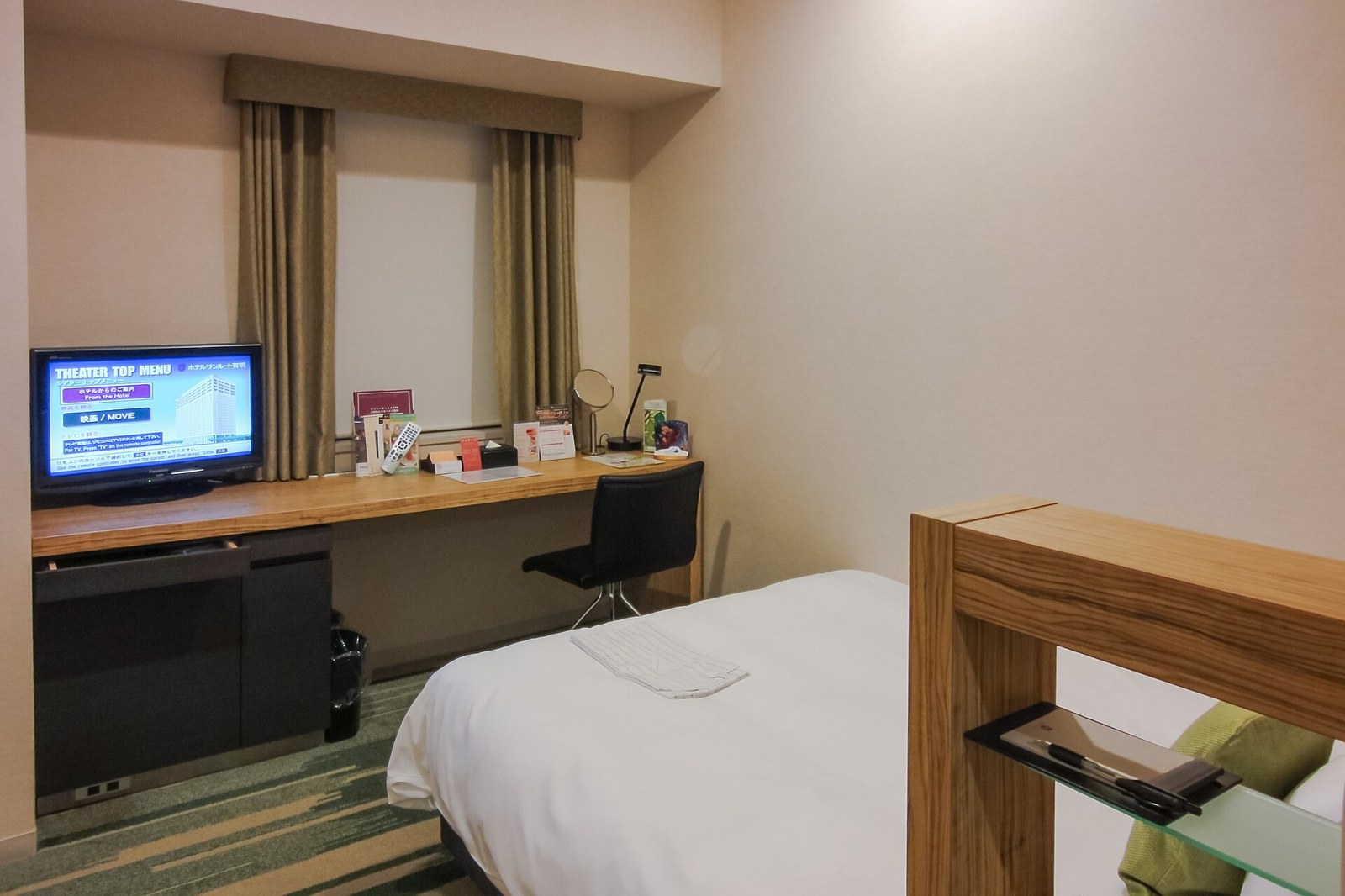
    Cover photo: a single room at Hotel Sunroute Ariake by J o, CC BY-SA 4.0, via Wikimedia Commons. It shows a different hotel from the ones discussed.
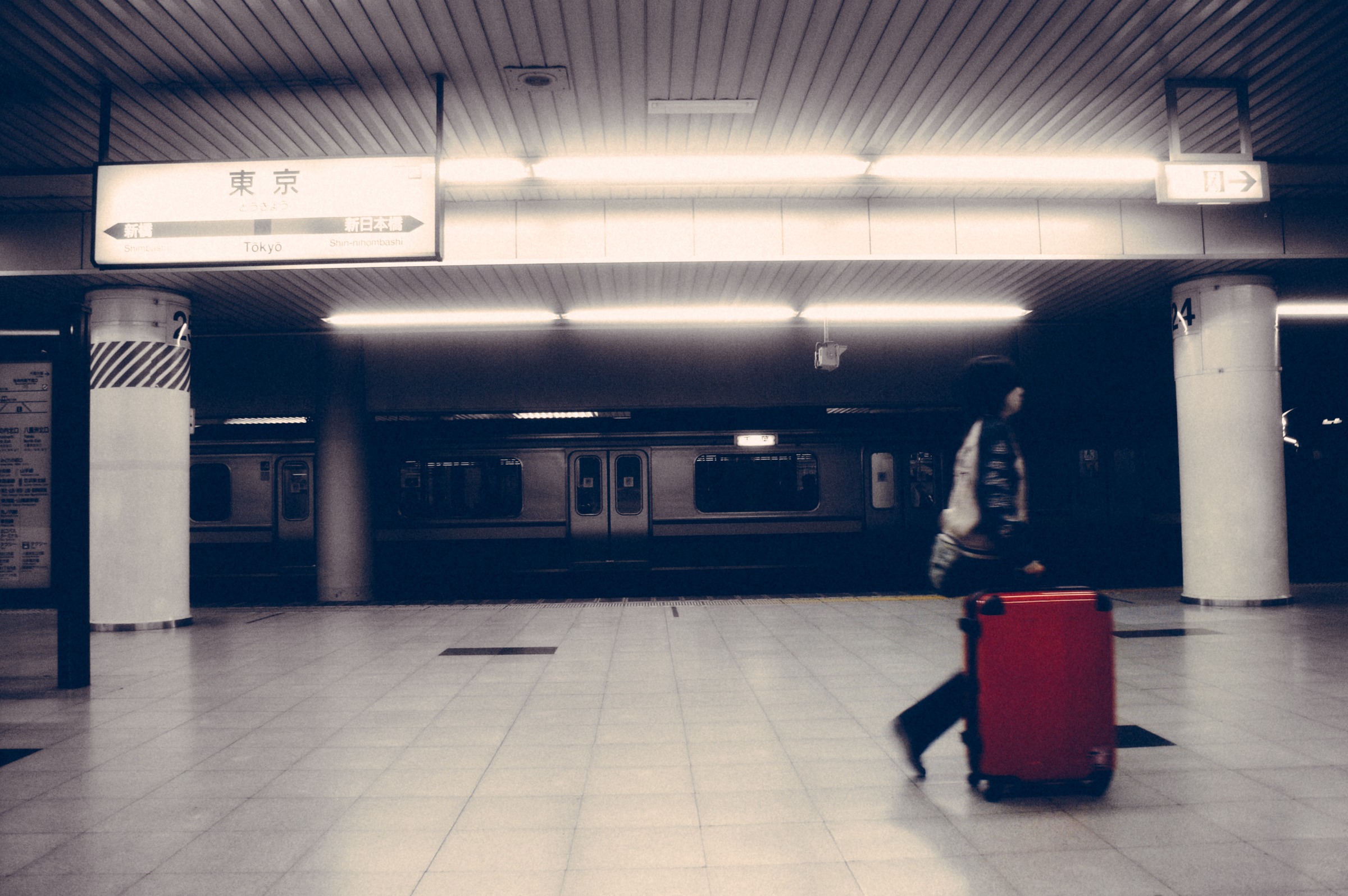

  • Arriving Before Check-In in Japan: What to Do With Your Luggage

    Arriving Before Check-In in Japan: What to Do With Your Luggage

    In the US, arriving at 10 a.m. with a suitcase is a small problem. Most hotels set check-in around 3 or 4 p.m., and if your room isn’t ready, “many hotels can hold your luggage,” so you can go out without your bags. You hand the bag over, you get on with the day.

    As of October 2026, from WoodSpring Suites: check-in and check-out times explained.

    Japan runs on the same afternoon clock. The surprises are around it: some hotels attach conditions to holding a bag, early check-in is often a paid add-on, and the check-out time on one booking page can be an hour different from the next.

    The times on the page, and the line under them

    Screenshot of the Service Provision Period section of Toyoko Inn's English transaction page, stating the standard check-in and check-out times and that they may differ by plan
    Toyoko Inn, English page. Screenshot.

    Toyoko Inn says “The standard check-in time is from 15:00 and check-out is until 10:00.” The next sentence matters more: “Check-in and check-out times may differ based on your chosen plan so please check the information displayed on each accommodation plan details page and reservation page.”

    So the default is 15:00 in, 10:00 out, and the real answer is on the plan details page, then the reservation page.

    Dormy Inn’s FAQ says “基本的にチェックイン15:00・チェックアウト11:00となります”, basically check-in at 15:00 and check-out at 11:00, and adds that stay hours may differ by facility or plan. SEKITEI’s English site lists check-in 15:00 and check-out 11:00. At the three or four ryokan I’ve stayed at, check-in was generally from 3 p.m. or later.

    As of October 2026: Dormy Inn FAQ (in Japanese), SEKITEI rates page.

    Japanese pages use the 24-hour clock, so 15:00 is 3 p.m. A 10:00 check-out is an hour earlier than an 11:00 one, which matters on the way out. These three chains use 15:00 as the default, which doesn’t mean every hotel does.

    Ask the front desk, but ask first

    The cheapest fix is the one you expect from home: ask the front desk. Hotels answer it differently.

    Dormy Inn’s FAQ answers both “チェックイン前に荷物を預かってもらえますか?” (can you hold my luggage before check-in?) and the same question for leaving bags after check-out to sightsee with: “当ホテルが事前に了解した物に限り、責任を持って荷物を保管致します” (the hotel stores luggage it has agreed to in advance and takes responsibility for it). The hotel isn’t responsible for loss or damage to luggage it didn’t know about, and it can’t hold fragile items or valuables. The hotel doesn’t say what “agreed in advance” means for a suitcase at the desk, so ask before you fly. A short message with your landing time and the number of bags is a reasonable form of asking.

    Hotel Super Tomari’s FAQ answers a question about holding luggage with “お荷物はチェックイン前、チェックアウト後でもフロントにてお預りしております”, meaning bags are held at the front desk before check-in and after check-out. It states no time limit, fee or advance approval.

    As of October 2026, from Dormy Inn and Hotel Super Tomari (in Japanese): Dormy Inn FAQ, Super Tomari FAQ.

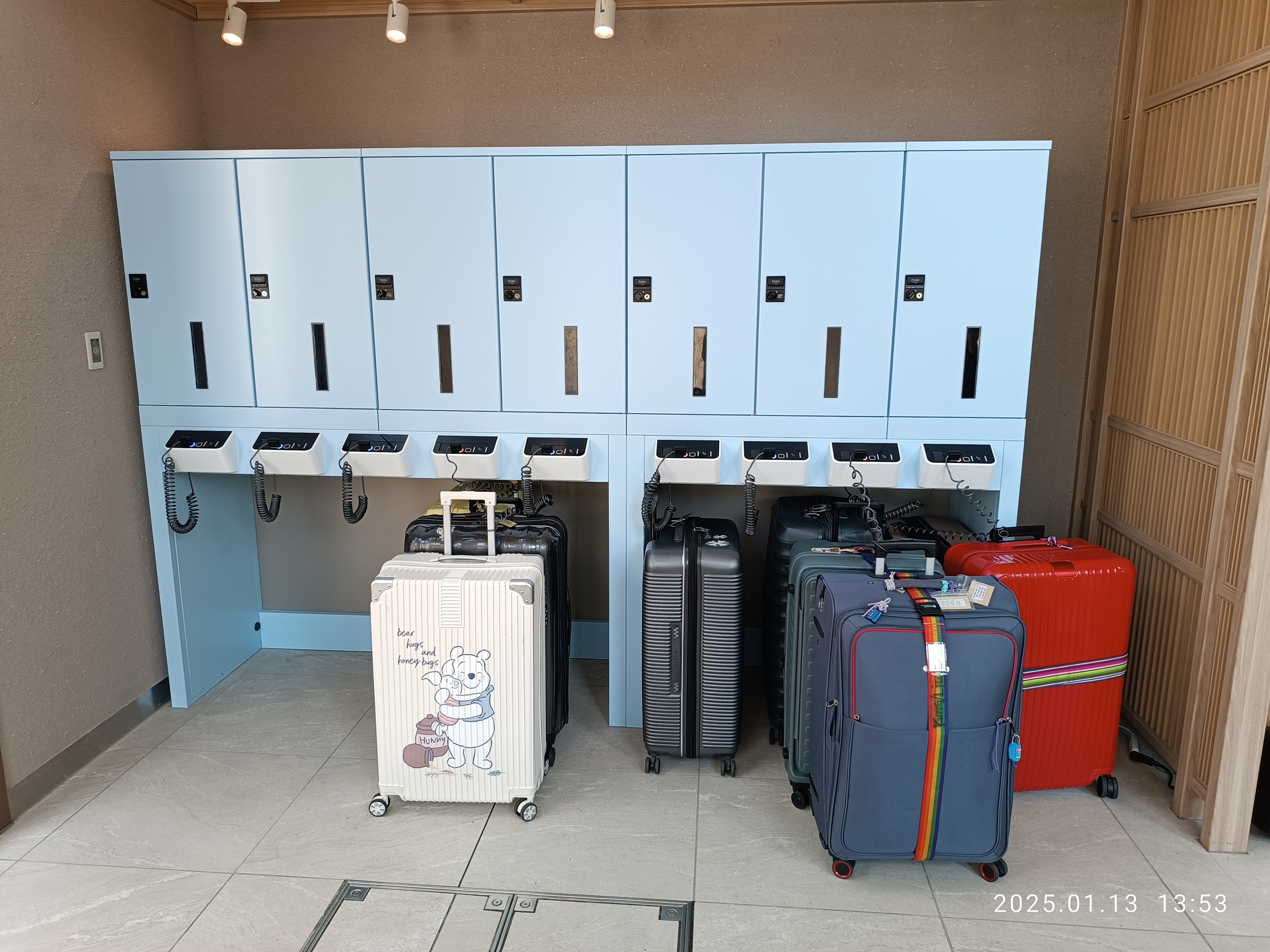
    One chain asks for an agreement and the other states a plain yes, so which one you’re booked into decides what to do. When I’ve arrived early, the front desk has held my bags. At a Tokyo hotel I stayed at recently, the form was different: I put the bag in a luggage area myself and locked it, with no one taking it from my hands.

    A hotel luggage storage area: blue lockers with charging cradles above, and seven suitcases of different colors standing in front.
    Hotel luggage storage. Photo: Naha Mama Pavilionz / Wikimedia Commons / CC0.

    Paying to walk in early

    Some hotels sell the hours. SEKITEI lists an early check-in option at 13:00 and a late check-out option at 13:00, against standard times of 15:00 and 11:00.

    Dormy Inn does. An FAQ item titled “チェックイン・チェックアウトの早着・延長料金は?” (what are the fees for early arrival and extension?) answers: “原則、1時間につきお一人様1,000円いただいています。但し、最大延長14:00まで。” It adds an example, “1部屋2名なら1時間2,000円”, so two people in one room pay ¥2,000 per hour.

    The item covers early arrival and extension together, and the hotel doesn’t say which direction the 14:00 cap applies to. If the same rate applies to early arrival, a couple arriving two hours early would pay ¥4,000. Whether the room is ready by then is a separate matter.

    As of October 2026, from SEKITEI (English) and Dormy Inn (in Japanese): SEKITEI rates page, Dormy Inn FAQ.

    A bag that gets there before you do

    Yamato Transport runs the black-cat TA-Q-BIN parcel service, and its English FAQ covers sending parcels to a hotel or ryokan. Send them “before the cut-off time at least 2 days before your check-in date,” with “3 days may be necessary depending on the distance.” Delivery times can’t be specified, and hotels may restrict where and when they take parcels, so confirm with the accommodation.

    From the airport itself, Yamato’s Airport TA-Q-BIN FAQ describes shipping luggage from airport counters to your home or hotel. It lists a ¥660 counter usage fee at Narita and Haneda, and says cash on delivery isn’t available when sending to a hotel. Confirm delivery timing and the shipping rate for that direction at the counter.

    JAL ABC’s English site lists a hotel luggage delivery service that sends bags “from the airport to hotels (or vice versa) for delivery on the same day,” at Narita, the Haneda international terminal and Kansai. Check cut-off times and fees with JAL ABC before counting on a 3 p.m. check-in. I’ve used JAL ABC to send luggage from an airport to a hotel or home, and to an airport. What I paid depended on a credit-card perk, from free to about ¥500.

    As of October 2026, from Yamato Transport and JAL ABC (English pages): parcels to a hotel FAQ, Airport TA-Q-BIN FAQ, JAL ABC hands-free travel page.

    The same problem, backwards

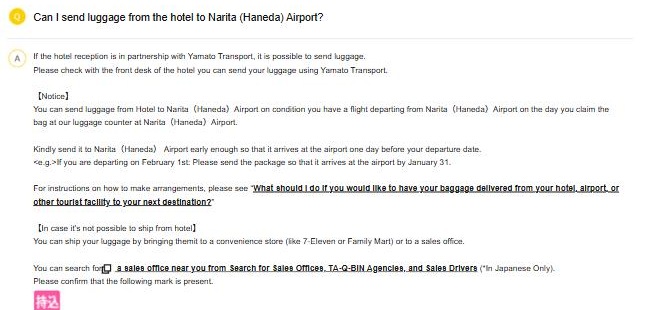
    Screenshot of Yamato Transport's English FAQ answering whether luggage can be sent from the hotel to Narita or Haneda Airport, showing the partner-hotel condition and the one-day-early arrival rule
    Yamato Transport, English FAQ. Screenshot.

    A 10:00 or 11:00 check-out against an evening flight leaves the same bag and the same gap. The answer starts “If the hotel reception is in partnership with Yamato Transport, it is possible to send luggage.” You also need a flight departing from that same airport on the day you collect the bag, and you must send the bag so that it “arrives at the airport one day before your departure date,” with a February 1 departure meaning arrival by January 31.

    So this is not a way to drop a bag at noon and collect it at 6 p.m. The bag goes a day early, to the airport you leave from, through a partner hotel. If your hotel isn’t a partner, the hotel says you can take the bag to a convenience store (it names 7-Eleven and FamilyMart) or a Yamato sales office.

    For the gap after check-out, the front desk hold is the simpler tool, and both FAQs above cover storage after check-out. The airport service suits a bag you’re willing to part with a day early. Ask at check-in whether your hotel is a partner.

    Station lockers have a clock too

    JR East’s locker operator lists sizes in its English FAQ. The largest, LL, is 13.5 to 18.1 inches wide (342 to 461 mm), 22.6 to 26.1 inches deep (575 to 663 mm) and 41.3 to 69.4 inches high (1,049 to 1,762 mm). These are ranges, not one fixed size. Measure your suitcase’s width against the 13.5 to 18.1 inch range before heading to the station. For how the bag then fits in the room, see how much luggage fits in a Japanese hotel room.

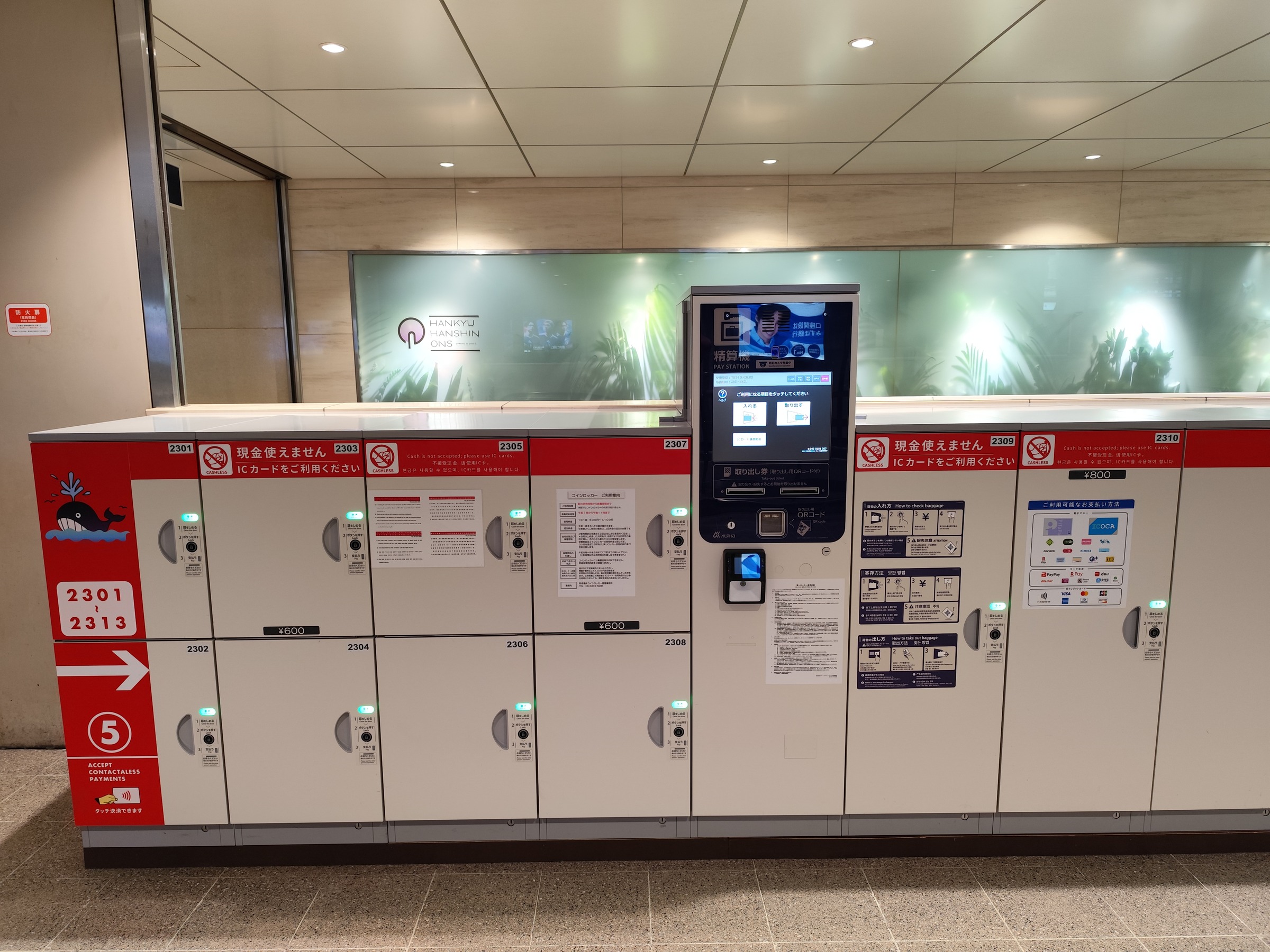
    A bank of white coin lockers with red headers and a payment machine in a Japanese station.
    Station coin lockers. Photo: TKdows / Wikimedia Commons / CC0.

    The rules matter more than the sizes. The FAQ says “The maximum rental period is three days from the start date,” that rates are calculated daily, and that the date changes at 2 a.m. After the limit, the operator “unlock[s] the locker, inspect[s] the luggage and transfer[s] it to our designated storage facility, where we will keep it for up to 30 days,” after which the luggage “is considered discarded.” Stored luggage is charged at the same daily rate.

    As of October 2026, from JR East’s locker operator (English): Station Locker FAQ.

    A locker suits a few hours between a train and a hotel that won’t take bags. It is a poor fit for a bag you want to forget for three days.

    If neither the hotel nor a locker works, ask the hotel about a Yamato parcel.

    The short version

    • Standard check-in is 15:00 and check-out is 10:00 or 11:00, but each hotel adds a plan or facility caveat. Read the plan details page and the reservation page for your booking.
    • Hotel Super Tomari’s FAQ says bags are held at the front desk, with no condition stated. Dormy Inn holds items it has agreed to in advance and won’t take fragile items or valuables. Ask before you fly.
    • Dormy Inn lists, in principle, ¥1,000 per person per hour for early check-in, and SEKITEI lists a 13:00 option. Yamato parcels to a hotel go at least 2 days before check-in, sometimes 3.
    • JR East lockers cap at three days, then the bag moves to storage. Hotel-to-airport shipping needs a partner hotel and arrival one day before departure.
    • Arriving late instead of early has its own rules, covered in Checking In Late at a Japanese Hotel.

    Cover photo: Suitcase in train station (Unsplash) by Israel Sundseth, CC0, via Wikimedia Commons. It shows a different place from the ones discussed here.

  • Sending Your Luggage From the Airport to Your Hotel in Japan: JAL ABC and Credit Card Perks

    Sending Your Luggage From the Airport to Your Hotel in Japan: JAL ABC and Credit Card Perks

    If you’re used to landing, collecting your bags, and dragging them onto a train or into a taxi, Japan offers a different routine. Counters in the arrivals area will take your suitcase and deliver it to your hotel front desk, usually the next day or later. You get on the train with a carry-on and a coffee. The catch is that “next day” is the earliest standard date, so this works for some itineraries and fails for others.

    How the service works

    JAL ABC covers Narita (T1 and T2), Haneda (T2 and T3), Kansai, and Chubu, with the counter “located in the arrivals lobby.” You fill in the delivery details at the counter, and the bag goes by truck.

    For a hotel, you give the postal code, the address, a phone number, and the recipient’s name. The phone field reads “Telephone number of delivery location (telephone number within Japan)”. That means the hotel’s number, not yours, so a US phone plan doesn’t get in the way. The bag is received at the destination, which for a hotel means the front desk, and the front desk will ask for your check-in date. If you reach the hotel before check-in, Arriving Before Check-In in Japan covers holding bags at the front desk, early check-in fees and station lockers.

    As of October 2026, from JAL ABC (English): from-the-airport page.

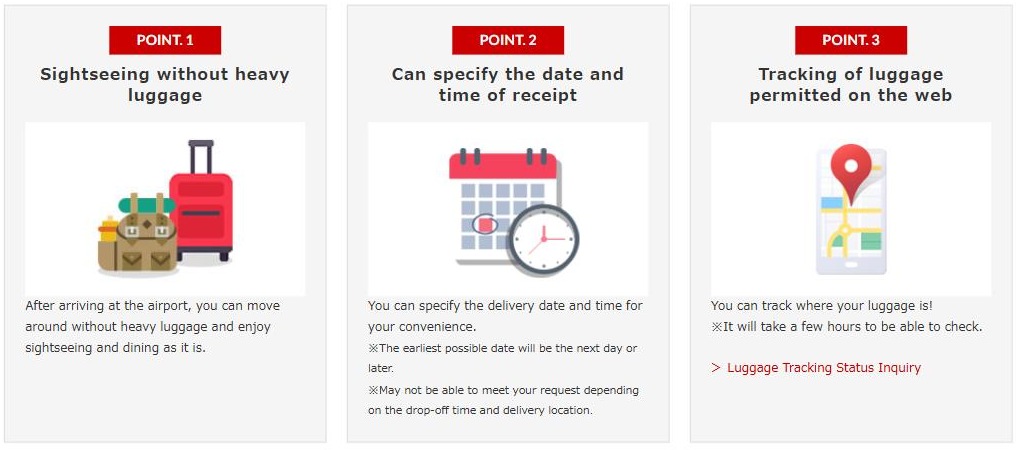
    JAL ABC English page, "Merits of using Delivery Service": sightseeing without heavy luggage, choosing a receiving date and time, and tracking your luggage
    JAL ABC English page, “Merits of using Delivery Service.”

    Look at the second item. You can choose the receiving date and time, but the earliest is the next day or later, and JAL ABC says your request may not always be met. The third item is tracking, and it comes with a delay: the bag can be checked only after a few hours.

    What it costs

    The charge depends on the size and weight of each bag. In JAL ABC’s size table, Size 140 means 140 cm (about 55 inches) or less in the sum of three sides and up to 25 kg (about 55 lb). Size 160 allows 30 kg (about 66 lb). From Size 180 up, the limit is 50 kg (about 110 lb).

    These are the Kanto rows, for Narita or Haneda to an address in the Kanto region (Tokyo, Kanagawa, Chiba, Saitama, Gunma, Tochigi, Ibaraki, Yamanashi). Prices are in yen, per bag.

    Size class Narita or Haneda to Kanto
    140 ¥2,430
    160 ¥2,820
    180 ¥4,240
    240 ¥7,000

    A large checked suitcase often lands in the 160 class or near it, but measure yours. Add the three sides in centimeters. A bag 75 cm tall, 50 cm wide, and 30 cm deep comes to 155 cm, which is Size 160.

    JAL ABC English page, Delivery Charge notes: maximum 240 cm and 50 kg per item, golf bags and ski gear priced as Size 160, and an extra 500 yen when you pick a carrier at Narita or Haneda
    JAL ABC English page, delivery charge notes.

    The notes set the maximum for one piece at 240 cm in total dimensions and 50 kg. Golf bags, skis, and snowboards are priced at the 160 rate. If you ask for a specific delivery company from Narita or Haneda, JAL ABC adds ¥500 (tax included) per piece to the normal fee. Most travelers have no reason to pay it.

    Dates and tracking

    The earliest delivery date is the next day or later, so the question to ask is when you need the bag, not when you land. Arrive Tuesday and check in Tuesday, and the bag reaches the front desk Wednesday at the earliest. That suits a stay of several nights and does nothing for tonight’s dinner. Keep a day of clothes and any medication in your carry-on.

    JAL ABC also has a separate Hotel Luggage Delivery Service page, which advertises “delivery on the same day”. It states a 14:00 deadline for sending to a hotel and lists Haneda to Bay Area hotels and Kansai to Osaka and Kyoto city hotels. But it says “This service will resume at some hotels on February 1, 2022”, and a page that old doesn’t tell you the service is running now. If same-day delivery matters to your plan, confirm with JAL ABC first.

    As of October 2026, from JAL ABC (English): Hotel Luggage Delivery Service page.

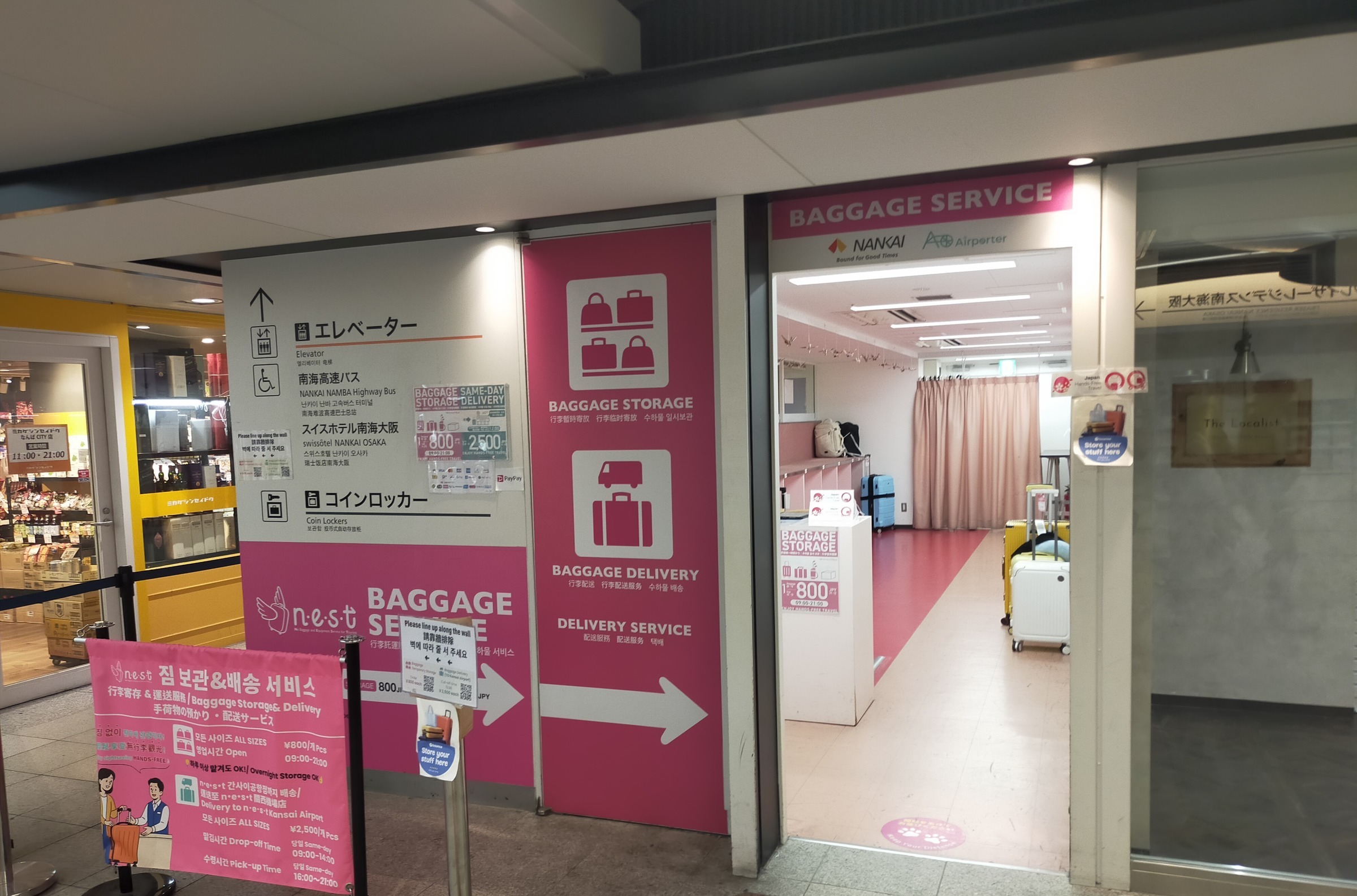
    The entrance to a baggage storage and baggage delivery service in a Japanese railway station, with pink signs and suitcases visible inside.
    A baggage counter at a Japanese station. Photo: Mr.ちゅらさん / Wikimedia Commons / CC BY-SA 3.0, cropped.

    What they won’t take

    The list on the page includes fragile items, perishables, hazardous materials, bags containing liquids, precision instruments, badly packed bags, musical instruments, and paintings. Because bags sometimes travel by air, anything restricted on aircraft is excluded too.

    Sending bags to the airport

    The other direction needs a reservation. A reservation by telephone or on the Internet is required in advance, and the phone line is staffed 10:00 to 17:00, so don’t wait for the last evening. A driver collects the bag on the date and time you choose and hands you a delivery slip. At the airport you show a copy of that slip and pick the bag up. The bag arrives at the airport on your specified pick-up date. Narita Terminal 2’s counter is open 7:00 to 21:00.

    This direction has its own price table, and the figures are not the same as the airport-to-hotel ones. For the Kanto region, going to Narita or Haneda, the rows are ¥2,700 for 120 cm, ¥3,580 for 160 cm, and ¥5,130 for 200 cm. Compare the 160 rows: ¥2,820 from the airport and ¥3,580 to it, so a round trip is not the same price twice. Size classes are also listed separately for each direction, so check your bag’s class on the right page.

    As of October 2026, from JAL ABC (English): to-the-airport page.

    Credit card perks

    Card perks can cut the price a lot, and they depend on who issued your card.

    Cards issued in Japan

    My card is the ANA VISA Platinum Premium card, a Japan-issued card. As I understand it, it is issued only to people who live in Japan, though SMBC lists only age and income conditions.

    I’ve used the card perk for deliveries to hotels as well as home. It has cost nothing or about ¥500, depending on the trip. The card pages below say “home” or “home or similar” and don’t say whether a hotel front desk is accepted, so confirm that with your card company.

    The ¥500 matches the price table on Visa Japan’s Visa Platinum Airport Delivery (return) page. You show your Visa Platinum card on the return leg, which for a visitor to Japan means the airport delivery to your accommodation or home. The table reads 500 yen for the 1st, 2nd, and 3rd bags, then “3個目以降” at 20% off the standard rate. The column headings make the third bag hard to read, so check the original. Other terms from that page:

    • The benefit period is April 1, 2026 to March 31, 2027, counted by the date you hand the bag over at the airport counter.
    • It covers Narita, Haneda Terminal 2 (international), Haneda Terminal 3, Chubu, and Kansai.
    • Bags can be up to 160 cm in total dimensions and 30 kg, or 25 kg at Haneda Terminal 2 (international), which Yamato handles.
    • From November 1, arrival delivery from Narita and Haneda Terminal 3 ships by Sagawa or Japan Post. If you name Yamato, JAL ABC adds 500 yen per bag (tax included).
    • Fragile items, perishables, valuables, hazardous items, liquids (including alcohol and seasonings), precision instruments, and badly packed bags are refused.
    • You tell the JAL ABC arrival counter you’re using the Visa Platinum Airport Delivery benefit, show the card, and pay with it. Booking online on JAL ABC’s website isn’t covered, and the offer can’t be combined with other perks or coupons.

    SMBC also lists “international baggage delivery”: up to two bags per direction at ¥500 each (tax included) and a 20% discount from the third bag, but it is labeled for Mastercard members.

    Sumitomo Mitsui Card’s own airport delivery page is a separate offer. It states “通常料金より15%OFF”, 15% off the standard rate. It splits members by brand. Visa Infinite, Visa Platinum, Platinum Preferred, and Gold members are pointed to the service that Visa Worldwide provides, which SMBC says has a higher discount rate. Mastercard Platinum and Gold members go to Mastercard’s service. SMBC also says that from April 1, 2026, arrival and round-trip deliveries at Haneda Terminal 2 International carry a counter fee of ¥500 (tax included) per bag.

    As of October 2026, from SMBC and Visa Japan (in Japanese): SMBC basic information page, Visa Platinum Airport Delivery (return), Sumitomo Mitsui Card airport delivery page.

    American Express Japan describes free delivery of a suitcase or golf bag between your home and the airport at departure and return, one piece. It lists Narita, Haneda, Kansai, and Chubu, with a limit of 160 cm in total dimensions and 30 kg. The outbound leg needs a reservation 7 days before departure through a domestic toll-free number (0120-989-509, 9:00 to 17:00), which may not work from abroad. The return leg needs no reservation. You must present the physical card in your own name. American Express Japan says the Green Card stopped getting the benefit on February 28, 2023.

    JAL ABC’s explainer on card perks, updated January 30, 2024, describes Amex Japan’s ANA and Delta SkyMiles cards as arrival delivery only, one piece, at Narita, Chubu, and Kansai, excluding Haneda. The Amex Japan page names Haneda and covers both directions. Follow your card company’s page.

    TRUST CLUB gives one departure bag and one arrival bag, but you choose two of three services (departure delivery, arrival delivery, or coat storage), and non-member companions aren’t covered.

    As of October 2026, from American Express Japan, JAL ABC and TRUST CLUB (in Japanese): Amex Japan delivery page, JAL ABC card explainer, TRUST CLUB Platinum Visa page.

    Cards issued in the US

    Visa Japan’s terms for the Visa Platinum offer say, in the original, “本特典は、日本国内で発行されたVisa クラシックカード、Visaゴールドカード、Visaプラチナカード、Visa Infiniteカードが対象です。” That translates as “This benefit applies to Visa Classic, Gold, Platinum, and Infinite cards issued in Japan.” It also covers the member and family card members. A US-issued Visa Platinum isn’t covered by that offer.

    That is one offer. The benefits pages for The Platinum Card from American Express, Chase Sapphire Reserve, and Capital One Venture X don’t list luggage delivery. Chase lists lost luggage reimbursement (up to $3,000 per traveler) and baggage delay insurance, which pay after a problem and don’t move a bag. Amex’s UK site has a Luggage Free benefit for UK Platinum members, with 15% off door-to-door worldwide shipping. Amex UK doesn’t mention airports in Japan. These pages can’t tell you about other cards, so ask your issuer in writing and keep the reply.

    As of October 2026, from American Express, Chase, Capital One and Amex UK.

    A discount for any visitor

    MATCHA, a travel site, lists a JAL ABC coupon for ¥200 off per bag at the Narita, Haneda, Chubu, and Kansai counters. On arrival you show the coupon or give code 4047 at the arrival counter. MATCHA says it can’t be combined with other campaigns or coupons and shows an expiry of March 31, 2027. JAL ABC’s own English homepage doesn’t list the coupon, so it’s a third-party listing. If you plan to use it, ask at the counter.

    As of October 2026, from MATCHA (English): coupon page.

    Yamato’s airport service

    Yamato’s Airport TA-Q-BIN is a service for sending heavy suitcases and other bulky luggage to airports in Japan. It works both ways: to an airport, or from an airport counter to your home or hotel. Yamato lists a handling fee of ¥660 (tax included) at Kansai, Narita, and Haneda. It also lists a separate counter-use fee of ¥660 that takes effect at Narita on June 1, 2025 and at Haneda on July 1, 2025. Those are two fees. Yamato doesn’t give sizes or the full delivery price. It says cash on delivery isn’t available when sending to hotels, and that a round trip can’t start from an airport.

    As of October 2026, from Yamato Transport (English): Airport TA-Q-BIN FAQ.

    Price both services for your bag’s size and route.

    The short version

    JAL ABC will deliver a bag from a Japanese airport to your hotel, next day at the earliest, and will carry bags back to the airport if you reserve ahead. Measure the bag, because the price steps up after the 160 class. Don’t ship liquids or anything you need on arrival night. Visa’s Platinum offer is limited to cards issued in Japan, so ask your US card issuer before you count on a perk.

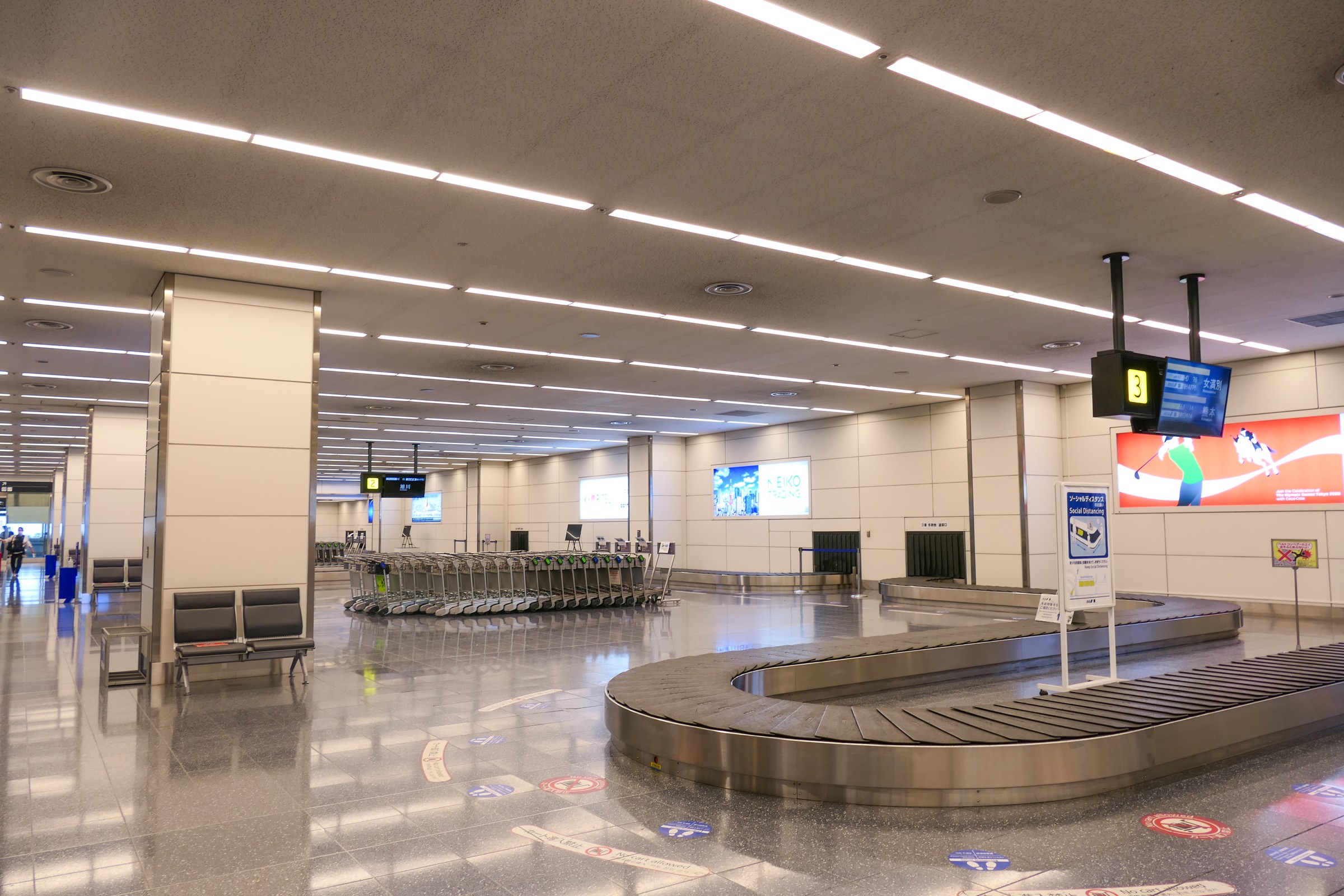
    Cover photo: Tokyo-International-Airport T2 Baggage-claim by MaedaAkihiko, CC BY-SA 4.0, via Wikimedia Commons. It shows a different terminal from the ones discussed here.

  • How Much Luggage Fits in a Japanese Hotel Room?

    How Much Luggage Fits in a Japanese Hotel Room?

    In an American hotel, a big suitcase is a non-event. You drop it on the floor between the bed and the window, unzip it flat, and live out of it for a week. The airline decides how big the bag can be, and the room quietly assumes you brought one.

    Japanese business hotels assume something else. The room is built around a bed, a desk, and a unit bath (a prefabricated toilet, sink and tub in one pod), and the floor is whatever is left. A bag that is legal at the airline counter may have no place to lie open once you are inside.

    Where does a 29-inch checked bag go in a Japanese room, how do you open it, and what can you read on a booking page before you pay?

    Floor space a bag needs

    Delta says checked baggage “must not exceed 62 inches (157 cm)” when you total length, width and height. It puts the weight limit at 50 lbs (23 kg) for Main, Comfort and Premium Select.

    As of September 2026, from Delta: baggage page.

    The rest is arithmetic, not a product spec. A 29-inch body that is 20 inches wide and 12 deep totals 61 inches. Open it like a book and the two halves lie side by side, about 29 by 40 inches (74 by 102 cm). That is roughly 8 ft² (0.75 m²), plus somewhere to kneel. Two bags double it.

    My rough benchmark for opening a large bag comfortably is about 25 m² (269 ft²), and about 30 m² (323 ft²) for two.

    At least one hotel says otherwise. Richmond Hotel Kagoshima Tenmonkan says of its 23.02 m² (248 ft²) Deluxe Double: “大きなスーツケースも余裕を持って広げられる居住性の高さ”, roughly “living quality that lets you open even a large suitcase with room to spare”. Of its 19.54 m² (210 ft²) Double, with a 160 cm bed, it says “大きな荷物を広げるスペースも確保されており”, roughly “space is also secured to open large luggage”. Those are a hotel’s marketing lines, and both rooms sit below my benchmark. Layout likely matters as much as size.

    As of September 2026, from Richmond Hotel (in Japanese): Kagoshima Tenmonkan rooms page.

    What the chains publish

    The table covers six room pages from four business-hotel chains, plus one Imperial Hotel page for a higher-end room.

    Page Room Size Bed
    Super Hotel Anjo Station Front (in Japanese) Standard 12 m² / 129 ft² 120 or 140 x 200 cm
    same page Economy Twin 12 m² / 129 ft² two 90 x 200 cm
    same page Twin 15 m² / 161 ft² two 120 x 200 cm
    Dormy Inn Ikebukuro (in Japanese) Economy Single 12.0 m² / 129 ft² 120 x 195 cm
    same page Standard Double 13.9 to 14.5 m² / 150 to 156 ft² 140 x 195 cm
    same page Standard Twin 20.5 m² / 221 ft² two 110 x 195 cm
    Dormy Inn Hiroshima (in Japanese) Compact Single 14.25 m² / 153 ft² 120 x 195 cm
    same page Twin 18.8 m² / 202 ft² two 110 x 195 cm
    Tokyu Stay Suidobashi (in Japanese) Residential Double 18 m² / 194 ft² 160 cm
    same page Superior Twin (up to 3) 23 m² / 248 ft² 120 cm
    Richmond Hotel Tokyo Shiba (in Japanese) Single 16 m² / 172 ft² 140 cm
    same page Superior Twin 32 m² / 344 ft² two 122 cm
    Richmond Hotel Kagoshima Tenmonkan (in Japanese) Single / Standard Double 17.81 m² / 192 ft² 140 cm
    Imperial Hotel Tokyo Tower Standard 30 m² / 323 ft² twin 110 x 205 or king 170 x 205 cm

    As of September 2026, from the hotels’ own room pages linked in the table.

    The ranges below leave out deluxe rooms such as Richmond Shiba’s 25 m² king, and the Richmond Shiba Superior Twin at 32 m² (344 ft²) is the largest ordinary one. Sizes vary by property inside a chain, so read each row as one hotel’s number.

    A bed is a big share of a small room. A 140 x 200 cm bed covers 2.8 m², which is 23 percent of a 12 m² room. Two 90 x 200 cm beds in the Super Hotel Economy Twin cover 3.6 m², or 30 percent. Twin rooms lose floor faster than their square meters suggest.

    None of the hotels say whether the size includes the unit bath. If it does, the usable floor is smaller than it looks.

    Reading the photos

    The bed is what a listing photo shows off. Look at the floor.

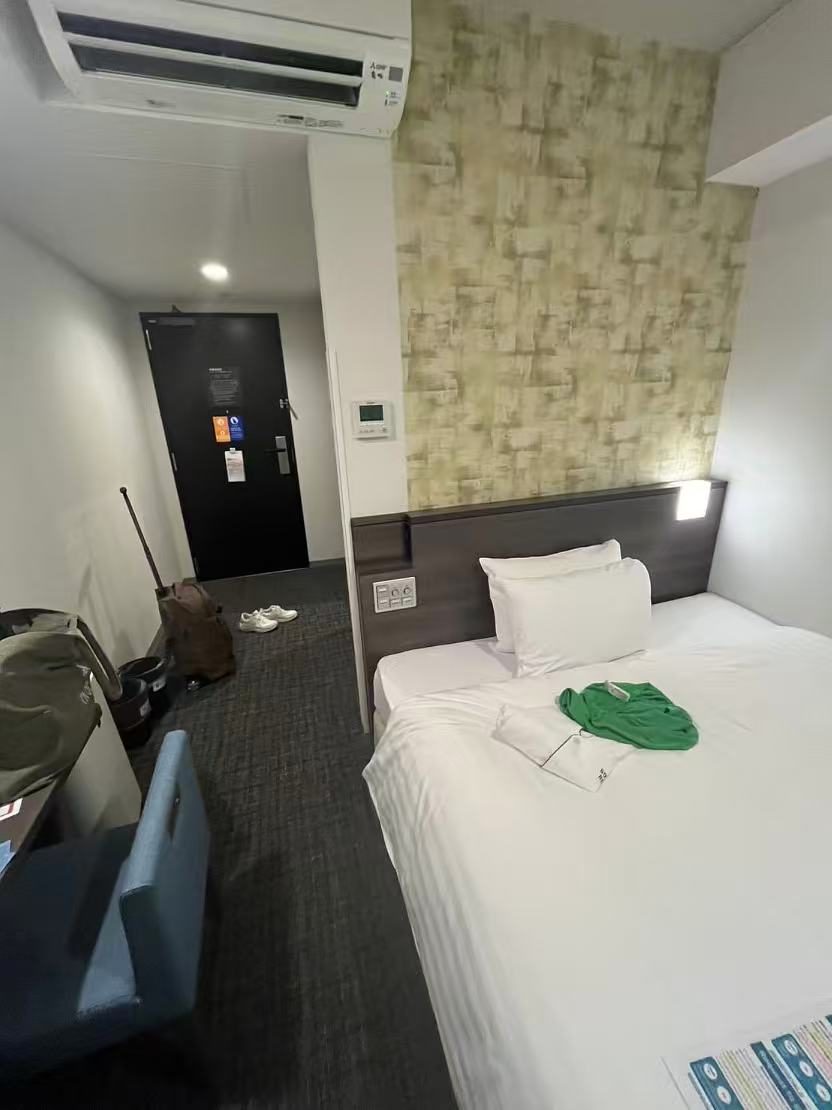
    A small business hotel room seen from the door, with a wheeled bag standing upright near the entrance, shoes beside it, and the bed filling the right half of the frame.
    A small room from the door, with the bag standing near the entrance.

    The bag stands upright just inside the door, and the bare floor around it is a narrow strip. A chair and a desk edge crowd the left. The only place in the frame to lay a bag flat is that strip, and a bag open there would sit across the path to the door. Most of the visible floor is the entrance.

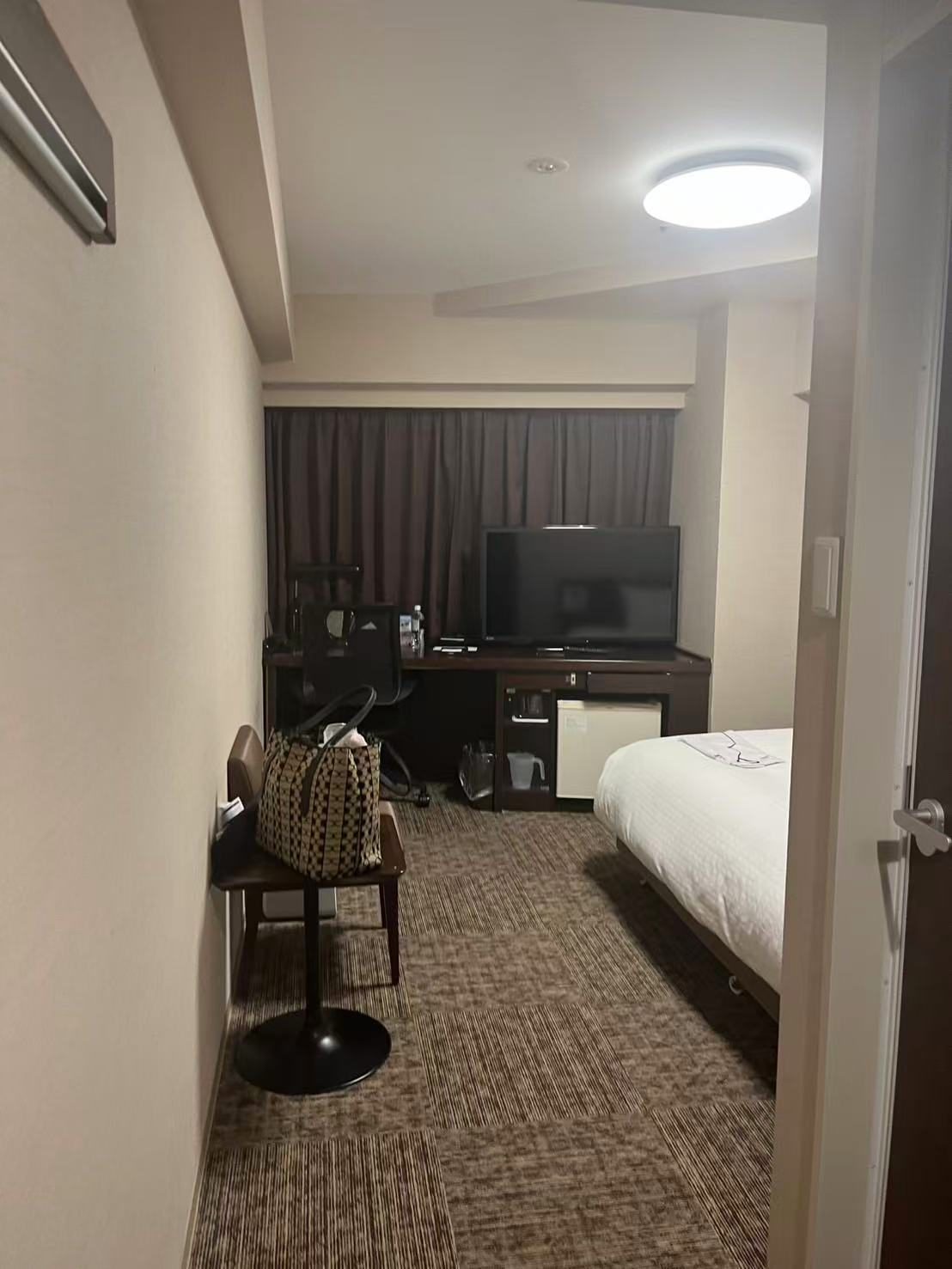
    A small business hotel room seen from the door, with a tote bag on a small chair beside the door and a desk with a monitor across the room.
    A small room from the door, with a tote on the chair.

    Here the bed is on the right and the desk runs across the far wall. A tote sits on a small chair by the door, and I don’t see a luggage rack. Between the chair and the bed is a carpet lane. Whatever else the room offers, a case has that lane or the chair.

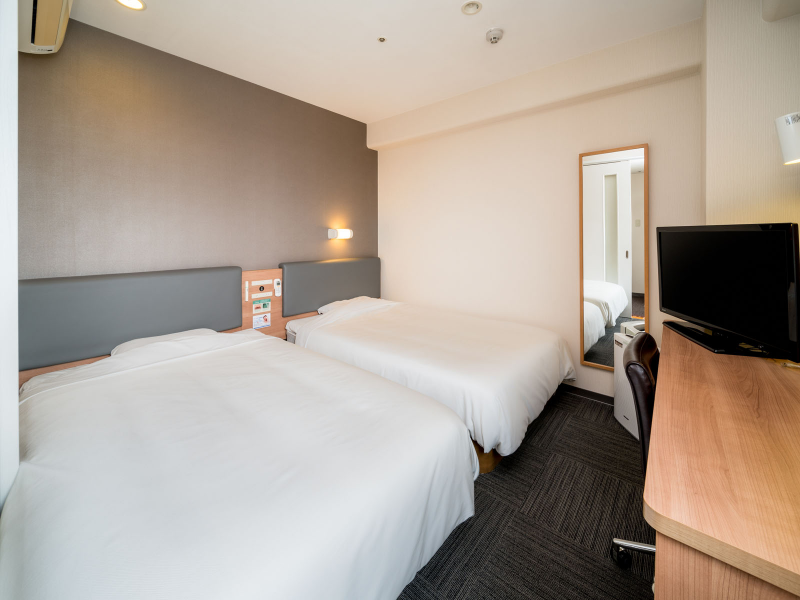
    The Twin room at Super Hotel Anjo Station Front: two beds side by side along the far wall, a mirror, a TV and a desk on the right.
    Super Hotel’s 15 m² Twin. Quoted from the official page (link), September 30, 2026. Copyright belongs to the owner.

    Super Hotel’s own picture of the 15 m² twin has two beds side by side along the far wall and a desk on the right. The bare carpet is the lane between the near bed and the desk. Two people with two bags would be opening one on a bed or in the entrance.

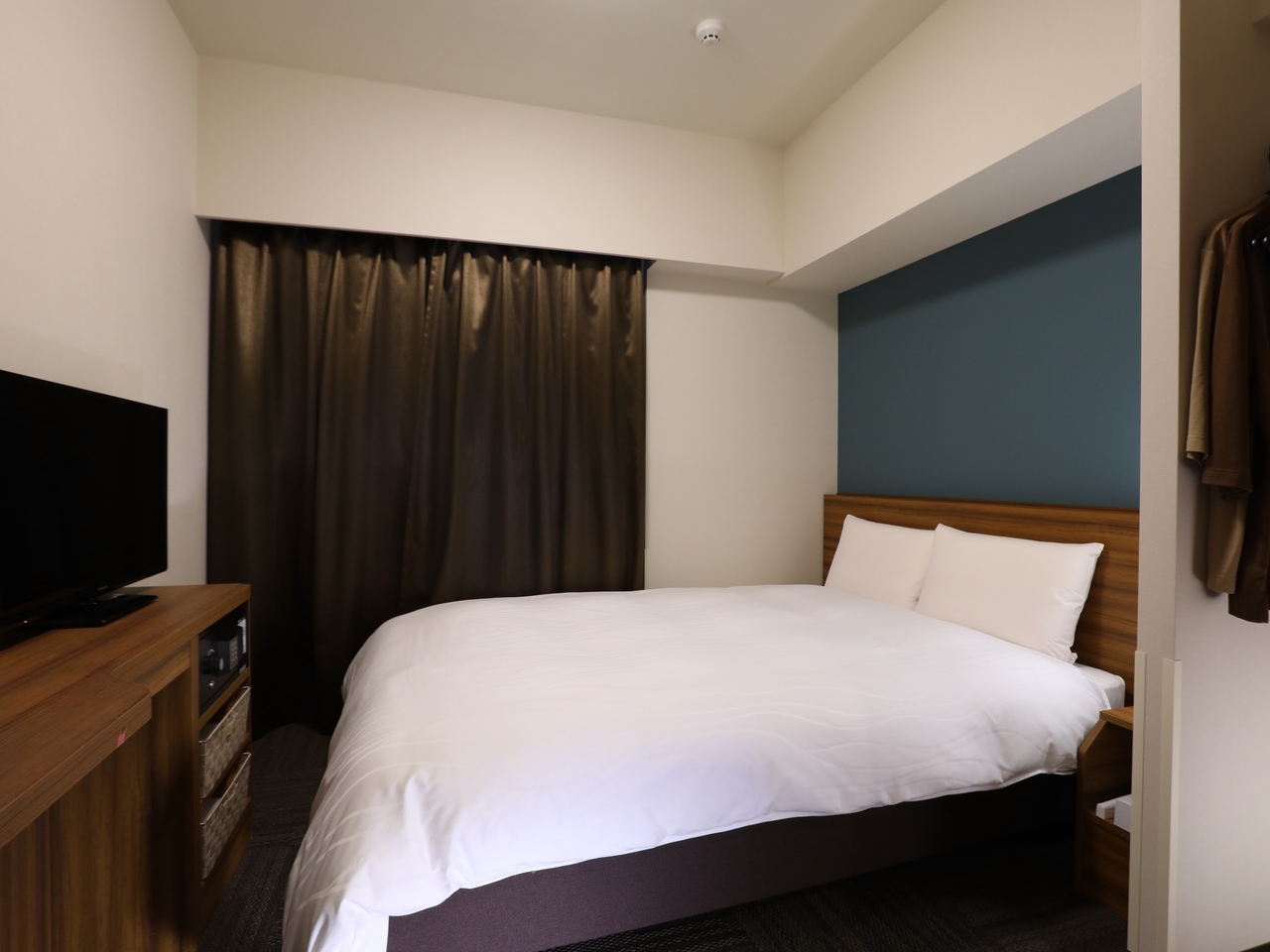
    The Standard Double at Dormy Inn Ikebukuro: a double bed between a TV unit and a closet, with a dark curtain behind it.
    Dormy Inn’s Standard Double. Quoted from the official page (link), September 30, 2026. Copyright belongs to the owner.

    In Dormy Inn’s picture the bed fills the width between the TV unit and the closet. The floor left is the strip at its foot, which is also how you get in and out. I wouldn’t count on more than one open bag fitting in a room laid out like this.

    The first two photos are mine (sizes unknown). The last two are the chains’ own photos, with the sizes the chains list.

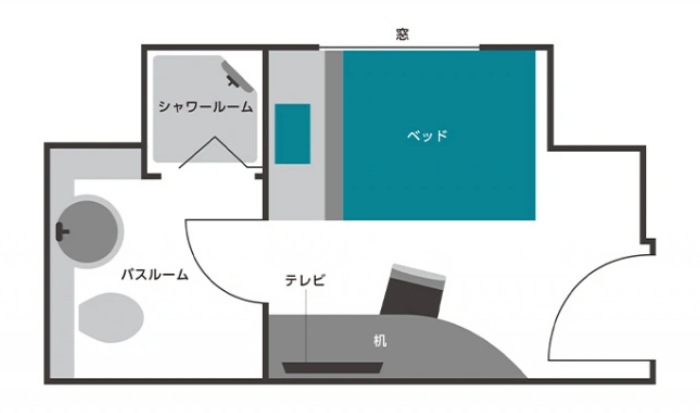
    A floor plan shows what a photo can’t. This one is the Express Single at Sotetsu Fresa Inn Tokyo-Kyobashi, which it gives as 12.7 m² (137 ft²) with a 120 cm (47 in) bed. The labels are in Japanese: 窓 is the window, ベッド the bed, シャワールーム the shower room, バスルーム the bath room, テレビ the TV and 机 the desk.

    Screenshot of a floor plan of the Express Single room at Sotetsu Fresa Inn Tokyo-Kyobashi. The bed runs along the window wall at the top right, the shower room and the bath room take the left side, and the desk sits along the bottom beside the entrance door.
    The Express Single floor plan on Sotetsu Fresa Inn Tokyo-Kyobashi’s rooms page (in Japanese). Screenshot.

    The bed sits against the window wall and the shower room and bath room take the left side. What is left is the white floor between the foot of the bed, the desk and the entrance door, and the bath room door swings into it. The plan carries no measurements, so it can’t tell you whether a bag opens there. It does show where the floor is.

    As of October 2026, from Sotetsu Hotels (in Japanese): the Fresa Inn Tokyo-Kyobashi rooms page.

    What I do

    I open my bag on the floor. When there are two of us, one bag goes on the rack and one on the floor. In a small room I often open it in the entrance corridor.

    Racks in these rooms tend to be small, and a small rack is why a second big bag ends up on the floor.

    Single, double, twin

    Single rooms, 12 to 17.81 m² (129 to 192 ft²). One bag, opened at the entrance or on the floor beside the bed. A second full-size bag stays closed, and a closed 29-inch bag stands on about 20 by 12 inches (51 by 30 cm) of floor. That is far less than an open bag needs, and most rooms have a corner for it.

    Standard double rooms, 12 to 19.54 m² (129 to 210 ft²). The beds on these pages are 140 to 160 cm (55 to 63 in) wide, so a bigger bed can mean a smaller floor. The Super Hotel Double is 12 m² with a 140 cm bed, and the Tokyu Stay Residential Double is 18 m² with a 160 cm bed. Compare the m² and the bed width together.

    Twin rooms, 12 to 27.32 m² (129 to 294 ft²). Two beds take the floor, and each bed is also a surface to open a bag on. In a twin, two people can each open a bag on their own bed, though the floor may still be short.

    Upper rooms. The Imperial Hotel’s Tower Standard is 30 m² (323 ft²), with a twin or king bed. That is the size where two bags start to be a floor problem you can solve, and it is priced like a different kind of hotel.

    Living out of a closed second bag is the compromise for most rooms. You take out what you need, set it on the desk, and close the lid.

    With kids, a stroller or four bags

    Two adults and two kids can easily mean three or four bags, say 29-inch ones, plus a stroller. Most rooms in the table above are listed for one or two guests, so the first check is the capacity line, not the floor.

    • Super Hotel Anjo: the Standard, Economy Twin, Super and Double rooms (all 12 m², 129 ft²) say 1 to 2 guests, and the 15 m² (161 ft²) Twin says 1 to 3.
    • Tokyu Stay Suidobashi: the 23 m² (248 ft²) Superior Twin is the only room on its page listed for three.
    • Richmond Shiba: the 32 m² (344 ft²) Superior Twin is listed for two.

    A third guest uses an extra bed, for a fee, arranged by phone before arrival. For four people, look at a family room or book two rooms.

    As of October 2026, from the hotels’ own pages (in Japanese): Super Hotel Anjo, Tokyu Stay Suidobashi and Richmond Shiba.

    Page Room Size Listed capacity
    Tokyu Stay Yotsuya Residential Family 37 m² / 398 ft² 4
    MIMARU Ueno Inaricho Apartment (Sofa-Bed) 38 m² / 409 ft² Adults 4 / Children 2 (6 people with children)
    same page Japanese Apartment 40 m² / 431 ft² Adults 4 / Children 2 (6 people with children), two futons

    MIMARU’s FAQ says up to two children aged 6 or under at check-in “will not be counted towards adult capacity and can share a bed with an adult.” Ask how your own hotel counts children before you pick a room.

    Now the bags. A closed 29-inch bag stands on about 20 by 12 inches (51 by 30 cm), so four take about 6.7 ft² (0.6 m²), against 8 ft² (0.75 m²) for one open bag (see floor space). In a 37 to 40 m² family room that is easy. In a small twin, the question is where closed bags sit once the beds, the bath door and the desk have their share, and the listed m² may include the unit bath. If the bags still won’t fit, you can ship some ahead from the airport. If you land before check-in, Arriving Before Check-In in Japan covers where the bags can wait.

    Babies change the math. Cribs:

    • Dormy Inn: no baby cribs, though some hotels have bed guards.
    • Tokyu Stay: baby beds at some hotels, so contact the hotel.
    • MIMARU: “we only provide free baby crib services for infants ages 2 below,” in limited numbers, so contact the hotel in advance.
    • The Tokyo Station Hotel (a city hotel): a crib for 0 to 12 months in rooms of 34 m² (366 ft²) or more.
    • Miyakojima Tokyu Hotel & Resorts (a resort): a crib of about 120 x 70 cm (47 x 28 in) for infants up to 24 months.

    As of October 2026, from Dormy Inn FAQ (in Japanese), Tokyu Stay FAQ (in Japanese), MIMARU FAQ, Tokyo Station Hotel and Miyakojima Tokyu.

    That last crib covers about 9 ft² (0.84 m²), slightly more than an open 29-inch bag.

    Strollers are easier to rent than to store. The Tokyo Station Hotel lists a baby stroller among its baby equipment and recommends reserving ahead. Miyakojima Tokyu lists strollers as free rental items that must be reserved. MIMARU says nine of its hotels rent strollers through a service called Babycal. The notice gives no price, so the Babycal rates below may not apply there.

    Babycal requires member sign-up and a reservation, and prices “may differ by location and item”. The first hour costs ¥250 to ¥500 (about $1.70 to $3.30), then ¥150 per 30 minutes (about $1), capped at ¥2,000 per 12 hours (about $13), for up to 7 days. Late returns cost ¥500 per 15 minutes (about $3.30), and the cap does not apply to them. Dollar figures use a round ¥150, so check the day’s rate. You return the stroller to the place you rented it. Most models stop at 48 months and 18 kg (40 lb), some at 36 months and 15 kg (33 lb), and the THE S ISOFIX model at 19 kg (42 lb). Match the model to your child’s age and weight.

    As of October 2026, from MIMARU’s news page and Babycal (in Japanese): rental page.

    When you reserve, ask whether the stroller stays at the front desk or comes up to the room.

    Before you book

    Four things on the booking page decide it.

    1. The floor in the photos. Find the shot from the door and look at the floor, not the bed.
    2. The bed count and width, not the room name. “Double” runs 140 to 160 cm (55 to 63 in) across these chains, and “twin” means two beds taking more floor than one wide one.
    3. The size in m², converted. Set it against 8 ft² (0.75 m²) per open bag, plus the bed and the desk. Where the hotel doesn’t say what the number includes, take the lower estimate.
    4. The desk. A laptop-size desk gives you a surface once the bag is closed.

    The short version

    A 29-inch bag opened flat needs about 8 ft² (0.75 m²) of clear floor, and most small Japanese rooms have that only at the entrance or along one side of the bed. Read the floor in the photo, count the beds, and convert the m². Plan on one open bag and one closed bag in a single. With kids, check the capacity line first, and ask about cribs and strollers before you book.

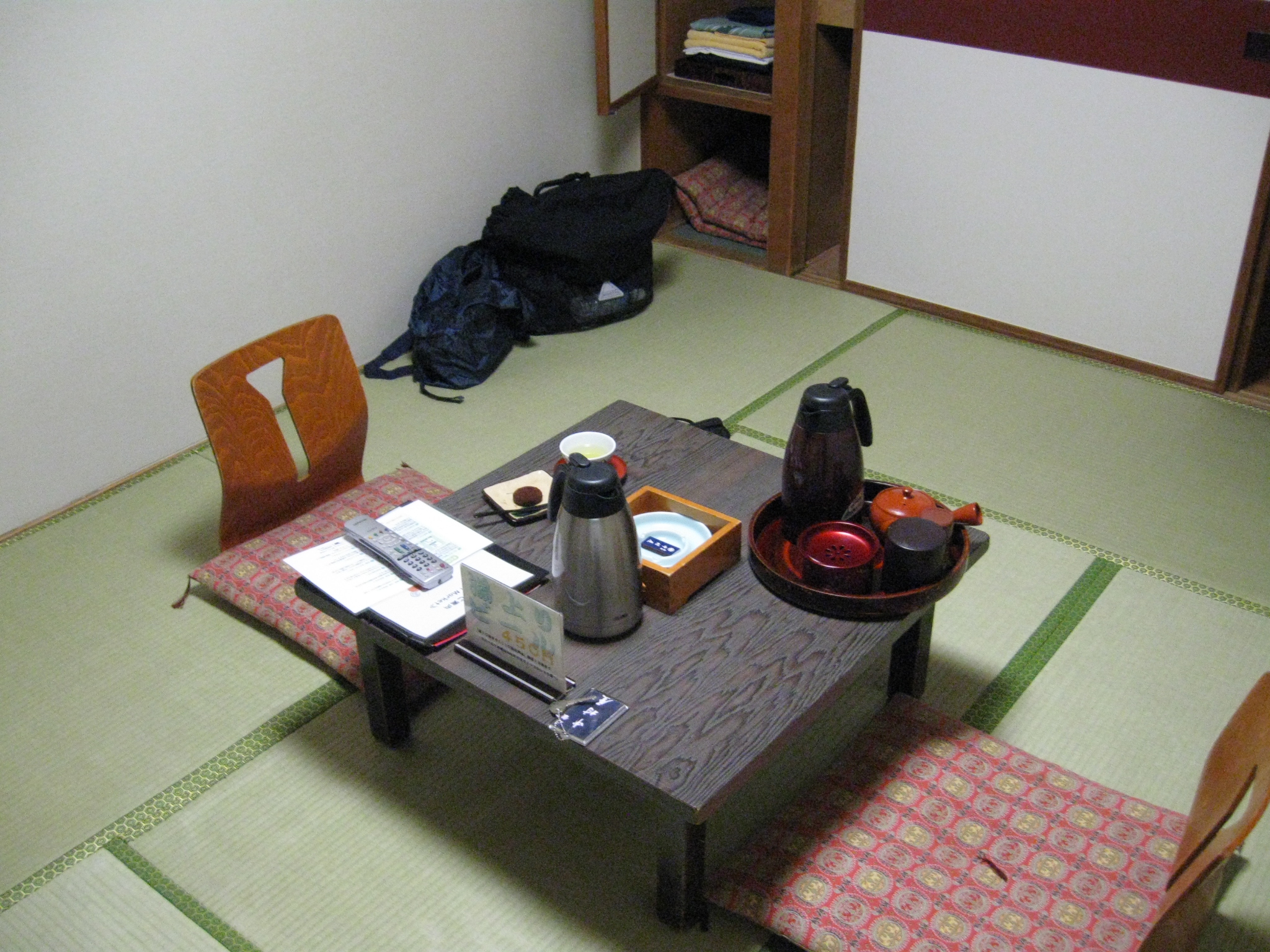
    Cover photo: lic-1-ryokan-room-backpack by ㇹヮィㇳ, CC BY 2.0, via Wikimedia Commons. It shows a different property from the ones discussed here.