1. You have two tabs open and the numbers don’t match
Same hotel, same night, and as far as you can tell the same room. One tab says ¥24,513, about $163. The other says ¥31,500, about $210. That is 28.5% more, and the obvious next move is to work out which screen is lying to you.
Neither was. Add back the tax that one screen leaves out, and the four numbers collected for that room fall into two tiers: the hotel’s standard rate and a discounted rate, and the hotel’s own site was selling both. The tiers are ¥4,725 apart, about $32. The missing tax is ¥2,451, about $16.
Each storefront decides what goes inside the number it prints, and the six covered here do not agree. The prices are for one night in November 2026 at two Tokyo hotels: the Sotetsu Fresa Inn Tokyo-Kyobashi and the Dormy Inn Korakuen. Yen convert at ¥150 to the dollar, so check the day’s rate. I spent more than twenty years in Japan and I book from the US now.
Each price is a single reading of a screen that can change.
This article does not say which site is cheapest, because the same plan was not lined up across the six.
2. One room, four numbers
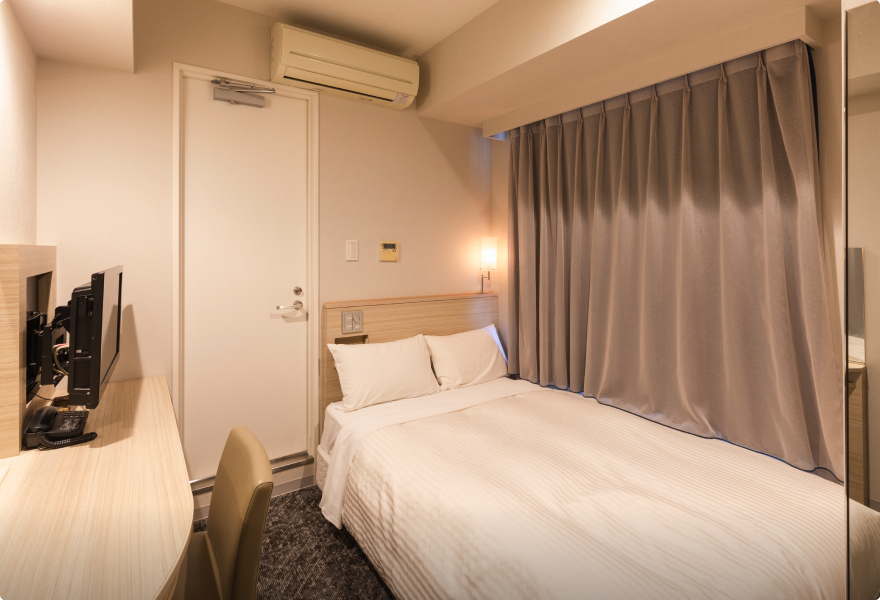
The room is the EXPRESS Single at the Sotetsu Fresa Inn Tokyo-Kyobashi, a business hotel, which in Japan means a small, cheap, station-adjacent room rather than anything upmarket. The pillar article covers what you get. The hotel lists about 137 ft² (12.7 m²), one 47-inch (120 cm) bed, a shower booth, no tub, non-smoking. The night is November 18, 2026, one adult, one room.
| Where the room was priced | The number on the screen | What that number contains |
|---|---|---|
| Hotel’s own site, member rate | ¥26,775 (about $179) | consumption tax and service charge included |
| Hotel’s own site, standard rate | ¥31,500 (about $210) | same |
| Jalan, cheapest plan | ¥31,500 (about $210) | column headed per adult, tax included |
| Booking.com | ¥24,513 (about $163), struck through from ¥34,045 (about $227) | breakdown box reads: excluded, 10% consumption tax, plus a 10% Genius discount line |
Jalan’s cheapest plan and the hotel’s standard rate match to the yen.
Booking.com prints its own tax answer in a breakdown line under the price. Add that 10% back to ¥24,513 and you get ¥26,964 (about $180), only ¥189 from the hotel’s member rate of ¥26,775 (about $179). That is 0.7%. The same box lists a 10% Genius discount applied before tax, on a signed-out screen. So ¥24,513 is a discounted tier reachable without an account, and it lands beside the hotel’s own member rate.
Two of the four numbers were the standard rate and two were a discounted tier. The tax was inside three of them and outside one. Both differences are doing work. The site labels the whole markdown as 28% off in a year-end sale, with no split showing how much is the Genius line.
Booking.com’s figure also moves. On September 27, 2026 the same signed-out screen read ¥27,236, about $182, struck through from the same ¥34,045 and now labeled 20% off. That is 11.1% above the figure a week earlier, so reopen both tabs if a day has passed.
The Japanese Booking.com listing calls it an “economy semi-double room, with shower room, non-smoking.” That fits the EXPRESS Single’s shower booth, and the hotel’s other single rooms have tubs. The bed itself came back under five wordings, from single to semi-double, and Japanese Hotel Rooms Decoded takes that apart.
3. What each of the six storefronts is counting
The six are the two hotels’ own sites, Jalan, Rakuten Travel, Booking.com and Ikyu. Five said what their figure counts on the first screen where a price appeared. Booking.com did not. Searched for one adult, it printed no party size next to the price, and the rate table had no column for one. The “Number of guests” column appeared only at two.


| Storefront | What it says the figure is |
|---|---|
| Dormy Inn, own site | Per adult where you pick the room, consumption tax included, lodging tax and bathing tax charged separately depending on the hotel. One click on, at plan selection, the notice called the price the total |
| Sotetsu Fresa Inn, own site | The total for the party size, labeled “total, adult x 1, one night’s charge,” consumption tax and service charge included |
| Jalan | Two columns: one headed per adult, tax included, one headed total, tax included |
| Rakuten Travel | Two figures: a total headed “adults x 2, one night’s charge, tax included,” and at two adults a per-person line under it |
| Booking.com | Per night, with no party size printed at one adult. Breakdown box: 10% service charge included, 10% consumption tax excluded |
| Ikyu | The total for the party size, tax included, written into the price string (“no meals, 2 people, tax included”). The search box defaults to two adults |
The split had nothing to do with where a site is from: Japanese sites did not all quote per person, and foreign sites did not all quote per room. Three printed the total for the party size: Booking.com, Sotetsu and Ikyu. Booking.com goes in that group on its prices rather than its wording, since ¥27,236 for one adult and ¥29,143 for two is neither twice the first figure nor half the second. One printed a single adult’s share, the Dormy Inn site. Two printed both figures at once, Jalan and Rakuten.
The hotels’ own sites were no plainer. Sotetsu labels its figure a total, while the Dormy Inn site says per adult where you pick the room and total a click later. Ikyu decides before you do. Its row for the Sotetsu room read “no meals, 2 people, tax included, from ¥12,084” (about $81), with the search box already on two adults and no dates set. That is a two-person price until you change the box.
At one adult, the per-adult figure and the total are the same number. A second person pulls them apart, and the second adult cost well under double. With the room held still, the second adult added ¥450 (about $3, or 1.9%) on the Dormy Inn site’s room-only plan at the Korakuen. On Booking.com the second adult added ¥1,907 (about $13, or 7.0%). On Ikyu it added 10.0% to 15.4% across five Sotetsu room types. Why Japanese Hotels Price Per Person explains the per-person unit.
Jalan’s English fee page defines both columns as fees “per room per night” and adds: “Both 1) and 2) are the charges displayed just to give you rough ideas for comparison.”
The Sotetsu booking engine can open in US dollars, and reopening the same address after switching to yen returned dollars again, so check the currency before comparing. Booking.com sometimes answered a request for English with a Japanese page, so check the language too.
4. One site, several prices for the same room
The comparison can come apart inside a single site, before you open a second tab. The EXPRESS Single, that night, one adult, came back on Jalan as six rows: ¥31,500, ¥32,985, ¥33,250, ¥34,817, ¥35,000 and ¥36,650, roughly $210 to $244. Cheapest to dearest is ¥5,150, about $34, or 16.3%, for the same bed, room and night.
The second hotel did the same on a different site. On Rakuten Travel, the Corner Twin at the Dormy Inn Korakuen, 347 ft² (32.2 m²), came back that night at ¥27,120, ¥29,380, ¥31,640 and ¥33,900, about $181 to $226. Low to high is 25.0%.
What moves is the plan, which is the actual product on sale. On these two pages the rows differed on whether breakfast is included, whether you can cancel, whether you prepay or settle at the property, and whether points are involved. Some of that is printed on the row and some sits two clicks down. The top row on one site and the top row on another are two products picked by two different sorting rules.
5. The lodging tax sits outside the price
Both hotels’ own sites said consumption tax is inside their prices and the lodging tax is not.
From March 1, 2026, the Sotetsu chain’s lodging tax at its properties in Tokyo, Osaka prefecture and Kyoto City moved from inside the displayed price to on top of it. The cutoff runs on the booking date, not the stay date, so a booking made now falls on the later side. The chain’s notice closes the loophole in a line of its own: “Please note that for reservations already paid in advance, the lodging tax will also be collected separately at the property.”
As of September 2026, from Sotetsu Hotels (in Japanese): lodging tax notice.
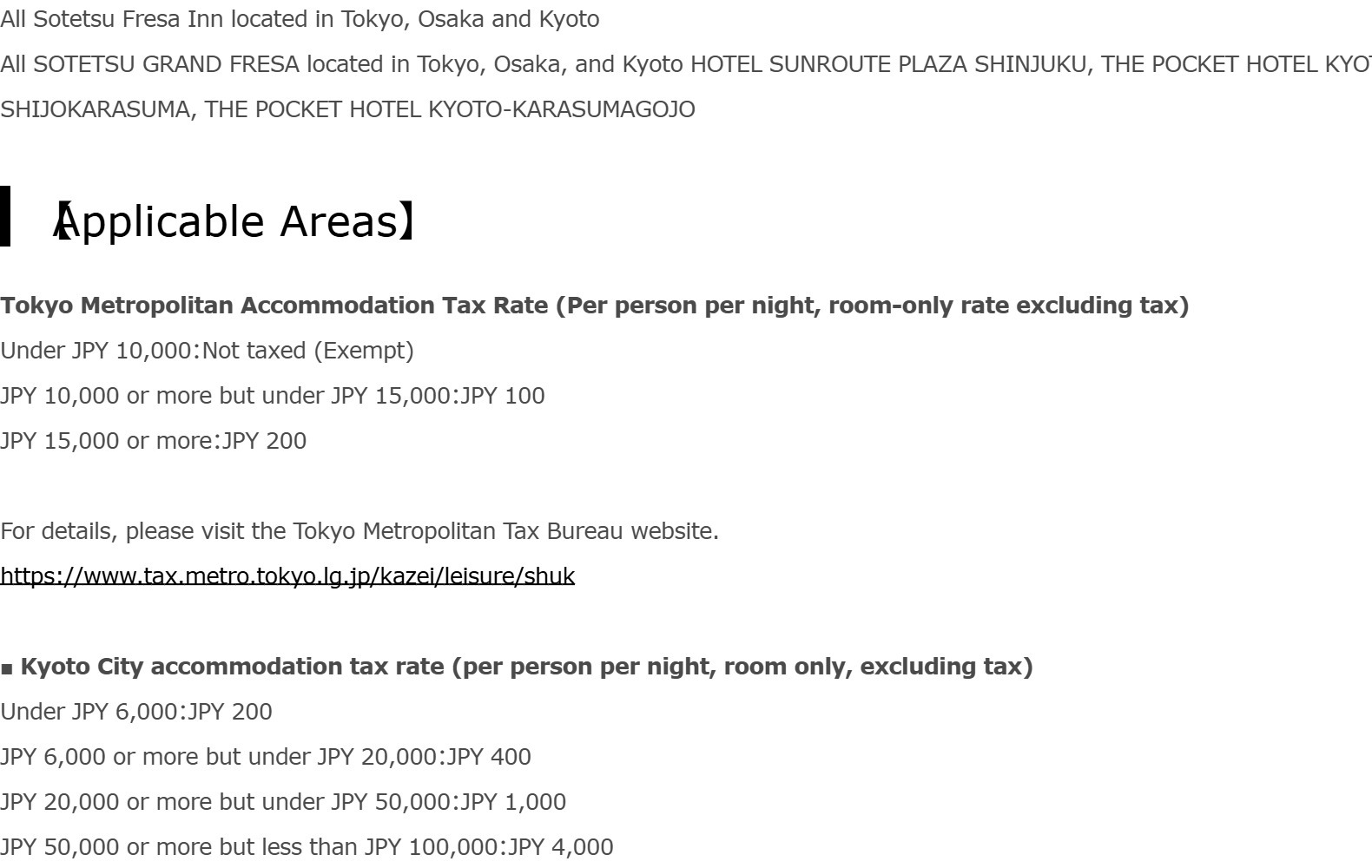
The tax depends on the city and on the room charge before consumption tax. For the room in section 2 that is ¥28,636 (about $191) of the ¥31,500. At that charge Tokyo’s table sets ¥200 per person per night (about $1.30), and Kyoto City’s sets ¥1,000 (about $6.70) for charges from ¥20,000 up to but not including ¥50,000. That is five times the tax on the same room charge. Tokyo, Osaka prefecture and Kyoto City are three separate local governments, so one city’s figure is no guide to another’s.
As of September 2026, from the local governments (in Japanese): Tokyo rate table and Kyoto City rate page.
A price marked tax included can still have a line after it. I’ve paid for an inn stay online and still had the bathing tax to pay at the property on the day.
6. A phishing warning about Booking.com reservations
The Dormy Inn Korakuen’s own website carries a notice dated May 22, 2026 and marked important. The body reads: “We have confirmed instances in which suspicious messages are being sent to some customers who reserved this hotel through the online booking site Booking.com, using messaging apps such as WhatsApp, posing as confirmation of the reservation and asking them to enter credit card details. These messages contain URL links leading to malicious phishing sites.”
The notice does not say Booking.com sent the messages. It says guests who booked through that channel are the ones being targeted, and it is one hotel’s notice.
As of September 2026, from Dormy Inn Korakuen (in Japanese): phishing notice.
A booking made through a third party creates a second channel of communication about that stay, and a fake message there is harder to tell from a real one. Treat a request for card details that arrives in a messaging app after you have paid as fake. Confirm with the hotel only on a number or address you found yourself. If you have already typed card details into one, call your card issuer first, not the hotel.
7. What to check before you book, in order
Two tabs, and you want to close one. This is the order I’d go in, and the first four are the steps that moved the number.
1. Enter the real number of people first. Everything below assumes both screens show rooms for the party actually coming. With three of you, or a child, the box itself changes what comes back, and that has its own article.
2. Find out what the number counts before you read it. Look for wording attached to the price that says whose night it covers: a column heading, a label above the figure, a party size inside the price string, or a per-person line under a total. The table in section 3 shows what each of the six said.
3. Find out whether the tax is in. On Booking.com, read the breakdown box under the price. On a hotel’s own site, read the small print beside it. Then assume the lodging tax is outside the printed price, since both hotel sites said so and one chain moved it outside during 2026.
4. Find out which tier you’re being shown. The lowest number carried a 10% discount applied without an account, and three of the six storefronts had taken something off the figure on a signed-out screen. Booking.com’s breakdown box said a 10% Genius discount had been applied. Rakuten printed “Rakuten member discount (applied)” beside the total at two adults. Ikyu’s row said “with 2% of points used.”
If you collect points, Ikyu’s is the one to read twice. The switch is on the page. Moving it took the same room, night and plan from ¥30,870 (about $206) to ¥31,500 (about $210), which is the hotel’s standard rate to the yen. The default is the cheaper one. Ikyu says what that costs: “If the points you are due to earn are used immediately, no points are awarded after the stay.” It adds that for guest bookings, only immediate use is possible.
As of September 2026, from Ikyu (in Japanese): points page.
5. Compare plans, not rooms. One room on one night sold at six prices on one site and four on another, and section 4 lists what those rows differed on. Read the cancellation deadline as a date. Japan’s National Consumer Affairs Center has published a notice saying cancellation conditions differ from plan to plan on booking sites. One case it describes is a hot-spring inn booking canceled two hours after it was made and charged at 100%.
As of September 2026, from the National Consumer Affairs Center (in Japanese): notice.
6. Match rooms by bed width and floor area, not by name. The room in section 2 is called EXPRESS Single by the hotel and Economy Double Room with Small Double Bed on a booking site. Same room.
7. If a site says sold out, reload it, then open the property’s own page on the same site. Booking.com sometimes showed “no availability” on a results card for the Dormy Inn Korakuen while the property page showed rooms for the same dates, and reloading the identical search removed the line. A price you wrote down yesterday gets the same reload.
The short version: one room read 28.5% apart because one number was a discounted tier without tax and the other was the standard rate with it. The checks above will stop you setting a per-adult figure against a room total, or a discounted pre-tax figure against a tax-inclusive standard one.
Cover photo: lic-2-business-desk-bed by J o, CC BY-SA 4.0, via Wikimedia Commons. It shows a different property from the ones discussed here.
