If you book hotels in the US, you may carry one rule in your head: cancel a day or two ahead and it costs nothing. Hyatt, for one, has required cancellation at least 48 hours ahead to avoid a fee since January 1, 2018. That is one US chain’s rule, not a US default, but it shows the shape you are used to: one deadline, then a fee.
As of September 2026, from Hyatt’s newsroom: 2018 cancellation policy announcement.
The Japanese pages below are built differently. They use a ladder of percentages that climbs as check-in approaches, and the numbers can change from one plan to the next within the same hotel. The “free cancellation” label on a booking site is a separate thing again. It is one line on one plan’s page, and it is easy to misread.
Where the ladder comes from
Japan’s Tourism Agency publishes model lodging terms, last revised December 13, 2023. Hotels and inns can adopt them. Article 6 says the guest may cancel, and that the lodging will collect a penalty “as set out in Appendix 2” when the guest cancels for reasons attributable to the guest (translated from the Japanese).
In Appendix 2, the percentages are blank. The document gives each lodging a template and leaves the numbers for the lodging to fill in.
The template does show the shape:
- The hotel version has five steps: no-show, the day of, the day before, 9 days before, and 20 days before. Rows separate individual bookings of up to 14 people, groups of 15 to 99, and groups of 100 or more.
- The ryokan (traditional inn) version has thirteen steps, from the day of up to 30 days before, with four size bands.
- A note says the percentages apply to the base lodging charge. Another says that if a multi-night stay is shortened, the penalty is for one night (the first day), however many nights are cut.
- Article 6 also lets the lodging treat a guest as cancelled if they haven’t arrived by a set hour on the day and haven’t called. The hour is another blank.
As of September 2026, from the Tourism Agency (in Japanese): model lodging terms.
Two real schedules
A chain’s general table. The Dormy Inn and Nono policy lists fees by party size:
- 1 to 5 guests: 100% for a no-show, 100% on the day, and 50% the day before.
- 6 to 9 guests: the same, plus 30% at 3 days before.
- 10 or more: 100% for the day, the day before and 3 days before, then 50% at 7 days and 20% at 30 days.
A note says the percentages apply to the base lodging charge and that they may differ by plan, so the plan details should be checked.
As of September 2026, from Dormy Inn (in Japanese): cancellation policy PDF.
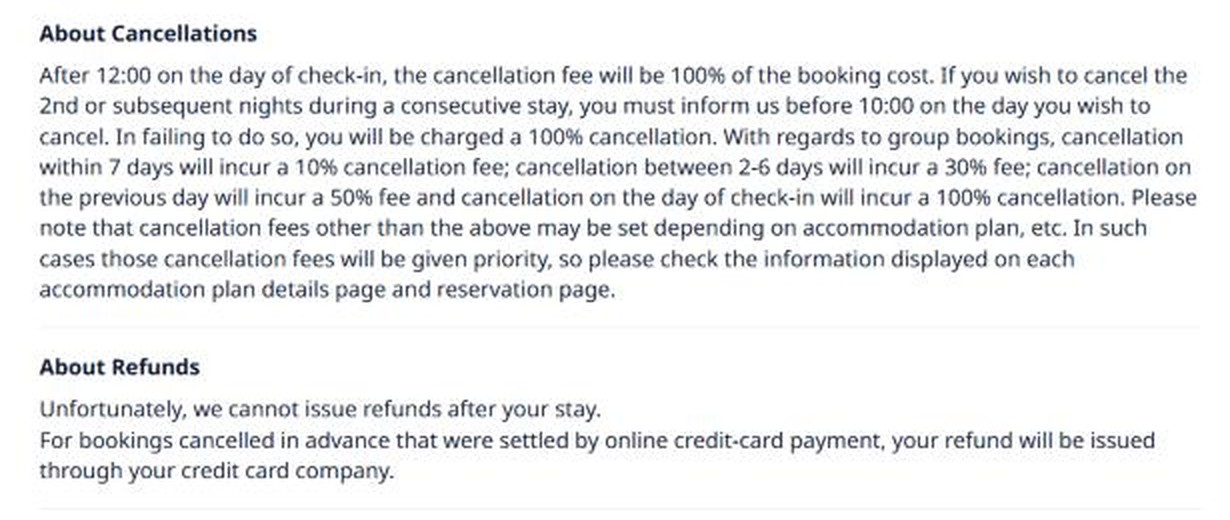
A business chain’s English page. Toyoko Inn’s English cancellation page is the plain version:
Screenshot.
For individual guests, Rakuten states one rule: after 12:00 on the day of check-in, the fee is 100% of the booking cost. For a consecutive stay, the guest must tell the hotel before 10:00 on the day of a later night they want to drop, or pay 100% for that night. The percentage ladder (10%, 30%, 50%, 100%) is printed for group bookings.
Rakuten also says fees “other than the above may be set depending on accommodation plan,” and in that case “those cancellation fees will be given priority.”
As of September 2026, from Toyoko Inn: English cancellation page.
Plan terms beat hotel terms
Dormy’s PDF says plans may differ. Toyoko says plan fees take priority. The model terms themselves (Article 1, paragraph 2) say a special agreement the lodging makes takes precedence over the standard terms.
So there is no single “cancellation policy of Dormy Inn” to learn and apply to your booking. The general table tells you what a typical page looks like. Your plan’s own box is the one that applies.
As of September 2026, from the Tourism Agency: model terms, English version.
APA Hotels shows the same split. Its FAQ says cancellation is free until the day before, then adds that some plans have different rules and that the rules on the booking screen apply (「一部プランではキャンセル規定が異なる場合がございます」). Bookings made through a travel agency or bundled with a flight can carry fees even when the hotel’s own rule says free.
As of October 2026, from APA Hotel (in Japanese): FAQ and cancellation article.
The free-until line
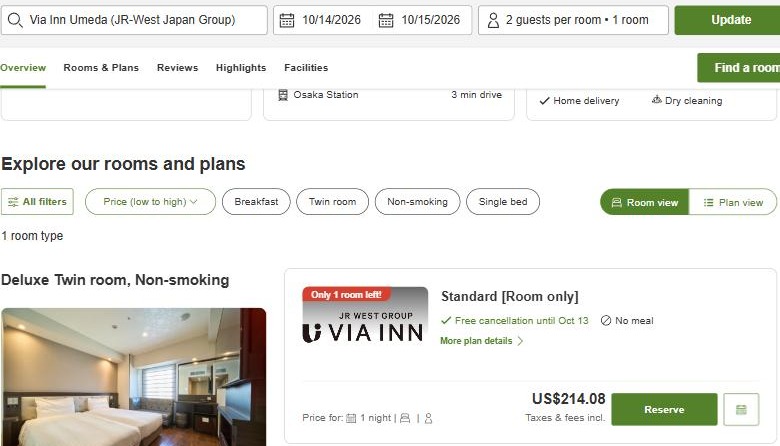
On Rakuten Travel’s US English site, a Via Inn Umeda plan for October 14 to 15, 2 guests, showed a green line:
Screenshot.
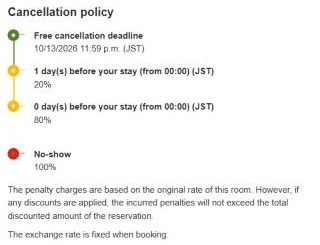
The plan’s detail page gave the timeline:
Screenshot.
It reads:
- Free cancellation deadline: 10/13/2026 11:59 p.m. (JST).
- “1 day(s) before your stay (from 00:00) (JST)”: 20%.
- “0 day(s) before your stay (from 00:00) (JST)”: 80%.
- No-show: 100%.
Under the timeline are two notes. One says “The penalty charges are based on the original rate of this room. However, if any discounts are applied, the incurred penalties will not exceed the total discounted amount of the reservation.” The other says “The exchange rate is fixed when booking.”
What that means for this plan:
- The deadline is a clock time in Japan. It is printed in JST, and 11:59 p.m. on October 13 is 10:59 a.m. the same day in New York (EDT), so convert it before you set a reminder. Booking.com’s guide to cancelling says the deadline “is usually calculated in the hotel’s local time zone, not your own.”
- The 80% step starts at 00:00 JST on the check-in day. On this plan, cancelling at 9 a.m. on October 14 would fall in that step, after a free period that ended the night before.
- The fee has a base that isn’t always what you paid. Here the penalty is figured on the original rate, capped at the discounted total. If a promotion cut your price, that sentence is the one to read.
- The 20% line sits under a free deadline. The 20% line is labeled “1 day before,” yet the free deadline runs to the end of October 13. The site doesn’t say which applies, so ask Rakuten or the hotel.
- The refund currency is not explained. The dollar price was converted at booking and Rakuten says that rate is fixed, but it doesn’t say how a yen fee is refunded in dollars. Ask the site’s help desk before relying on a partial refund.
As of September 2026, from Booking.com: guide to cancelling.
Close to a free-cancellation deadline, a cheaper plan has turned up, or I have gone with another hotel instead. When I read a free-cancellation line on a Japanese booking page, I check both the date and the time.
Official site or booking site
None of the three sites says which channel’s terms prevail when they differ. What they do say:
- Rakuten Travel’s FAQ says “Each hotel decides the cancellation fee for which you are responsible,” and “When it is near the staying date, the reservation can not be cancelled in ‘Rakuten Travel.’ In case of this, you have to contact the hotel directly.” It also says that if you do not contact the hotel to cancel, you are “subject to a fee of 100% of one night room rate.”
- Toyoko Inn’s page points to the plan details page and the reservation page for the fee that applies.
- Booking.com’s guide says the policy depends on “the hotel’s individual rules, your booking type” and timing.
As of September 2026, from Rakuten Travel: FAQ.
Read together, the three suggest the booking site displays your terms while the hotel sets the numbers, so keep your confirmation email and a screenshot of the plan’s cancellation box from the day you book.
The Rakuten FAQ also implies something practical. Near the stay date the online cancel button may be gone, and a late cancellation then goes to the property by phone or email.
A typhoon is not automatically a free cancellation
The fee ladder above runs on dates. A typhoon is an event, and the pages split on who decides whether it counts.
The Tourism Agency’s model terms draw the line in two places. In Article 6, paragraph 2, the guest owes cancellation charges when canceling “due to causes for which the Guest is liable.” In Article 7, paragraph 1(7), the hotel may cancel when it “is unable to provide accommodation due to natural calamities and/or other causes of force majeure,” and paragraph 2 says it then “shall not charge the Guest for any of the services during the contractual period he/she has not received.” A hotel that cannot host you and a guest who cannot reach it are different cases, and the template doesn’t say which one a stopped train is.
As of October 2026, from the Tourism Agency: model terms, English version.
Booking sites mostly pass the decision to the property. On Rakuten Travel, when bad weather or a disaster makes a stay difficult, the response is in principle the facility’s own cancellation policy, you should contact the facility early, and after check-in time the facility may treat the booking as canceled. A second Rakuten page says to cancel on the site yourself even for a typhoon.
As of October 2026, from Rakuten Travel (in Japanese): bad-weather help page and typhoon cancellation page.
Booking.com and Agoda put the rule in their contracts with properties. Booking.com’s General Delivery Terms define a force majeure event as one “affecting multiple Guests and multiple accommodations” and list natural disaster, “curtailment of transportation facilities” and anything “preventing or making it impossible or illegal or highly unsafe for Guests to travel to or stay at the Accommodation.” Clause 2.10.1 says the property will not charge and must refund affected guests, nonrefundable rates included. Agoda’s Partner Hub says Agoda will check the reported impact and waive affected bookings once the situation is confirmed, and that the property is expected to waive too.
As of October 2026, from Booking.com and Agoda: Booking.com General Delivery Terms and Agoda Partner Hub.
The two hotel notices, both from UDS Hotels properties in Okinawa, name a canceled final flight or suspended public transport. UDS Hotels’ Strata Naha notice waives the fee for guests whose final flight to or from the island is canceled or who are “physically unable to reach our hotel due to the suspension of public transportation.” Its Hotel Locus notice adds that without word from you the hotel assumes you are staying and charges in full.
Neither notice mentions a weather warning level, so a warning on the weather map is a reason to call the property, not a promise of a waiver. Tell the property, or the site you booked through, early.
As of October 2026, from UDS Hotels: Strata Naha notice and Hotel Locus notice (in Japanese).
Canceling a points booking
A points booking looks like it should cancel cleanly, since no money moved. What comes back, and when, depends on the program.
IHG says a Reward Night canceled within the hotel’s policy gets its points redeposited. One canceled after the time the policy allows still gets them back, but the hotel charges the credit card used for the booking its cancellation fee. For a Points & Cash booking, the cash portion is nonrefundable either way. The deadline is the hotel’s own cancellation policy, the one shown when you book.
On Rakuten Travel, if you prepaid by card, the Rakuten points you used return anywhere from immediately to the next business day after you cancel. Limited-time points already expired when you cancel lapse on return. Points used go to the cancellation fee first, with any difference returned. The English terms of use, Article 16, paragraph 4, say that when a user cancels, the points “shall be applied to payment of the change fee or cancellation fee” unless Rakuten stipulates otherwise.
As of October 2026, from IHG: Reward Nights page. From Rakuten Travel: points FAQ (in Japanese) and terms of use.
Receipts, invoices and company names
If the stay goes on an expense report, how you paid decides who can give you the paper. When a plan offers both and prepaying saves around $10 or more, I usually prepay. That also decides who issues the receipt.
On Rakuten Travel, the receipt for an online-card booking is issued by Rakuten Travel from the reservation-confirmation page, and its counter doesn’t issue or mail them. For pay-at-property, the property issues it at settlement and the Rakuten site can’t. The name line takes up to 50 characters, with 様 or 御中 as the honorific, and can be corrected once. If the property is a registered qualified invoice issuer, the receipt follows the invoice rules.
Two chains split the same way. At Dormy Inn, an on-site payment gets a receipt from the desk or payment machine. A prepaid-card booking gets it from the JTB Book&Pay portal through the link in the confirmation email. The receipt meets qualified-invoice requirements, and you can check the hotel’s registration status on the National Tax Agency’s site. At Super Hotel, the hotel desk can’t issue a receipt for a prepaid-card payment, which comes from the JTB Book&Pay site.
Agoda puts the tax invoice on the hotel. A tax invoice can only be issued by the service provider, and Agoda can’t issue one for the room. Agoda can provide an e-receipt showing a payment was collected. A guest can ask the property directly or through Agoda, which relays the request.
Rakuten’s English site lets you enter someone else’s name as the guest, but a guest name can’t be changed except by canceling online and rebooking, so a wrong name can put you on the ladder above.
As of October 2026, from Rakuten Travel: receipt help page (in Japanese) and English FAQ. From Dormy Inn: FAQ (in Japanese). From Super Hotel: FAQ (in Japanese). From Agoda: Partner Hub.
Before you book
- Open the plan’s own cancellation box, not the hotel’s general page.
- Write down the deadline in your own time zone.
- Check whether the percentages apply to the original rate or the discounted one.
- For stays of more than one night, check for a separate cut-off on later nights (Toyoko Inn’s is 10:00 on the day).
- For groups of six or more, expect a different table. Dormy Inn’s schedule changes at that size.
- Set a reminder for the day before the deadline.
- If a typhoon could touch your dates, look for a disaster line in the plan’s box and decide who you would tell first.
- For a points booking, find the deadline in the property’s policy and check how fast the program returns points.
- If you need a receipt in a company name, check which route issues it before choosing prepaid or pay-at-property.
The short version
- Fees are a ladder of percentages that climbs toward check-in. The Tourism Agency’s model terms leave the percentages blank, so each lodging writes its own, and plan terms can override the hotel’s general table.
- Read the deadline in the plan’s own box. On the Rakuten plan shown, “free cancellation until Oct 13” ended at 11:59 p.m. JST, and an 80% step began at 00:00 JST on the check-in day.
- A typhoon doesn’t waive the fee by itself. What counts is the trigger the property or site has written down.
- On an IHG points booking, the points come back even after a late cancellation, but the hotel charges the card its cancellation fee. Who issues a receipt depends on how you paid: Rakuten or the JTB Book&Pay portal for prepaid cards, and the property for pay-at-property.