1. Twenty-eight replies later, the person who asked still didn’t know what to do
A traveler posted on the r/JapanTravel forum asking a plain question. Do hotels in Japan charge per person, or per room? Twenty-eight replies came in, and near the end the poster wrote this:
“I’m getting a lot of mixed answers and I’m not really sure what to do.”
The replies had split four ways. Inns need your headcount because they are cooking for you. The per-person habit came out of the inn trade and spread to Western-style hotels. Most hotels land somewhere in the middle. And the same double room costs more with two people in it than with one.
Four answers, four mechanisms, and they can’t all be the top-level rule. What decides the unit isn’t the kind of building. It’s the plan you’re buying and the site you’re buying it through. That is why a single rule keeps failing, and why the same hotel can honestly show up as both.
2. What the number on the screen actually covers
When I look at a price on a Japanese-language booking page, I read it as one person’s share. Even after more than twenty years in Japan, I sometimes can’t tell at a glance whether a number includes tax or is per person when a property lists many plans.
Your resting position is probably the room: a number attached to a room, with the number of people as a ceiling you stay under. Both readings are reasonable. Some booking pages say which one they mean, and many don’t. Two people can look at the identical number, reach opposite conclusions about what it covers, and both feel the page was clear.
Two pricing defaults meet on one screen, so if you’re confused, you’re not reading the page badly.
3. The price is attached to a person plus what that person is handed
The price isn’t really attached to the room. It’s tied to what each guest gets: dinner, breakfast, bedding, and so on.
The clearest version is on an inn’s own rate page. Sukawa Kogen Onsen, a hot-spring inn, prices a child as a share of the adult rate. A child who gets the same meal as the adults plus a set of bedding is 70%. A child’s meal plus bedding is 50%. Bedding and no meal is 30%. A child’s meal with no bedding is a flat ¥4,400, about $29. The page carries no age brackets at all, and none of those four lines is about the room. Which of those boxes to tick for your own child has its own article: Booking for Three, or With Kids.
As of October 2026, from Sukawa Kogen Onsen’s rate page (in Japanese).
My own nights at Japanese inns line up with that. At most of the three or four inns I’ve stayed at, dinner was either a slot I picked from the two or three the inn offered or a time already fixed when I booked, and my bedding was put out on the floor while I was downstairs eating. Both are per-head jobs, and neither is a fixed cost of opening the door to the room.
So “per person” is shorthand for “per person, per service.” A room-only plan has a small per-head component, and a plan with dinner and breakfast has a large one. One property can sell both on the same night, which is the first reason the tidy rule falls apart.
4. What the tax is written on
The lodging tax you’re used to at home is a percentage of the room rate, a line computed off the room. Two Japanese taxes are counted by head instead.
The lodging tax (shukuhaku-zei, 宿泊税)
Tokyo’s lodging tax is decided on the rate for one person for one night. Where two or more people share a room, a twin for example, the room’s rate is converted to a per-person figure. A per-person nightly rate of ¥10,000 to under ¥15,000 (about $67 to $100) carries ¥100 a person a night, about 70 cents. ¥15,000 and up carries ¥200, about $1.33. Under ¥10,000 carries nothing. The rate the tax looks at is the lodging portion, with meals taken out. From April 1, 2027, the tax becomes 3% of the per-person nightly rate, with nights under ¥13,000 (about $87) exempt.
As of September 2026, from the Tokyo metropolitan tax bureau’s guest page (in Japanese).
The bathing tax (nyūtō-zei, 入湯税)
This one is collected where you soak. In Niseko the rate is ¥150 for a guest staying the night, about a dollar, with an exemption for anyone under 15. The charge tracks the person who got into the water, and the room’s price isn’t in the formula.
As of September 2026, from the town of Niseko’s bathing tax page (in Japanese).
Both are local, so check the rates on your own itinerary. The amounts are small and the unit is the point: a property that wanted to quote one flat room price still has to account for these taxes guest by guest and night by night.
5. “Inns are per person, business hotels are per room” is the wrong line
That sentence is the one you’ll find, because it describes a real tendency. japan-guide.com lists price ranges by accommodation type, and the unit changes as you go down the page:
| What the page lists | Range given | Unit |
|---|---|---|
| Ryokan | ¥6,000 to ¥60,000 | per person |
| Minshuku | ¥5,000 to ¥14,000 | per person |
| Western-style hotel | ¥8,000 to ¥200,000 | per room |
| Business hotel | ¥7,000 to ¥20,000 | per room |
| Pension | ¥8,000 to ¥15,000 | per person |
| Hostel or dormitory | ¥2,000 to ¥5,000 | per person |
| Capsule hotel | ¥3,000 to ¥5,000 | per person |
As of September 2026, from japan-guide.com’s accommodation page.
Business hotel is the domestic class of small, cheap, station-adjacent rooms described in the pillar article. At a round ¥150 to the dollar, that line is roughly $47 to $133 a night. As a summary of tendencies, the table is fair, but as a rule about property types it fails in the situations below.
Same brand, two different rates
In a 2005 FlyerTalk thread about Hyatt properties in Tokyo and Osaka, the opening post said: “Even at Hyatt.com, 2 people in a room increases the rate by 47%.” A reply about a Tokyo property said: “Our corporate rate at the PHT is the same for either 1 or 2 people in the room.” Same brand, same city, and the second guest costs 47% on one rate and nothing on another. What moved was the rate plan.
Same property, two different channels
In the 2018 r/JapanTravel thread from section 1, a poster reported pricing a Hotel Metropolitan property. Agoda listed the room at ¥9,700, about $65. The hotel’s own site gave ¥9,000 per person, about $60 each. That is one poster’s report from 2018, so it shows the shape of the problem, not today’s prices. The unit can depend on the storefront: the plan and the channel predict it better than property type does.
6. The same room, priced for one guest and then for two
One poster in the 2018 thread put the worry plainly: having booked three hotels on Booking.com for two people, they expected to be charged double on arrival. The reports don’t support one multiplier in either direction, since they run from 47% on one Hyatt rate to zero on another. A booking site’s own results make a better test.
Booking.com’s English site was searched twice, for one adult and then for two, with the same night and currency, for Tokyo in January and Kyoto in March. Only properties that showed the identical room both times were kept, because a different room is a different price, not a second-guest charge.
That left twenty-four properties with an identical room name in both searches. Sixteen of the twenty-four cost exactly the same for two people as for one, to the dollar. Of the eight that moved, the largest increase was 10.9%, and one property was 12% cheaper for two than for one. Nothing doubled. This covers the top twenty-five results in two cities on one English-language site, with prices shown before the 10% tax it excludes. These were not ryokan rates. On that channel, on those nights, the unit was the room. The same Tokyo search on Booking.com’s Japanese site, in yen, gave the same answer, so the language of the page did not change it.
Do the Japanese sites do it differently? On Jalan, a Japanese booking site, one Tokyo hotel’s plan table leads with a column labeled per adult, tax included. For one adult, a room read 32,121 yen. The same room, same night, for two adults, read 16,060 yen.
That looks like a 50% discount for a second guest until you multiply: 16,060 times two is 32,120. The room costs the same. Jalan was dividing it by the number of people, and the Booking.com results above, which show the room total, weren’t. Every one of the twenty-seven room types on that page moved by exactly the same factor, which is what dividing looks like.
From Jalan’s price help page (in Japanese).
So on that hotel, on that night, nobody charged anything for the second guest. What changed was the arithmetic printed on the screen. Once meals are attached (section 3), a headcount does move the total, but a per-person number is not, by itself, evidence that anyone is being charged per person.
Open the property’s own page. Price the room you want for one guest. Price the same room, same date, for two. The gap between those two numbers is the answer for that room on that night, and it’s the only answer that governs your reservation. If you get two prices, don’t assume you were shown two different rooms. In Japanese Hotel Rooms Decoded, one property listed its standard room, with the same floor area and the same bed, for one guest and for two.
7. Traveling alone
Single supplement is a package-tour and cruise term at home. It’s the surcharge on a tour price for not having a roommate, and it belongs to a product you booked through an agent months ago. In Japan the same arithmetic can turn up on a one-night independent booking at a small inn, which is not where you’d expect to meet it.
A Japanese trade outlet, Merkmal, published a piece in 2024 asking why solo travelers were not welcomed at inns. The writer’s read on the real reason: the work involved in taking one guest and taking two is not very different, so an inn does better to prioritize parties of two or more. That’s one reporter’s conclusion, not an industry statement. The same article adds an older reason that has nothing to do with money: inns not wanting a woman traveling alone to come to harm on the premises. It is the article’s account of what inns were avoiding, and a solo traveler who meets an odd refusal should know it has a history and isn’t about them.
As of September 2026, from Merkmal (in Japanese): article on solo travelers at inns.
If a room’s revenue is the per-person rate multiplied by the people in it, a room laid out for four with one guest in it is a quarter sold. The pressure points at not taking the booking at all, not just at a surcharge. So the first question to settle with a small inn is whether it takes a party of one, and the price is the second.
For inn nights, look for plans sold for one guest rather than assuming a two-person plan will be sold to you at half of its price. Where an inn does take a solo guest, compare the per-person figure for one against the figure for two on the same plan, on the property’s own page. Keep your city nights out of this entirely. Rooms sold to one guest are an ordinary product at the business hotel chains.
8. What this does to a two-week budget
A two-week trip has both kinds of night in it, as the pillar article lays out, so the unit is a question you answer fourteen times, not once. Four things to actually do.
- Price every candidate twice, at one guest and at two. On the property’s own page. This replaces every rule of thumb on this page, including mine.
- On inn nights, look at what plan you’re holding. Meals are the largest per-head component, and a room-only rate shrinks it, though at a traditional inn it also strips out much of what you came for.
- Check the property’s own site against the site you’re shopping on, on identical dates. One traveler’s report of a gap is a reason to look, not a promise about which one wins. Which channel to use for what is covered in the booking-sites comparison.
- Add the per-head taxes last. Two people for ten nights, if every night landed in Tokyo’s ¥200 band, is ¥4,000, about $27. Bathing tax is a separate charge where it applies, ¥150 a guest a night in Niseko, about a dollar.
One thing not to do, which costs more than all of the above. Don’t book for fewer people than are coming in order to get the lower number. The headcount you enter decides which rooms the site shows you, so a party you understated becomes a room built for the smaller party, and that is settled weeks before you reach the front desk.
The short version
If you read nothing else on this page.
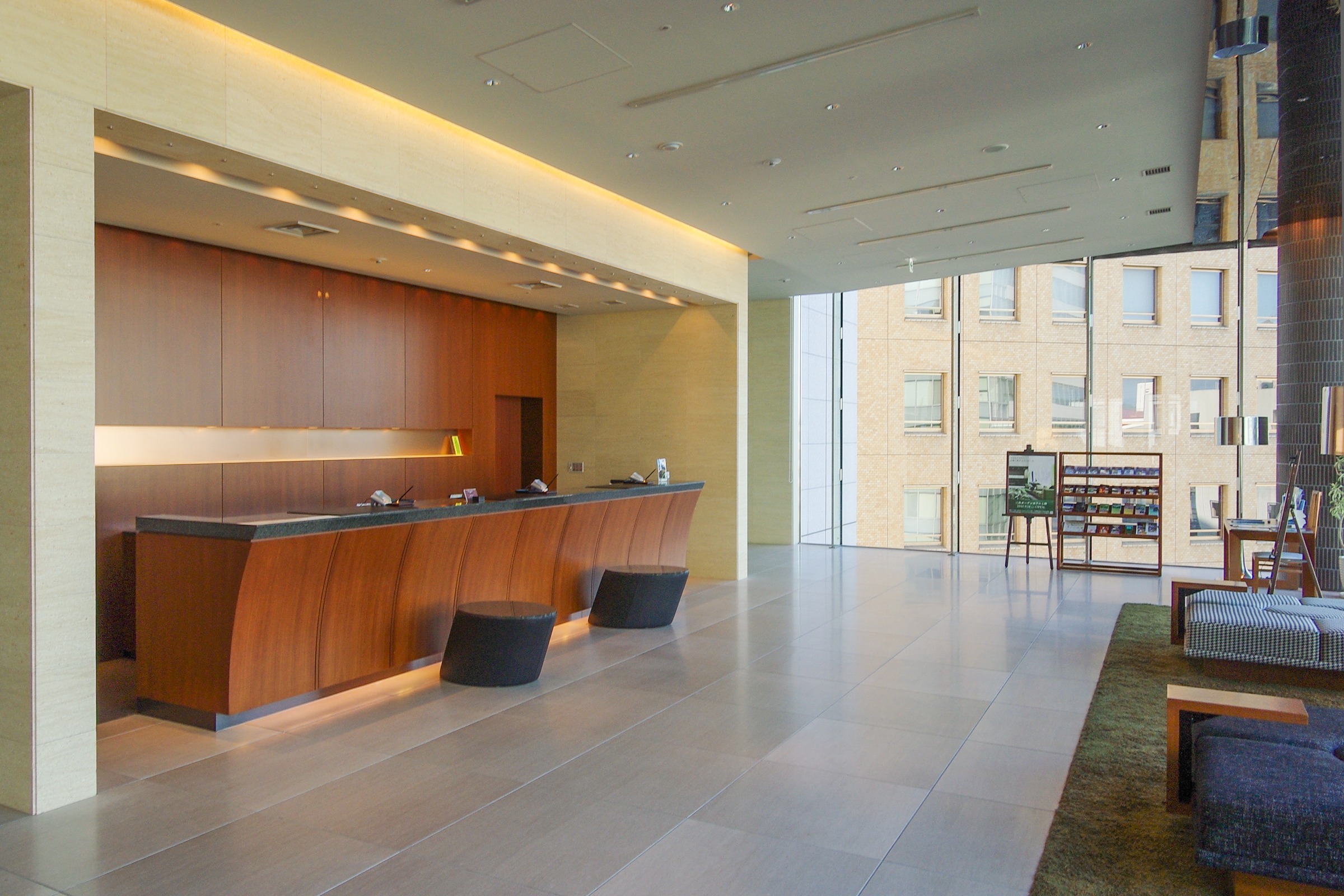
Cover photo: lic-6-hotel-lobby-empty by J o, CC BY-SA 3.0, via Wikimedia Commons. It shows a different property from the ones discussed here.
