30-second answer
A unit bath (yunitto basu) puts the tub, sink and toilet in one small, wet room. You shower inside the tub with the curtain tucked in, and you hang the curtain outside the tub if you fill it to soak. In my experience the tub is deeper than an American one but shorter. Smaller business hotel rooms often have one, and larger room types at some chains have a separate toilet, so the wording on the booking page matters.
The tub, the sink and the toilet share one wet room
An American hotel bathroom is usually a room with a tub or shower and a toilet in it, and nobody thinks much about where the water goes. A Japanese unit bath is the same idea made smaller, with a rule attached: the curtain goes in one place for showering and another for soaking. Get it wrong and the floor, which is also the toilet floor, is wet.
Toyoko Inn’s English site describes its bathroom as one that “consists of bathtub, shower, sink and toilet in a single unit,” and says some hotels in the chain have rain showers installed within the tubs. TOTO, the bath maker, sells a hotel line it calls 洋風ユニット and describes as トイレ洗面付き3点タイプ, a “three-fixture type with toilet and washbasin.”
As of October 2026: Toyoko Inn rooms page, TOTO hotel line (in Japanese).
The same unit bath comes in several sizes. As with the beds in our guide to Japanese hotel rooms, the room type decides what you get.
The shower curtain: in to shower, out to soak
Toyoko Inn’s guidance says to put the curtain inside the tub when you wash, so water does not splash around the bathroom, and outside the tub when you fill it to soak, so the hem stays out of the water and off your body. The article adds that the chain rounds the center of its tubs to keep the curtain off you.
Super Hotel and APA give the same advice: curtain inside the tub when you wash, outside when you soak.
As of October 2026, from Japanese sites (in Japanese): Grapee article, Otonanswer write-up.
So the working rule is: curtain inside to shower, outside to soak.
Tub size
Hotels rarely publish tub dimensions. TOTO’s catalog lists a 1620-size unit with a tub floor length of 1180 mm (about 46 in), described as roomy at the feet, but that is a product spec, not any hotel’s tub.
Toyoko Inn’s Japanese site describes the bath as バスタブがゆったりと深いユニットバス, “a unit bath with a roomy, deep tub,” and says some hotels have a rain shower inside the tub. That is marketing, not a measurement.
As of October 2026, from TOTO and Toyoko Inn (in Japanese): TOTO press release, room-features page.

A 2015 fan blog says Toyoko Inn’s newest tub type kept the width but lost depth, while the older type was deep enough for two children, so tubs may vary between hotels.
As of October 2026, from a fan blog (in Japanese): Toyoko Inn tub post.
In my experience, these tubs are deeper than an American bathtub but shorter. A smaller person can sit in one and soak. At 6 ft (183 cm), I basically don’t. If a deep soak matters to you, a hotel with a 大浴場 (large public bath) is the safer plan than counting on the tub in the room.
Soaking and washing
Super Hotel’s TikTok account recommends soaking first to warm up, then washing while the water drains, which it says saves time compared with showering and then filling the tub. A separate item reports the same account’s advice to tuck the curtain inside and let the shower spray stick it to the tub wall.
As of October 2026, from Japanese sites (in Japanese): Maidona News, ITmedia Nlab.
If you do not want to soak, shower inside the tub with the curtain tucked in. That is what I do. The floor has still gotten wet on me, and the curtain has clung to me.
Rooms without one
A unit bath is common in business hotels, but chains also sell rooms without it, and the difference is written into the room type.
At Richmond Hotel Suidobashi, the Moderate Single and Moderate Double are 18 ㎡ (about 194 ft²) and the Moderate Twin is 24 ㎡ (about 258 ft²). All three say お風呂はユニットバスタイプでございます, “the bath is the unit bath type.” The Superior Twin at 27.4 ㎡ (about 295 ft²) says バス・トイレが分立しています, “bath and toilet are separate,” and the Premium Twin at 31.2 ㎡ (about 336 ft²) lists a bath with a washing area, a toilet and a washbasin all apart. The Asakusa branch uses the same vocabulary: its 29 ㎡ twin says バス・トイレ別、2点セパレートタイプ, and its 36 ㎡ comfort twin says 三点分離式, “three-point separated.” At these two branches, the bigger rooms are the ones with the separate toilet. For how small the small ones get, see the 12 ㎡ room article.
Dormy Inn Korakuen adds a variation. Its Economy Double line reads ベッドサイズ:シモンズ社製ベッド(1400×1950 1台)※シャワーブースなし, “no shower booth.” The note sits inside the bed-size line, so it is easy to skip past.
As of October 2026, from Richmond Hotel and Dormy Inn (in Japanese): Suidobashi rooms, Asakusa rooms, Korakuen rooms.
Booking-page wording
Words to look for before you pay:
- ユニットバス (unit bath). Tub, sink and toilet in one room.
- バス・トイレ別 (separate bath and toilet). The toilet is its own room. Richmond also writes 2点セパレート.
- 三点分離 (three-point separated). Bath, toilet and washbasin each independent.
- 洗い場付 (with washing area). A place to wash outside the tub.
- シャワーブース (shower booth). A shower with no tub, as in the Dormy Inn note above.

If a listing says only “private bathroom,” that phrase does not tell you the layout. The hotel’s own room page is where the wording appears. If you are sharing a room, remember that a unit bath is one small room, so one person uses it at a time.
The short version
- Tuck the curtain inside the tub to shower and hang it outside to soak.
- Tub size is rarely published, so plan a deep soak around a 大浴場.
- For a separate toilet, look for バス・トイレ別 in the room description. Expect it mostly in larger room types.
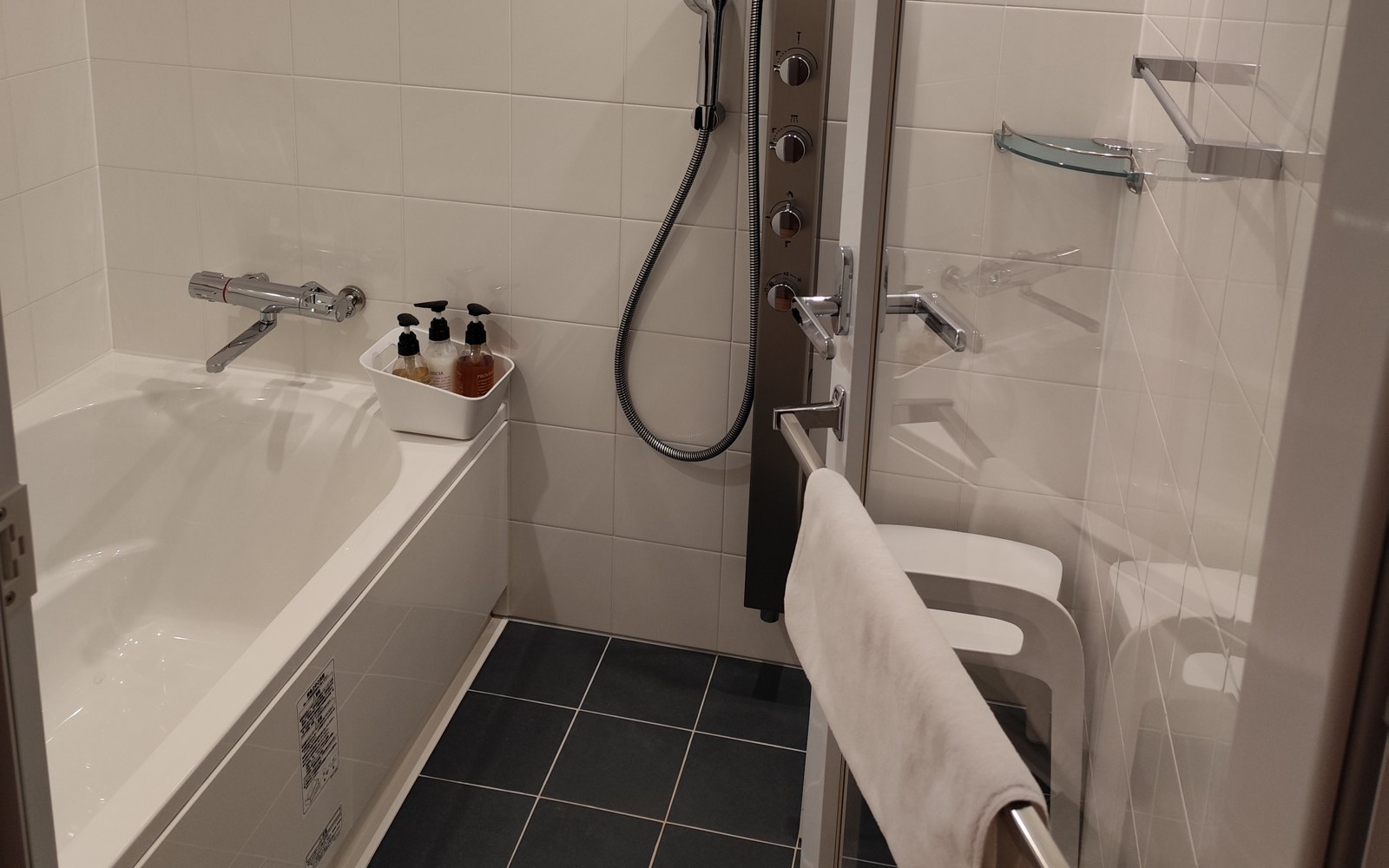
Cover photo: a hotel bathroom at Hotel Forza Kyoto Shijo Kawaramachi by HAGAT hOMSZE, CC0, via Wikimedia Commons, cropped. It shows a bath with a washing area, not a unit bath.