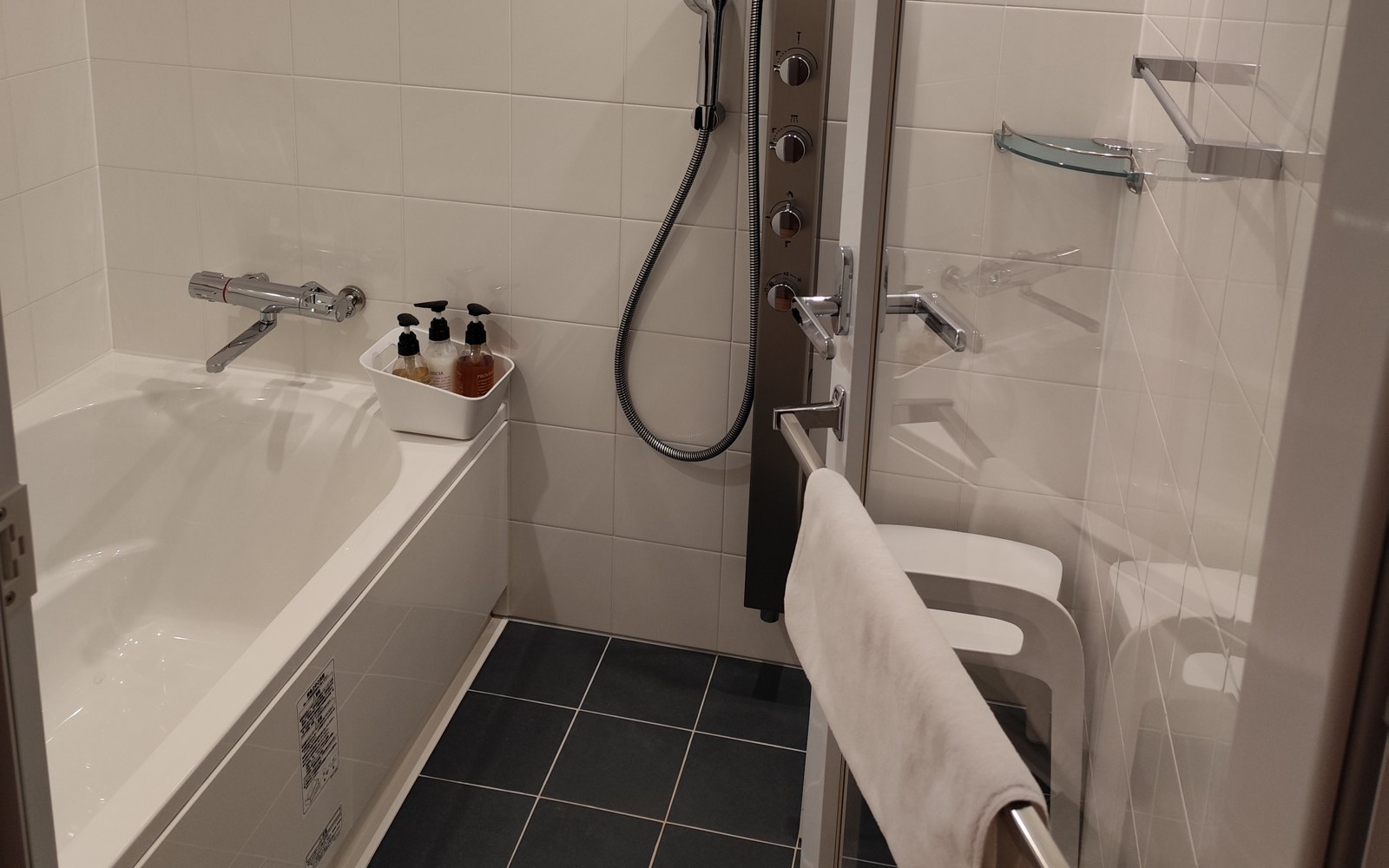
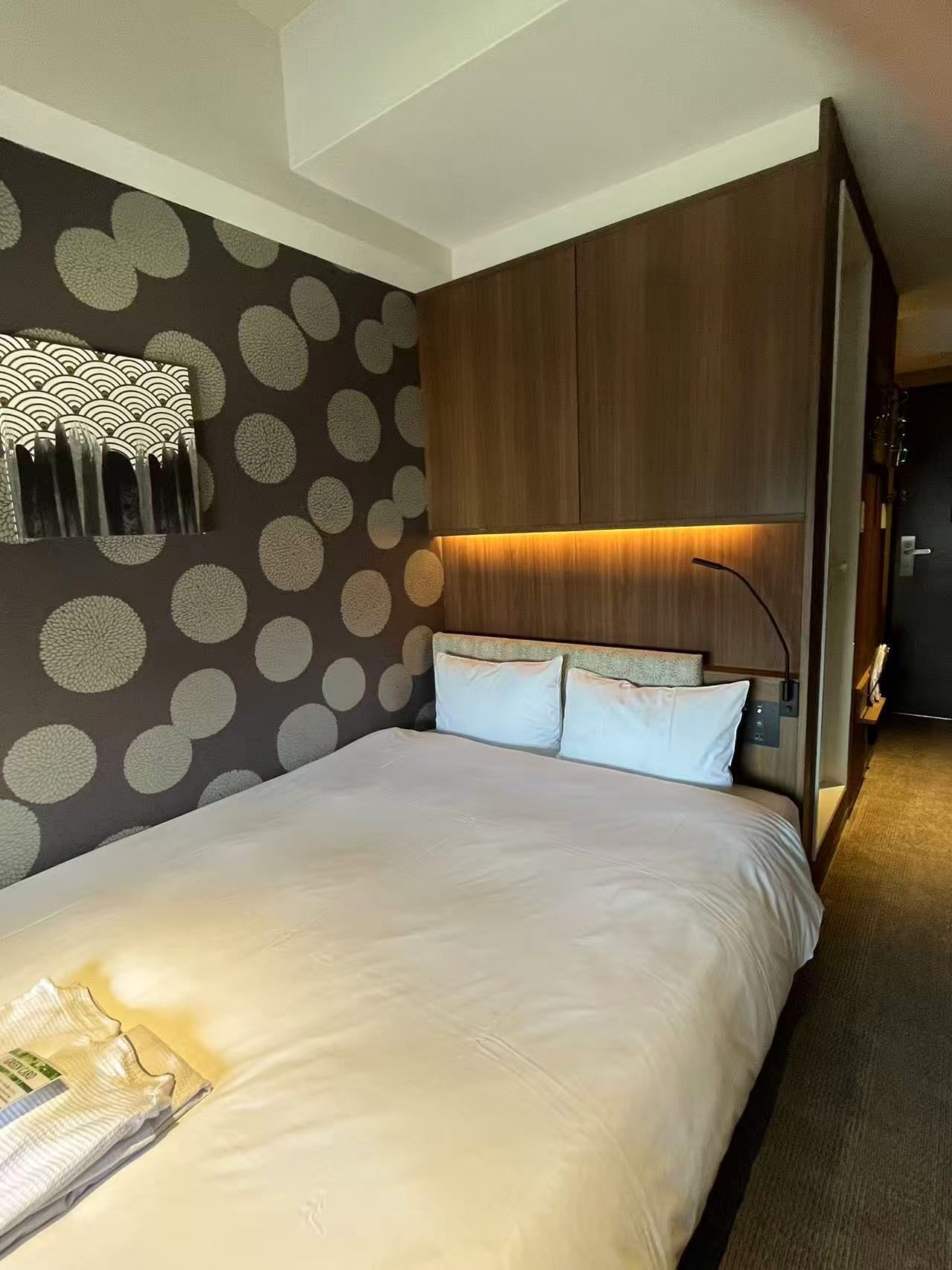
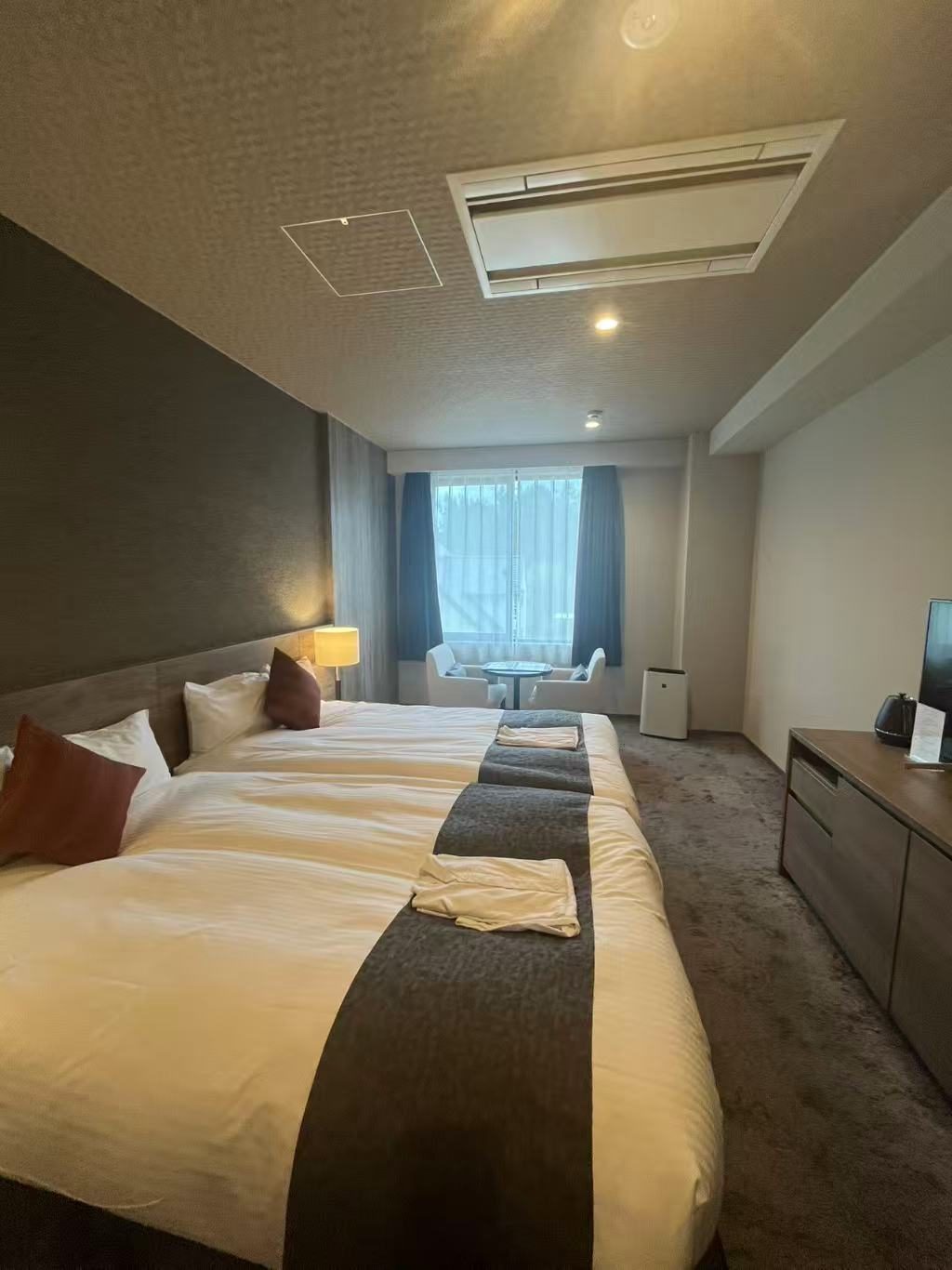
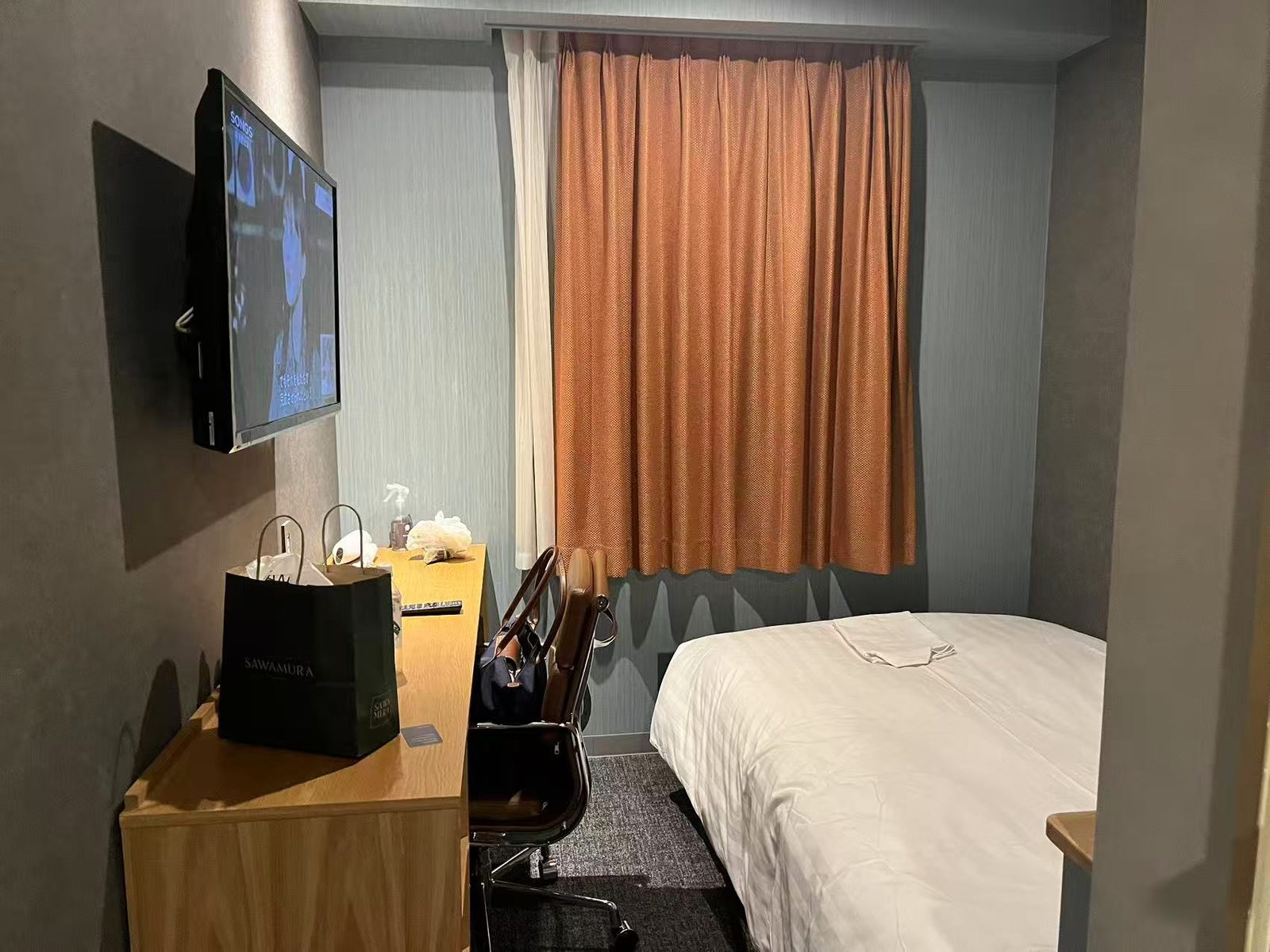
A unit bath (yunitto basu) puts the tub, sink and toilet in one small, wet room. You shower inside the tub with the curtain tucked in, and you hang the curtain outside the tub if you fill it to soak. In my experience the tub is deeper than an American one but shorter. Smaller business hotel rooms often have one, and larger room types at some chains have a separate toilet, so the wording on the booking page matters.
The tub, the sink and the toilet share one wet room
An American hotel bathroom is usually a room with a tub or shower and a toilet in it, and nobody thinks much about where the water goes. A Japanese unit bath is the same idea made smaller, with a rule attached: the curtain goes in one place for showering and another for soaking. Get it wrong and the floor, which is also the toilet floor, is wet.
Toyoko Inn’s English site describes its bathroom as one that “consists of bathtub, shower, sink and toilet in a single unit,” and says some hotels in the chain have rain showers installed within the tubs. TOTO, the bath maker, sells a hotel line it calls 洋風ユニット and describes as トイレ洗面付き3点タイプ, a “three-fixture type with toilet and washbasin.”
The same unit bath comes in several sizes. As with the beds in our guide to Japanese hotel rooms, the room type decides what you get.
The shower curtain: in to shower, out to soak
Toyoko Inn’s guidance says to put the curtain inside the tub when you wash, so water does not splash around the bathroom, and outside the tub when you fill it to soak, so the hem stays out of the water and off your body. The article adds that the chain rounds the center of its tubs to keep the curtain off you.
Super Hotel and APA give the same advice: curtain inside the tub when you wash, outside when you soak.
So the working rule is: curtain inside to shower, outside to soak.
Tub size
Hotels rarely publish tub dimensions. TOTO’s catalog lists a 1620-size unit with a tub floor length of 1180 mm (about 46 in), described as roomy at the feet, but that is a product spec, not any hotel’s tub.
Toyoko Inn’s Japanese site describes the bath as バスタブがゆったりと深いユニットバス, “a unit bath with a roomy, deep tub,” and says some hotels have a rain shower inside the tub. That is marketing, not a measurement.
Toyoko Inn, Japanese room-features page. Screenshot.
A 2015 fan blog says Toyoko Inn’s newest tub type kept the width but lost depth, while the older type was deep enough for two children, so tubs may vary between hotels.
In my experience, these tubs are deeper than an American bathtub but shorter. A smaller person can sit in one and soak. At 6 ft (183 cm), I basically don’t. If a deep soak matters to you, a hotel with a 大浴場 (large public bath) is the safer plan than counting on the tub in the room.
Soaking and washing
Super Hotel’s TikTok account recommends soaking first to warm up, then washing while the water drains, which it says saves time compared with showering and then filling the tub. A separate item reports the same account’s advice to tuck the curtain inside and let the shower spray stick it to the tub wall.
If you do not want to soak, shower inside the tub with the curtain tucked in. That is what I do. The floor has still gotten wet on me, and the curtain has clung to me.
Rooms without one
A unit bath is common in business hotels, but chains also sell rooms without it, and the difference is written into the room type.
At Richmond Hotel Suidobashi, the Moderate Single and Moderate Double are 18 ㎡ (about 194 ft²) and the Moderate Twin is 24 ㎡ (about 258 ft²). All three say お風呂はユニットバスタイプでございます, “the bath is the unit bath type.” The Superior Twin at 27.4 ㎡ (about 295 ft²) says バス・トイレが分立しています, “bath and toilet are separate,” and the Premium Twin at 31.2 ㎡ (about 336 ft²) lists a bath with a washing area, a toilet and a washbasin all apart. The Asakusa branch uses the same vocabulary: its 29 ㎡ twin says バス・トイレ別、2点セパレートタイプ, and its 36 ㎡ comfort twin says 三点分離式, “three-point separated.” At these two branches, the bigger rooms are the ones with the separate toilet. For how small the small ones get, see the 12 ㎡ room article.
Dormy Inn Korakuen adds a variation. Its Economy Double line reads ベッドサイズ:シモンズ社製ベッド(1400×1950 1台)※シャワーブースなし, “no shower booth.” The note sits inside the bed-size line, so it is easy to skip past.
ユニットバス (unit bath). Tub, sink and toilet in one room.
バス・トイレ別 (separate bath and toilet). The toilet is its own room. Richmond also writes 2点セパレート.
三点分離 (three-point separated). Bath, toilet and washbasin each independent.
洗い場付 (with washing area). A place to wash outside the tub.
シャワーブース (shower booth). A shower with no tub, as in the Dormy Inn note above.
Richmond Hotel Suidobashi, Moderate Single Room. Screenshot.
If a listing says only “private bathroom,” that phrase does not tell you the layout. The hotel’s own room page is where the wording appears. If you are sharing a room, remember that a unit bath is one small room, so one person uses it at a time.
The short version
Tuck the curtain inside the tub to shower and hang it outside to soak.
Tub size is rarely published, so plan a deep soak around a 大浴場.
For a separate toilet, look for バス・トイレ別 in the room description. Expect it mostly in larger room types.
Cover photo: a hotel bathroom at Hotel Forza Kyoto Shijo Kawaramachi by HAGAT hOMSZE, CC0, via Wikimedia Commons, cropped. It shows a bath with a washing area, not a unit bath.
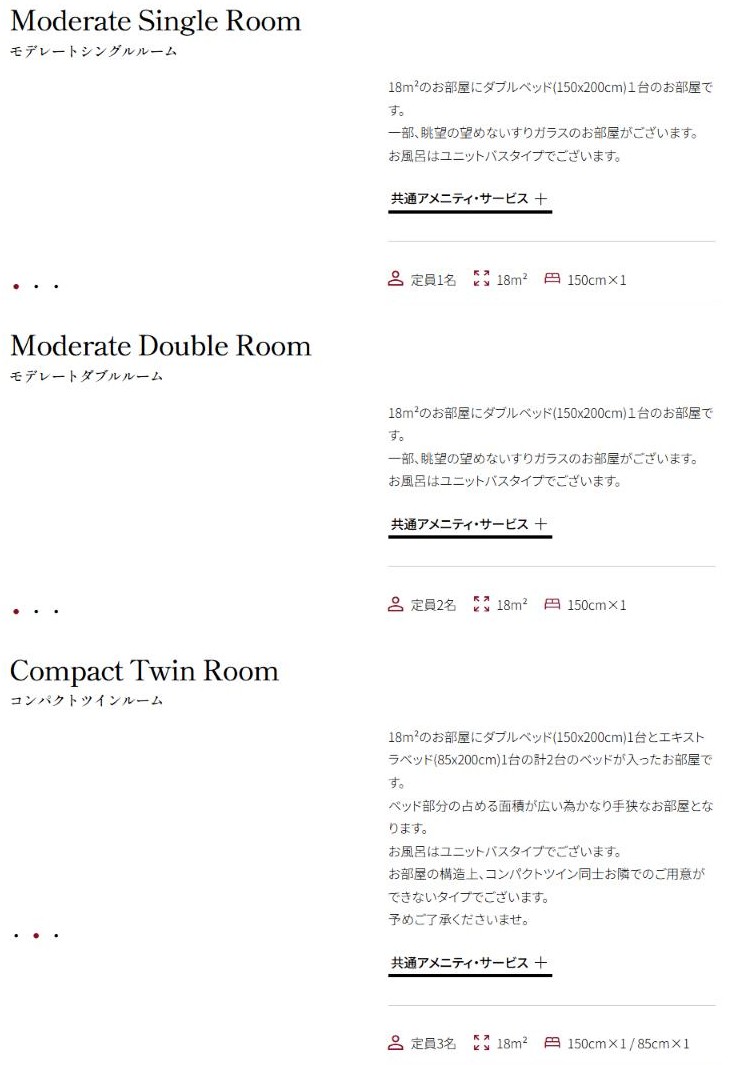
Richmond Hotel Tokyo Suidobashi lists three rooms of 18 m² (194 ft²), each with one 59-inch (150 cm) double bed. One is sold to one guest, one to two guests, and the third, with an extra bed, to three. The number doesn’t tell you who the room is for.
Last checked: October 3, 2026. The hotel pages below are in Japanese.
194 ft² and what it counts
18 m² is 194 ft², about a 10 by 19 foot rectangle. Sources differ on what a room size counts. Mews’s hotel blog says “Some properties include bathroom square footage in published dimensions; others report bedroom area,” and that “economy rooms run 160 to 230 sq ft, midscale rooms 230 to 350 sq ft”. As a rough frame, 194 ft² sits near the middle of the economy band.
The 12 m² single in the 12㎡ article is 129 ft². Eighteen is half again as much floor, 65 ft² (6 m²) more, and the number alone doesn’t say how many people the room is for.
One size, three guest counts
The table has 15 rows from 10 hotels in seven cities, all rooms between 17.6 and 18.8 m² (189 to 202 ft²). It is not a census of Japan.
Start with the three Richmond Suidobashi rows. The Moderate Single and the Moderate Double share one sentence, 「18m²のお部屋にダブルベッド(150x200cm)1台のお部屋です。」, roughly “a room of 18 m² with one double bed (150 x 200 cm)”, yet the single lists a capacity of 1 and the double 2. The Compact Twin is the same 18 m² with that 150 cm bed plus an 「エキストラベッド」, an extra bed at 85 x 200 cm, and its capacity is 3. The hotel itself calls this room “quite cramped”.
Richmond Hotel Tokyo Suidobashi, three 18 m² rooms (in Japanese). Screenshot.
Read the capacity line first. Fourteen of the 15 rows print a guest count: three say 1, eight say 2 (Universal City says up to 2), two say 1 to 2, and one says 3. Shinjuku Washington prints none. So if a search for two returns an 18 m² room, the page still has to say 2. The 140 cm article shows the same looseness at another hotel, where one 16 m² room with a 140 cm bed is sold as both a single and a double.
The beds vary as much. Among the eight rooms with “double” in the name, the one bed is 55 in (140 cm) at two hotels, 59 in (150 cm) at two, 63 in (160 cm) at three and 71 in (180 cm) at one. Japanese Hotel Rooms Decoded goes through why the name doesn’t give you the width.
Floor left after the bed
What remains after the bed is everything else: the bath, the entry, the desk, the closet, the walkway and the guests. The Keihan twin uses 200 cm, the shorter of the two lengths its page prints.
Room
Size
Bed area
Share of room
Floor left
Per guest
Richmond Suidobashi Moderate Double
194 ft² (18 m²)
32 ft² (3.0 m²)
17%
161 ft² (15.0 m²)
81 ft² (7.5 m²), 2 guests
Oriental Universal City Moderate Double
194 ft² (18.0 m²)
30 ft² (2.8 m²)
16%
164 ft² (15.2 m²)
82 ft² (7.6 m²), 2 guests
Route Inn Uozu Double
194 ft² (18 m²)
34 ft² (3.14 m²)
17%
160 ft² (14.9 m²)
80 ft² (7.4 m²), 2 guests
Keihan Sapporo Superior Double
194 ft² (18 m²)
39 ft² (3.6 m²)
20%
155 ft² (14.4 m²)
78 ft² (7.2 m²), 2 guests
Dormy Hiroshima Twin
202 ft² (18.8 m²)
46 ft² (4.29 m²)
23%
156 ft² (14.5 m²)
78 ft² (7.3 m²), 2 guests
Keihan Sapporo Casual Twin
194 ft² (18 m²)
45 ft² (4.2 m²)
23%
149 ft² (13.8 m²)
74 ft² (6.9 m²), 2 guests
Richmond Suidobashi Compact Twin
194 ft² (18 m²)
51 ft² (4.7 m²)
26%
143 ft² (13.3 m²)
48 ft² (4.4 m²), 3 guests
For comparison: Dormy Ikebukuro Economy Single
129 ft² (12.0 m²)
25 ft² (2.34 m²)
20%
104 ft² (9.7 m²)
104 ft² (9.7 m²), 1 guest
For comparison: Keihan Sapporo Superior Twin
280 ft² (26 m²)
52 ft² (4.87 m²)
19%
227 ft² (21.1 m²)
114 ft² (10.6 m²), 2 guests
The Dormy Ikebukuro single comes from the 12㎡ article, and the Keihan superior twin is two 120 x 203 cm beds on the same Keihan page.
As of October 2026, from the hotel pages in the table above (in Japanese).
On the six rows listed for two, the bed takes 16 to 23 percent of the room, against 16 to 32 percent for the eight rooms in the 12㎡ article. The per-guest column is the one to read: two guests in an 18 m² double or twin have 74 to 82 ft² (6.9 to 7.6 m²) each, against 104 ft² (9.7 m²) for one guest in a 12 m² single, with the bath inside all of these figures.
The 26 m² twin gives each guest 114 ft² (10.6 m²), a little more than the 12 m² single gives one. Per person, then, 18 m² for two is tighter than either 12 m² for one or 26 m² for two. The three guests in the Compact Twin each get 48 ft² (4.4 m²).
Double, wide bed or twin
The hotels give sizes and beds, not floor plans.
One double bed, 55 to 59 in (140 to 150 cm). The bed covers 30 to 32 ft² (2.8 to 3.0 m²), 16 to 17 percent of the room. Some of the leftover floor goes to furniture the hotel chose. Hotel Oriental Express Fukuoka Tenjin has two versions of its 18 m² Corner Double with a 140 cm bed, and the hotel says of the sofa version 「備え付けのソファでゆっくり寛げます」, “you can relax on the built-in sofa”. The 140 cm article goes through whether that width is enough for two.
One wide bed, 63 to 71 in (160 to 180 cm). A wider bed costs little floor. Route Inn’s 160 x 196 cm bed covers about 4 ft² (0.34 m²) more than a 140 x 200 cm one, and Keihan’s 180 x 200 cm bed about 9 ft² (0.8 m²) more. When two rooms of about the same size are on the screen and one has the 160 cm bed, I take the wider bed for two people, even over a 140 cm bed with a built-in sofa.
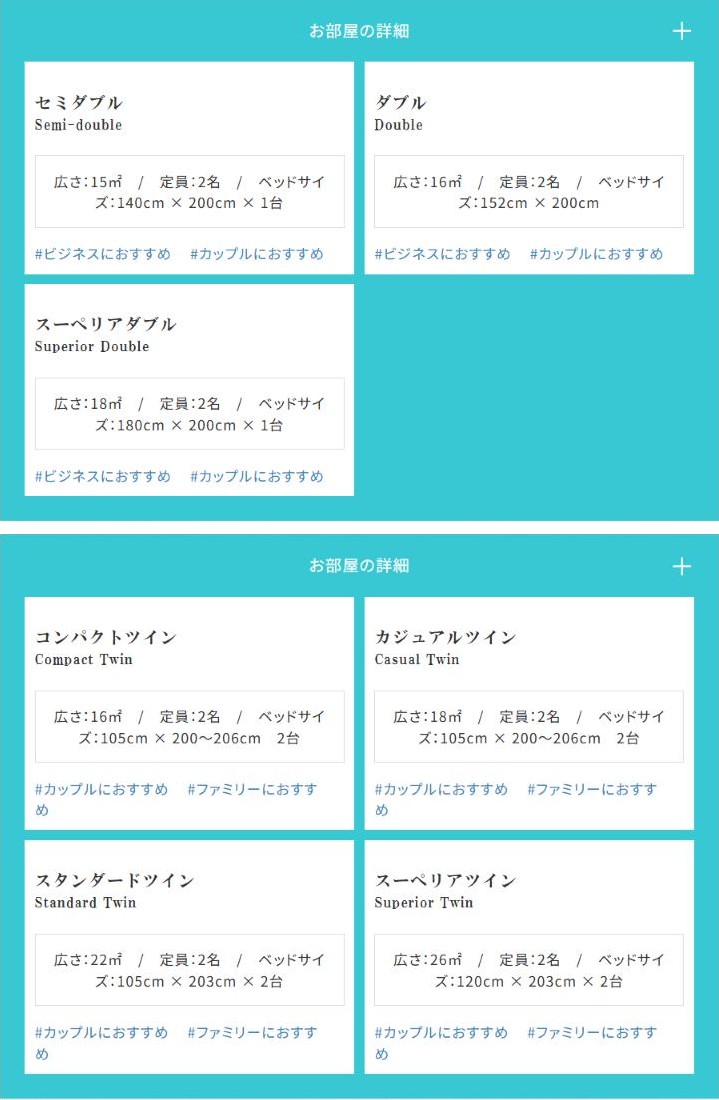
Hotel Keihan Sapporo, Superior Double and Casual Twin (in Japanese). Screenshot.
Look at those two lines side by side. Both are 18 m² and both list two guests, and the twin spends about 6 ft² (0.6 m²) more floor on beds.
Two single beds, 39 to 43 in (98 to 110 cm). Two beds cover 45 to 46 ft² (4.2 to 4.3 m²), 15 to 16 ft² (1.4 to 1.5 m²) more than one 140 cm bed, which leaves 149 to 156 ft² (13.8 to 14.5 m²) of floor.
Three guests. Richmond’s Compact Twin puts a 59-inch (150 cm) bed and a 33-inch (85 cm) extra bed in 18 m², which leaves 48 ft² (4.4 m²) of non-bed floor per guest. The hotel’s own description of the room reads 「ベッド部分の占める面積が広い為かなり手狭なお部屋となります。」, “quite cramped because the bed area is large.”
The bath is in there somewhere
At least four of the ten hotels state a bath type. Richmond Suidobashi’s Moderate Twin reads 「お風呂はユニットバスタイプでございます」, and its three 18 m² rooms are listed as unit bath type. Shinjuku Washington’s double rooms are listed with a unit bath, and Route Inn Uozu lists ユニットバス in an amenity list that covers its rooms. A unit bath is a prefabricated pod with tub, sink and toilet in one wet room.
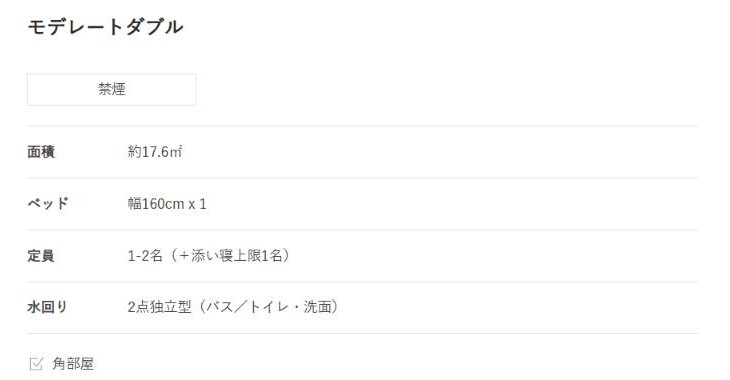
Hotel Vista Tokyo Tsukiji describes a different arrangement at the same size. Its 17.6 m² (189 ft²) Moderate Double reads 「2点独立型(バス/トイレ・洗面)」 and its 18.8 m² (202 ft²) Moderate Twin B reads 「3点独立型(バス/トイレ/洗面)」. The parentheses show the grouping: bath | toilet and washbasin in the first, bath | toilet | washbasin in the second.
Hotel Vista Tokyo Tsukiji, Moderate Double (in Japanese). Screenshot.
Bath type doesn’t follow size. Vista separates the bath at 17.6 m². Richmond Suidobashi keeps a unit bath at 24 m² (258 ft²), and its 27.4 m² (295 ft²) Superior Twin reads 「バス・トイレが分立しています」.
TOTO’s hotel unit baths come in the 1014 and 1216 sizes. The 1216 is 1,200 by 1,600 mm, about 21 ft² (1.92 m²), and the 1014, by the same code, is an estimated 1.0 by 1.4 m², about 15 ft² (1.4 m²). The hotels don’t say which size any of these hotels fitted. If a pod of 15 to 21 ft² is inside an 18 m² figure, it is 8 to 11 percent of it.
No page in this sample says whether the bath is inside the listed size. One hotel does print a footnote on how area is counted. Mitsui Garden Hotel Prana Tokyo Bay reads 「本客室の面積はPS(パイプスペース)を含む壁芯で計算し、小数点第2位以下を切り捨てた概算の表示です。」 That says the area is figured to the centers of the walls with the pipe space included, with figures from the second decimal place down dropped, and is approximate. A listed number can therefore run ahead of the floor you walk on at that hotel.
Every per-guest figure above has the bath still inside. Take a 15 to 21 ft² (1.4 to 1.92 m²) pod off the 12 m² single and off each 18 m² room, then divide the 18 m² floor between two guests, and the gap narrows from 22 to 29 percent to about 14 to 25 percent.
One open bag at a time
The luggage article works out about 8 ft² (0.75 m²) of clear floor for a 29-inch (74 cm) bag opened flat. A long-time Japan resident’s rough guess there is about 25 m² (269 ft²) to open one large bag comfortably and about 30 m² for two, a guess and not a rule.
Area alone isn’t the limit here. Two open bags would take about 16 ft² of the 143 to 164 ft² left after the bed in an 18 m² room. What decides it is whether a clear patch of about 29 by 40 inches (74 by 102 cm) exists, and the listing photo from the door shows that where the number doesn’t. In a small room I often open my bag in the entrance corridor, and a closed second bag goes there too. In a twin, each bed is also a surface to open a bag on, as the luggage article describes. If the price gap is small, I’ll pay for a bigger room.
Could two of you stay a few nights?
Eight of the 15 rows list their room for two, and two more list 1 to 2. The bed gives each of two guests 27.5 inches (70 cm) at 140 cm and 31.5 inches (80 cm) at 160 cm, and the 140 cm article covers that choice. The floor gives each guest 74 to 82 ft² (6.9 to 7.6 m²) with the bath still inside. The bags take 8 ft² each when open, which is why only one fits open at a time.
A second checked bag stays closed, and a day spent working in the room is spent on the same 74 to 82 ft². A twin or a 160 cm double changes the bed side of that arithmetic, and it costs 15 to 16 ft² (twin) or about 4 ft² (160 cm) of floor.
The step to 18 often buys a wider bed
Against the 12 m² single, 18 m² adds 65 ft² (6 m²). On these pages that mostly buys a wider bed or a different bed layout, and it doesn’t always buy more room per person.
+27 to 29 ft² (2.5 to 2.7 m²), one wide bed becomes two narrow ones
In four of the six pairs the bed got wider, in one it got narrower, and in one it became two beds. At Fukuoka the 14.5 m² queen has a wider bed than the 18 m² corner double.
Going up from 18 m², the rooms around 22 to 27 m² are mostly twins. Keihan’s 22 m² (237 ft²) Standard Twin has two 105 x 203 cm beds for 2 guests, and its 26 m² Superior Twin has two 120 x 203 cm beds for 2. The 23 m² twins are listed for more people. Dormy Inn Hiroshima’s Studio Twin (two 120 cm beds) and Tokyu Stay Suidobashi’s Superior Twin (120 cm beds) are listed for 3, and Fukuoka Tenjin’s Superior Twin (two 110 cm beds plus extra beds) for up to 4. Richmond Suidobashi’s 27.4 m² Superior Twin is listed for 2 to 3.
Take the Dormy Hiroshima Studio Twin: 23.0 m² with 4.68 m² of beds leaves 197 ft² (18.3 m²), or 66 ft² (6.1 m²) for each of three guests, less than the 80 ft² (7.4 m²) each in Route Inn’s 18 m² double for two. Past 22 m², check what the hotel did with the floor.
Before you book
Bed width and room size are among the things I check right before I press the book button, and for a room under 20 m² I always look at the bath type. At 18 m² there are four lines to read together:
The guest count printed beside the size. The same 18 m² is sold for 1, 2 or 3.
The bed count and width. A double at this size ranged from 55 to 71 in (140 to 180 cm), and a wider bed cost about 4 to 9 ft² (0.34 to 0.8 m²) of floor.
The bath wording. 「ユニットバス」 is a pod, and 「バス・トイレ別」 or 「独立型」 means the rooms are apart. Where a page doesn’t say what its number counts, subtract a pod of 15 to 21 ft² (1.4 to 1.92 m²) before you decide.
A photo from the door. Find the shot that shows the floor between the bed and the desk, and whether the entry and the bath door share a strip.
If you plan on two big bags, look at a twin in the 22 m² range or above, or accept one open bag and one closed.
The short version
An 18 m² room is 194 ft² and is sold for one, two or three guests, with bed widths from 39 to 71 inches (98 to 180 cm). With the bath inside the figure, two guests have 74 to 82 ft² of non-bed floor each. Read the guest count and bed width first, treat the bath as inside the number unless the hotel says otherwise, and plan on one open 29-inch bag at a time.
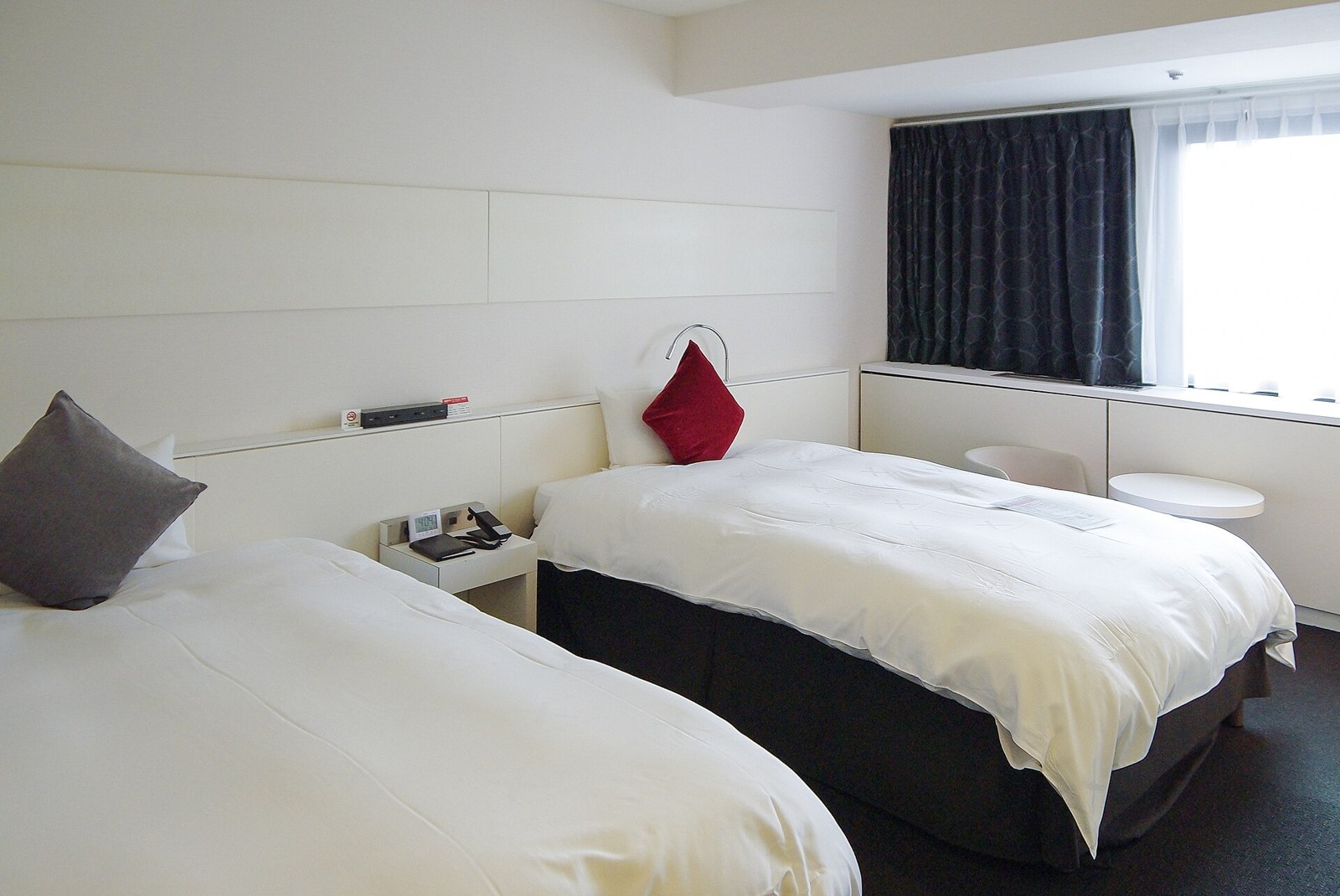
Cover photo: a twin room at Cross Hotel Osaka by J o, CC BY-SA 4.0, via Wikimedia Commons. It shows a different hotel from the ones discussed.
Last checked: October 2, 2026. Pages in Japanese are marked.
1. The label names the floor, not the bed
At home, the room type on a booking screen tells you the beds: one king, two queens, a sofa bed. In Japan, 和室 (washitsu, “Japanese-style room”) tells you the floor. JTB’s help page on room types defines it in one line, “メインの客室が畳敷きの客室”, a guest room whose main space has a tatami floor. The line says nothing about a bed. Tatami is the thick woven mat flooring, and japan-guide describes the mats as “about one by two meters in size”. Section 5 gives the exact sizes.
The same JTB page defines 和洋室 (wayoshitsu, “Japanese-Western room”) as a room with a Japanese part and a Western part, where “それぞれで寝ることができるのが一般的です。(施設によって異なります)”, meaning you can generally sleep in either part, though it differs by facility. The usual layout is a bedroom with beds plus a living area floored with tatami. 洋室 (yoshitsu) is the plain Western-style room, the one you already know.
As of October 2026, from Japan Hotel School (in Japanese): glossary.
The Japan Tourism Agency’s FAQ for ryokan guests puts it this way: “Traditionally at a ryokan, you do not sleep on a bed. You use a futon, a type of bedding that you lay right on the tatami flooring.” In recent years, it adds, there are more ryokan with “Japanese-style rooms with beds,” mixed Japanese/Western rooms, and completely Western-style rooms. “Japanese-style rooms with beds” is easy to skim past in a list. A business hotel page shows what it looks like.
Hotel Route Inn Ise lists three rooms called 和室: a single, a semi-double and a twin. Each carries the same sentence, “畳敷きのお部屋ですがベッドを設置しております。お部屋の入り口で靴をぬいでご入室ください。” In English, it is a tatami room with beds installed, and you take your shoes off at the room’s entrance. The single and the semi-double list a 51 × 79 in (130 × 200 cm) bed in 118 ft² (11 m²). The twin lists 43 × 79 in (110 × 200 cm) beds in 161 ft² (15 m²).
Someone who read 和室 and pictured a futon would be wrong at this hotel. Someone who pictured a bed would be wrong at Hotel Banso in section 5, where every tatami room lists futon bedding.
2. Where you sleep
Three layouts sit behind these labels, and the booking page seldom says which one you are getting.
Futon on tatami. Here “futon” means the Japanese bedding, a thin mattress pad and a quilt. The US word names a fold-down sofa frame. japan-guide’s tatami page says futon “are kept folded in the closet during the day and set out in the evening after dinner.” A single mattress pad is 39 × 83 in (100 × 210 cm), about as wide as a US twin (38 inches). The Japan Ryokan Association’s guestroom page adds that in a washitsu the bedding is “usually directly placed on the tatami, but low beds are used in the place of futon at some ryokans.”
In the photo, the quilts lie straight on the mats and there is no bed frame anywhere. The low table is still in the room, squeezed between the two sets of bedding, and the sliding doors at the left are the kind of closet where the bedding sits during the day.
Beds on tatami. This is the Route Inn Ise layout. Dormy Inn Premium Ginza says its 12th-floor rooms are “畳敷きの和風フロア”, a tatami-floored Japanese-style floor, and asks guests to take off their footwear. Its Japanese-style Standard Room lists 2 guests, 283 to 291 ft² (26.3 to 27.0 m²) and two Serta beds at 43 × 77 in (110 × 195 cm). The beds are ordinary hotel beds and the tatami is the floor around them.
A bed area and a tatami area. Dormy Inn Kanazawa lists 和洋室 types for 4 and 5 guests, each with two beds plus “和布団”, Japanese futon. Miyako Hotel Gifu Nagaragawa’s 和洋室 gives the clearest count: 807 ft² (75 m²), a Western bedroom with two beds of 48 × 80 in (122 × 203 cm), an 8-mat tatami room, and 5 guests. The hotel can prepare three futon for sleeping (“お休みの際には、ふかふかのお布団を3つご用意させていただけます”), and this is its only 和洋室. Two beds and three futon make five sleepers.
You open the door and there is a low table, floor cushions and no bed. That is normal. japan-guide’s ryokan room page says it directly: “The futon will not be laid out when you first enter the room. Instead, they are kept in the closet during the day to be set out in the evening and put away again in the morning by the ryokan staff.”
At the three or four inns I’ve stayed at, the futon often went down while I was at dinner. What the room looks like when you come back, and how the timing gets set at check-in, is in the ryokan day article.
Some places hand the job to you. Sixth Diary Kahoku’s notice opens with “和室にご宿泊いただく際、お布団敷きはセルフサービスとなります.” Staff used to enter the room and lay the bedding out, but the hotel changed this for privacy, so staff do not normally come into the room now. You lay out the futon whenever you like after check-in, and staff take it up after check-out, so you leave it down. That is one hotel’s notice and says nothing about how common this is.
As of October 2026, from Sixth Diary Kahoku (in Japanese): notice.
I have laid out a futon myself. If you book a 和室, check whether staff lay it out or you do, and if the hotel doesn’t say, ask at the front desk. JNTO’s etiquette page also tells ryokan guests, “If in doubt, simply ask.” A sentence like お布団は自分で敷きますか? (“Do I lay out the futon myself?”) is enough, in person or in the booking site’s message box.
4. Walking on tatami
At an inn the sequence is shoes off at the entrance, slippers in the corridor, and slippers off again at the edge of the mats. As japan-guide puts it: “Footwear – even slippers – should be removed before stepping onto tatami.”
As of October 2026, from Kashiwaya Ryokan: etiquette page.
The business hotels that sell tatami rooms write the rule on the page. Route Inn Ise says to take your shoes off at the room’s entrance, and Dormy Inn Premium Ginza says to take off your footwear on its tatami floor.
What goes on your feet instead depends on the setting. For visiting a home, japan-guide tells visitors to carry a fresh pair of socks, since entering barefoot is not considered well mannered, though it is acceptable in informal situations. Kashiwaya Ryokan describes relaxing barefoot in a tatami room.
The size in a tatami room’s name is a count of mats (畳, jo). japan-guide says room size in Japan is “commonly measured by the number of mats that would fit it, e.g. an 8-mat room.” A mat is not one fixed size. The rental site chintai.net lists four standards, from 15.6 ft² (1.45 m²) for the danchi mat to 19.6 ft² (1.82 m²) for the Kyoto mat, with the Edo mat at 16.6 ft² (1.55 m²). The real estate advertising rule counts a listed mat as at least 1.62 m² (17.4 ft²), which is above the Edo mat, so the figures below use 1.62 m². At that size 6 mats is about 105 ft² (9.7 m²), 8 mats about 140 ft² (13 m²) and 10 mats about 174 ft² (16.2 m²). The hotels don’t say which mat they count, so these estimates run high if a hotel counts Edo mats.
As of October 2026, from chintai.net (in Japanese): mat sizes.
Hotel Banso lists three tatami rooms, all with futon bedding: 7.5 mats for 1 to 3 guests, 8 mats for 2 to 4, and “42㎡(15畳)” for 2 to 6. At the top of each range that is 2 to 2.5 mats per guest, about 35 to 44 ft² (3.2 to 4 m²) at 1.62 m² a mat. The 15-mat room also shows that mats and square meters measure different things. Fifteen mats is about 262 ft² (24.3 m²), but the hotel gives 452 ft² (42 m²), so that figure counts a good deal besides the mats. Miyako Hotel Gifu Nagaragawa’s Japanese-style room pairs a 6-mat and an 8-mat room in 807 ft² (75 m²) and lists 5 guests, with futon bedding. japan-guide’s ryokan room page says “Rooms are typically designed for two to four occupants, although larger groups can sometimes be accommodated as well.”
The number that governs your booking is the guest count on the plan page. How that count turns into rooms and bedding, including a child’s extra futon and the fire-code arithmetic that counts tatami rooms by floor area, is in the headcount article.
6. Business hotel or ryokan
Dormy Inn Ikebukuro, Richmond Hotel Tokyo Shiba and Hotel Route Inn Kato list no 和室, 和洋室 or tatami room on their Japanese room pages. Tatami rooms exist only at some properties of the same chains, such as Route Inn Ise, Dormy Inn Premium Ginza and Dormy Inn Kanazawa. JTB’s page of APA hotel Japanese-room plans lists four APA properties with rooms of 8 to 10 mats, one of them marked “布団式”, futon style.
The same room name can hide a futon, a bed or both. Read these lines on the plan page, in this order.
The bedding word. 布団 or 和布団 means futon on the floor. ベッド means a bed. Both words in one listing means a bed area plus a futon, as at Miyako. Confirm the details in the plan’s “お部屋詳細” box. JTB says “詳細は、必ずプラン詳細画面の「お部屋詳細」欄にてご確認ください”.
Mats and square meters. The 畳 count is the tatami area and the ㎡ figure is the room, and Banso shows they can be far apart (section 5).
The guest count and how it splits. Read ご利用人数 or 定員 and then the beds and futon lines. At Miyako it was two beds and three futon for five guests.
Who lays out the futon. Look for セルフサービス, the word the Sixth Diary notice uses, in the plan text or a notice. If neither says, ask.
An either-or listing. Anjuan, a nine-room inn, sells two of its room types as “和室または和洋室”. The rooms are nearly identical and differ in “お布団をご用意するかベッドが付いているかという違い”, whether futon are prepared or beds are installed. Each exists once, so the inn sells either-or. With no preference, three guests of the same sex usually get the 和室, so nobody is the only one on a futon while two use beds. A preference entered on the inn’s own site is honored first while rooms are free, but requests are first come and not guaranteed, so the inn recommends its own site if you need one or the other.
The floor itself. If getting down to a futon and up from it is hard, a tatami room with beds or a 和洋室 avoids it. The JTA FAQ adds that some ryokan offer Western-style tables and chairs for guests who would rather not sit on the floor.
As of October 2026, from Anjuan (in Japanese): news page.
和室 names a tatami floor, and the bedding is a separate line. Route Inn Ise sells three 和室 types with beds installed, and a 和洋室 has a Japanese part and a Western part.
At a traditional inn the futon is kept in the closet and set out in the evening, and one hotel’s notice makes it self-service. Check whether staff lay it out or you do, and if the hotel doesn’t say, ask at the front desk.
Slippers come off at the edge of the tatami. The mat count and the square meters measure different things: Hotel Banso lists a 15-mat room as 452 ft² (42 m²) for 2 to 6 guests.
A “和室または和洋室” listing at one inn meant the inn decides which you get, so confirm the bedding line before you pay.
Cover photo: a Japanese-style room at a youth hostel by Blue Lotus, CC BY 2.0, via Wikimedia Commons. It shows a different place from the ones discussed.
At home, “double” means a bed for two. A full is a double. So a semi-double sounds like a small double, a bit snug, fine for a couple who like each other.
In Japan the word works the other way around. It is a step above the single bed, and it is sold first as a bed for one person who wants room to move. The “double” part describes how much wider it is than a single. It does not describe who sleeps in it.
This article covers one word. For how a whole room name (single, twin, double, deluxe) fails to carry a bed width, see the rooms article.
What the word names
Start with how Japanese bedding companies use it. Nihonbashi Nishikawa, a long-established Japanese bedding company, publishes a size table. Its table runs single 97 to 100 cm, semi-double 120 cm, double 140 cm and queen 160 cm, all 195 to 200 cm long. The same article labels the semi-double a bed for one person with room to spare, and the double a bed for one or two. The 120 cm figure is 47 inches.
That is one retailer’s table, so read it as the usual retail picture and not a rule.
As of September 2026, from Nihonbashi Nishikawa (in Japanese): size table article. For the national bed standard, see kikakurui.com (in Japanese): JIS S 1102:2017 page.
A person living in Japan, asked whether a semi-double is for one person or two, said it depends: someone with a Japanese build can probably manage two, and someone with an American build basically can’t. That is one person’s reading, not a measurement, but it points the same way as the retailer’s table: a semi-double is a one-person bed.
One hotel, two photographs
The 120 cm bed is the textbook figure. Hotel pages are looser. Richmond Hotel Tokyo Shiba lists six room types on its rooms page.
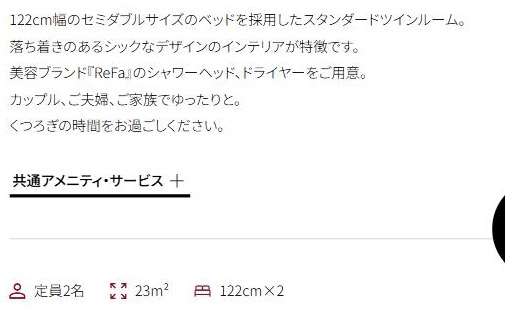
Richmond Hotel Tokyo Shiba, Standard Twin Room (in Japanese).
The Standard Twin Room’s text reads 「122cm幅のセミダブルサイズのベッドを採用したスタンダードツインルーム」, a standard twin room with 122 cm wide semi-double size beds. The icons under it say capacity 2, 23 m² (248 ft²), and 122 cm x 2.
Here the semi-double is each bed in a twin room: two people, two beds, 48 inches each.
Richmond Hotel Tokyo Shiba, Single Room (in Japanese).
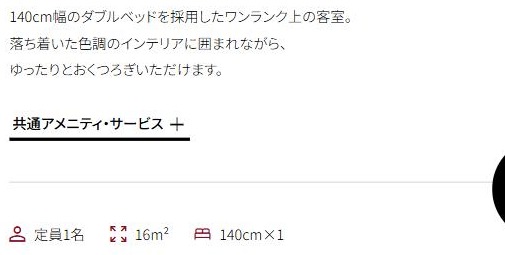
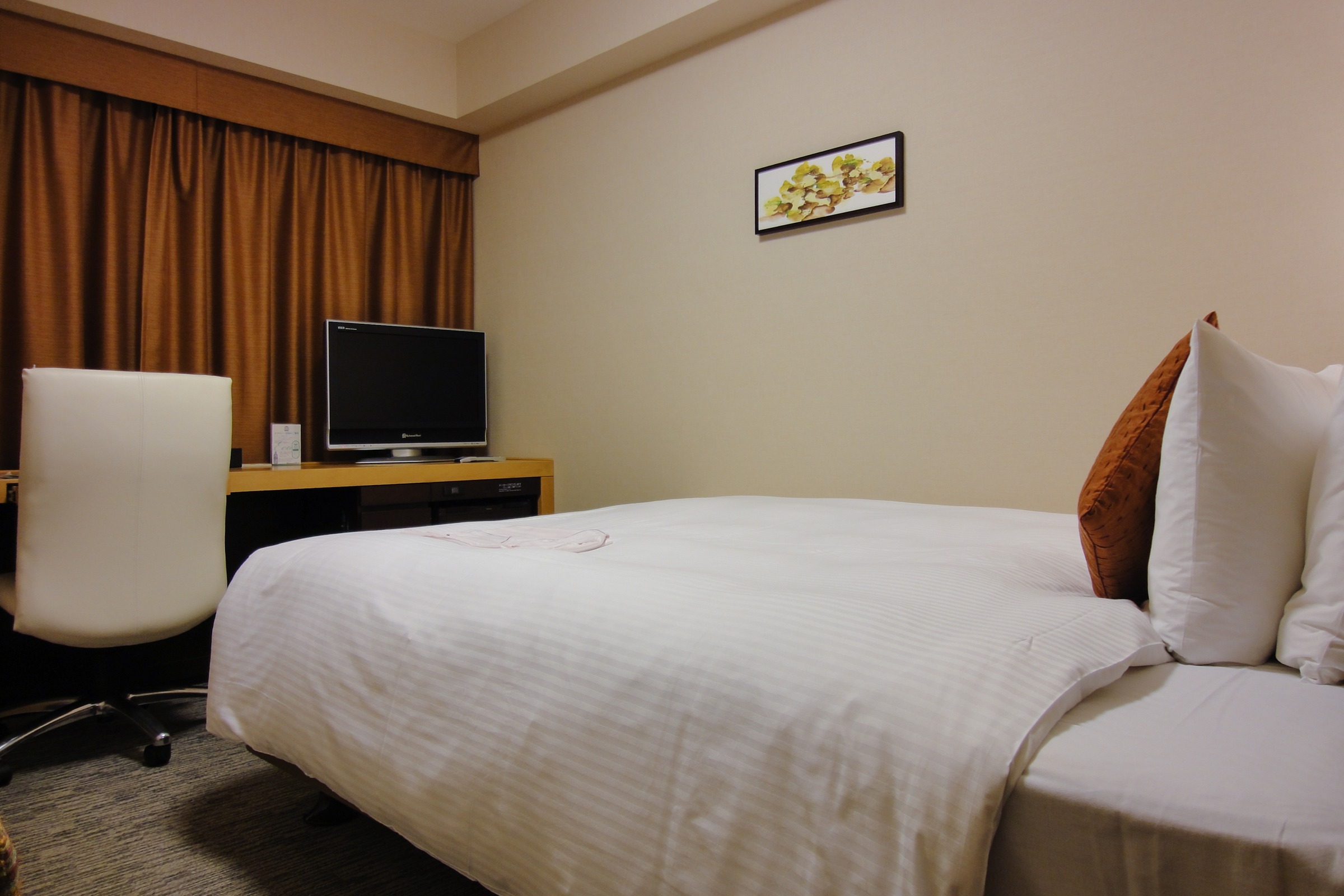
Now the Single Room on the same page: 「140cm幅のダブルベッドを採用したワンランク上の客室」, a room one rank up with a 140 cm wide double bed. Capacity 1, 16 m² (172 ft²), 140 cm x 1.
The hotel calls the 122 cm bed a semi-double and the 140 cm bed a double. The room sold as a “single” holds the wider bed, 55 inches against 48, a difference of about 7 inches (18 cm). So the room name told you nothing here, and the bed word is the only part that sorts the two. Only two of the six room types use the word “semi-double,” both of them twins at 122 cm.
A semi-double is closer to a full than to a twin, but it is a full with 7 inches shaved off. One adult will be comfortable. Two adults share about 23 inches each, against 38 on a US twin.
One person or two
Don’t expect the room page to settle it with the word. Dormy Inn Ikebukuro’s rooms page has no room called semi-double. Its single rooms have a 120 cm bed, the semi-double width, and a capacity of 1. Its double rooms have a 140 cm bed and a capacity of 2. Here, width and guest count line up.
Super Hotel Anjo’s gallery page does not line up. Its Standard Room is listed as 120 cm x 200 cm or 140 cm x 200 cm, 12 m² (129 ft²), capacity 1 to 2 people. The hotel gives two widths for one room name, so you need to know which bed you are getting. 120 cm is the semi-double width.
The rooms article covers other hotels where a 140 cm bed is called a semi-double (Route Inn) and where a 120 cm single bed is the semi-double room (Sotetsu Fresa Inn). In a twin room, a semi-double is the nicer outcome: one 48-inch bed each, wider than the 38-inch twins you know. In a room with one bed, “capacity 2” next to a 47-inch bed is the maximum the hotel will sell, not a promise that two people will sleep well.
After the booking I describe in the rooms article, where a room that came back from a search for two was too tight, I treat a semi-double as a bed for one and let the page change my mind.
Before you book
Four things to read, all on the hotel’s own page:
The centimeters. 120 cm is 47 inches. 122 is 48. 140 is 55. If the hotel says only “semi-double” with no number, you don’t have the size.
The count. “122 cm x 2” is two beds. “140 cm x 1” is one bed. A twin room with semi-double beds is the comfortable case for two.
The guest count next to the bed. One bed under 55 inches with “capacity 2” means the maximum, not the comfort level.
Both long sides in the photos. If one side is against the wall, the person on that side climbs over the other to get out. In a narrow bed that matters more.
The short version
Semi-double is a Japanese bed size, 47 inches (120 cm), sold as a bed for one. Hotels stretch the word: it appears here at 47 to 48 inches, and the rooms article has one at 55.
The room name tells you little. At one Tokyo hotel, a room called “single” had a wider bed than the semi-double twin.
For two people, look for two beds or a published 55 inches or more.
At home, the word on the booking page answers the question. A double or full is the bed for a couple who are fine with snug, and a queen is the normal bed for two. Carry those words to Japan and the width holds, but the meaning of “double” doesn’t.
A Japanese “double” is usually a 140 cm bed. That is 55 inches, one inch over a US full’s 54 inches. A full is 54 by 75 inches. The Japanese pages below give 195 or 200 cm for the length, which is 77 to 79 inches, so the Japanese bed is a couple of inches longer.
The idea that “double” means “for two” doesn’t hold. Nihonbashi Nishikawa, a Japanese bedding company, publishes a size table. It lists the semi-double at 120 cm wide with 推奨使用人数 “1人(ゆったり)”, the double at 140 cm with “1〜2人”, and the queen at 160 cm with “2人”. In that table, the plain “2” sits on 160 cm, which is 63 inches.
As of September 2026, from Nishikawa (in Japanese): size column.
The US side isn’t settled either. Sleep Foundation says “Couples generally need at least a full size mattress.” Amerisleep says a full is “not big enough for two adults but can accommodate one adult and a child,” and says a queen gives each sleeper 30 by 80 inches. They agree on the size and disagree on whether it is enough for two.
2. Inches per person
Each figure is the bed’s width halved, ignoring the gap between sleepers, blankets and how anyone lies.
Bed
Width
Each of two adults
Japanese semi-double (Nishikawa: 1 person)
47 in (120 cm)
24 in (60 cm)
US full
54 in (137 cm)
27 in (69 cm)
Japanese double
55 in (140 cm)
27.5 in (70 cm)
US queen
60 in (152 cm)
30 in (76 cm)
Japanese queen
63 in (160 cm)
31.5 in (80 cm)
The Japanese double gives each person half an inch more than a US full, and 2.5 inches less than a US queen. The Japanese queen is the first row that gives each of you more than a US queen does. The semi-double, at 24 inches each, is where Nishikawa’s “1人” label starts to make sense. The word isn’t stable from hotel to hotel: the room-names article shows it running from 47 to 55 inches.
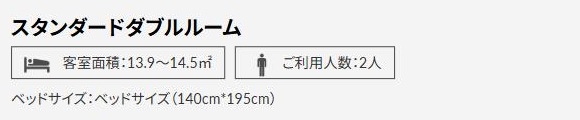
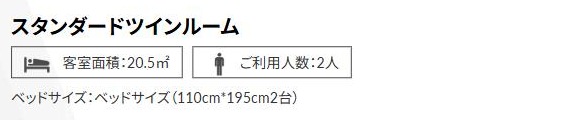
Floor area (客室面積), guest count (ご利用人数) and bed size (ベッドサイズ) sit in three separate boxes. The guest count reads “2人” and the bed reads “140cm*195cm”. Nothing in the line says whether 140 cm is comfortable for the two guests. The floor area is a range, 13.9 to 14.5 m², which is 150 to 156 ft².
The same hotel lists the chain’s single rooms too. The Economy Single and the Standard Single are each “120cm*195cm”. So on this page the step from one guest to two is 20 cm, or 8 inches, the same gap Nishikawa’s table puts between a semi-double and a double.
Super Hotel’s Anjo property words it differently. Its Double Room entry reads ベッドサイズ “140cm ×200cm”, 部屋の広さ “12㎡” (129 ft²) and 収容人数 “1~2名”. Where Dormy Inn lists 2, Super Hotel lists 1 to 2.
As of September 2026, from Super Hotel (in Japanese): Anjo gallery page.
4. One bed sold for one, and for two
Richmond Hotel’s Tokyo Shiba property lists a Single Room and a Double Room on one page. The Single is 16 m² (172 ft²) with a “140cm幅のダブルベッド”, capacity 1. The Double is 16 m² with the same “140cm幅のダブルベッド”, capacity 2.
That is one bed in one room size, sold under two names, with one more person in the count. On that page, “single” doesn’t mean a narrow bed and “double” doesn’t mean a wider one.
If you want a wider bed at that property, the Deluxe Double is listed at 25 m² (269 ft²) with a “180cm幅のキングサイズベッド”. That is 71 inches wide, or about 35.5 inches each. It is also 9 m² (97 ft²) more floor than the 140 cm rooms, so the upgrade is a larger room as well as a larger bed.
In the room-names article, 55 inches turned up at eleven of twelve properties under three different names.
5. The wall side
Width is only one of the ways a 140 cm bed can feel tight. In a small room, one long side of the bed may sit against the wall, and then one of you has a wall on one side and a person on the other. At home you can probably get out of either side. When the bed is against the wall and there are two of us, I climb over the other person.
On a 140 cm bed, you’d each have about 27.5 inches, and the wall-side person’s way out runs across the other’s half.
The check is in the room photos. Look at both long sides of the bed and see whether there’s floor on each. The room-names article has a diagram for it.
6. Choosing
I only open the dimension line when two of us are going, and then I read it alongside the room photos, the floor area and the reviews.
The bad booking in the room-names article, a cheap room that came back from a search for two, was a single-size bed.
Here is how I would sort it:
If a full would be fine for the two of you at home, 140 cm is close to the same bed.
If you would have booked a queen, look for 160 cm (63 inches) or wider. Nishikawa lists “2人” there, and at Richmond Tokyo Shiba the wider bed came with a larger room.
If the hotel lists a room called “single,” open its dimension line before you skip it. At Richmond Tokyo Shiba, it was a 140 cm bed.
If the hotel gives a guest count and no width, you don’t have the number. Ask, or pick a room that publishes one.
7. The short version
A Japanese double is 140 cm, which is 55 inches. That is one inch over a US full, and about 27.5 inches for each of two adults, against 27 on a full and 30 on a queen.
Hotels list guest count and bed width separately. Dormy Inn lists its 140 cm room for “2人” and Super Hotel Anjo lists its for “1~2名”. Nishikawa puts “2人” on the 160 cm queen.
The same 140 cm bed can be a single or a double. Richmond Tokyo Shiba lists it as both, at 16 m², with the capacity the only difference.
Two checks cost nothing. Read the width on the room’s own page, and look at the photos for floor on both long sides of the bed.
Cover photo: lic-10-single-bed-large by J o, CC BY-SA 3.0, via Wikimedia Commons. It shows a different property from the ones discussed here.
At home, “twin” is a size. It names one mattress, 38 by 75 inches (97 by 191 cm), the one you slept on in a dorm.
In Japan the word turns into a room type. A twin room (ツイン) is a room with two single beds, and the beds are whatever size that hotel installed. The word survives the trip and the measurement doesn’t.
If you came here worried that a twin room means two narrow cots, it usually doesn’t. The bigger risk runs the other way: you read “twin,” picture 38 inches, and plan a room around the wrong number.
As of September 2026, from the chains’ room pages linked in the table (in Japanese).
Of the six rooms, one has a 35-inch bed, the closest to the US twin’s 38. The other five are 43 to 48 inches (110 to 122 cm) per bed. Two beds in one room give 86 to 96 inches (220 to 244 cm) of sleeping surface, plus the gap between them.
Two things follow. A Japanese twin bed can sit ten inches wider than a US twin, which puts it within six inches of a US full’s 54. And a chain’s “Twin” and “Economy Twin” can differ by 12 inches a bed in one building, as Super Hotel shows. At Dormy Inn Ikebukuro, one grade up added ten centimeters, and the bigger bed came in the smaller room.
These are six rooms, not every hotel in Japan.
3. One page, in Japanese
Here is the Dormy Inn Ikebukuro page for its Standard Twin.
Dormy Inn Ikebukuro, Standard Twin Room (in Japanese).
The label reads スタンダードツインルーム (Standard Twin Room), 客室面積 20.5㎡ (floor area), ご利用人数 2人 (two guests), and ベッドサイズ 110cm*195cm2台 (bed size, two beds). The number that settles it is the last one, 110 x 195 cm, times two, in a room for two. That is 43 inches wide for each bed.
So this twin is two beds that are each five inches wider than a US twin.
4. Double or twin for two
Choose by how you sleep, not by the price.
Double: one bed, both of you in it. On the chain pages, double beds run from about 55 to 71 inches (140 to 180 cm), covered with the other sizes in the decoder article. Check the width. A 55-inch bed is one inch over a US full.
Twin: two beds, each of you in your own. Each bed is likely wider than a US twin, as above, and you get a gap or a shared night stand between them.
If you are a couple who shares a bed at home, a twin is a downgrade in closeness and an upgrade in space. If you snore, travel with a colleague, or sleep badly next to anyone, a twin is the room built for it. Compare the price of both on your dates.
I only open the bed-width line when two of us are going. For one person it doesn’t matter. For two it does, most of all on a double.
There is no general yes or no for Japan on whether the two beds can be pushed together.
What you can do is ask the property, in writing, before you book, and ask in a way that is hard to misread: “Can the two beds in the twin room be joined?” Don’t assume a hotel that sells a “Hollywood twin” does it by default. The one chain page that lists that term gives only a width, 35 inches (90 cm) a bed (see the decoder article).
Even if the beds move, joined beds are two mattresses with a seam, not one 96-inch bed.
6. What to read on the booking page
The number and unit of beds. “Twin” should come with a count of two, and a width for each. Look for something like 122cm×2.
The width in centimeters. If the hotel gives a size name and no centimeters, you do not have the number. Convert: 90 cm is 35 inches, 110 is 43, 120 is 47, 122 is 48.
Capacity and floor area. The Dormy Inn room above is 20.5 m² (221 ft²) for two, and the other Dormy Inn rooms are 202 to 217 ft². Two 120 cm beds in a room under 220 ft² leave little floor.
The third-party site’s wording. An English booking site can translate a room into its own word. Japanese Hotel Rooms Decoded has one listing where the room name said “double” and the line below it said “twin.” Open the hotel’s own page and compare.
The short version
In Japan, twin is a room with two beds. At home it is a mattress size.
Across the six twin rooms in the table, each bed was 35 to 48 inches (90 to 122 cm) wide, against the US twin’s 38.
For two people, a double is one bed and a twin is two. Read the width either way.
Ask the property before you count on joining the beds.
Cover photo: lic-4-twin-beds by Aspiringshortlot, CC BY-SA 4.0, via Wikimedia Commons. It shows a different property from the ones discussed here.
When a hotel says 300 square feet, you picture a bed, a dresser, a chair and some open carpet. Japanese booking pages give square meters instead, and the cheapest single rooms are listed at 12. That is 129 ft², about 10 by 13 feet. The room is built around a bed, a desk and a unit bath (a prefabricated toilet, sink and tub in one pod), and the floor is whatever remains.
What 129 ft² looks like
Start with what you can picture, a small spare bedroom. Hotel-industry figures for the US are loose. The software company Mews says on its blog that “economy rooms run 160 to 230 ft², midscale rooms 230 to 350 ft²”.
Wikipedia’s Tru by Hilton page reports Hilton’s stated design goal of 228 ft² (21.2 m²) per room. American sources define “room size” differently from one another, so treat these as a rough frame. A 129 ft² Japanese room sits below both.
Super Hotel Anjo Station Front lists its Standard room at 12 m² with a bed of “120cm ×200cm, or 140cm ×200cm”. Dormy Inn Ikebukuro lists an Economy Single at 12.0 m² with a 120 x 195 cm bed. Dormy Inn Hiroshima lists an Economy Single at 12.25 m² (132 ft²), same bed.
If the unit bath is counted in the size, the floor outside it is smaller than 12 m² suggests. The pages do not say, so ask the hotel.
Reading the floor
Super Hotel’s 12 m² Standard room. Quoted from the official page (link), September 30, 2026. Copyright belongs to the owner.
Look at the carpet. The bed runs along the window wall and the desk unit takes the near side, so the floor that is left is a narrow strip between them. The walk from the door and anywhere you would set a bag all share that strip. Whatever the listed size, the floor in a room like this is a lane, not a patch.
Where it eases
The share of the room that is bed follows from the printed bed sizes.
Room
Size
Beds
Bed area
Share of room
Super Hotel Anjo Double
12 m² / 129 ft²
140 x 200 cm
2.8 m²
23%
Dormy Ikebukuro Economy Single
12.0 m² / 129 ft²
120 x 195 cm
2.34 m²
20%
Dormy Hiroshima Economy Single
12.25 m² / 132 ft²
120 x 195 cm
2.34 m²
19%
Dormy Hiroshima Compact Single
14.25 m² / 153 ft²
120 x 195 cm
2.34 m²
16%
Dormy Hiroshima Twin
18.8 m² / 202 ft²
two 110 x 195 cm
4.29 m²
23%
Dormy Ikebukuro Standard Twin
20.5 m² / 221 ft²
two 110 x 195 cm
4.29 m²
21%
Super Hotel Anjo Economy Twin
12 m² / 129 ft²
two 90 x 200 cm
3.6 m²
30%
Super Hotel Anjo Twin
15 m² / 161 ft²
two 120 x 200 cm
4.8 m²
32%
As of September 2026, from the hotels’ pages above. Share of room is bed area divided by listed size.
At Dormy Inn Hiroshima, the step from the 12.25 m² single to the 14.25 m² single adds 2 m² (22 ft²) of everything that isn’t bed. Spread along a 10-foot wall, that is a strip about 2 feet wide.
Twins behave differently. Dormy Ikebukuro’s Standard Twin has 20.5 m² and 4.29 m² of beds, which leaves 8.1 m² of non-bed area per person. The same chain’s 12.0 m² Economy Single leaves 9.7 m² for one guest. So a twin at 20 m² is about as bed-heavy per person as a single at 12 m².
My rough benchmark for opening a large suitcase comfortably is about 25 m² (269 ft²), and 12 m² is under half of that. How much luggage fits in a Japanese hotel room covers the floor space a bag needs. My rough guess from one business hotel is that a room around 20 m² (215 ft²) is six or seven steps from door to bed. These are impressions, not measurements.
Before you book
Read the bed row before the room name, because the bed is the number most hotels list. Then subtract the bed area from the listed size and treat the remainder as an upper limit, since the bath may sit inside it. And look for a photo taken from the door to see how long the lane is.
The short version
In the table above the bed takes between 16 and 32 percent of the room. The extra 2 m² of a 14 m² single is worth roughly a 2-foot strip of floor. For a twin, read 20 m² as a room about as tight per person as a 12 m² single.
1. The cheap room that came back from a search for two
Booking for two of us, I once ran the search and took a price that looked too good to walk past. A single, or a semi-double. I don’t remember which. The name didn’t carry enough information to be worth remembering. The bed was too tight for the two of us.
Twenty years in Japan, and I still got that booking wrong. If a search for two returns a room called a single, look twice.
A business hotel room with one bed.
A room that comes back from a search for two is not, on that evidence alone, a room built for two. One APA property sells its standard room at 118 ft² (11 m²) with a 55-inch (140 cm) bed for one guest, and the same 118 ft² with the same 55-inch bed for two. The guest count moves and the room doesn’t.
If your fix at home for a too-small room is the sofa bed, plan without it. Of twelve properties at five chains, exactly one listed a sofa bed, and it was in a room sold for three people.
2. One word, two bed widths in one building
The same word, twice, in one building
APA’s Keikyu Kamata property in Tokyo lists eight room types on one page. Here are four of them.
The word “single” does two jobs in one building. It means 43 inches and it means 55 inches, twelve inches apart, on one rate page. The deluxe single publishes the same width as the double, so book it thinking “single, so narrow,” and you get the double’s number.
The same width, different chains
Route Inn’s Ishinomaki property calls 55 inches (140 cm) a semi-double, and its double is 63 inches (160 cm). APA’s Keikyu Kamata property calls 55 inches a double. Across the twelve properties, rooms sold as a single ran 39 to 63 inches (100 to 160 cm). The bottom of that range is a US twin. The top is three inches over a US queen, in a room the chain calls a single.
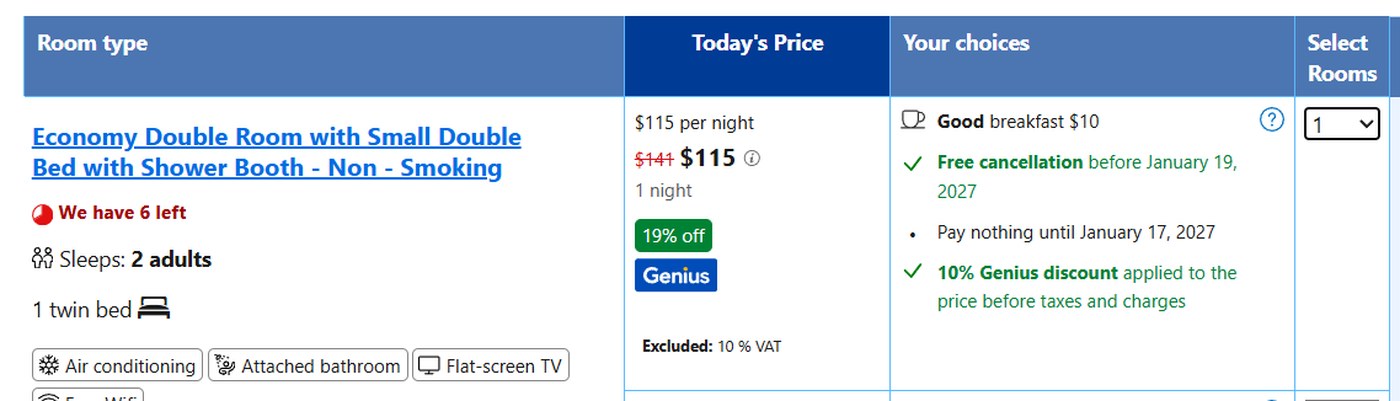
The English Booking.com listing for Sotetsu Fresa Inn Tokyo-Kyobashi named one room Economy Double Room with Small Double Bed. The line directly under that name said 1 twin bed.
Room name and bed line on one listing.
A double is around 54 inches at home and a twin is 38, so the listing offers both readings at once. The hotel’s own Japanese site calls the room a semi-double with a single bed 120 cm wide. That is 47 inches, and both English labels miss it, in opposite directions, by about the same amount.
So the semi-double is 47 inches here and 55 inches at the Route Inn property above. Same word, eight inches apart, and the booking site’s translation adds a third reading.
The same room, sold twice, under two names
On several of these pages, a single and a room for two are separate listings for the same room.
Richmond, Fukuyama
Moderate single
Sold to one person
Moderate double
Sold to two people
Both listings
195 ft² (18.1 m²)
60 in (152 cm) bed
The same room under two names.
At Richmond’s Fukuyama property, the high-grade single and the high-grade double are both 198 ft² (18.4 m²) with a 63-inch (160 cm) bed. At Richmond’s Hakata property, the single and the standard double are both 194 ft² (18 m²) with a 55-inch (140 cm) bed. At Route Inn’s Yokohama property, the single and the semi-double are both 129 ft² (12 m²) with a 55-inch bed. That is how a 63-inch bed ends up inside the single range.
As of August 2026, from the room pages (in Japanese): Richmond Fukuyama and Hakata, Route Inn Yokohama.
The room name and the bed name, one step apart
Toyoko Inn says that single rooms get a double-size bed and double rooms get a queen-size bed. The room name sits one rung below the bed name, and the chain publishes that as a feature. The chain gives no centimeters, so carry none of this article’s numbers over to Toyoko.
As of August 2026, from Toyoko Inn’s room page (in Japanese).
3. What the words mean in Japanese
Words that are slippery in Japanese too
Three kinds of word give me trouble even in Japanese.
Grade names (deluxe, superior, moderate, standard, economy). These belong to a chain, and they move between properties of the same chain. In Richmond’s pages, a “deluxe double” was 67 inches (170 cm) at the Hakata property and 71 inches (180 cm) at Fukuyama and Tokyo Shiba.
Hollywood twin. One Dormy Inn property lists it as two 35-inch (90 cm) beds. Read the bed line and look at the photo.
Wide-something, comfort-something. House coinages. Where the chains put a width on them, it’s the plain room’s width: Route Inn lists a single and a comfort single as separate types, both at 55 inches (140 cm).
Semi-double. It’s ordinary vocabulary to me, and it isn’t a word you’ll have met on a US booking page. You’d read it as “a bit smaller than a double, so snug for two but fine.” On the pages it ran 47 to 55 inches (120 to 140 cm), against a US full’s 54.
How many people is one for? It depends. Two Japanese builds probably manage it and two American builds probably don’t, but that is an inference from the widths, not a measurement.
Twin. The word survives the trip and the measurement changes underneath it. Beds in rooms called twin ran 35 to 48 inches (90 to 123 cm) each, against a US twin’s 38, so they’re often wider than the twins you’re picturing.
Queen. At all four Dormy Inn properties in the sample, the rooms called queen carried a 63-inch (160 cm) bed, three inches over a US queen’s 60.
4. The widths, next to the sizes you know
Two single beds pushed together.
The table covers twelve properties (four Dormy Inn, three Richmond, two Route Inn, two APA and one Super Hotel), ten of them in big cities. It is a snapshot of August 2026, not the whole country. Rooms sold for families get their own lines, and a room whose page gives a name and no width, as at Toyoko Inn, isn’t in the table.
The word on the page
What the pages published
The US size you’re comparing it to
Single (シングル)
39 to 63 in (100 to 160 cm)
Twin 38, full 54, queen 60
Semi-double (セミダブル)
47 to 55 in (120 to 140 cm)
Full, 54 in
Double (ダブル)
55 to 71 in (140 to 180 cm)
Full 54, queen 60, king 76
Twin (ツイン), per bed
35 to 48 in (90 to 123 cm) each
Twin, 38 in
Family twin (ファミリーツイン)
47 in and 55 in (120 and 140 cm) in one room, one property
Two different sizes side by side
Queen (クイーン)
63 in (160 cm), four properties at one chain
Queen, 60 in
Family double (ファミリーダブル)
Two 45-in (115 cm) beds pushed together, 91 in (230 cm) across, at one property
One width, 55 inches (140 cm), sits in all three of those ranges at once. Because the ranges overlap, the words can’t tell you whether two adults fit. The widest bed outside the family rooms was 71 inches (180 cm), five inches under a US king’s 76.
5. What 55 inches means with two of you in it
Fifty-five inches (140 cm) is the number you’ll meet most often once you start opening these pages. Eleven of the twelve properties had one somewhere in their lineup.
Whether it works for two adults depends on who you’re sharing with and your build. The firmer part is the numbers: an inch over a US full, five inches under a US queen, in a room that may be 118 ft² (11 m²).
In a narrow room, one long side of the bed can be against the wall. When it is, and there are two of you, the inside spot has a wall on one side and a person on the other. I climb over the other person.
Bed against the wall
Floor on both long sides
Check for floor on both long sides of the bed.
How many people a room will legally and practically sleep, including what happens when you put a third person or a child into the search box, is covered in Booking for Three, or With Kids.
6. Booking one grade up sometimes grows the bed and sometimes doesn’t
The obvious move, once you know the names don’t carry widths, is to book one grade up and assume the bed grows. Sometimes it does. At APA Keikyu Kamata, walking up the grades walked the bed up too, from 43 inches at the plain single to 63 at the deluxe double (110 to 160 cm). Those are the four rows in section 2. At Super Hotel’s Shimbashi property, three room grades all had the same 129 ft² (12 m²) and the same 55-inch (140 cm) bed. What a higher grade buys at the same hotel varies by hotel.
Floor area doesn’t predict the width either. At Dormy Inn’s Korakuen property, the single is 210 ft² (19.5 m²) with a 39-inch (100 cm) bed. The double at the same hotel is 155 to 192 ft² (14.4 to 17.8 m²) with a 55-inch (140 cm) bed. The larger room has the narrower bed.
As of August 2026, from the room pages (in Japanese): Super Hotel Shimbashi and Dormy Inn Korakuen.
Before you pay for the grade above, open both room types and put the two dimension lines side by side. If the width is identical, you’re buying floor space or a view, which may well be what you want. If the width jumps eight inches, or twelve, now you know what the money is for.
7. Bed length and firmness
Length. Most published lengths were 195 or 196 cm, which is 77 inches. A handful ran to 200 cm and two room types to 205 cm (79 and 81 inches). A US queen or king is usually 80 inches (203 cm), so most rooms are about three inches shorter. If anyone in your party is tall, read the length line on the specific room.
A slot by the door that powers the lights only while your key card is in it usually ties the room’s power to the card, so a phone left plugged in may not charge while you’re at dinner. Pull the card on your way out and see what stays lit.
Firmness. Japanese hotel mattresses feel firmer than what you’re used to at home. That’s my impression, not a measurement. If a soft mattress is a medical matter for you, it’s worth an email to the property.
At a traditional inn, the bedding goes on the floor, on tatami. The Japanese word for that bedding is futon, and in the US the same word names a sofa frame that folds down flat. Different object, and firmer again. What else is in the room is in the pillar article.
8. What I do before I book
A compact business hotel room.
I only check the width when two of us are going. Booking for myself, I don’t open the dimension line at all. With two of you in one bed, it’s the whole game.
I look at four things: the room photos, the floor area, the bed dimension line and the reviews. The floor area won’t predict the width, as the Dormy Inn example in section 6 shows, and the photos are where you run the check in section 5. At the same price, I take the floor space over the wider bed. Yours may run the other way, particularly if width is what went wrong on a previous trip.
On the chain sites, the width sits in plain text on the property’s own pages, in no fixed format. Some pages give millimeters and some centimeters, some width by length and some the width alone. If a page gives a size name and no centimeters, you don’t have the number.
For a night when two of you share one bed, in order:
Open the property’s own room page, not just the booking site summary.
Find the bed width in centimeters. If it isn’t published, ask the property or pick a room that publishes it.
Convert it. 140 cm is 55 inches, an inch over a US full. 152 cm is 60 inches, a queen. 160 cm is 63 inches, three over a queen. 180 cm is 71 inches, five under a king.
Read the length too if anyone is tall.
Look at the room photos for floor on both long sides of the bed.
If you’re considering the grade above, open both pages and compare the two dimension lines before you pay the difference.
The short version
If you read nothing else on this page.
1
The room name does not carry a bed width. If the centimeters aren’t on the property’s own page, you don’t have the number.
2
One word can mean two widths inside one building. At one Tokyo property, “single” meant 43 inches and 55 inches on the same rate page.
3
One grade up doesn’t reliably buy a wider bed. Neither does a bigger room. Open both room pages and compare the two dimension lines before you pay the difference.
4
Fifty-five inches (140 cm) is the number you’ll meet most, and it matters most when two of you share one bed. If a search for two returns a single, look twice, check the photos for floor on both long sides, and plan without a sofa bed.
The numbers are printed on the property’s own Japanese-language page.