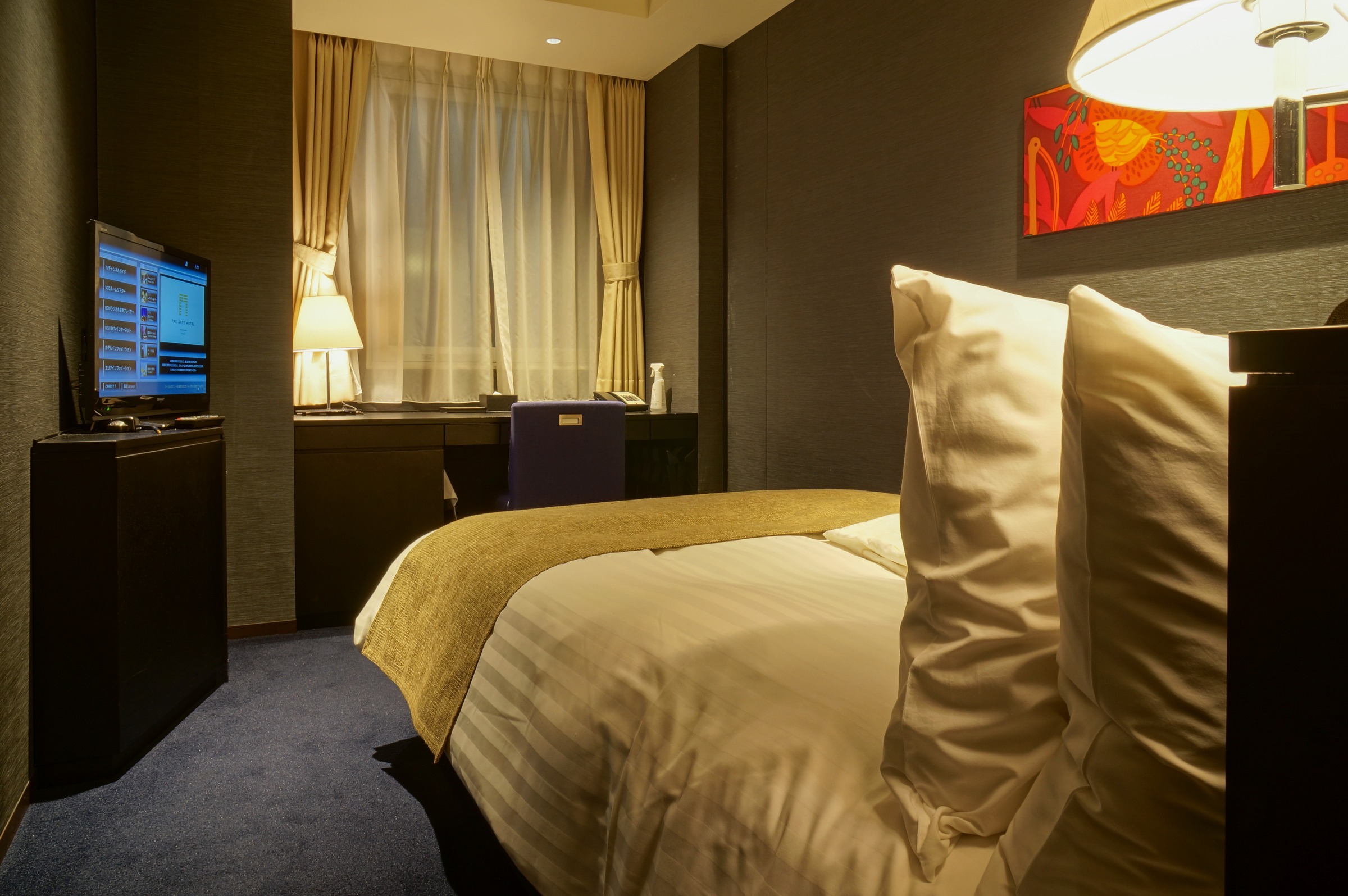
The double you have in your head
At home, “double” means a bed for two. A full is a double. So a semi-double sounds like a small double, a bit snug, fine for a couple who like each other.
In Japan the word works the other way around. It is a step above the single bed, and it is sold first as a bed for one person who wants room to move. The “double” part describes how much wider it is than a single. It does not describe who sleeps in it.
This article covers one word. For how a whole room name (single, twin, double, deluxe) fails to carry a bed width, see the rooms article.
What the word names
Start with how Japanese bedding companies use it. Nihonbashi Nishikawa, a long-established Japanese bedding company, publishes a size table. Its table runs single 97 to 100 cm, semi-double 120 cm, double 140 cm and queen 160 cm, all 195 to 200 cm long. The same article labels the semi-double a bed for one person with room to spare, and the double a bed for one or two. The 120 cm figure is 47 inches.
That is one retailer’s table, so read it as the usual retail picture and not a rule.
As of September 2026, from Nihonbashi Nishikawa (in Japanese): size table article. For the national bed standard, see kikakurui.com (in Japanese): JIS S 1102:2017 page.
A person living in Japan, asked whether a semi-double is for one person or two, said it depends: someone with a Japanese build can probably manage two, and someone with an American build basically can’t. That is one person’s reading, not a measurement, but it points the same way as the retailer’s table: a semi-double is a one-person bed.
One hotel, two photographs
The 120 cm bed is the textbook figure. Hotel pages are looser. Richmond Hotel Tokyo Shiba lists six room types on its rooms page.
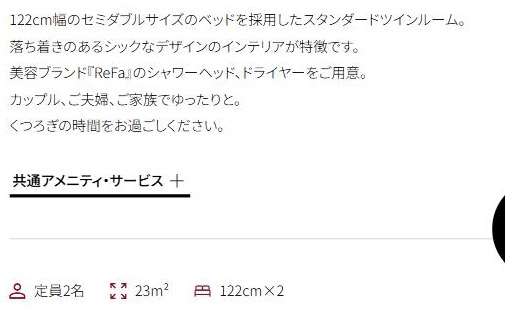
The Standard Twin Room’s text reads 「122cm幅のセミダブルサイズのベッドを採用したスタンダードツインルーム」, a standard twin room with 122 cm wide semi-double size beds. The icons under it say capacity 2, 23 m² (248 ft²), and 122 cm x 2.
Here the semi-double is each bed in a twin room: two people, two beds, 48 inches each.
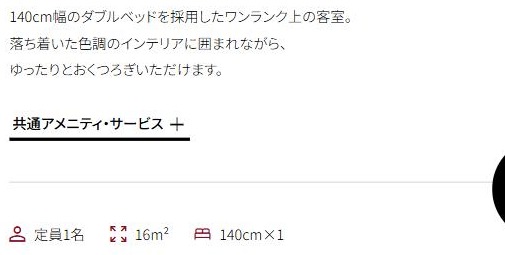
Now the Single Room on the same page: 「140cm幅のダブルベッドを採用したワンランク上の客室」, a room one rank up with a 140 cm wide double bed. Capacity 1, 16 m² (172 ft²), 140 cm x 1.
The hotel calls the 122 cm bed a semi-double and the 140 cm bed a double. The room sold as a “single” holds the wider bed, 55 inches against 48, a difference of about 7 inches (18 cm). So the room name told you nothing here, and the bed word is the only part that sorts the two. Only two of the six room types use the word “semi-double,” both of them twins at 122 cm.
As of September 2026, from Richmond Hotels (in Japanese): Tokyo Shiba rooms page.
Next to US sizes
US sizes: twin 38 by 74 inches, full 54 by 75, queen 60 by 80. Some sellers list the twin at 75 inches long.
As of September 2026, from Amerisleep: mattress size guide.
| Bed | Width | Compared with |
|---|---|---|
| US twin | 38 in (97 cm) | |
| Semi-double, retail table | 47 in (120 cm) | 9 in wider than a twin, 7 in under a full |
| Semi-double, Richmond Shiba | 48 in (122 cm) | 10 in over a twin, 6 under a full |
| US full | 54 in (137 cm) | |
| Double, Japanese tables | 55 in (140 cm) | 1 in over a full |
| US queen | 60 in (152 cm) |
A semi-double is closer to a full than to a twin, but it is a full with 7 inches shaved off. One adult will be comfortable. Two adults share about 23 inches each, against 38 on a US twin.
One person or two
Don’t expect the room page to settle it with the word. Dormy Inn Ikebukuro’s rooms page has no room called semi-double. Its single rooms have a 120 cm bed, the semi-double width, and a capacity of 1. Its double rooms have a 140 cm bed and a capacity of 2. Here, width and guest count line up.
Super Hotel Anjo’s gallery page does not line up. Its Standard Room is listed as 120 cm x 200 cm or 140 cm x 200 cm, 12 m² (129 ft²), capacity 1 to 2 people. The hotel gives two widths for one room name, so you need to know which bed you are getting. 120 cm is the semi-double width.
As of September 2026, from Dormy Inn (in Japanese): Ikebukuro rooms page. From Super Hotel (in Japanese): Anjo gallery page.
The rooms article covers other hotels where a 140 cm bed is called a semi-double (Route Inn) and where a 120 cm single bed is the semi-double room (Sotetsu Fresa Inn). In a twin room, a semi-double is the nicer outcome: one 48-inch bed each, wider than the 38-inch twins you know. In a room with one bed, “capacity 2” next to a 47-inch bed is the maximum the hotel will sell, not a promise that two people will sleep well.
After the booking I describe in the rooms article, where a room that came back from a search for two was too tight, I treat a semi-double as a bed for one and let the page change my mind.
Before you book
Four things to read, all on the hotel’s own page:
- The centimeters. 120 cm is 47 inches. 122 is 48. 140 is 55. If the hotel says only “semi-double” with no number, you don’t have the size.
- The count. “122 cm x 2” is two beds. “140 cm x 1” is one bed. A twin room with semi-double beds is the comfortable case for two.
- The guest count next to the bed. One bed under 55 inches with “capacity 2” means the maximum, not the comfort level.
- Both long sides in the photos. If one side is against the wall, the person on that side climbs over the other to get out. In a narrow bed that matters more.
The short version
- Semi-double is a Japanese bed size, 47 inches (120 cm), sold as a bed for one. Hotels stretch the word: it appears here at 47 to 48 inches, and the rooms article has one at 55.
- The room name tells you little. At one Tokyo hotel, a room called “single” had a wider bed than the semi-double twin.
- For two people, look for two beds or a published 55 inches or more.
Cover photo: lic-3-semi-double-compact by J o, CC BY-SA 4.0, via Wikimedia Commons. It shows a different property from the ones discussed here.
