Contents
- A Japanese double is close to a US full
- Inches per person
- What the page means by two
- One bed sold for one, and for two
- The wall side
- Choosing
- The short version
1. A Japanese double is close to a US full
At home, the word on the booking page answers the question. A double or full is the bed for a couple who are fine with snug, and a queen is the normal bed for two. Carry those words to Japan and the width holds, but the meaning of “double” doesn’t.
A Japanese “double” is usually a 140 cm bed. That is 55 inches, one inch over a US full’s 54 inches. A full is 54 by 75 inches. The Japanese pages below give 195 or 200 cm for the length, which is 77 to 79 inches, so the Japanese bed is a couple of inches longer.
As of September 2026, from Sleep Foundation and Amerisleep.
The idea that “double” means “for two” doesn’t hold. Nihonbashi Nishikawa, a Japanese bedding company, publishes a size table. It lists the semi-double at 120 cm wide with 推奨使用人数 “1人(ゆったり)”, the double at 140 cm with “1〜2人”, and the queen at 160 cm with “2人”. In that table, the plain “2” sits on 160 cm, which is 63 inches.
As of September 2026, from Nishikawa (in Japanese): size column.
The US side isn’t settled either. Sleep Foundation says “Couples generally need at least a full size mattress.” Amerisleep says a full is “not big enough for two adults but can accommodate one adult and a child,” and says a queen gives each sleeper 30 by 80 inches. They agree on the size and disagree on whether it is enough for two.
2. Inches per person
Each figure is the bed’s width halved, ignoring the gap between sleepers, blankets and how anyone lies.
| Bed | Width | Each of two adults |
|---|---|---|
| Japanese semi-double (Nishikawa: 1 person) | 47 in (120 cm) | 24 in (60 cm) |
| US full | 54 in (137 cm) | 27 in (69 cm) |
| Japanese double | 55 in (140 cm) | 27.5 in (70 cm) |
| US queen | 60 in (152 cm) | 30 in (76 cm) |
| Japanese queen | 63 in (160 cm) | 31.5 in (80 cm) |
The Japanese double gives each person half an inch more than a US full, and 2.5 inches less than a US queen. The Japanese queen is the first row that gives each of you more than a US queen does. The semi-double, at 24 inches each, is where Nishikawa’s “1人” label starts to make sense. The word isn’t stable from hotel to hotel: the room-names article shows it running from 47 to 55 inches.
3. What the page means by two
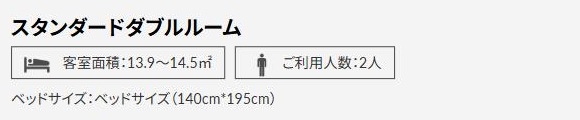
Floor area (客室面積), guest count (ご利用人数) and bed size (ベッドサイズ) sit in three separate boxes. The guest count reads “2人” and the bed reads “140cm*195cm”. Nothing in the line says whether 140 cm is comfortable for the two guests. The floor area is a range, 13.9 to 14.5 m², which is 150 to 156 ft².
The same hotel lists the chain’s single rooms too. The Economy Single and the Standard Single are each “120cm*195cm”. So on this page the step from one guest to two is 20 cm, or 8 inches, the same gap Nishikawa’s table puts between a semi-double and a double.
Super Hotel’s Anjo property words it differently. Its Double Room entry reads ベッドサイズ “140cm ×200cm”, 部屋の広さ “12㎡” (129 ft²) and 収容人数 “1~2名”. Where Dormy Inn lists 2, Super Hotel lists 1 to 2.
As of September 2026, from Super Hotel (in Japanese): Anjo gallery page.
4. One bed sold for one, and for two
Richmond Hotel’s Tokyo Shiba property lists a Single Room and a Double Room on one page. The Single is 16 m² (172 ft²) with a “140cm幅のダブルベッド”, capacity 1. The Double is 16 m² with the same “140cm幅のダブルベッド”, capacity 2.
That is one bed in one room size, sold under two names, with one more person in the count. On that page, “single” doesn’t mean a narrow bed and “double” doesn’t mean a wider one.
If you want a wider bed at that property, the Deluxe Double is listed at 25 m² (269 ft²) with a “180cm幅のキングサイズベッド”. That is 71 inches wide, or about 35.5 inches each. It is also 9 m² (97 ft²) more floor than the 140 cm rooms, so the upgrade is a larger room as well as a larger bed.
As of September 2026, from Richmond Hotel (in Japanese): Tokyo Shiba rooms page.
In the room-names article, 55 inches turned up at eleven of twelve properties under three different names.
5. The wall side
Width is only one of the ways a 140 cm bed can feel tight. In a small room, one long side of the bed may sit against the wall, and then one of you has a wall on one side and a person on the other. At home you can probably get out of either side. When the bed is against the wall and there are two of us, I climb over the other person.
On a 140 cm bed, you’d each have about 27.5 inches, and the wall-side person’s way out runs across the other’s half.
The check is in the room photos. Look at both long sides of the bed and see whether there’s floor on each. The room-names article has a diagram for it.
6. Choosing
I only open the dimension line when two of us are going, and then I read it alongside the room photos, the floor area and the reviews.
The bad booking in the room-names article, a cheap room that came back from a search for two, was a single-size bed.
Here is how I would sort it:
- If a full would be fine for the two of you at home, 140 cm is close to the same bed.
- If you would have booked a queen, look for 160 cm (63 inches) or wider. Nishikawa lists “2人” there, and at Richmond Tokyo Shiba the wider bed came with a larger room.
- If the hotel lists a room called “single,” open its dimension line before you skip it. At Richmond Tokyo Shiba, it was a 140 cm bed.
- If the hotel gives a guest count and no width, you don’t have the number. Ask, or pick a room that publishes one.
7. The short version
- A Japanese double is 140 cm, which is 55 inches. That is one inch over a US full, and about 27.5 inches for each of two adults, against 27 on a full and 30 on a queen.
- Hotels list guest count and bed width separately. Dormy Inn lists its 140 cm room for “2人” and Super Hotel Anjo lists its for “1~2名”. Nishikawa puts “2人” on the 160 cm queen.
- The same 140 cm bed can be a single or a double. Richmond Tokyo Shiba lists it as both, at 16 m², with the capacity the only difference.
- Two checks cost nothing. Read the width on the room’s own page, and look at the photos for floor on both long sides of the bed.
Cover photo: lic-10-single-bed-large by J o, CC BY-SA 3.0, via Wikimedia Commons. It shows a different property from the ones discussed here.
