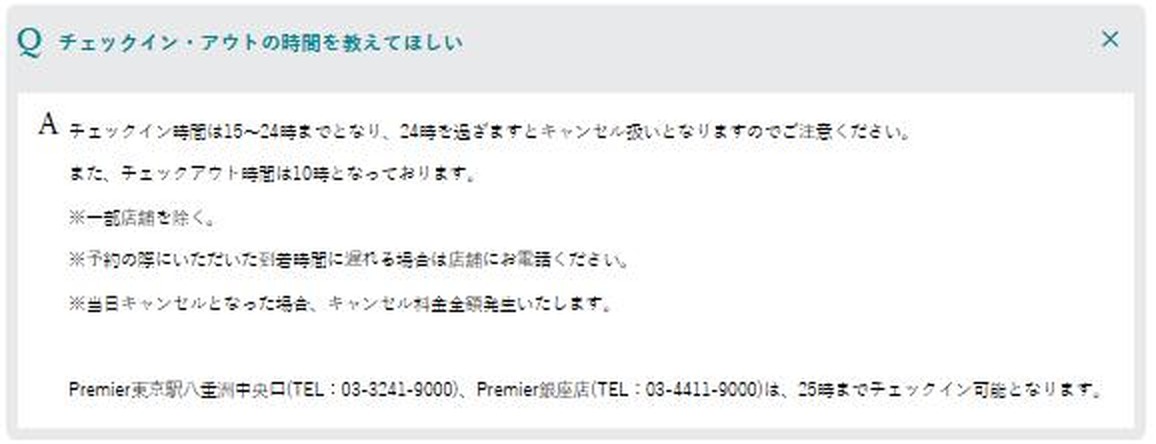
Check-in time reads like a start time. The room is yours from 3 p.m., and if you walk in at 1 a.m. the hotel still has your booking and your card. Super Hotel’s English FAQ reads differently: “check-in time is from 15:00 to 24:00, and your reservation will be canceled after 24:00”. Richmond Hotels’ terms put the line at 10 p.m. (22:00) if you gave no arrival time. Tokyu Stay’s front desk is staffed 24 hours, and its FAQ still asks for contact by midnight and says the booking may be canceled without it.
As of October 2026, from Super Hotel: FAQ.
These rules come from hotel, ryokan and booking-site pages. They show what a rule can look like, not how many hotels follow it.
Last checked: October 4, 2026. Hotel policies change, so the hotel’s own page on the day you book outranks anything here.
The arrival time you pick is also a deadline
Super Hotel’s terms word the rule more precisely. Article 5 says the hotel may treat the contract as canceled if the guest “does not appear without any advance notice by midnight on the accommodation date (or 2 hours after the estimated time of arrival if such estimated time was expressly informed beforehand)”. A guest who gave 6 p.m. and has not been in touch could be treated as canceled at 8 p.m. instead of midnight. For a stated time after 10 p.m. the FAQ and the terms differ, so ask.
As of October 2026, from Super Hotel: terms.
The lines differ by chain.
| Chain | When the terms say a booking may be canceled | What it asks you to do |
|---|---|---|
| Toyoko Inn | The expected time of arrival passes with no advance notice (terms, Article 6, revised September 29, 2026) | Contact the hotel in advance if you’ll be later than planned (guide). The FAQ asks for a phone call if arrival will be after 24:00 (FAQ, in Japanese) |
| Super Hotel | After 24:00 if you haven’t told the hotel (FAQ), or 2 hours after the stated arrival time (terms, Article 5) | Call the hotel if you’ll be significantly late for the time you filled in at booking |
| Richmond Hotels | 10 p.m., or 2 hours after the stated arrival time (terms, Article 6, in Japanese) | Contact the hotel. The clause covers a guest who neither arrives nor makes contact |
| Route Inn | The arrival time on the day passes with no contact (terms, Article 5, in Japanese, applied from October 1, 2015) | Contact the hotel |
| Tokyu Stay | No word by 24:00 that day (FAQ, in Japanese) | Call the front desk if arrival will be after 22:00. Midnight is the deadline for that contact |
The table shows three different clocks. Toyoko Inn and Route Inn use the time you gave. Super Hotel and Richmond add two hours to it and keep a fixed backstop for guests who gave none, midnight at one and 10 p.m. at the other. Tokyu Stay names midnight. The verb in all five is “may”, and Sotetsu Hotels’ English guide suggests the door isn’t always shut: “If you are late and unable to contact us in advance, please explain the situation to the front desk upon arrival.” The same guide says “The latest check-in time varies from hotel to hotel. Some hotels accept check-ins until midnight, or even 24 hours a day, while others may cancel your reservation if you arrive after a certain time”.
As of October 2026, from Sotetsu Hotels: English guide.
Check-in starts at 15:00 at Toyoko Inn, Super Hotel, Tokyu Stay, Dormy Inn and one Route Inn hotel. Dormy Inn gives 15:00 and 11:00 for check-out and adds that a facility’s or plan’s own times can differ. The last check-in is 23:00 or 24:00 at most hotels, according to Jalan’s news column. That fits the chains above, with Richmond’s 22:00 at the early end.
As of October 2026, from Dormy Inn (in Japanese): FAQ. From Jalan News (in Japanese): column.
Who is at the desk after midnight
A staffed desk and a check-in deadline are separate facts. Tokyu Stay’s answer says 「フロントは24時間営業しております」, the front desk is open 24 hours, in the same paragraph as the midnight line. Toyoko Inn’s English guide says “The hotel operates 24 hours a day”. One Route Inn hotel’s facilities page lists 「24時間フロント常駐」, a front desk staffed around the clock.
Other pages close the counter. Super Hotel’s FAQ has a question about “the hours when the front desk is closed (0:00 to 7:00)” and answers that in an emergency you use the intercom next to the elevator or phone a call center at night. The Japanese FAQ adds that after 24:00 you enter the building by unlocking it with the passcode for your room. That fits the 24:00 check-in line: you check in while the counter is open, and the passcode handles the door afterward.
As of October 2026, from Route Inn and Super Hotel (in Japanese): Route Inn facilities page, Super Hotel FAQ.
Richmond sits between the two. A notice from one Richmond hotel says staff are there 24 hours and that the entrance is locked after 1 a.m. for security, so you ring the intercom. It also asks guests to tell the hotel in advance when their arrival time changes.
As of October 2026, from Richmond Hotel Musashi-Kosugi (in Japanese): notice.
I have checked in at Japanese hotels both between 10 p.m. and midnight and after midnight. In my experience, at hotels and ryokan alike, after 10 p.m. or after midnight you mostly need your room’s card key to get through the lobby door.
Machines, passcodes and hotels with no desk
A machine at a staffed hotel changes who hands you the key. Toyoko Inn’s guide says “Please check-in either at the reception or by using our self-check-in machine”, on the same page as its late-arrival rule.
Dormy Inn’s 快速チェックイン (quick check-in) lets you register in the hotel’s app and hold a QR code to a machine at the hotel to get your key. Pre-registration opens at 6:00 a.m. on the day of the stay, late-night use varies by facility, and same-day or changed bookings can’t use it. Those go to the staffed front counter. For a late arrival, check your hotel’s page first, and expect the counter if you book on the road the same day.
As of October 2026, from Dormy Inn (in Japanese): quick check-in page.
Two pages describe the fully unmanned kind. Hotel Watari says “Our hotel is completely unmanned.” Check-in is done on your own phone from 4 p.m., after you arrive, using a pre-check-in link from the confirmation email, and a 4-digit passcode is displayed for the smart lock on the front door. If you haven’t completed the advance procedure, you’ll enter your guest information on the spot, and a phone number is listed for questions. At a place like that, the confirmation email with the link is what to have open when you reach the door.
Hotel B4T Iwaki uses a different design: a Suica card touched at a kiosk on arrival, at the security entrance and at the room door, with staff reachable around the clock by text or video chat, except for cabin-type rooms.
As of October 2026, from Hotel Watari: self check-in page. From Japan Today: unmanned hotel in Iwaki.
Ryokan: dinner is the deadline
At a ryokan, a traditional inn, the clock that matters is the kitchen’s. The Japan Tourism Agency says “You can usually check in starting at 15:00 or 16:00” and “dinner is usually served during a set time window, and if you arrive too late, you may miss it. If it does seem like you’ll arrive significantly later than the designated check-in time, let the ryokan know”. Here are the hours at four inns.
As of October 2026, from the Japan Tourism Agency: ryokan page.
| Page | What it says about arriving late |
|---|---|
| Kishigon Ryokan (FAQ, in Japanese) | Dinner plans: last check-in 18:00. Without dinner: 20:00. Dinner starts at 18:00 or 18:30, last start 19:00. No contact may mean cancellation |
| Satoyama Jujo (guest information, in Japanese) | Check-in from 15:00. Last check-in for dinner guests is 18:30 |
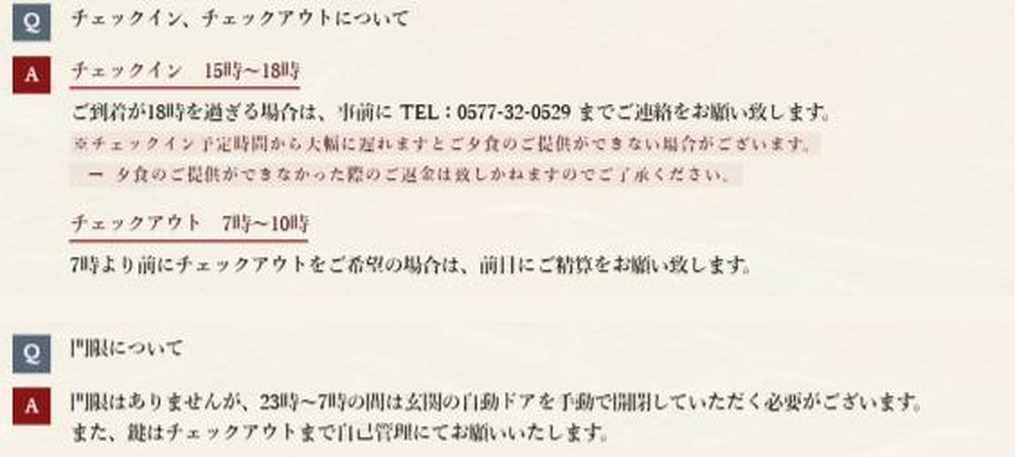
| Tanabe Ryokan (FAQ, in Japanese) | Check-in 15:00 to 18:00, with a call asked for if you’ll be after 18:00. Dinner may not be served if you’re well behind, and it says there is no refund for dinner not served. No curfew, but from 23:00 to 7:00 you open and close the automatic front door by hand |
| Ryokan Matsushima (FAQ, in Japanese) | Earliest dinner 18:30. After 20:00 dinner may not be prepared. A call is requested if you’ll be well past the planned time |
At Kishigon, dropping dinner moves the last check-in from 18:00 to 20:00. A family-run inn’s blog asks guests arriving after 5 p.m. to call that day, even from the road, because dinner starts at a set time.
As of October 2026, from Kadoya (in Japanese): blog post.
Three English-language terms sheets put the no-show line in numbers. Nishimuraya Honkan’s terms say the inn may treat the stay as canceled if the guest “does not appear by 7:00 pm of the accommodation date (or, two hours after the expected arrival time if the Ryokan has been notified)”, and the cancellation table that follows Article 11 lists a no-show at 100% of the reservation rate. Yunokuni Tensyo and Hotel Iyaonsen use the same form with 8 p.m.
As of October 2026, from the inns’ English terms: Nishimuraya Honkan, Article 5, Yunokuni Tensyo, Article 6 and Hotel Iyaonsen, Article 6.
The door is its own question. The Japan Tourism Agency says “Most ryokan do have a curfew”, with some inns that have none, some that keep staff at the desk after curfew, and some that hand you a key. Tanabe’s answer shows what “no curfew” can mean in practice. If you’ll arrive after 18:00, ask the inn before you book, including about the door.
As of October 2026, from the Japan Tourism Agency: curfew page.
What the booking sites say about arrival times
The hotel’s terms set the clock, and the booking site is the way you reach the hotel. Each site draws its line in a different place.
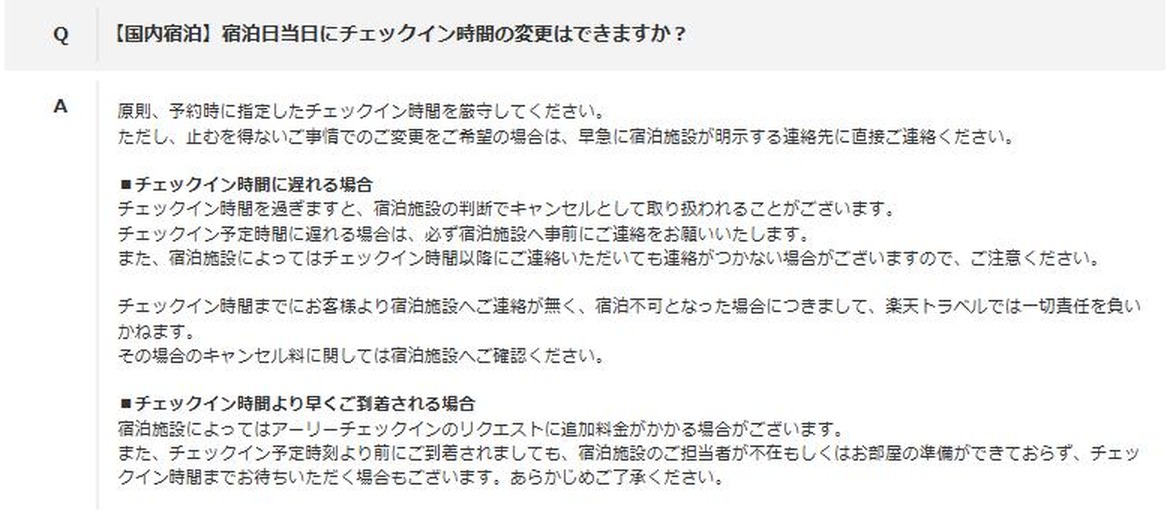
Rakuten Travel. Its help page on same-day changes says: 「原則、予約時に指定したチェックイン時間を厳守してください」, keep to the check-in time you specified when booking. If you can’t, contact the number the hotel shows, quickly. After the check-in time the hotel may treat the booking as canceled. If you hadn’t contacted the hotel by then and couldn’t stay, Rakuten Travel takes no responsibility and sends you to the hotel about the fee. Rakuten doesn’t pass requests to accommodations, domestic or overseas, and the hotel’s phone number is on the reservation confirmation page.
As of October 2026, from Rakuten Travel (in Japanese): same-day change help and help on contacting the hotel.
Jalan. Its reservation help lists the check-in time, planned check-in time included, among the items you can change on the reservation page, and says the phone number on the booking confirmation page reaches the property. Jalan’s news column adds that a large delay can be treated as a cancellation under a hotel’s terms, and that with a meal plan you should call even for a small delay because the kitchen prepares for your arrival time.
As of October 2026, from Jalan (in Japanese): reservation help.
Booking.com. Its FAQ has a question titled “I will be arriving earlier/later than the stated check-in time. Can I still check in?” and answers “This depends on the property who will do their best to meet your needs but can’t guarantee your request.” It lists three routes: give your expected arrival time while booking, manage the reservation online to ask for check-in outside the standard hours, or contact the property with the details in your confirmation email. Its terms add “If you think you’re not going to arrive on time, contact your Service Provider and tell them when they can expect you”.
As of October 2026, from Booking.com: FAQ and terms, section A9.
Agoda. A hotel can report a no-show “if your guest doesn’t arrive by midnight on the check-in date” and should first check whether the guest sent a “Late Check-in” request or made direct arrangements. That midnight is the point for reporting to Agoda, and a hotel’s own terms can set an earlier line, as Richmond’s 10 p.m. does. Special requests are by default “not confirmed and are subject to availability at the property upon arrival”.
As of October 2026, from Agoda Partner Hub: no-show page and special requests page.
For how the sites differ on price, see Two Prices for One Room: How Japanese Booking Sites Build the Number They Show You.
What a no-show costs
Toyoko Inn’s cancellation table lists a no-show at 100% of the basic accommodation charge, regardless of guest type or booking size. Super Hotel’s Japanese FAQ says a same-day cancellation incurs the full cancellation fee. Tanabe’s FAQ says dinner that couldn’t be served because of a big delay isn’t refunded.
Two pages carry relief. Toyoko Inn’s FAQ says that if you booked with online card payment, you needn’t call about arriving past your planned time, but you do need to tell the hotel if you won’t come at all. Super Hotel’s terms, Article 5 paragraph 3, say the fee “shall not be charged” if “it is proven that the Guest failed to arrive by midnight on the accommodation date (or 2 hours after the estimated time of arrival if such estimated time was informed beforehand) or to provide an advance notice thereof to the Hotel due to the delay of railway, airline or any other public transportation, or other circumstances not attributable to the Guest”. The wording is “if it is proven”, so a delay notice or ticket record is worth keeping.
As of October 2026, from Toyoko Inn: terms and FAQ (in Japanese). From Super Hotel: terms, and the FAQ (in Japanese).
Rakuten’s wording above leaves the fee to the hotel. Booking.com’s terms say “It’s your responsibility to ensure you’re on time, and if you aren’t, we aren’t responsible for any associated costs (e.g. the cancellation of your booking, or any fees the Service Provider may charge).” For the fee ladder before the day of stay, see Japanese Hotel Cancellation Policies Explained.
How to tell the hotel
- Enter the time you can really make. Under the Super Hotel and Richmond wording the stated time starts a two-hour clock, and under Toyoko Inn’s and Route Inn’s it is the line, so an optimistic entry shortens your margin. I enter the time I actually expect to arrive.
- Change it on the site if the site lets you. Jalan’s reservation help lists the planned check-in time among the changeable items, and Booking.com’s FAQ describes managing the reservation online to ask for later check-in.
- Phone for anything after midnight, or close to the hotel’s line. The hotel’s phone number is on the booking confirmation page.
- If you can’t reach anyone, explain at the desk. Treat that as a fallback, since the terms above still give hotels the right to cancel.
A short line like this works for email or a booking-site message, not for a phone call. The English is for your own reference:
〇月〇日に予約しております(お名前)です。到着が予定より遅れ、〇時ごろになりそうです。予約番号は〇〇です。よろしくお願いいたします。
This is (your name), booked for (date). My arrival will be later than planned, around (time). My reservation number is (number). Thank you.
When the train is already late
If the delay has already happened and the night is still ahead of you, these can help.
- Same-night booking on Rakuten Travel. Members can book a same-night stay until 29:00, which means 5 a.m., by picking the previous day’s date as the check-in date and a time of 24:00 or later. A hotel may not yet have registered a last-minute booking, so show the booking screen and say it came through Rakuten Travel.
- Plans that take check-in after midnight. Jalan marks such plans with 「24時〜もOK」 and describes arrival and check-in after 24:00, up to 29:00. Each plan page carries its own terms.
- Hotels that run later than the usual line. Super Hotel’s Japanese FAQ lists Premier Tokyo Station Yaesu Central Exit and Premier Ginza as taking check-in until 25:00, which is 1 a.m.
- A transport delay as the cause. Keep the proof. Super Hotel’s Article 5 paragraph 3, quoted above, ties the fee waiver to it.
As of October 2026, from Rakuten Travel and Jalan (in Japanese): Rakuten same-night booking help, Jalan help on late check-in plans.
The short version
- The time you give a Japanese hotel is also a deadline if you haven’t told the hotel. It is the stated time itself at Toyoko Inn and Route Inn, two hours after it at Super Hotel and Richmond, and midnight as the contact deadline at Tokyu Stay.
- Without a stated time, Richmond’s line is 10 p.m. and Super Hotel’s is midnight. A machine, a passcode door or a 24-hour desk sits beside that line and does not remove it.
- Ryokan with dinner are earlier: last check-in is 18:00 at Kishigon and 18:30 at Satoyama Jujo, and the terms sheets put the no-show line at 7 or 8 p.m.
- Tell the hotel by phone, or through the booking site if it has a message tool, whenever you’ll be later than the time you entered.
Cover photo: a single room at Hotel Sunroute Ariake by J o, CC BY-SA 4.0, via Wikimedia Commons. It shows a different hotel from the ones discussed.
