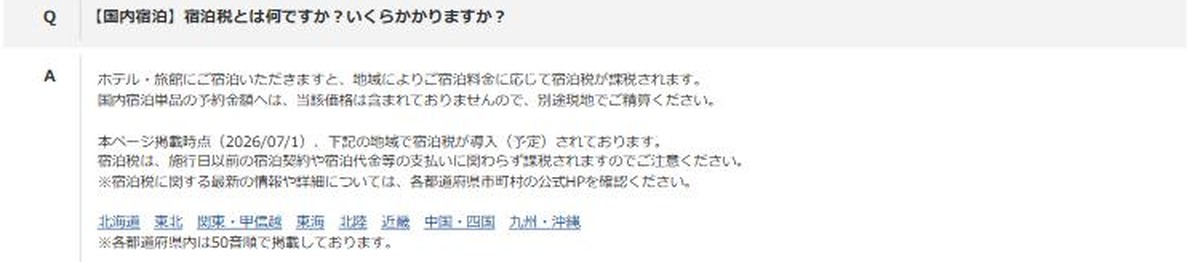
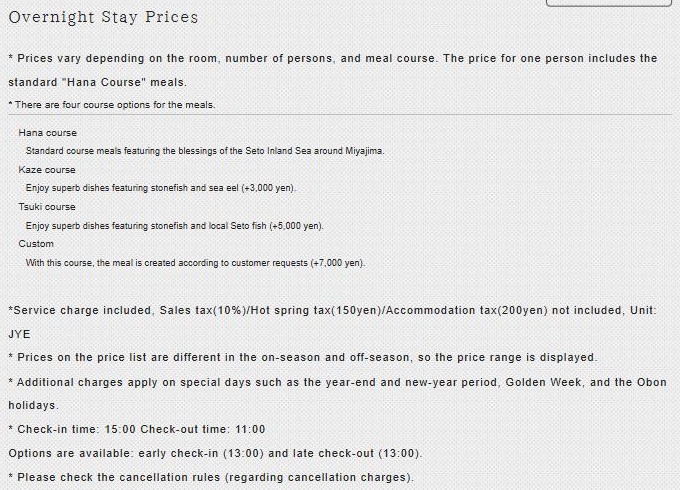
“Tax included” reads like a promise that the number is the total. On a Japanese booking page it usually covers one tax. Rakuten Travel says the amount shown for a domestic stay includes consumption tax and service charge, and that the hot-spring tax and, by region, the lodging tax can be due separately at the property. On the lodging tax it says it in one line: 「国内宿泊単品の予約金額へは、当該価格は含まれておりませんので、別途現地でご精算ください」. That means the tax is not in the reservation amount for a stand-alone domestic stay, so settle it separately on site.
As of October 2026, from Rakuten Travel (in Japanese): extra charges help and lodging tax help.
A room can therefore be paid in full online and still leave a line to pay at the desk. The amount depends on the prefecture, city or town, on the room-only price per person, and in some places on who is staying. The table below covers 15 places. Other municipalities charge too, and more are scheduled.
Last checked: October 5, 2026. Rates change, so the municipality’s own page for your dates outranks anything here.
“Tax included” covers the national tax, not the local ones
Four charges can land on one stay, and they are treated differently.
| Charge | Set by | On the Rakuten Travel and JTB pages (stand-alone stays) |
|---|---|---|
| Consumption tax (消費税) | National government | Included in the displayed price |
| Service charge (サービス料) | The property | Included in the displayed price |
| Lodging tax (宿泊税) | Prefecture, city or town | Not included. Settle on site |
| Hot-spring tax (入湯税) | City or town | Not included. Settle on site |
Consumption tax is the national one. The standard rate is 10 percent, of which 2.2 points is local consumption tax, and a business that shows prices to consumers in advance must show the price including consumption tax. Booking pages generally do this with the room price, though one storefront covered in Two Prices for One Room listed the room with 10% consumption tax excluded. There are still times I can’t tell at a glance whether a figure includes tax.
As of October 2026, from the National Tax Agency (in Japanese): standard rate page and price display page.
Service charge is the property’s own line. Rakuten and JTB both say their displayed price includes it, and the lodging-tax pages count it toward the base. Kyoto City’s page defines the lodging charge as 「素泊まり料金(室料及びサービス料)」, the room-only charge (room and service charge), and leaves out meals and consumption tax.
As of October 2026, from Kyoto City (in Japanese): lodging tax page.
The other two are local taxes. The hot-spring tax is a municipal tax, and some local governments, Tokyo among them, have introduced a lodging tax of their own. JTB’s displayed price for hotels and ryokan includes consumption tax and service charge, but not 「入湯税、宿泊税が課税される地域における宿泊税などの諸税は含まれておりません」: the hot-spring tax and, where it is levied, the lodging tax. Package tours differ. JTB says a package tour includes the hot-spring tax in the tour price for stays through March 31, 2027, and from April 1, 2027 it is paid at the accommodation.
As of October 2026, from the Ministry of Finance (in Japanese): Q&A. From JTB (in Japanese): FAQ on hotel and ryokan prices and package tour page.
What the accommodation tax is
It is a tax each local government decides for itself. The rules fall into three types: one flat amount, tiered amounts by room price, or a percentage. Many places exempt school trips, and the inn collects the tax from the guest and remits it.
As of October 2026, from the House of Councillors secretariat (in Japanese): research paper.
The base is the room-only price per person per night. Kyoto City and Nasu Town both define it as the room-only charge with its service charge, excluding meals and consumption tax. Kanazawa and Hiroshima state their thresholds on prices excluding consumption tax. So the band follows the room part of a plan, not the headline price of a plan with dinner. The per-person unit is the same one the room price uses, which the per-person pricing article explains.
A prefecture and a town can both tax the same stay. Hokkaido adds its amount to the town’s, with Kutchan folding both into one 3% rate, and Fukuoka Prefecture cut its own share to ¥50 inside Fukuoka City and Kitakyushu. In the table, Sapporo and Niseko show the two amounts already added together.
Rates by place
Bands are per person per night. Tokyo’s page names only the accommodation charge.
| Place | Rate per person per night | Exemptions on the page | Source |
|---|---|---|---|
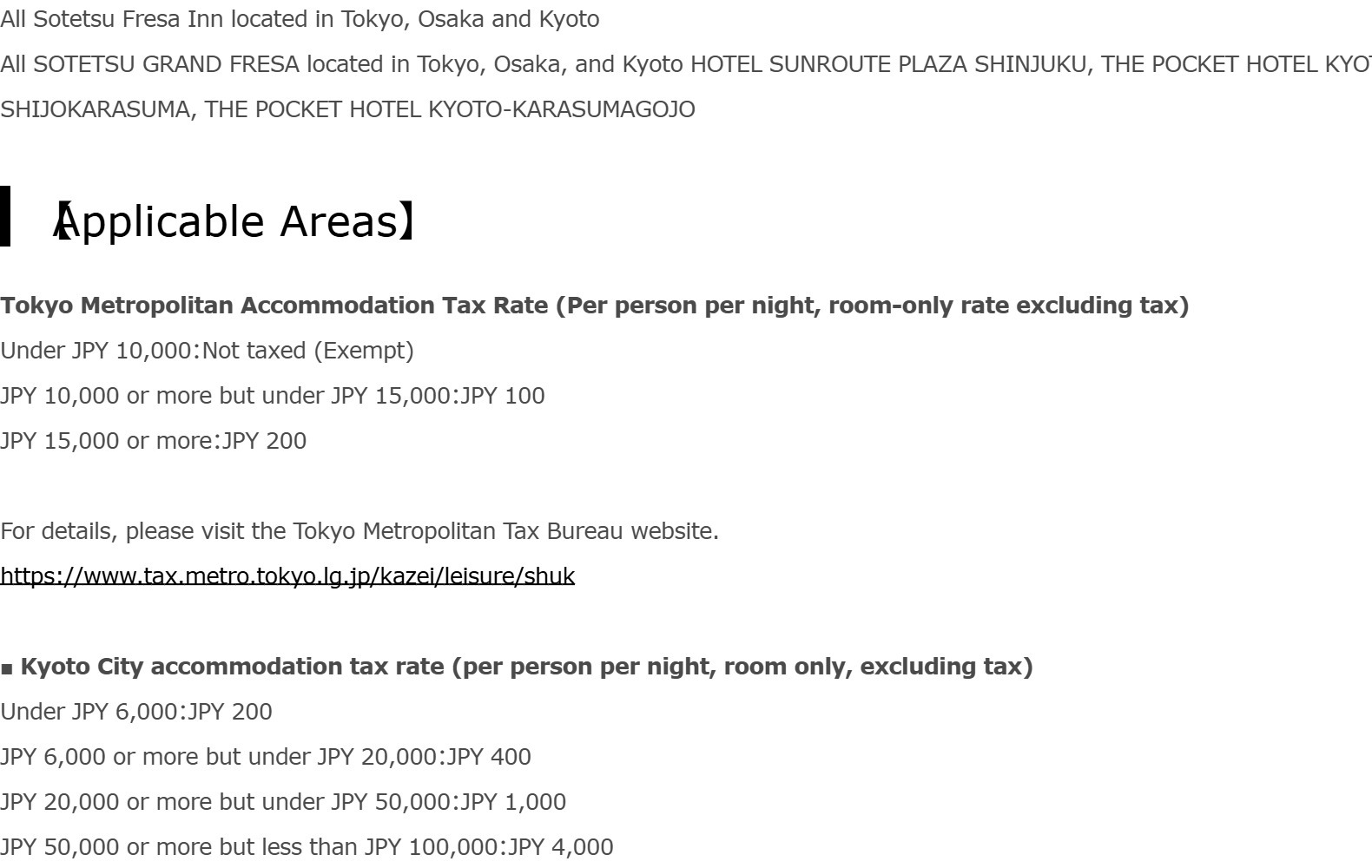
| Tokyo | Under ¥10,000: none. ¥10,000 to under ¥15,000: ¥100. ¥15,000 and up: ¥200 | None listed beyond the threshold | Tokyo Bureau of Taxation (in Japanese) |
| Kyoto City | From March 1, 2026: under ¥6,000: ¥200. ¥6,000 to under ¥20,000: ¥400. ¥20,000 to under ¥50,000: ¥1,000. ¥50,000 to under ¥100,000: ¥4,000. ¥100,000 and up: ¥10,000 | School trips and school events (universities excluded). The guest FAQ says the tax applies regardless of age when a room charge arises | Kyoto City and guest FAQ (in Japanese) |
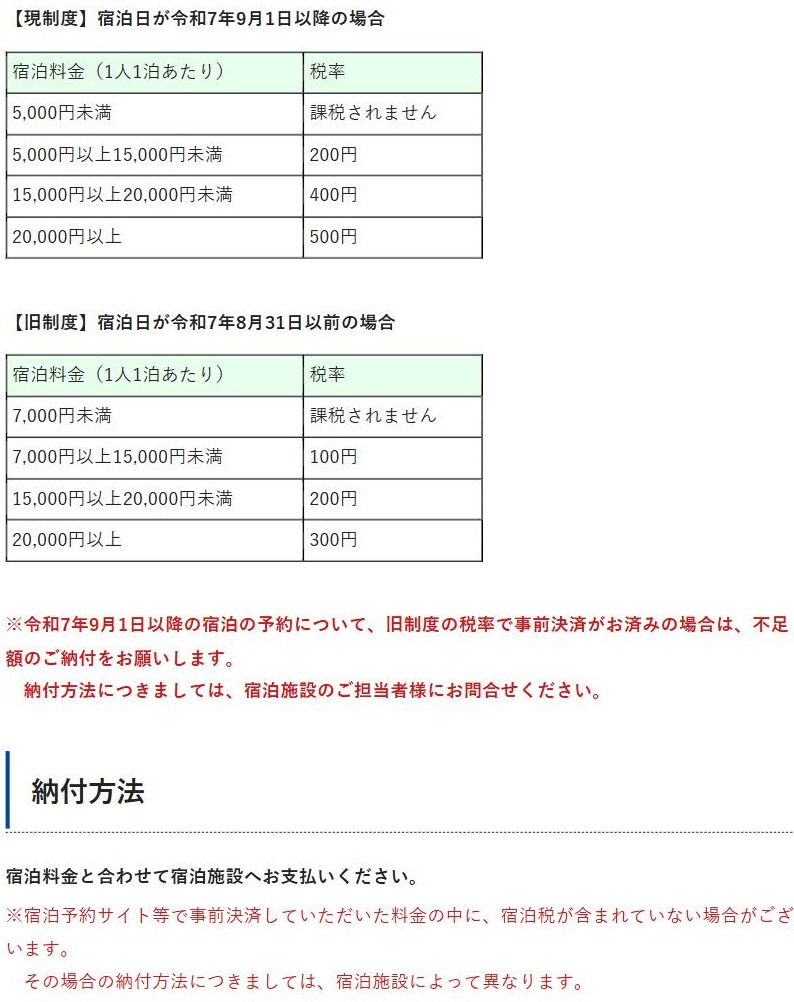
| Osaka Prefecture | From September 1, 2025: under ¥5,000: none. ¥5,000 to under ¥15,000: ¥200. ¥15,000 to under ¥20,000: ¥400. ¥20,000 and up: ¥500 | School trip students and chaperones | Osaka guest page and rates page (in Japanese) |
| Fukuoka Prefecture | ¥200 flat, outside Fukuoka City and Kitakyushu | None listed. The tax applies regardless of age when a lodging charge arises | Fukuoka Prefecture (in Japanese) |
| Fukuoka City | Under ¥20,000: ¥200. ¥20,000 and up: ¥500. Both include ¥50 for the prefecture | None listed. A child is taxed only if a lodging charge is collected | Fukuoka City and FAQ (in Japanese) |
| Kitakyushu | ¥200 (¥150 city plus ¥50 prefecture) | None listed | Kitakyushu (in Japanese) |
| Kanazawa | Under ¥5,000: none. ¥5,000 to under ¥20,000: ¥200. ¥20,000 and up: ¥500. Prices excluding consumption tax | None listed. The tax applies to every guest regardless of age who stays with a room charge | Kanazawa and Q&A (in Japanese) |
| Nagasaki City | Under ¥10,000: ¥100. ¥10,000 to under ¥20,000: ¥200. ¥20,000 and up: ¥500. New bands from April 2027, see below | School trips and school events, and others the mayor approves | Nagasaki City (in Japanese) |
| Hokkaido (prefecture) | From April 1, 2026: under ¥20,000: ¥100. ¥20,000 to under ¥50,000: ¥200. ¥50,000 and up: ¥500 | School trips and school events | Hokkaido tax page (in Japanese) |
| Sapporo | From April 1, 2026, city and Hokkaido tax together: under ¥20,000: ¥300. ¥20,000 to under ¥50,000: ¥600. ¥50,000 and up: ¥1,000 | School trips and school events | Sapporo (in Japanese) |
| Kutchan | 3% of the room charge, Hokkaido’s tax included. It was 2% until March 31, 2026 | School trips and school events (universities excluded), and students on work experience in the town | Kutchan rates and exemptions (in Japanese) |
| Niseko | Until October 31, 2026, town and Hokkaido tax together: under ¥5,001: ¥200. ¥5,001 to under ¥20,000: ¥300. ¥20,000 to under ¥50,000: ¥700. ¥50,000 to under ¥100,000: ¥1,500. ¥100,000 and up: ¥2,500. From November 1, 2026: 3% of the room charge | School trips and school events, others the mayor approves | Niseko flyer, from April 2026 and flyer on the 3% change (in Japanese, English) |
| Hiroshima Prefecture | From April 1, 2026: ¥200 when the room charge is ¥6,000 or more, excluding consumption tax. Nothing below | School trips and school events (universities excluded) | Hiroshima Prefecture (in Japanese) |
| Nasu (Tochigi) | From October 1, 2026: under ¥10,000: ¥100. ¥10,000 to under ¥20,000: ¥300. ¥20,000 to under ¥30,000: ¥500. ¥30,000 to under ¥50,000: ¥800. ¥50,000 to under ¥100,000: ¥1,500. ¥100,000 and up: ¥3,000 | Anyone under 12. School trips and school events | Nasu Town (in Japanese) |
| Tokoname (Aichi) | ¥200, no threshold, since January 6, 2025 | None listed | Tokoname (in Japanese) |
The inn is the collector. The guest pays the inn, which remits the tax to the prefecture, city or town.
Where the tax starts varies: Tokyo at ¥10,000, Hiroshima at ¥6,000, Osaka and Kanazawa at ¥5,000. Fukuoka Prefecture, Kitakyushu and Tokoname charge a flat ¥200. At the top, Kyoto charges ¥10,000 a person once the room-only price reaches ¥100,000, ahead of Nasu’s ¥3,000 and Niseko’s ¥2,500 (until October 31). Kutchan’s rate now and Niseko’s from November are percentages, which scale with the price.
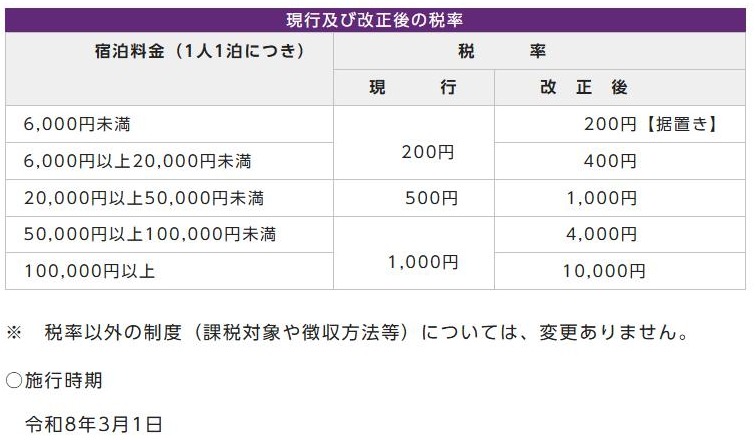
Kyoto’s old top band was ¥1,000 for ¥50,000 and up. Now ¥50,000 to under ¥100,000 is ¥4,000 and ¥100,000 and up is ¥10,000. The stay date decides which table applies. Kyoto’s guest FAQ says 「令和8年3月1日(宿泊税額改正)以降の宿泊の際は、改正後の宿泊税額が適用されます」, so stays from March 1, 2026 use the new amounts even if booked earlier. Sapporo says the same about its April 1, 2026 start: 「令和8年4月1日より前に予約がされた場合でも課税の対象となります」.
As of October 2026, from Kyoto City (in Japanese): guest FAQ.
Changes already on the calendar
Treat each of these as a reason to check the page again for your dates.
- Niseko, November 1, 2026. The town moves from tiers to 3% of the room charge, with Hokkaido’s share included. The change applies to stays from that date.
- Okinawa Prefecture, February 1, 2027. The prefecture sets 2% of the room-only charge with a ¥2,000 cap, and its own example rounds the price down to the nearest ¥1,000 first: ¥8,500 becomes ¥8,000, and ¥8,000 times 2% is ¥160. Where a municipality also taxes, the split is 0.8% for the prefecture (cap ¥800) and 1.2% for the municipality (cap ¥1,200).
- Tokyo, April 1, 2027. The tax becomes 3% of the accommodation charge per person per night, with nights under ¥13,000 not taxed, and simple lodgings and private rentals are added. Tokyo doesn’t say how meals or service charge are treated. A ¥20,000 per-person charge carries ¥200 today and would be ¥600 under 3%.
- Nagasaki City, April 2027. The city’s council papers from February 2026 set the new bands at ¥100 under ¥6,000, ¥300 from ¥6,000 to under ¥20,000 and ¥500 from ¥20,000. The Nagasaki Shimbun reported on October 5, 2026 that the minister consented on September 30.
As of October 2026, from Okinawa Prefecture (in Japanese and English): flyer. From the Tokyo Bureau of Taxation (in Japanese): tax page. From Nagasaki (in Japanese): council papers and Nagasaki Shimbun report.
Exemptions are written for school groups, not for families
Exemptions are mostly for students and chaperones on school trips and school events. Kyoto’s wording excludes universities, and Kutchan adds students on work experience in the town.
For a child traveling with family, the pages mostly follow the room charge, not the age. Kyoto, Fukuoka Prefecture and Kanazawa each say the tax applies regardless of age when a room charge arises. Fukuoka City puts it for families: a child is taxed if a lodging charge is collected, and not if none arises, with free co-sleeping as its example (「添い寝無料などにより、宿泊料金が発生しない場合は課税対象となりません」). Nasu Town is the outright age exemption in the table: anyone under 12 (「年齢12歳未満の者」). So the question for a family is whether the plan puts a room charge on the child, which the per-person pricing article covers.
The hot-spring tax is a different tax
The hot-spring tax (入湯税, nyūtō-zei) is charged for bathing, not for sleeping. When you go to a bathing facility that uses a hot spring and enter the spring, the hot-spring tax applies, and the operator pays it to the town on your behalf. The law’s standard is ¥150 per person per day, each municipality can set a different amount, and the amount can differ between overnight and day guests. A one-night stay is generally treated as one day.
As of October 2026, from the Ministry of Finance (in Japanese): Q&A. From the Ministry of Internal Affairs (in Japanese): local tax page. The one-day rule and the Fukuoka City hot-spring figures below are from the House of Councillors paper.
Two towns show how the amounts vary. Niseko charges ¥150 for an overnight guest and ¥100 for a day-bath visit, and exempts anyone under 15. Hakone charges ¥150 per person per night and ¥50 for a day visit, and exempts anyone under 12.
As of October 2026, from Niseko and Hakone (in Japanese): Niseko hot-spring tax, Hakone hot-spring tax.
It follows the bath. Rakuten says it arises when you use accommodation with a hot-spring bath (「鉱泉浴場(温泉浴場)を備える宿泊施設をご利用の際に発生いたします」). A large shared bath and a hot spring are not the same thing, a split that Where to Stay in Japan covers.
Both taxes can land on one bill. The two aren’t treated as double taxation because they tax different acts, a stay and a bath, but a guest at a hot-spring inn owes both. Fukuoka City cut the hot-spring tax for overnight guests from ¥150 to ¥50 for as long as its lodging tax applies. The ryokan day, with this payment in it, is in What Actually Happens During a Ryokan Stay.
Paid online, with a line still left at the desk
Municipal pages say the tax is paid at the property. Osaka Prefecture says 「宿泊料金と合わせて宿泊施設へお支払いください」, pay the inn together with the room charge, and warns that 「宿泊予約サイト等で事前決済していただいた料金の中に、宿泊税が含まれていない場合がございます」, an advance payment on a booking site may not include the tax. Tokyo says you may pay at the hotel or ryokan front desk, separate from the travel price. Okinawa’s flyer says: “Please pay the accommodation tax to the accommodation provider with the method used to pay for your accommodation.”
Some properties do fold the tax into the rate. A Sotetsu Hotels notice dated November 4, 2025 (cited in Two Prices for One Room) says that from March 1, 2026 the lodging tax at its Tokyo, Osaka Prefecture and Kyoto City properties moves from inside the displayed price to on top of it.
What I did: on my ryokan stays I paid online, and the hot-spring tax was paid on the day. At hotels and ryokan alike, I paid either tax at check-in at some places and at check-out at others. When I paid the hot-spring tax at a ryokan, card and electronic payment both worked. Which methods an inn takes depends on the inn and the plan, so check before you count on one.
Working out your own bill
- Find the place that taxes your stay. It may be a prefecture, a city, a town, or two of them at once. Use the table above and the municipality’s own page.
- Take the room-only price per person per night. Leave out meals and consumption tax, as the Kyoto and Nasu pages define it.
- Match it to the band, then multiply by people and nights. Kyoto City at ¥12,000 room-only per person for 2 adults and 3 nights is ¥400 times 2 times 3, or ¥2,400. At ¥25,000 it is ¥1,000 times 6, or ¥6,000.
- Add the hot-spring tax if the inn has a hot-spring bath. At ¥150 per person per night, 2 adults for 2 nights is ¥600, less for anyone the town exempts by age.
Before I press the book button I check the total with tax and service charge included. The two local taxes are the part of the bill that total can leave out.
The short version
- On a stand-alone booking, “tax included” covers consumption tax and service charge. The lodging tax and hot-spring tax are settled on site even on a prepaid room.
- Look up the municipality’s rate on the room-only price per person per night, multiply by people and nights, and add the hot-spring tax if the inn has a spring bath.
- A child follows the room charge unless the place has an age rule, as Nasu does for under 12.
- Check the municipality’s page for your dates, then keep a card or cash for the desk.
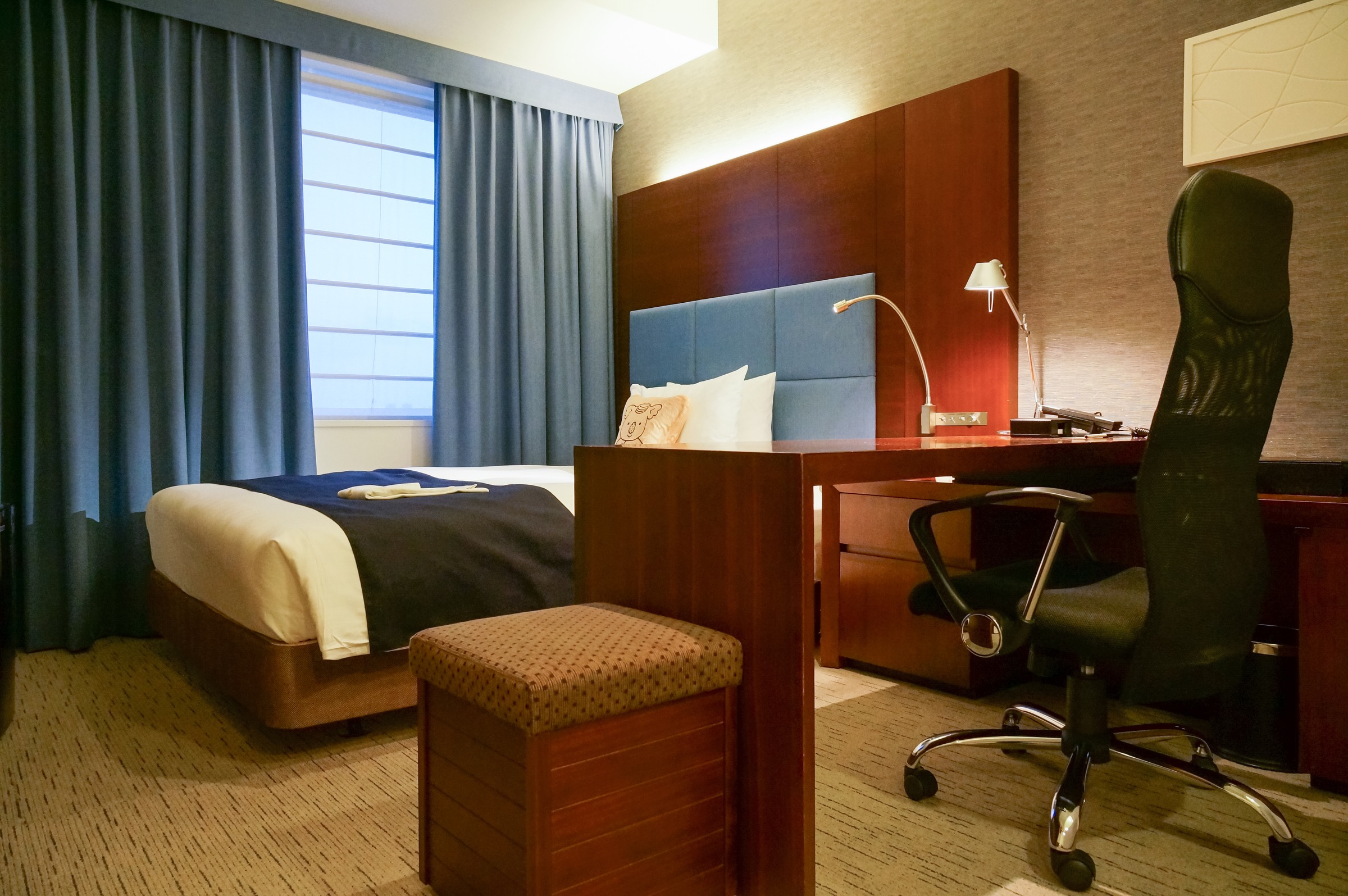
Cover photo: a double room at Millennium Mitsui Garden Hotel Tokyo by J o, CC BY-SA 4.0, via Wikimedia Commons. It shows a different hotel from the places discussed.





.jpg)


