Category: Costs & Manners

Tipping, breakfast and the small costs and customs of a hotel stay.

  • Accommodation Tax in Japan: What It Is and What You Pay

    Accommodation Tax in Japan: What It Is and What You Pay

    “Tax included” reads like a promise that the number is the total. On a Japanese booking page it usually covers one tax. Rakuten Travel says the amount shown for a domestic stay includes consumption tax and service charge, and that the hot-spring tax and, by region, the lodging tax can be due separately at the property. On the lodging tax it says it in one line: 「国内宿泊単品の予約金額へは、当該価格は含まれておりませんので、別途現地でご精算ください」. That means the tax is not in the reservation amount for a stand-alone domestic stay, so settle it separately on site.

    As of October 2026, from Rakuten Travel (in Japanese): extra charges help and lodging tax help.

    A room can therefore be paid in full online and still leave a line to pay at the desk. The amount depends on the prefecture, city or town, on the room-only price per person, and in some places on who is staying. The table below covers 15 places. Other municipalities charge too, and more are scheduled.

    Last checked: October 5, 2026. Rates change, so the municipality’s own page for your dates outranks anything here.

    “Tax included” covers the national tax, not the local ones

    Four charges can land on one stay, and they are treated differently.

    Charge Set by On the Rakuten Travel and JTB pages (stand-alone stays)
    Consumption tax (消費税) National government Included in the displayed price
    Service charge (サービス料) The property Included in the displayed price
    Lodging tax (宿泊税) Prefecture, city or town Not included. Settle on site
    Hot-spring tax (入湯税) City or town Not included. Settle on site

    Consumption tax is the national one. The standard rate is 10 percent, of which 2.2 points is local consumption tax, and a business that shows prices to consumers in advance must show the price including consumption tax. Booking pages generally do this with the room price, though one storefront covered in Two Prices for One Room listed the room with 10% consumption tax excluded. There are still times I can’t tell at a glance whether a figure includes tax.

    As of October 2026, from the National Tax Agency (in Japanese): standard rate page and price display page.

    Service charge is the property’s own line. Rakuten and JTB both say their displayed price includes it, and the lodging-tax pages count it toward the base. Kyoto City’s page defines the lodging charge as 「素泊まり料金(室料及びサービス料)」, the room-only charge (room and service charge), and leaves out meals and consumption tax.

    As of October 2026, from Kyoto City (in Japanese): lodging tax page.

    The other two are local taxes. The hot-spring tax is a municipal tax, and some local governments, Tokyo among them, have introduced a lodging tax of their own. JTB’s displayed price for hotels and ryokan includes consumption tax and service charge, but not 「入湯税、宿泊税が課税される地域における宿泊税などの諸税は含まれておりません」: the hot-spring tax and, where it is levied, the lodging tax. Package tours differ. JTB says a package tour includes the hot-spring tax in the tour price for stays through March 31, 2027, and from April 1, 2027 it is paid at the accommodation.

    As of October 2026, from the Ministry of Finance (in Japanese): Q&A. From JTB (in Japanese): FAQ on hotel and ryokan prices and package tour page.
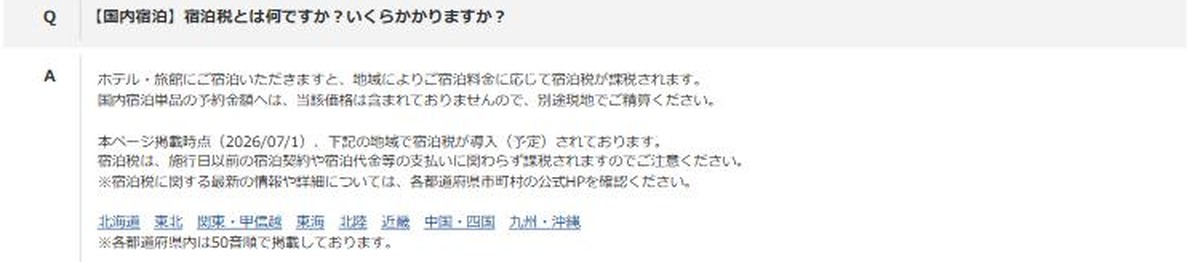
    Screenshot of a Rakuten Travel help page in Japanese about the accommodation tax. It says that depending on the region a lodging tax is charged according to the room rate, that the price is not included in the reservation amount for a stand-alone domestic stay and is to be settled separately on site. It also says the tax is charged whatever the contract date or payment, and that the page was current as of July 1, 2026.
    Rakuten Travel help page on the accommodation tax (in Japanese). Screenshot.

    What the accommodation tax is

    It is a tax each local government decides for itself. The rules fall into three types: one flat amount, tiered amounts by room price, or a percentage. Many places exempt school trips, and the inn collects the tax from the guest and remits it.

    As of October 2026, from the House of Councillors secretariat (in Japanese): research paper.

    The base is the room-only price per person per night. Kyoto City and Nasu Town both define it as the room-only charge with its service charge, excluding meals and consumption tax. Kanazawa and Hiroshima state their thresholds on prices excluding consumption tax. So the band follows the room part of a plan, not the headline price of a plan with dinner. The per-person unit is the same one the room price uses, which the per-person pricing article explains.

    A prefecture and a town can both tax the same stay. Hokkaido adds its amount to the town’s, with Kutchan folding both into one 3% rate, and Fukuoka Prefecture cut its own share to ¥50 inside Fukuoka City and Kitakyushu. In the table, Sapporo and Niseko show the two amounts already added together.

    Rates by place

    Bands are per person per night. Tokyo’s page names only the accommodation charge.

    Place Rate per person per night Exemptions on the page Source
    Tokyo Under ¥10,000: none. ¥10,000 to under ¥15,000: ¥100. ¥15,000 and up: ¥200 None listed beyond the threshold Tokyo Bureau of Taxation (in Japanese)
    Kyoto City From March 1, 2026: under ¥6,000: ¥200. ¥6,000 to under ¥20,000: ¥400. ¥20,000 to under ¥50,000: ¥1,000. ¥50,000 to under ¥100,000: ¥4,000. ¥100,000 and up: ¥10,000 School trips and school events (universities excluded). The guest FAQ says the tax applies regardless of age when a room charge arises Kyoto City and guest FAQ (in Japanese)
    Osaka Prefecture From September 1, 2025: under ¥5,000: none. ¥5,000 to under ¥15,000: ¥200. ¥15,000 to under ¥20,000: ¥400. ¥20,000 and up: ¥500 School trip students and chaperones Osaka guest page and rates page (in Japanese)
    Fukuoka Prefecture ¥200 flat, outside Fukuoka City and Kitakyushu None listed. The tax applies regardless of age when a lodging charge arises Fukuoka Prefecture (in Japanese)
    Fukuoka City Under ¥20,000: ¥200. ¥20,000 and up: ¥500. Both include ¥50 for the prefecture None listed. A child is taxed only if a lodging charge is collected Fukuoka City and FAQ (in Japanese)
    Kitakyushu ¥200 (¥150 city plus ¥50 prefecture) None listed Kitakyushu (in Japanese)
    Kanazawa Under ¥5,000: none. ¥5,000 to under ¥20,000: ¥200. ¥20,000 and up: ¥500. Prices excluding consumption tax None listed. The tax applies to every guest regardless of age who stays with a room charge Kanazawa and Q&A (in Japanese)
    Nagasaki City Under ¥10,000: ¥100. ¥10,000 to under ¥20,000: ¥200. ¥20,000 and up: ¥500. New bands from April 2027, see below School trips and school events, and others the mayor approves Nagasaki City (in Japanese)
    Hokkaido (prefecture) From April 1, 2026: under ¥20,000: ¥100. ¥20,000 to under ¥50,000: ¥200. ¥50,000 and up: ¥500 School trips and school events Hokkaido tax page (in Japanese)
    Sapporo From April 1, 2026, city and Hokkaido tax together: under ¥20,000: ¥300. ¥20,000 to under ¥50,000: ¥600. ¥50,000 and up: ¥1,000 School trips and school events Sapporo (in Japanese)
    Kutchan 3% of the room charge, Hokkaido’s tax included. It was 2% until March 31, 2026 School trips and school events (universities excluded), and students on work experience in the town Kutchan rates and exemptions (in Japanese)
    Niseko Until October 31, 2026, town and Hokkaido tax together: under ¥5,001: ¥200. ¥5,001 to under ¥20,000: ¥300. ¥20,000 to under ¥50,000: ¥700. ¥50,000 to under ¥100,000: ¥1,500. ¥100,000 and up: ¥2,500. From November 1, 2026: 3% of the room charge School trips and school events, others the mayor approves Niseko flyer, from April 2026 and flyer on the 3% change (in Japanese, English)
    Hiroshima Prefecture From April 1, 2026: ¥200 when the room charge is ¥6,000 or more, excluding consumption tax. Nothing below School trips and school events (universities excluded) Hiroshima Prefecture (in Japanese)
    Nasu (Tochigi) From October 1, 2026: under ¥10,000: ¥100. ¥10,000 to under ¥20,000: ¥300. ¥20,000 to under ¥30,000: ¥500. ¥30,000 to under ¥50,000: ¥800. ¥50,000 to under ¥100,000: ¥1,500. ¥100,000 and up: ¥3,000 Anyone under 12. School trips and school events Nasu Town (in Japanese)
    Tokoname (Aichi) ¥200, no threshold, since January 6, 2025 None listed Tokoname (in Japanese)

    The inn is the collector. The guest pays the inn, which remits the tax to the prefecture, city or town.

    Where the tax starts varies: Tokyo at ¥10,000, Hiroshima at ¥6,000, Osaka and Kanazawa at ¥5,000. Fukuoka Prefecture, Kitakyushu and Tokoname charge a flat ¥200. At the top, Kyoto charges ¥10,000 a person once the room-only price reaches ¥100,000, ahead of Nasu’s ¥3,000 and Niseko’s ¥2,500 (until October 31). Kutchan’s rate now and Niseko’s from November are percentages, which scale with the price.
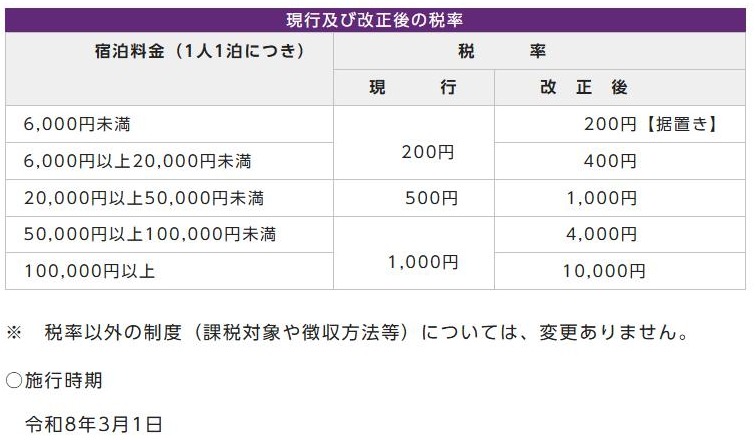
    Screenshot of the Kyoto City accommodation tax page in Japanese showing the five price bands that apply from March 1, 2026: under 6,000 yen is 200 yen, 6,000 to under 20,000 yen is 400 yen, 20,000 to under 50,000 yen is 1,000 yen, 50,000 to under 100,000 yen is 4,000 yen, and 100,000 yen and over is 10,000 yen. A second column lists the previous rates.
    Kyoto City accommodation tax page, rates from March 1, 2026 (in Japanese). Screenshot.

    Kyoto’s old top band was ¥1,000 for ¥50,000 and up. Now ¥50,000 to under ¥100,000 is ¥4,000 and ¥100,000 and up is ¥10,000. The stay date decides which table applies. Kyoto’s guest FAQ says 「令和8年3月1日(宿泊税額改正)以降の宿泊の際は、改正後の宿泊税額が適用されます」, so stays from March 1, 2026 use the new amounts even if booked earlier. Sapporo says the same about its April 1, 2026 start: 「令和8年4月1日より前に予約がされた場合でも課税の対象となります」.

    As of October 2026, from Kyoto City (in Japanese): guest FAQ.

    Changes already on the calendar

    Treat each of these as a reason to check the page again for your dates.

    • Niseko, November 1, 2026. The town moves from tiers to 3% of the room charge, with Hokkaido’s share included. The change applies to stays from that date.
    • Okinawa Prefecture, February 1, 2027. The prefecture sets 2% of the room-only charge with a ¥2,000 cap, and its own example rounds the price down to the nearest ¥1,000 first: ¥8,500 becomes ¥8,000, and ¥8,000 times 2% is ¥160. Where a municipality also taxes, the split is 0.8% for the prefecture (cap ¥800) and 1.2% for the municipality (cap ¥1,200).
    • Tokyo, April 1, 2027. The tax becomes 3% of the accommodation charge per person per night, with nights under ¥13,000 not taxed, and simple lodgings and private rentals are added. Tokyo doesn’t say how meals or service charge are treated. A ¥20,000 per-person charge carries ¥200 today and would be ¥600 under 3%.
    • Nagasaki City, April 2027. The city’s council papers from February 2026 set the new bands at ¥100 under ¥6,000, ¥300 from ¥6,000 to under ¥20,000 and ¥500 from ¥20,000. The Nagasaki Shimbun reported on October 5, 2026 that the minister consented on September 30.

    As of October 2026, from Okinawa Prefecture (in Japanese and English): flyer. From the Tokyo Bureau of Taxation (in Japanese): tax page. From Nagasaki (in Japanese): council papers and Nagasaki Shimbun report.

    Exemptions are written for school groups, not for families

    Exemptions are mostly for students and chaperones on school trips and school events. Kyoto’s wording excludes universities, and Kutchan adds students on work experience in the town.

    For a child traveling with family, the pages mostly follow the room charge, not the age. Kyoto, Fukuoka Prefecture and Kanazawa each say the tax applies regardless of age when a room charge arises. Fukuoka City puts it for families: a child is taxed if a lodging charge is collected, and not if none arises, with free co-sleeping as its example (「添い寝無料などにより、宿泊料金が発生しない場合は課税対象となりません」). Nasu Town is the outright age exemption in the table: anyone under 12 (「年齢12歳未満の者」). So the question for a family is whether the plan puts a room charge on the child, which the per-person pricing article covers.

    The hot-spring tax is a different tax

    The hot-spring tax (入湯税, nyūtō-zei) is charged for bathing, not for sleeping. When you go to a bathing facility that uses a hot spring and enter the spring, the hot-spring tax applies, and the operator pays it to the town on your behalf. The law’s standard is ¥150 per person per day, each municipality can set a different amount, and the amount can differ between overnight and day guests. A one-night stay is generally treated as one day.

    As of October 2026, from the Ministry of Finance (in Japanese): Q&A. From the Ministry of Internal Affairs (in Japanese): local tax page. The one-day rule and the Fukuoka City hot-spring figures below are from the House of Councillors paper.

    Two towns show how the amounts vary. Niseko charges ¥150 for an overnight guest and ¥100 for a day-bath visit, and exempts anyone under 15. Hakone charges ¥150 per person per night and ¥50 for a day visit, and exempts anyone under 12.

    As of October 2026, from Niseko and Hakone (in Japanese): Niseko hot-spring tax, Hakone hot-spring tax.

    It follows the bath. Rakuten says it arises when you use accommodation with a hot-spring bath (「鉱泉浴場(温泉浴場)を備える宿泊施設をご利用の際に発生いたします」). A large shared bath and a hot spring are not the same thing, a split that Where to Stay in Japan covers.

    Both taxes can land on one bill. The two aren’t treated as double taxation because they tax different acts, a stay and a bath, but a guest at a hot-spring inn owes both. Fukuoka City cut the hot-spring tax for overnight guests from ¥150 to ¥50 for as long as its lodging tax applies. The ryokan day, with this payment in it, is in What Actually Happens During a Ryokan Stay.

    Paid online, with a line still left at the desk

    Municipal pages say the tax is paid at the property. Osaka Prefecture says 「宿泊料金と合わせて宿泊施設へお支払いください」, pay the inn together with the room charge, and warns that 「宿泊予約サイト等で事前決済していただいた料金の中に、宿泊税が含まれていない場合がございます」, an advance payment on a booking site may not include the tax. Tokyo says you may pay at the hotel or ryokan front desk, separate from the travel price. Okinawa’s flyer says: “Please pay the accommodation tax to the accommodation provider with the method used to pay for your accommodation.”
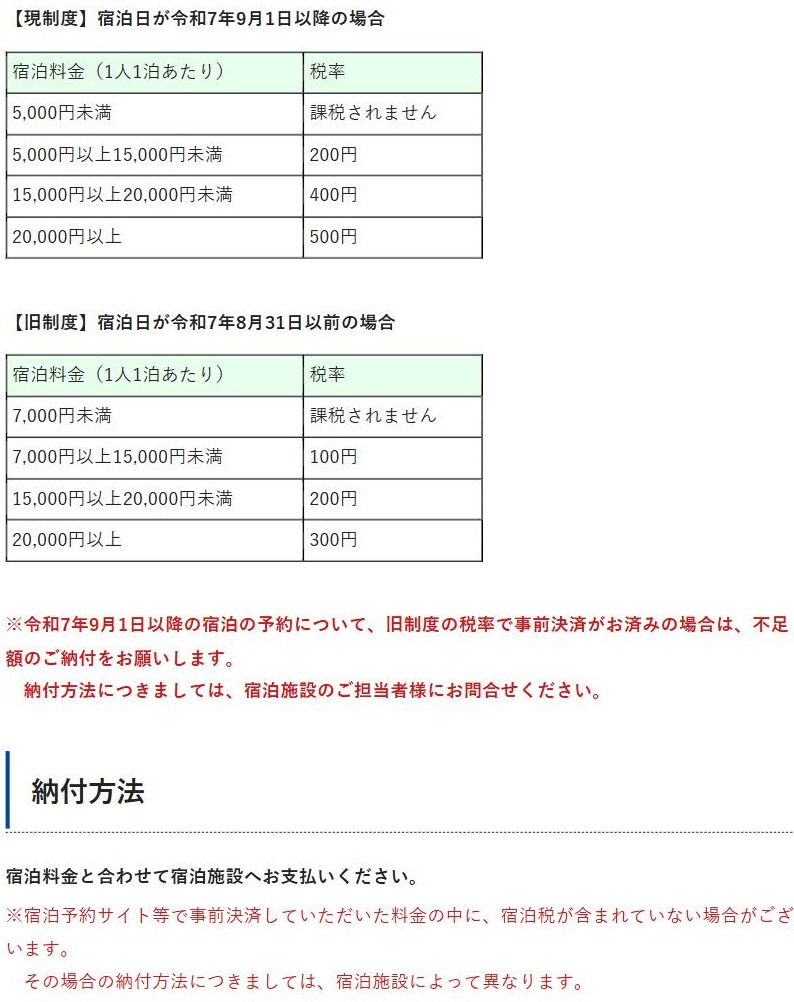
    Screenshot of the Osaka Prefecture guest page in Japanese. It says to pay the accommodation tax to the facility together with the room charge, lists the current tax by price band from September 1, 2025 and the previous bands, and notes that an advance payment made on a booking site may not include the tax.
    Osaka Prefecture guest page, payment note (in Japanese). Screenshot.

    Some properties do fold the tax into the rate. A Sotetsu Hotels notice dated November 4, 2025 (cited in Two Prices for One Room) says that from March 1, 2026 the lodging tax at its Tokyo, Osaka Prefecture and Kyoto City properties moves from inside the displayed price to on top of it.

    What I did: on my ryokan stays I paid online, and the hot-spring tax was paid on the day. At hotels and ryokan alike, I paid either tax at check-in at some places and at check-out at others. When I paid the hot-spring tax at a ryokan, card and electronic payment both worked. Which methods an inn takes depends on the inn and the plan, so check before you count on one.

    Working out your own bill

    1. Find the place that taxes your stay. It may be a prefecture, a city, a town, or two of them at once. Use the table above and the municipality’s own page.
    2. Take the room-only price per person per night. Leave out meals and consumption tax, as the Kyoto and Nasu pages define it.
    3. Match it to the band, then multiply by people and nights. Kyoto City at ¥12,000 room-only per person for 2 adults and 3 nights is ¥400 times 2 times 3, or ¥2,400. At ¥25,000 it is ¥1,000 times 6, or ¥6,000.
    4. Add the hot-spring tax if the inn has a hot-spring bath. At ¥150 per person per night, 2 adults for 2 nights is ¥600, less for anyone the town exempts by age.

    Before I press the book button I check the total with tax and service charge included. The two local taxes are the part of the bill that total can leave out.

    The short version

    • On a stand-alone booking, “tax included” covers consumption tax and service charge. The lodging tax and hot-spring tax are settled on site even on a prepaid room.
    • Look up the municipality’s rate on the room-only price per person per night, multiply by people and nights, and add the hot-spring tax if the inn has a spring bath.
    • A child follows the room charge unless the place has an age rule, as Nasu does for under 12.
    • Check the municipality’s page for your dates, then keep a card or cash for the desk.

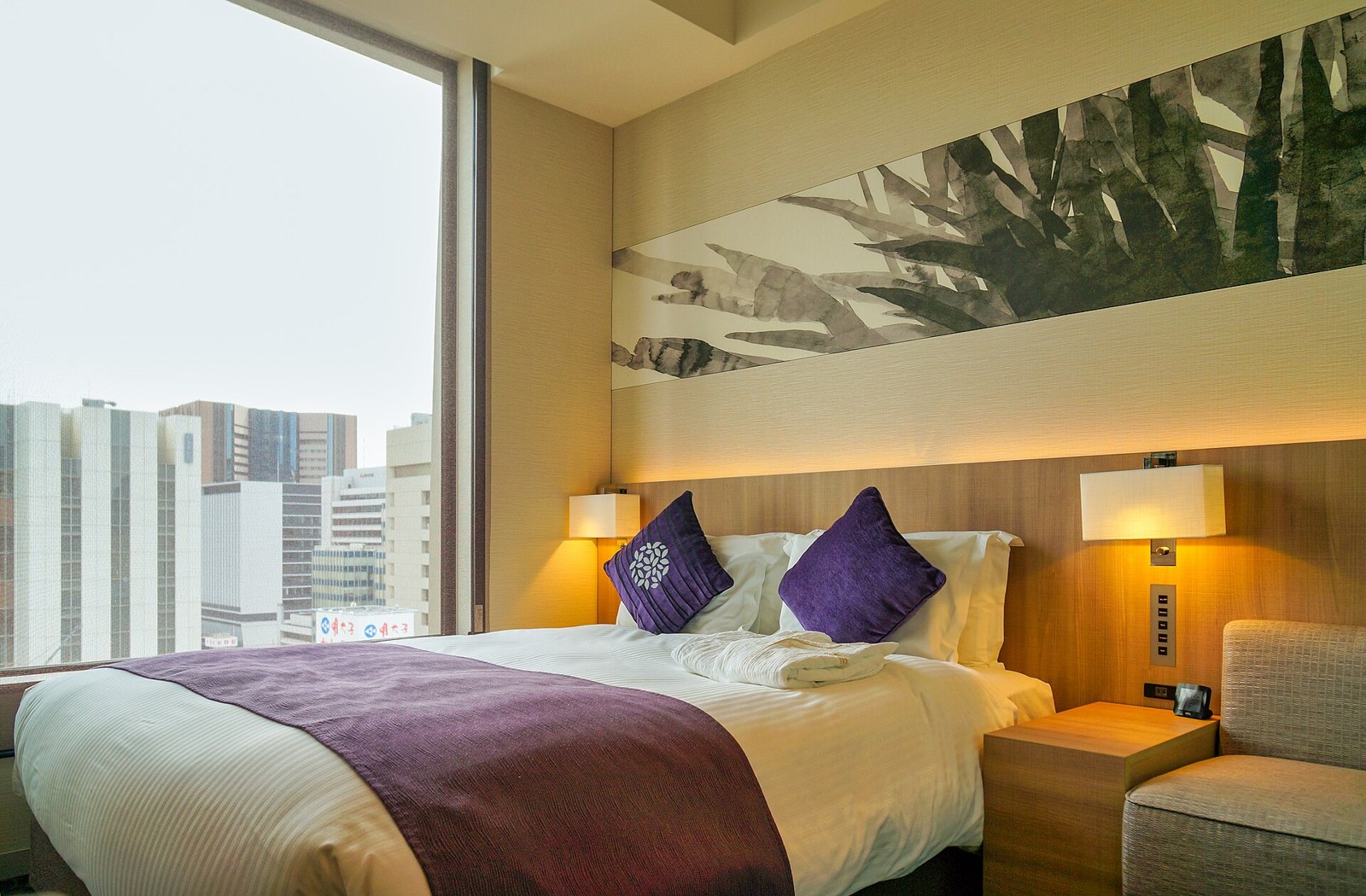
    Cover photo: a double room at Millennium Mitsui Garden Hotel Tokyo by J o, CC BY-SA 4.0, via Wikimedia Commons. It shows a different hotel from the places discussed.
  • Hotel Breakfast in Japan: What It Costs, What You Get and Whether to Add It

    Hotel Breakfast in Japan: What It Costs, What You Get and Whether to Add It

    At home, hotel breakfast follows a pattern you can predict. The cheap places set out coffee, a waffle iron and a basket of muffins, and a nicer hotel charges extra for a sit-down meal. It is natural to expect Japan to run the same way, with the business hotel handing you a muffin and the city hotel selling the real thing.

    The budget end doesn’t work like that. Toyoko Inn and Hotel Route Inn say breakfast is free, and so do two Super Hotel pages. What they offer is a buffet, rice balls or sandwiches. The paid breakfasts below start near $9 and climb past $40, and every figure is per person, so a two-person room doubles it.

    Prices below are converted at about ¥158 to the dollar (Trading Economics), so check the day’s rate.

    Three chains that say free

    Toyoko Inn’s English site says “Start the day right with healthy and locally-sourced original menus, all provided free of charge.” Its breakfast page names three styles: a “classic buffet-style breakfast,” “Stuffed Rice Ball Style” and “Assorted Sandwich Style,” and lists a daily selection of soups. Guests may carry the food up to their rooms, and children sharing a bed eat at no additional charge.

    As of October 2026, from Toyoko Inn: English home page and breakfast page.

    Super Hotel’s Shiba and Shinbashi pages both describe a free breakfast buffet with organic vegetable salad and baked bread. It runs 6:30 to 9:00 at Shiba. At Shinbashi it runs 6:30 to 9:00 Monday to Saturday and 6:30 to 9:30 on Sundays and holidays. The chain’s home page carries the line “オーガニックな健康朝食。無料でも妥協しません,” an organic, healthy breakfast that doesn’t compromise even though it’s free. Those are two hotels and a slogan, so check the page of the one you book.

    As of October 2026, from Super Hotel (in Japanese): Shiba, Shinbashi and the home page.

    Hotel Route Inn says guests get a free buffet breakfast with 30 or more items on the menu. The free offer has conditions. The chain says it applies at Hotel Route Inn, Court included, while Hotel Route Inn Grand, Route Inn Grantia and Arc Hotel get it free with a booking made on the official site. That is one of the plan differences between booking channels, which the booking sites comparison lays out.

    As of October 2026, from Hotel Route Inn: breakfast page (in Japanese).

    What the paid buffets charge

    Prices are per adult. Dormy Inn, Mets, Henn na and the Imperial label theirs as tax included, and the two Richmond hotels give no tax note. Children’s prices are listed separately, for example ¥1,200 for ages 3 through elementary school at Dormy Inn Ikebukuro and ¥1,000 for elementary-school children at Richmond Kinshicho.

    Hotel page Adult price Hours Style
    Dormy Inn Niigata (in Japanese) ¥2,000 ($12.70) 6:15 to 9:30 Japanese and Western buffet
    Dormy Inn Ikebukuro (in Japanese) ¥2,500 ($15.80) 6:30 to 10:00 Japanese and Western buffet
    Keisei Richmond Hotel Tokyo Kinshicho (in Japanese) ¥2,000 ($12.70) 6:30 to 10:00 Buffet
    Richmond Hotel Premier Kyoto Ekimae (in Japanese) ¥3,500 ($22) 6:30 to 11:00 Buffet with Kyoto dishes
    JR East Hotel Mets Shibuya (in Japanese) ¥1,980 ($12.50) 6:30 to 10:30 Japanese and Western buffet
    Henn na Hotel Komatsu Ekimae (in Japanese, February 2, 2025 notice) ¥1,400 booked by the day before, ¥1,500 same day ($9 to $9.50) 6:30 to 10:00 Set meals, Japanese or Western
    Imperial Hotel Tokyo, Imperial Viking Sal ¥6,800 ($43) 7:00 weekdays, 6:30 weekends, to 10:00 Buffet

    Where a last order is listed, it falls 30 minutes before the closing time in the table. The Imperial adds that its prices “are inclusive of consumption tax and service charge,” so nothing more goes on top. Its Tokyo Nadaman restaurant sells a Japanese breakfast at ¥5,800 ($37).

    Outside the Imperial, the paid prices cluster around ¥2,000, so five mornings for two comes to ¥20,000, about $127. Nothing in the table opens before 6:15, so an early train means a breakfast you’ve paid for or been given and can’t eat.

    Mostly buffets, and some set meals

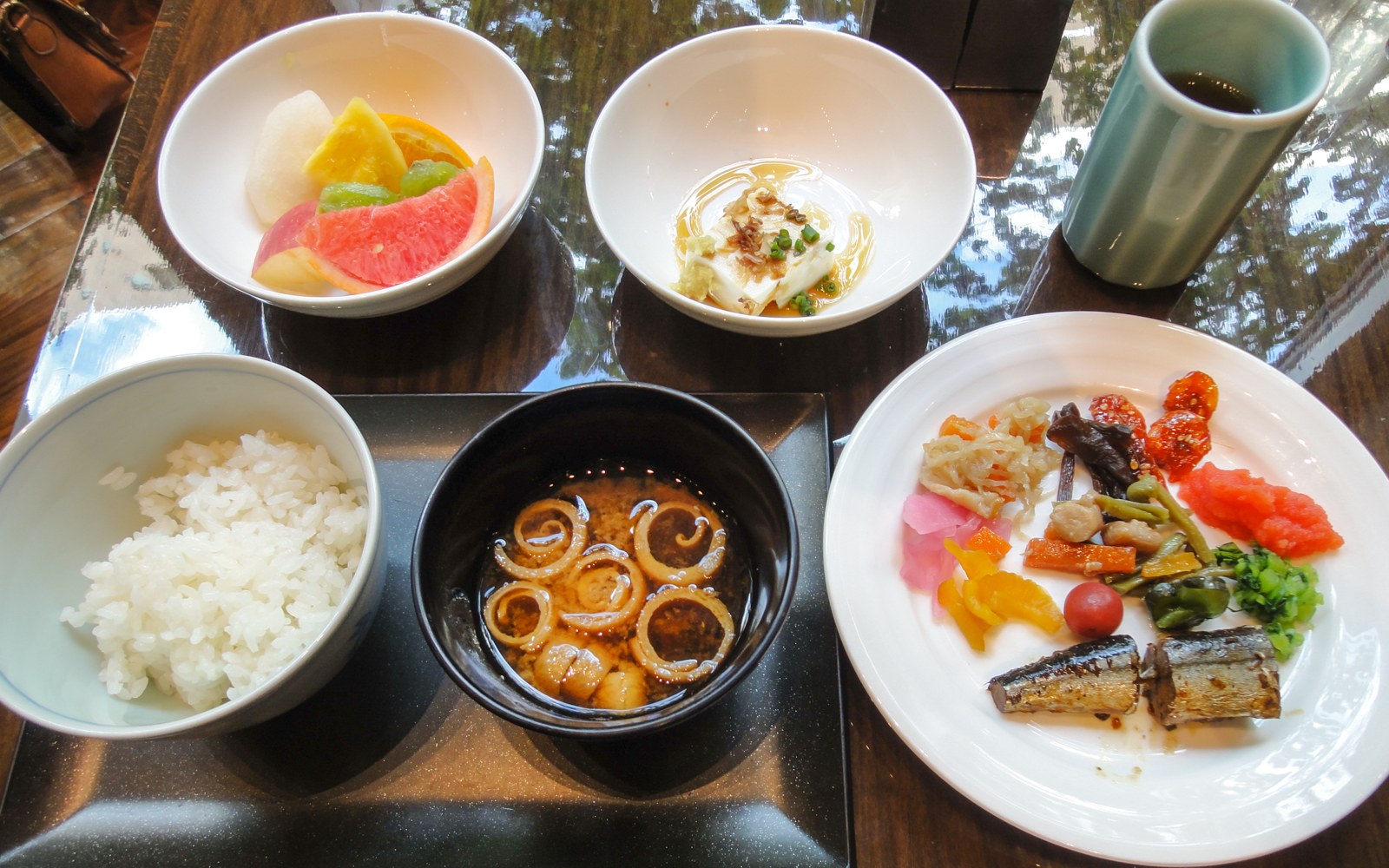
    Most are buffets. The exception is the Henn na Hotel, which lists two set breakfasts. The Japanese one is grilled fish, miso soup, pickles, two side dishes, salad, a raw egg and nori. The Western one is a hamburger steak with a roll, a boiled egg and salad, and a choice of coffee, apple juice or orange juice. The Imperial runs both styles, with the buffet above and a set Japanese breakfast at Nadaman where you choose grilled fish or chilled roast beef.

    Most of the buffets put Japanese and Western food side by side. The Mets FAQ says guests pick Japanese or Western by mood that day, and Dormy Inn calls theirs 和洋バイキング, a Japanese and Western buffet. Rice, miso soup and nattō are usually part of the Japanese side, and Super Hotel’s English site lists all three. There is no real equivalent of the American continental breakfast as a tier of its own. The lightest version is Toyoko Inn’s rice ball style.

    As of October 2026, from Super Hotel: English breakfast page.

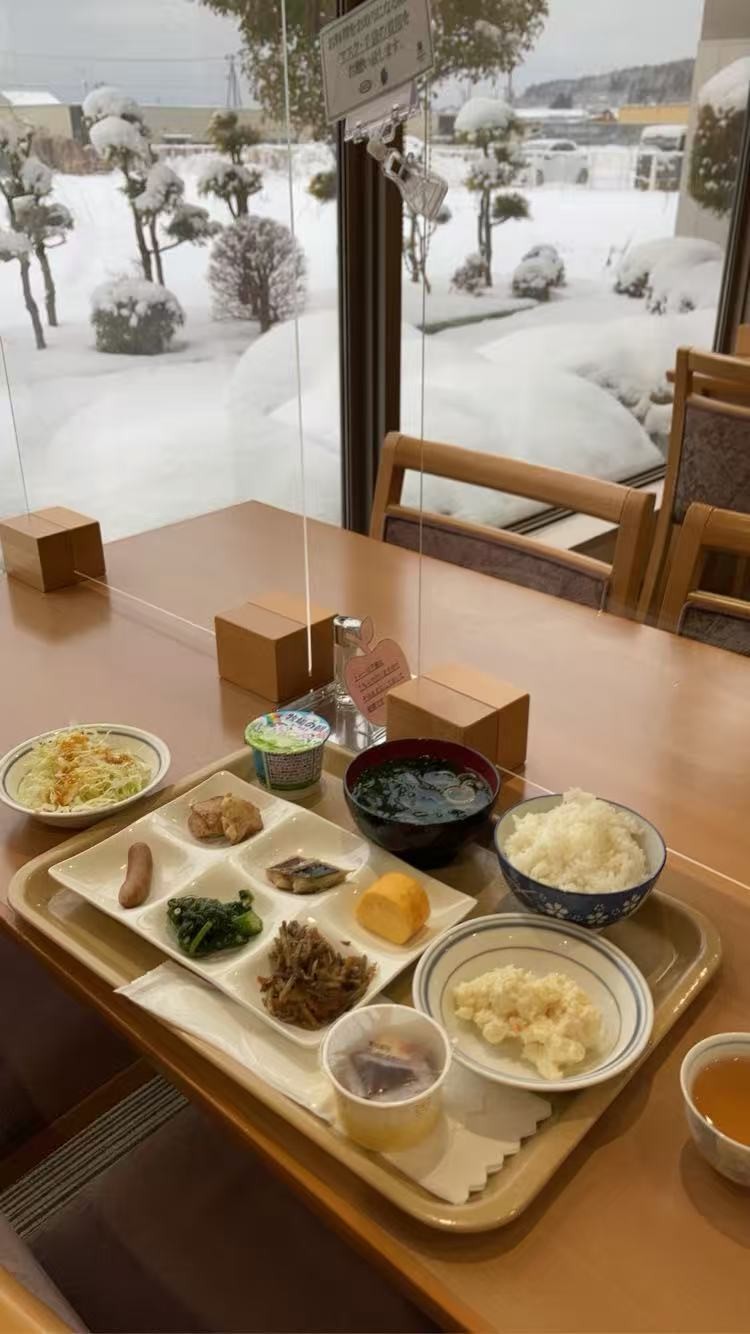
    A hotel breakfast on a tray by a window with snow outside: rice, miso soup, grilled fish, spinach, a sausage, rolled egg, salad and potato salad.
    A hotel breakfast tray, my photo.

    Reading the booking page

    Three labels cover most of what you’ll see. 朝食付き or 1泊朝食 means breakfast is in the price. 素泊まり (sudomari) or 食事なし means room only, which JTB defines as lodging without meals, at a lower rate. 1泊2食 is the ryokan-style bundle of dinner and breakfast. On JTB’s site, a plan with no meal mentioned is a no-meal plan.

    As of October 2026, from JTB (in Japanese): FAQ on meal plans and room-only page.

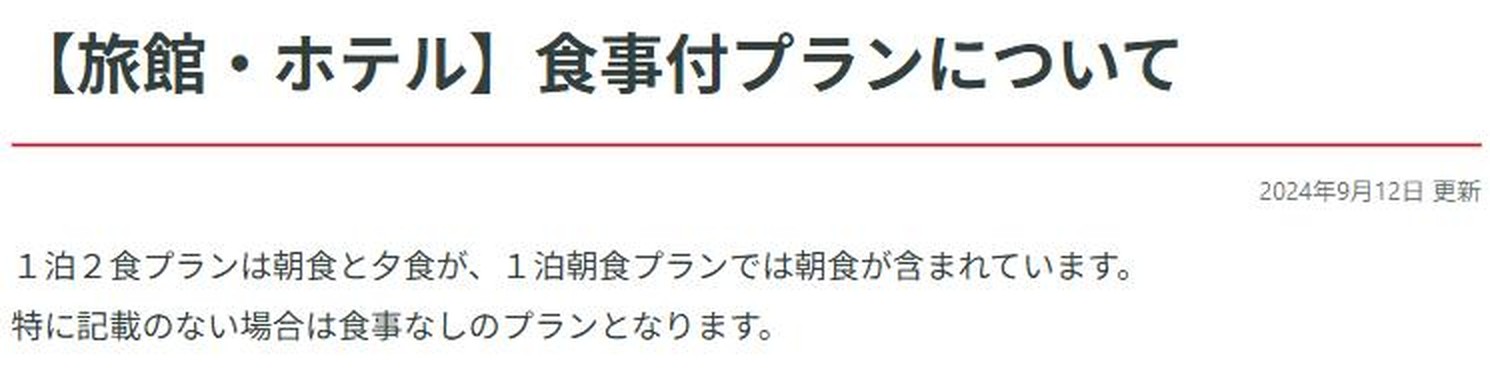
    JTB FAQ on meal plans: two-meal plans include dinner and breakfast, breakfast plans include breakfast, and a plan with no meal mentioned is a no-meal plan.
    JTB, FAQ on meal plans (in Japanese). Screenshot.

    That is JTB’s wording, and other sites lay it out differently. Booking.com’s FAQ says “Each room or accommodation you can book has its own breakfast policy. If breakfast is included, you’ll see it listed on the property page when you compare different options to book.” Two rooms in the same hotel can carry different breakfast terms, so read the line on the plan you pick and not the one on the hotel.

    You don’t always have to decide at booking. At Dormy Inn, guests on a no-breakfast plan can sign up at check-in and pay the breakfast price separately, with the price set by each hotel. A different hotel, the Henn na above, lists ¥1,500 for same-day sign-up against ¥1,400 booked by the day before.

    As of October 2026, from Booking.com: FAQ. From Dormy Inn: FAQ (in Japanese).

    Breakfast prices are per person, the same logic as in the per-person pricing article.

    If you have an allergy, ask before you book

    The Dormy Inn FAQ answers the allergy question directly: “当ホテルのお食事はバイキング形式でのご提供となるため、アレルギーに特化した個別メニューの作成や、特定食材を個別に除去したお料理の提供は行っておりません.” In English, because the meals are a buffet, the hotel does not make separate allergy menus or remove a specific ingredient from a dish. Dormy Inn Ikebukuro adds that the kitchen uses the same equipment and oil for nine allergens it names: egg, wheat, shrimp, dairy, crab, buckwheat, peanuts, walnuts and cashews.

    Compare that list with the FDA’s nine: “milk, eggs, fish, Crustacean shellfish, tree nuts, peanuts, wheat, soybeans, and sesame.” Dormy’s notice names buckwheat, which is not on the FDA’s list. It does not name fish, soybeans or sesame, and for tree nuts it names only walnuts and cashews. That does not mean those foods are absent. The notice is not a map of your allergy, so ask the hotel directly if yours isn’t on it.

    Dietary rules have the same problem. The tourism office’s vegetarian guide says to “say no meats, seafoods, or animal products including dashi or stocks” and warns of “hidden ingredients such as meat or bonito flakes.” It also says the sauce packed with ready-to-eat nattō is “often dashi (fish stock),” which matters if you plan to pick nattō up at a convenience store instead. For a strict allergy or diet, a room-only plan and packaged food may be the safer route. Japan’s Consumer Affairs Agency says mandatory allergen labeling applies to packaged processed foods, and it lists restaurant and prepared food in a separate section.

    As of October 2026, from Dormy Inn: Ikebukuro breakfast page (in Japanese). From the FDA: food allergies page. From the Japan National Tourism Organization: vegetarian guide. From the Consumer Affairs Agency: allergy labeling page (in Japanese).

    The convenience store alternative

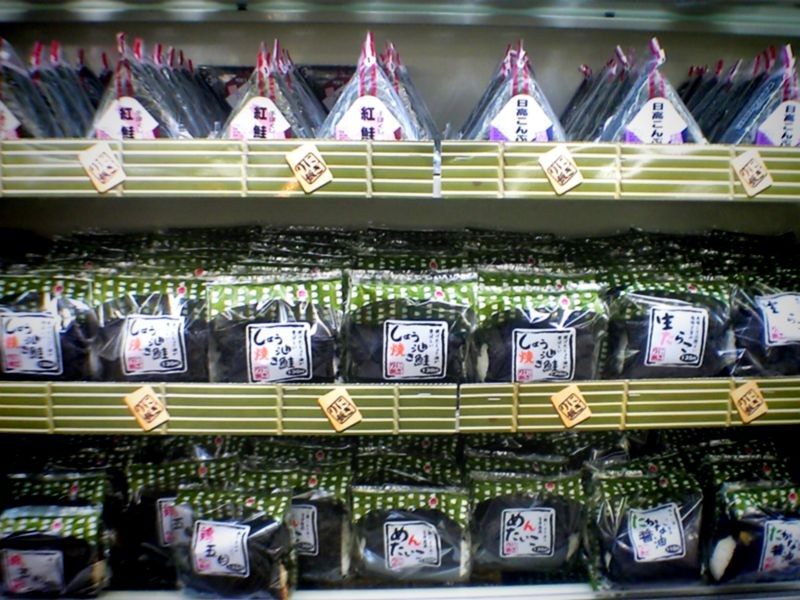
    Shelves of packaged rice balls in a Japanese convenience store.
    Rice balls on a convenience store shelf. Photo: typester / Wikimedia Commons / CC BY-SA 2.0.

    A 7-Eleven hand-rolled tuna mayo onigiri is ¥182 before tax (¥196.56 with tax). A hot Seven Café coffee in the R size is ¥130 (¥140.40 with tax). Together that is ¥337, about $2.10, and it is the floor: one rice ball and a coffee. A second hand-rolled onigiri adds ¥182 to ¥198 before tax at the standard price.

    For two people at the floor, that’s ¥674 ($4.30) against ¥5,000 ($32) at ¥2,500 a head, a gap of about $27 a morning.

    As of October 2026, from 7-Eleven Japan (in Japanese): tuna mayo onigiri, Seven Café and the September 24, 2026 price release.

    When breakfast earns its price

    If the hotel says it’s free, eat it. Check the start time first. A free breakfast you can’t reach before a 6 a.m. train gets you nothing.

    If it costs ¥1,400 to ¥2,000 ($9 to $13), you’re paying for a full buffet and for not having to hunt for food, against roughly $2 at the convenience store floor. That is a fair purchase if you value the time. At ¥2,500 and up, the buffet costs more than seven times the floor. On a company business trip I add breakfast. On my own trips I skip it when it costs extra and buy something at a convenience store.

    If you’re unsure, ask whether the hotel lets you add breakfast on arrival, which Dormy Inn’s FAQ says it does for no-breakfast bookings. With an allergy or a strict diet, get the answer from the hotel before you add it.

    The short version

    • Toyoko Inn and Hotel Route Inn say breakfast is free, as do two Super Hotel pages, and Route Inn’s Grand, Grantia and Arc hotels make it free with an official-site booking.
    • The paid buffets in the table run ¥1,400 to ¥3,500 per person ($9 to $22), and the Imperial Hotel Tokyo charges ¥5,800 to ¥6,800 ($37 to $43) with service charge included.
    • 朝食付き is breakfast in the price and 素泊まり is room only. Dormy Inn says its buffet can’t make allergy menus or remove an ingredient, so ask the hotel before you book.
    • One onigiri and a coffee at 7-Eleven is about $2.10, so a paid buffet buys variety and time.

    Cover photo: a Japanese-style breakfast at Hotel Niwa Tokyo by J o, CC BY-SA 4.0, via Wikimedia Commons, cropped.

  • Do You Tip at Japanese Hotels and Ryokan?

    Do You Tip at Japanese Hotels and Ryokan?

    At home, thanking a hotel employee means cash. A few dollars for the person who carries the bag, something left for housekeeping, a bit extra when someone fixes a problem. It is easy to land in Japan with that reflex loaded and spend the first night looking for the right moment to use it.

    At some Japanese hotels there is no such moment, because the thanks is a percentage on your bill. Two Tokyo hotels’ own terms say they decline tips on top of it. At traditional inns the envelope of cash does exist, with its own name and its own etiquette. The tourism office treats it as optional, and Hoshino Resorts says it doesn’t accept it.

    What the tourism office says

    The Japan National Tourism Organization says “it’s not common to tip for services such as those provided in bars, cafes, restaurants, taxis, and hotels.”

    JNTO mentions a custom called kokorozuke, “coming from the heart.” It says a private guide or interpreter accustomed to overseas practices may accept a tip, but that tipping “is not expected and should be done discreetly, even in these cases.” It adds that a gratuity is customarily put in an envelope, sold at convenience stores, stationery stores and 100 yen stores. None of this is about hotels or ryokan, and the hotel gives no amount.

    As of October 2026, from JNTO: tipping page.

    Don’t add a tip to a service charge

    At Okura Tokyo, the room charge carries a line reading “Service Charge (①×15%),” and the 10% consumption tax is figured on the room charge plus that service charge. Food and drink get their own 15%. Then the hotel says: “Since a 15% service charge is added to your bill in addition to taxes required by law, it is our policy to decline tips and other gratuities.”

    The Okura Tokyo accommodation contract, item 7: since a 15% service charge is added to your bill in addition to taxes required by law, it is the hotel policy to decline tips and other gratuities.
    Okura Tokyo, accommodation contract, item 7. Screenshot.

    On a ¥30,000 base room charge, 15% service makes ¥34,500 and 10% tax on that makes ¥37,950, about 26.5% more. At roughly ¥158 to the dollar, that is about $240 for a room that looked like $190.

    The Imperial Hotel Tokyo’s terms have a matching rule in its house regulations, under Settlement of Accounts: “Individual tipping is not accepted in lieu of the standard 10% Service Charge added to bills in addition to government taxes.” Its Addendum Table No. 1 for lodging lists “Service Charges (1×15%).” The hotel gives both numbers and does not say which applies to a room. A guide’s general “10 to 15%” can’t tell you which one you will be charged, so read the hotel’s own page.

    As of October 2026, from the Okura Tokyo: accommodation terms. From the Imperial Hotel Tokyo: terms page. Dollar figures calculated at about ¥158 to the dollar from Trading Economics.

    How the price label reads

    On a Japanese booking page the label decides what you will pay at the desk. JTB’s FAQ on displayed rates describes two labels. One is “税込・サービス料込,” meaning consumption tax and service charge are in the displayed price. The other is “税込・サービス料無,” meaning tax is in and the lodging says “サービス料はいただきません,” roughly “we do not take a service charge.” The same FAQ says bathing tax and accommodation tax are not in the displayed rate.

    Two ryokan pages use the first label. Takinoya’s listing on the Japan Ryokan & Hotel Association’s English site says “The standard charge above is including the consumption tax and the service charge.” Houshi Ryokan’s FAQ says its displayed rates are “消費税込み・サービス料込み,” tax and service charge included, and that bathing tax is separate at ¥150 per adult, about $0.95.

    As of October 2026, from JTB: FAQ on displayed rates (in Japanese). From the Japan Ryokan & Hotel Association: Takinoya listing. From Houshi Ryokan: FAQ (in Japanese).

    Page Service charge Tips
    Okura Tokyo, accommodation terms Added, 15% on room and on food and drink “Our policy to decline tips”
    Imperial Hotel Tokyo, terms Added, 15% in the billing table, 10% in the house regulations “Individual tipping is not accepted”
    Hoshino Resorts, FAQ and regulations Not stated on those pages Not accepted, staff not permitted to accept gratuities
    Takinoya, ryokan listing Included in the listed rate, no percentage Not mentioned
    Houshi Ryokan, FAQ (in Japanese) Included in the displayed rate, no percentage Not mentioned

    Sotetsu Hotels’ English column calls the standard hotel charge “around 10 to 15 percent of the basic rate.”

    At the three or four inns I’ve stayed at, no service charge or tip appeared as a separate line on the bill.

    Sotetsu calls the service charge “the equivalent of a ‘tip’ in the West,” introduced instead of one. A hotel-business consultancy’s note says the opposite: “サービス料=チップ” is a common misconception, and the charge is really “接客・清掃・設備維持のための運営費,” operating costs for service, cleaning and upkeep.

    As of October 2026, from Sotetsu Hotels: column. From a hotel-business consultancy: note (in Japanese).

    What you may still pay at the desk is tax. Tokyo’s accommodation tax is per person per night: free under ¥10,000, ¥100 from ¥10,000 to ¥14,999 (about $0.63) and ¥200 from ¥15,000 (about $1.27). From April 1, 2027, Tokyo moves to a 3% rate on room rates above ¥13,000. At the inns I’ve stayed at, I paid bathing or accommodation tax at check-in at some and at check-out at others. The ryokan hour-by-hour article covers that desk payment and who you actually meet during a stay.

    As of October 2026, from the Okura Tokyo terms linked above and LoyaltyLobby.

    The envelope at the ryokan

    Kokorozuke (心づけ) is the one custom here with real history behind it. You Times, a travel media site, says it is wrapped in a small envelope and usually handed over when you are shown to your room. It also says: “断られても失礼ではなく、施設の規則だと考えてかまいません,” roughly “if it is refused, that is not rude, and you can take it as the facility’s rule.”

    As of October 2026, from You Times (in Japanese): kokorozuke article.

    How many inns decline depends on who you ask. A hotel-industry column from Omotenashi HR says: “ただし現在は、心付けを辞退するポリシーを設けている旅館が大半を占めています,” roughly “today, however, most ryokan have a policy of declining kokorozuke.” The sentence cites no count. Hoshino Resorts, which runs ryokan under its KAI brand, answers the question “Are tips required at hotels?” in its FAQ with “Tipping is not accepted at Hoshino Resorts in Japan. We appreciate your understanding.” Its hotel regulations say “The Hotel staff are not permitted to accept gratuities.” In the English-language forum thread quoted in the ryokan article, regulars say they always tip at inns, and one reply says some inns don’t accept it as a rule.

    As of October 2026, from Omotenashi HR: column (in Japanese). From Hoshino Resorts: KAI brand, FAQ and hotel regulations.

    Two Japanese columns treat kokorozuke as thanks for a special favor, such as caring for babies or small children, allergy handling, special pick-ups, room upgrades, older guests or anniversary requests, not a routine. Both put the guideline near a tenth of the stay’s cost, and Diamond adds that no amount is fixed and that skipping it does not lower your service. Neither says whether the tenth applies to the whole party’s bill or to one guest’s rate. On a ¥40,000 bill for the room, a tenth is ¥4,000, about $25. Many Japanese plans are priced per person, which changes what “the bill” means, as the per-person pricing article explains.

    As of October 2026, from Diamond Online and All About (both in Japanese). The ¥4,000 is calculated.

    If you decide to give one, put it in an envelope, as is customary. Whether a particular inn takes it, only that inn’s own pages or staff can say.

    Bell staff, housekeeping and room service

    Bell staff: the three hotels above all decline tips. The Imperial’s FAQ says “We shall be pleased to take care of your luggage at the Bell Captain’s Desk,” and the hotel lists no fee for it.

    Room service: the Imperial says “Prices are inclusive of consumption tax and service charge.”

    Housekeeping: none of the hotels cited asks for a tip.

    Budget chains: Dormy Inn’s Japanese FAQ has no tipping or service-charge entry. For business hotels in general, the tourism office’s line that tipping is not common in hotels is the rule to go by.

    As of October 2026, from the Imperial Hotel Tokyo: FAQ and room service page. From Dormy Inn: FAQ index (in Japanese).

    Thanks that doesn’t involve cash

    If someone was kind to you and you want it to count, the Japanese media pages point to the same few things. You Times suggests telling the front desk the staff member’s name at checkout, leaving a note, and writing specifics in the review on your booking site. The Omotenashi HR column lists spoken thanks at checkout and online reviews that name staff members. At the inns I’ve stayed at, I never handed over kokorozuke, and when I want to thank staff I say it out loud.

    The short version

    • No tipping is expected at Japanese hotels or ryokan. Okura Tokyo, the Imperial and Hoshino Resorts each say they decline or don’t accept tips.
    • Service charges appear as a percentage on the bill or already inside the rate: 15% at Okura Tokyo, and both 10% and 15% on the Imperial’s page.
    • Kokorozuke at a ryokan is optional, usually given in an envelope when you are shown to your room, and some inns refuse it.
    • Read the price label for “サービス料込,” and budget for bathing or accommodation tax at the desk, which is a tax and not a tip.

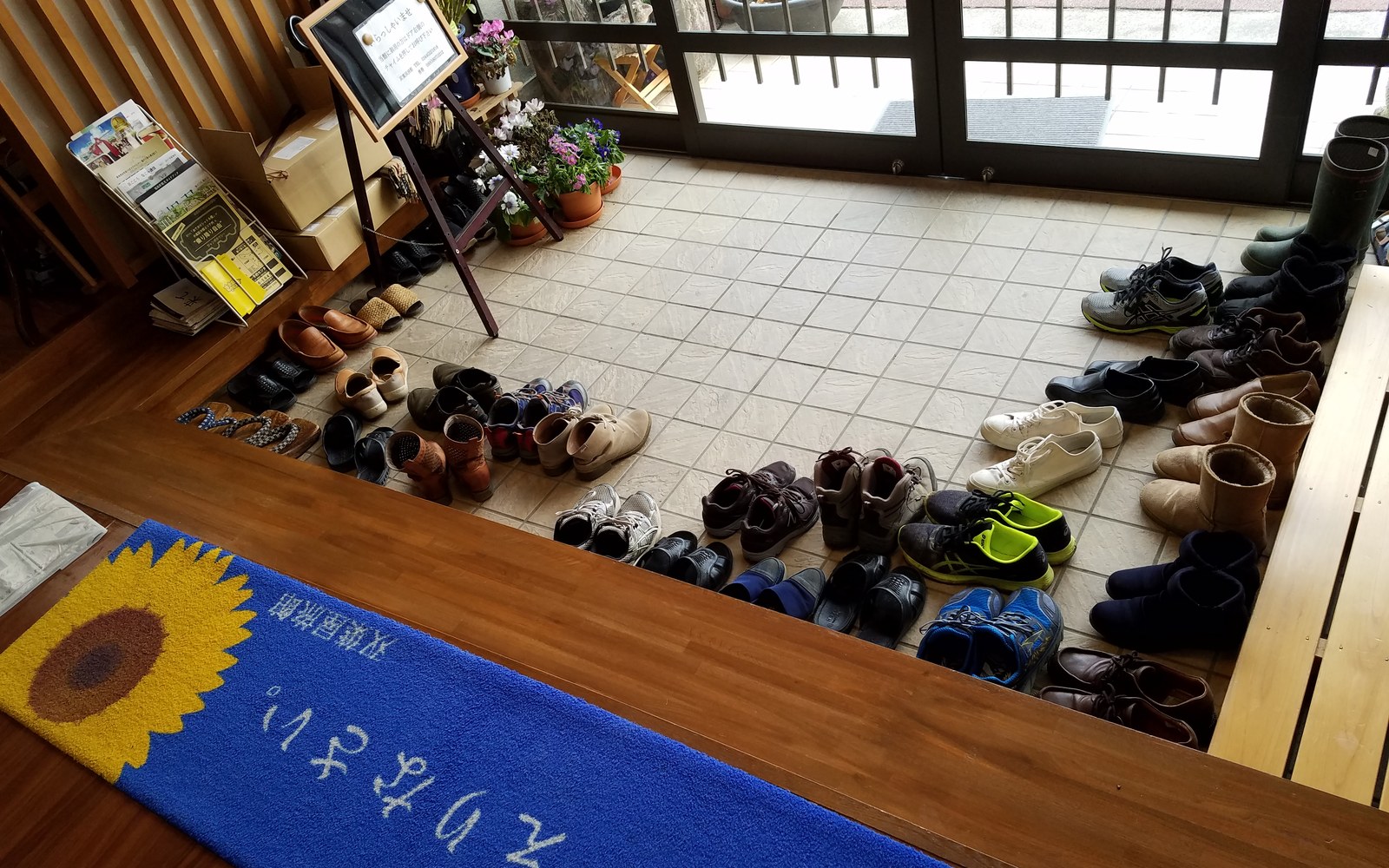
    Cover photo: the entrance of a ryokan in Minamisoma, Japan, by Hajime NAKANO, CC BY 2.0, via Wikimedia Commons, cropped.