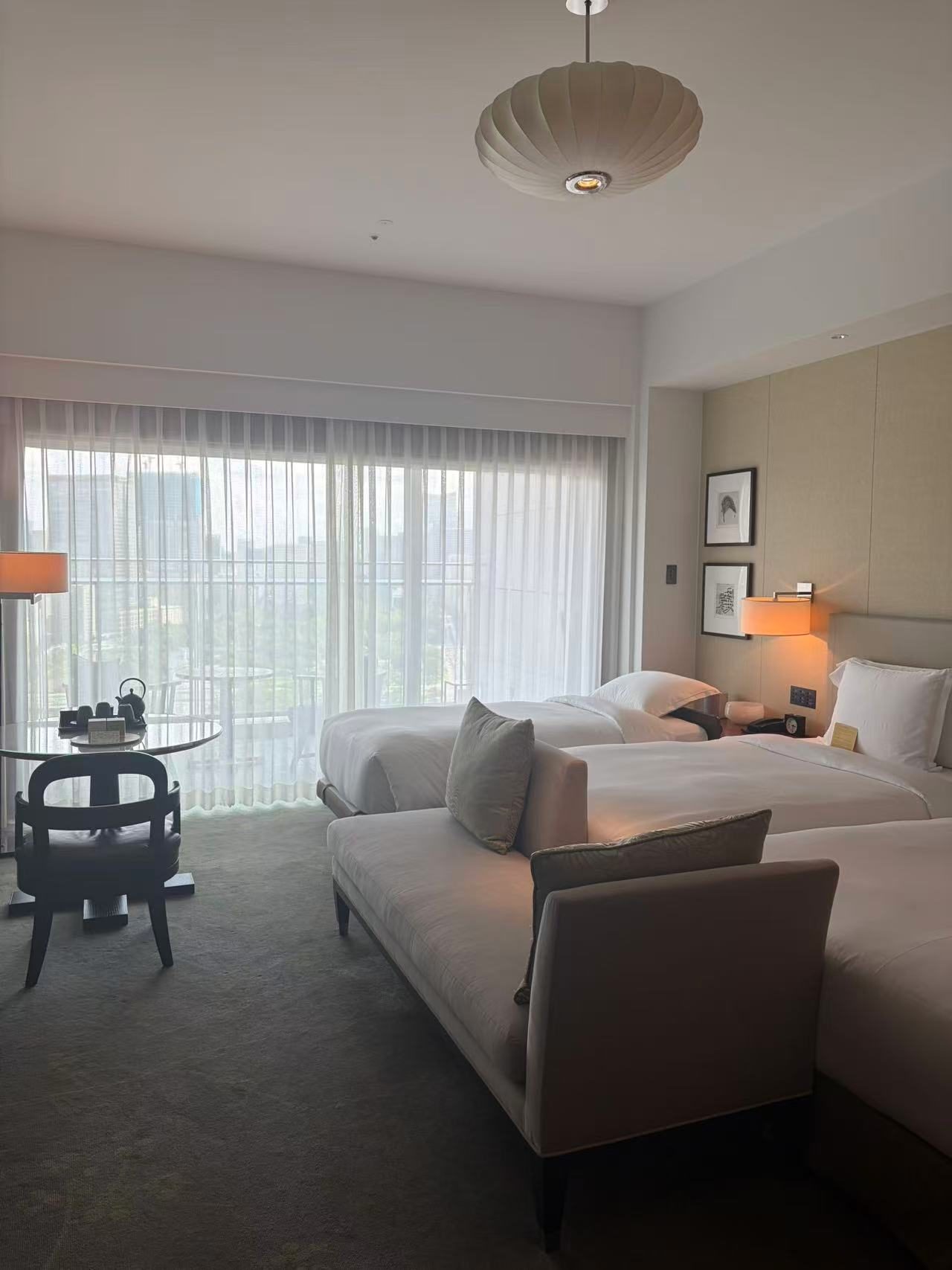
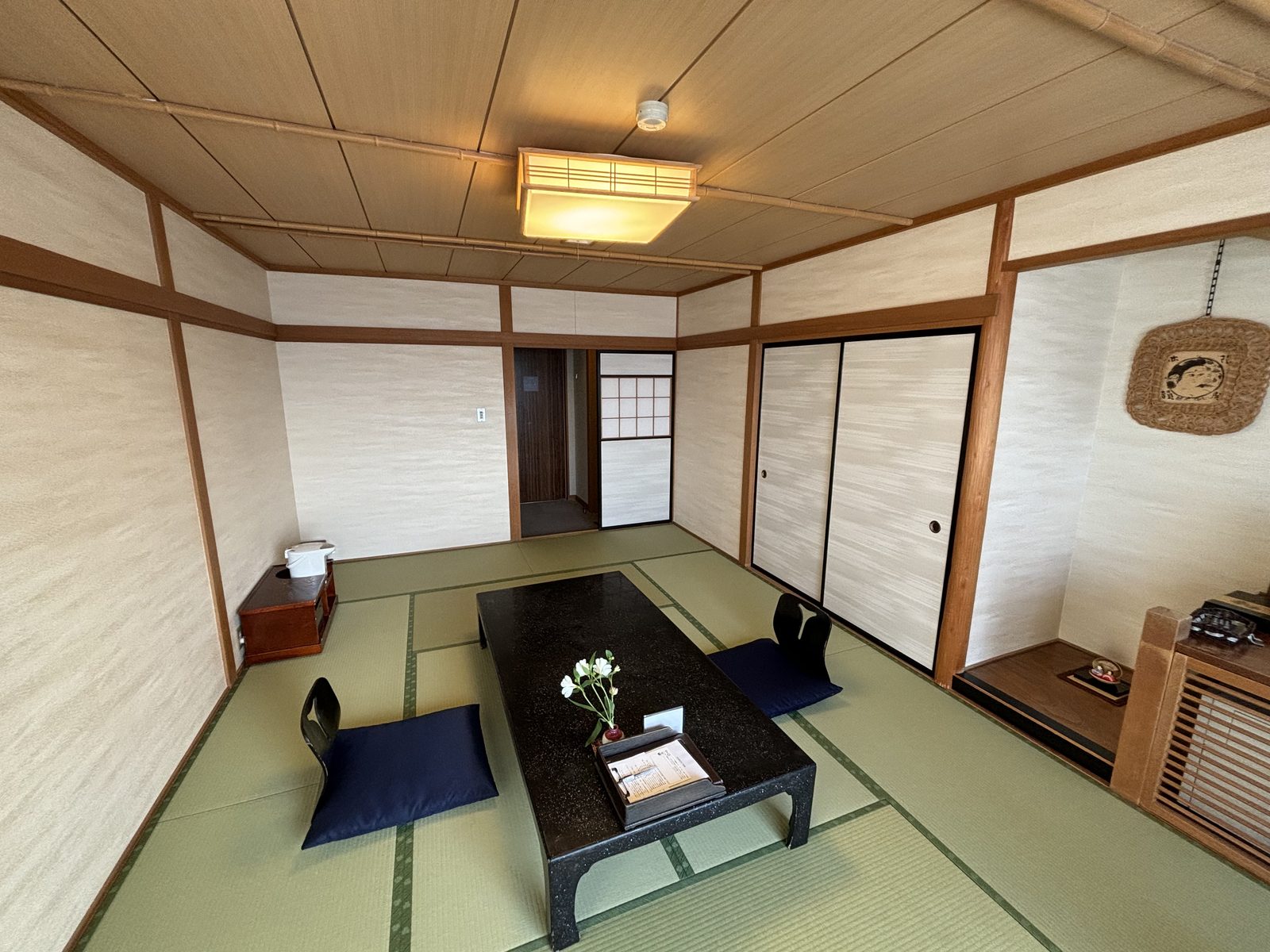
In the US, the price on a hotel screen is for the room. Food is a separate decision, taxes show up later, and nobody asks how many people are staying until you check in. A ryokan rate breaks all three habits at once. The number is usually per person. Meals are usually inside it, dinner and breakfast on some plans and dinner only on others. Whether tax and service charge are inside too depends on the inn.
So a ¥50,000 ryokan rate and a room-only hotel rate are not the same kind of number.
What one rate bundles
At the inns I’ve stayed at, check-in was generally from 3 p.m. Dinner is typically a time slot the inn offers or assigns at booking, and at many inns the futon goes down during dinner. A per-person rate plausibly covers a meal for each guest, bedding for each guest, and staff time spent turning the room over. Neither inn’s page says so.
The article on per-person pricing covers why the unit is the guest. What matters here: the number on screen contains goods and services, not just a room. A fair comparison with a hotel has to add the hotel’s meals back in. For how dinner timing gets set, see the hour-by-hour article.
Neither inn splits its rate into room, dinner and service. The inns do show where the price moves.
The fine print under the table
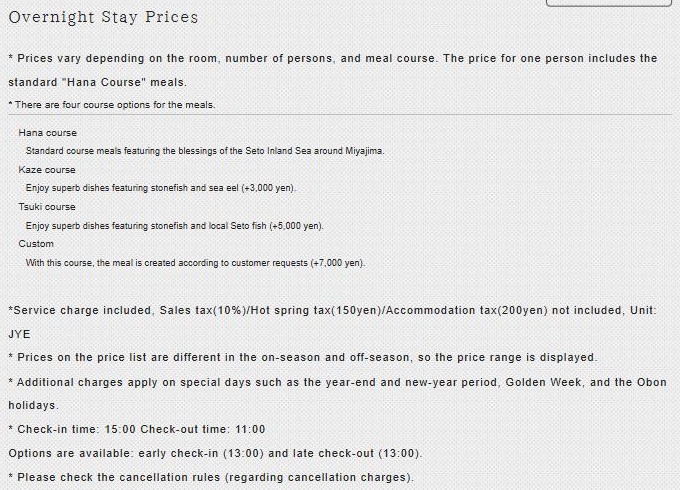
SEKITEI English rate page, notes under the price table.
SEKITEI, an inn in Hiroshima Prefecture, prints these notes under the price table. The first line says “The price for one person includes the standard ‘Hana Course’ meals,” so the unit and the food come before any number. Next it lists three upgrade courses at +¥3,000, +¥5,000 and +¥7,000, so the meal is a choice inside the rate. Then the line that matters most for your budget: “Service charge included, Sales tax(10%)/Hot spring tax(150yen)/Accommodation tax(200yen) not included.”
Then the calendar. Prices differ between on-season and off-season, extra charges apply around year-end, Golden Week and Obon, check-in is 15:00 and check-out is 11:00, and early check-in (13:00) and late check-out (13:00) are offered as options. The page ends by pointing to the cancellation rules.
Hakone Ginyu puts it in one sentence: “The rates shown are for one person per night with two meals (including service charge, tax, and bath tax).” It lists rate categories A to E by season and sends you to a calendar for the amounts. Its stated cancellation fees are 30% from three to two days before arrival, 50% the day before, and 100% on the day.
SEKITEI includes service charge but leaves out the 10% sales tax, the hot spring tax and the accommodation tax. Ginyu says its rate includes service charge, tax and bath tax. At the inns I’ve stayed at, service charge or tipping never showed up as a separate line on my bill, which fits SEKITEI’s “Service charge included.” The same word “included” covered different things on each page, so two ¥50,000 rates are not comparable until you read the sentence under each.
The hot spring tax (入湯税, nyuto-zei) is 150 yen per person per day as the standard under the law, with each municipality setting its own rate. The facility operator pays it to the municipality on behalf of guests. When I’ve paid these taxes, it was at check-in at some inns and at check-out at others.
SEKITEI lists an accommodation tax of 200 yen without saying whether it is per person or per room. Assume 150 yen per person for the hot spring tax (the Ministry’s description) and 200 yen per person for the accommodation tax. SEKITEI lists the room Anan, which sleeps two, at ¥52,000~ per person on weekdays, so two guests is ¥104,000 before tax. Add 10% sales tax (¥10,400), ¥300 of hot spring tax and ¥400 of accommodation tax, and the total is about ¥115,100, roughly 10.7% on top of a listed price that ends in a tilde. This shows the shape of the gap, not a quote.
Price levers
SEKITEI’s table lists twelve rooms per person with half board, service charge included. Three things move the price on this page.
Room. Weekday prices are listed from ¥39,000~ (Koseki, which sleeps three) to ¥52,000~ (Taikan, which sleeps eight, and Anan, which sleeps two).
Day of the week. For the same room, the Saturday and day-before-holiday price is ¥10,000 to ¥17,000 higher per person across the twelve rooms. Yusen goes from ¥51,000~ to ¥66,000~.
Meal course. The upgrades are +¥3,000, +¥5,000 and +¥7,000, in the table’s unit.
On this page the meal course is the smallest of the three levers, though the inn doesn’t say whether the upgrade is per person.
Room bath
Some plans add a private bath in the room, usually at a higher rate. At the inns I’ve stayed at, I go to the large bath even when the room has a bath, unless the room bath is open-air or hot spring. Check what kind of bath the plan actually includes before paying the difference.
The hotel number you’re used to is tied to the room, with meals as a separate line. A ryokan’s number is tied to the guest and arrives with the meals. To compare, build the hotel’s equivalent: the room, plus dinner somewhere, plus breakfast, plus tax. For which type fits your trip, start with the where-to-stay article.
Booking-page checklist
Check these five things on the page before you decide:
The unit. “Per person” or “per room,” and whether the table assumes two guests sharing.
The meals. Which course the base price includes, and what the upgrades cost.
The tax and service line. Which of service charge, sales tax, hot spring tax and accommodation tax are inside the number.
The calendar. Weekday against Saturday, and the named high-season dates.
The clock. Check-in and check-out times, and whether early or late options cost extra.
Cancellation rules sit next to these. SEKITEI links to them and Ginyu states them on the page. Read them before you pay, because the meals are part of what you’d be cancelling.
The short version
A ryokan rate is a per-guest figure that bundles the room, meals and service, while a hotel rate is typically a room figure with meals on a separate line. Read the note block under the table first, because it tells you whether service charge and taxes are inside. At SEKITEI, Saturday and day-before-holiday add ¥10,000 to ¥17,000 per person, the course upgrades add ¥3,000 to ¥7,000, and weekday rooms differ by up to ¥13,000.
1. You have two tabs open and the numbers don’t match
Same hotel, same night, and as far as you can tell the same room. One tab says ¥24,513, about $163. The other says ¥31,500, about $210. That is 28.5% more, and the obvious next move is to work out which screen is lying to you.
Neither was. Add back the tax that one screen leaves out, and the four numbers collected for that room fall into two tiers: the hotel’s standard rate and a discounted rate, and the hotel’s own site was selling both. The tiers are ¥4,725 apart, about $32. The missing tax is ¥2,451, about $16.
Each storefront decides what goes inside the number it prints, and the six covered here do not agree. The prices are for one night in November 2026 at two Tokyo hotels: the Sotetsu Fresa Inn Tokyo-Kyobashi and the Dormy Inn Korakuen. Yen convert at ¥150 to the dollar, so check the day’s rate. I spent more than twenty years in Japan and I book from the US now.
Each price is a single reading of a screen that can change.
This article does not say which site is cheapest, because the same plan was not lined up across the six.
2. One room, four numbers
The room is the EXPRESS Single at the Sotetsu Fresa Inn Tokyo-Kyobashi, a business hotel, which in Japan means a small, cheap, station-adjacent room rather than anything upmarket. The pillar article covers what you get. The hotel lists about 137 ft² (12.7 m²), one 47-inch (120 cm) bed, a shower booth, no tub, non-smoking. The night is November 18, 2026, one adult, one room.
Sotetsu Fresa Inn Tokyo-Kyobashi EXPRESS Single. Quoted from the official page (link). Copyright belongs to the owner.
Where the room was priced
The number on the screen
What that number contains
Hotel’s own site, member rate
¥26,775 (about $179)
consumption tax and service charge included
Hotel’s own site, standard rate
¥31,500 (about $210)
same
Jalan, cheapest plan
¥31,500 (about $210)
column headed per adult, tax included
Booking.com
¥24,513 (about $163), struck through from ¥34,045 (about $227)
breakdown box reads: excluded, 10% consumption tax, plus a 10% Genius discount line
Jalan’s cheapest plan and the hotel’s standard rate match to the yen.
Booking.com prints its own tax answer in a breakdown line under the price. Add that 10% back to ¥24,513 and you get ¥26,964 (about $180), only ¥189 from the hotel’s member rate of ¥26,775 (about $179). That is 0.7%. The same box lists a 10% Genius discount applied before tax, on a signed-out screen. So ¥24,513 is a discounted tier reachable without an account, and it lands beside the hotel’s own member rate.
Two of the four numbers were the standard rate and two were a discounted tier. The tax was inside three of them and outside one. Both differences are doing work. The site labels the whole markdown as 28% off in a year-end sale, with no split showing how much is the Genius line.
Booking.com’s figure also moves. On September 27, 2026 the same signed-out screen read ¥27,236, about $182, struck through from the same ¥34,045 and now labeled 20% off. That is 11.1% above the figure a week earlier, so reopen both tabs if a day has passed.
The Japanese Booking.com listing calls it an “economy semi-double room, with shower room, non-smoking.” That fits the EXPRESS Single’s shower booth, and the hotel’s other single rooms have tubs. The bed itself came back under five wordings, from single to semi-double, and Japanese Hotel Rooms Decoded takes that apart.
3. What each of the six storefronts is counting
The six are the two hotels’ own sites, Jalan, Rakuten Travel, Booking.com and Ikyu. Five said what their figure counts on the first screen where a price appeared. Booking.com did not. Searched for one adult, it printed no party size next to the price, and the rate table had no column for one. The “Number of guests” column appeared only at two.
One adult.Two adults: the price moves from ¥27,236 to ¥29,143.
Storefront
What it says the figure is
Dormy Inn, own site
Per adult where you pick the room, consumption tax included, lodging tax and bathing tax charged separately depending on the hotel. One click on, at plan selection, the notice called the price the total
Sotetsu Fresa Inn, own site
The total for the party size, labeled “total, adult x 1, one night’s charge,” consumption tax and service charge included
Jalan
Two columns: one headed per adult, tax included, one headed total, tax included
Rakuten Travel
Two figures: a total headed “adults x 2, one night’s charge, tax included,” and at two adults a per-person line under it
Booking.com
Per night, with no party size printed at one adult. Breakdown box: 10% service charge included, 10% consumption tax excluded
Ikyu
The total for the party size, tax included, written into the price string (“no meals, 2 people, tax included”). The search box defaults to two adults
The split had nothing to do with where a site is from: Japanese sites did not all quote per person, and foreign sites did not all quote per room. Three printed the total for the party size: Booking.com, Sotetsu and Ikyu. Booking.com goes in that group on its prices rather than its wording, since ¥27,236 for one adult and ¥29,143 for two is neither twice the first figure nor half the second. One printed a single adult’s share, the Dormy Inn site. Two printed both figures at once, Jalan and Rakuten.
The hotels’ own sites were no plainer. Sotetsu labels its figure a total, while the Dormy Inn site says per adult where you pick the room and total a click later. Ikyu decides before you do. Its row for the Sotetsu room read “no meals, 2 people, tax included, from ¥12,084” (about $81), with the search box already on two adults and no dates set. That is a two-person price until you change the box.
At one adult, the per-adult figure and the total are the same number. A second person pulls them apart, and the second adult cost well under double. With the room held still, the second adult added ¥450 (about $3, or 1.9%) on the Dormy Inn site’s room-only plan at the Korakuen. On Booking.com the second adult added ¥1,907 (about $13, or 7.0%). On Ikyu it added 10.0% to 15.4% across five Sotetsu room types. Why Japanese Hotels Price Per Person explains the per-person unit.
Jalan’s English fee page defines both columns as fees “per room per night” and adds: “Both 1) and 2) are the charges displayed just to give you rough ideas for comparison.”
The Sotetsu booking engine can open in US dollars, and reopening the same address after switching to yen returned dollars again, so check the currency before comparing. Booking.com sometimes answered a request for English with a Japanese page, so check the language too.
4. One site, several prices for the same room
The comparison can come apart inside a single site, before you open a second tab. The EXPRESS Single, that night, one adult, came back on Jalan as six rows: ¥31,500, ¥32,985, ¥33,250, ¥34,817, ¥35,000 and ¥36,650, roughly $210 to $244. Cheapest to dearest is ¥5,150, about $34, or 16.3%, for the same bed, room and night.
The second hotel did the same on a different site. On Rakuten Travel, the Corner Twin at the Dormy Inn Korakuen, 347 ft² (32.2 m²), came back that night at ¥27,120, ¥29,380, ¥31,640 and ¥33,900, about $181 to $226. Low to high is 25.0%.
What moves is the plan, which is the actual product on sale. On these two pages the rows differed on whether breakfast is included, whether you can cancel, whether you prepay or settle at the property, and whether points are involved. Some of that is printed on the row and some sits two clicks down. The top row on one site and the top row on another are two products picked by two different sorting rules.
5. The lodging tax sits outside the price
Both hotels’ own sites said consumption tax is inside their prices and the lodging tax is not.
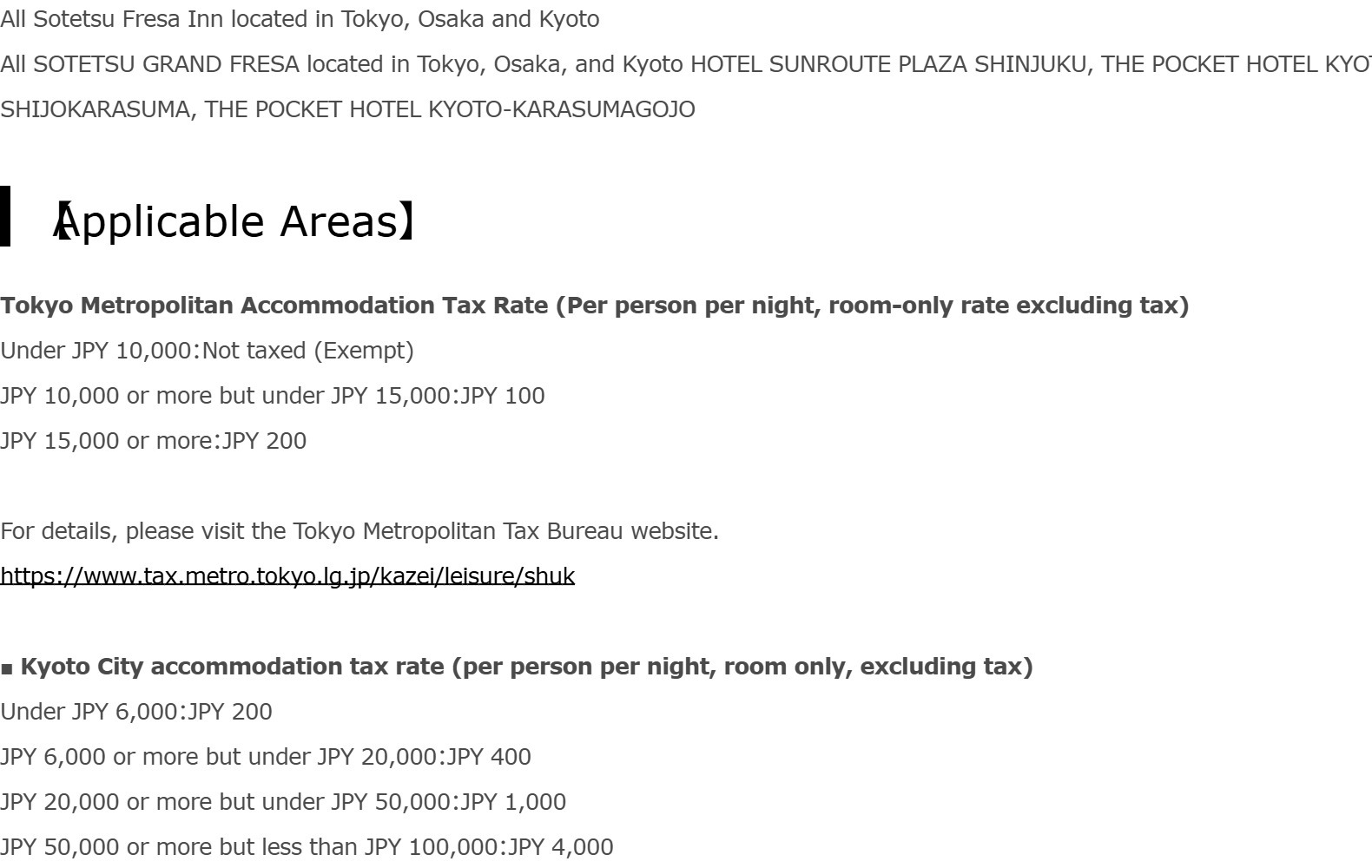
From March 1, 2026, the Sotetsu chain’s lodging tax at its properties in Tokyo, Osaka prefecture and Kyoto City moved from inside the displayed price to on top of it. The cutoff runs on the booking date, not the stay date, so a booking made now falls on the later side. The chain’s notice closes the loophole in a line of its own: “Please note that for reservations already paid in advance, the lodging tax will also be collected separately at the property.”
As of September 2026, from Sotetsu Hotels (in Japanese): lodging tax notice.
Sotetsu Hotels notice, English version.
The tax depends on the city and on the room charge before consumption tax. For the room in section 2 that is ¥28,636 (about $191) of the ¥31,500. At that charge Tokyo’s table sets ¥200 per person per night (about $1.30), and Kyoto City’s sets ¥1,000 (about $6.70) for charges from ¥20,000 up to but not including ¥50,000. That is five times the tax on the same room charge. Tokyo, Osaka prefecture and Kyoto City are three separate local governments, so one city’s figure is no guide to another’s.
A price marked tax included can still have a line after it. I’ve paid for an inn stay online and still had the bathing tax to pay at the property on the day.
6. A phishing warning about Booking.com reservations
The Dormy Inn Korakuen’s own website carries a notice dated May 22, 2026 and marked important. The body reads: “We have confirmed instances in which suspicious messages are being sent to some customers who reserved this hotel through the online booking site Booking.com, using messaging apps such as WhatsApp, posing as confirmation of the reservation and asking them to enter credit card details. These messages contain URL links leading to malicious phishing sites.”
The notice does not say Booking.com sent the messages. It says guests who booked through that channel are the ones being targeted, and it is one hotel’s notice.
As of September 2026, from Dormy Inn Korakuen (in Japanese): phishing notice.
A booking made through a third party creates a second channel of communication about that stay, and a fake message there is harder to tell from a real one. Treat a request for card details that arrives in a messaging app after you have paid as fake. Confirm with the hotel only on a number or address you found yourself. If you have already typed card details into one, call your card issuer first, not the hotel.
7. What to check before you book, in order
Two tabs, and you want to close one. This is the order I’d go in, and the first four are the steps that moved the number.
1. Enter the real number of people first. Everything below assumes both screens show rooms for the party actually coming. With three of you, or a child, the box itself changes what comes back, and that has its own article.
2. Find out what the number counts before you read it. Look for wording attached to the price that says whose night it covers: a column heading, a label above the figure, a party size inside the price string, or a per-person line under a total. The table in section 3 shows what each of the six said.
3. Find out whether the tax is in. On Booking.com, read the breakdown box under the price. On a hotel’s own site, read the small print beside it. Then assume the lodging tax is outside the printed price, since both hotel sites said so and one chain moved it outside during 2026.
4. Find out which tier you’re being shown. The lowest number carried a 10% discount applied without an account, and three of the six storefronts had taken something off the figure on a signed-out screen. Booking.com’s breakdown box said a 10% Genius discount had been applied. Rakuten printed “Rakuten member discount (applied)” beside the total at two adults. Ikyu’s row said “with 2% of points used.”
If you collect points, Ikyu’s is the one to read twice. The switch is on the page. Moving it took the same room, night and plan from ¥30,870 (about $206) to ¥31,500 (about $210), which is the hotel’s standard rate to the yen. The default is the cheaper one. Ikyu says what that costs: “If the points you are due to earn are used immediately, no points are awarded after the stay.” It adds that for guest bookings, only immediate use is possible.
As of September 2026, from Ikyu (in Japanese): points page.
5. Compare plans, not rooms. One room on one night sold at six prices on one site and four on another, and section 4 lists what those rows differed on. Read the cancellation deadline as a date. Japan’s National Consumer Affairs Center has published a notice saying cancellation conditions differ from plan to plan on booking sites. One case it describes is a hot-spring inn booking canceled two hours after it was made and charged at 100%.
As of September 2026, from the National Consumer Affairs Center (in Japanese): notice.
6. Match rooms by bed width and floor area, not by name. The room in section 2 is called EXPRESS Single by the hotel and Economy Double Room with Small Double Bed on a booking site. Same room.
7. If a site says sold out, reload it, then open the property’s own page on the same site. Booking.com sometimes showed “no availability” on a results card for the Dormy Inn Korakuen while the property page showed rooms for the same dates, and reloading the identical search removed the line. A price you wrote down yesterday gets the same reload.
The short version: one room read 28.5% apart because one number was a discounted tier without tax and the other was the standard rate with it. The checks above will stop you setting a per-adult figure against a room total, or a discounted pre-tax figure against a tax-inclusive standard one.
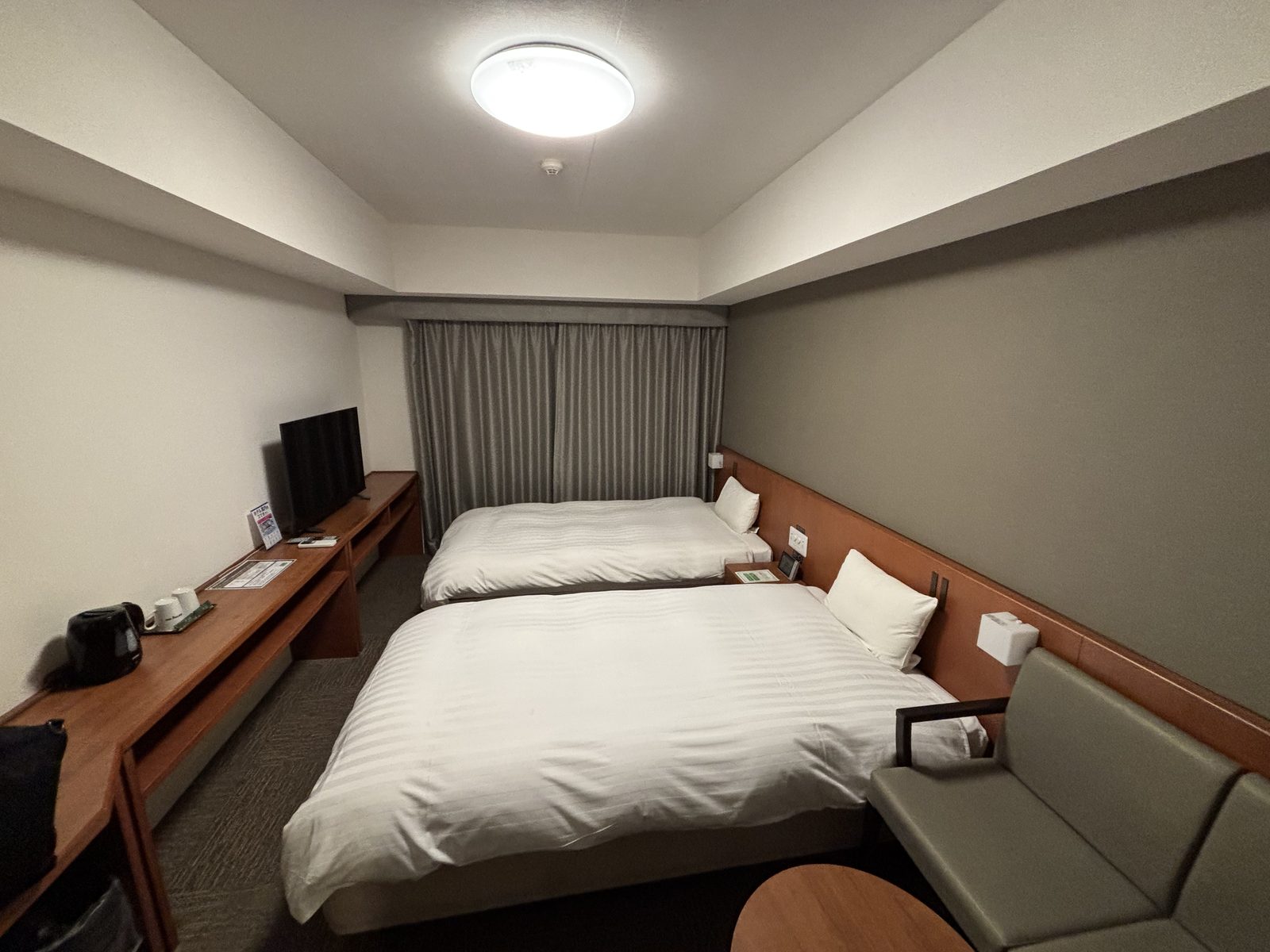
Cover photo: lic-2-business-desk-bed by J o, CC BY-SA 4.0, via Wikimedia Commons. It shows a different property from the ones discussed here.
On a thread on TripAdvisor’s Japan forum, a traveler wrote in ahead of a trip. “We’re trying to print out our train schedules in advance, so we can make our reservations when we arrive at Narita.” Then the question itself: “what time should we expect to eat breakfast at our ryokan?”
It is really a question about whether the inn’s morning and the train’s morning fit inside the same day. Once the inn is booked, most people want the same few things answered: who comes to the room, what gets asked and when, where the food happens, when the building stops letting you in, and when you pay and for what.
Most descriptions of a ryokan stay have a person in them. Someone kneels at your table, pours, disappears, returns. The Japanese ryokan trade association’s own English page describes that work down to the posture. The staff member who serves in the room does it “in a half-sitting posture (chugoshi),” and sits straight “(seiza) when making her initial greetings.” Not every inn works this way.
It also isn’t what my nights looked like. At the three or four inns I’ve stayed at, always with other people, the room got turned over while I was downstairs, and I basically never came face to face with the person who did it.
The second thing is money. I pay for these stays online, before I go, and there is still something to pay at the inn on the day.
2. Check-in is an interview, not a key handoff
At home, checking in is a handoff. Name, card, key, elevator. Nothing is decided.
At an inn, you sit down. japan-guide’s arrival page describes a form for your name, address and phone number, and says that “typically, the form will be offered alongside a cup of tea and a small snack.” It also lists what happens on the way to your room: the public baths and their opening times get pointed out, the location and times of meals get explained, and “your first drink order for dinner may be taken.” The trade association’s English page on the guest room describes the same moment from the attendant’s side: she brings “a serving of tea and sweets,” and then “enter[s] into conversation with you, confirming the time for serving meals and providing local information.”
What I got asked at that table was the dinner time, and at my stays that was the whole of it. A regular on that same TripAdvisor thread put it flatly: “When you check-in, they will ask you what time you would like to have dinner.” On a different thread, a poster asking about having the bedding put away was told that “once you confirm they will tell you when they plan to come and remove your bedding.” What you say about dinner determines when your room gets worked on, and so when you need to be out of it.
How those dinner slots collide with the big bath is worked out in the pillar article.
So decide before you arrive: what time you want to eat, whether anyone can’t eat something, and whether you’re coming back late. If your Japanese is nonexistent and theirs is too, a written note does more work here than a conversation. Foreign guests who don’t live in Japan are asked to show a passport, and the inn photocopies it because it’s required of them. Have it out of the bag before you sit down.
As of September 2026, from japan-guide: arrival page.
3. I basically never met the person who made up the room
A poster on TripAdvisor put the anxiety this way: “Is there generally time your room attendant will come to put your futon away? Is it disrespectful to ask that this not happen?”
A reply told him: “Everything is done discreetly enough so they won’t barge into your room.” That matches my stays. At my inns the room was turned over while I was at dinner, and I came back to the bedding already down where the table had been. At the inns where I saw it, the table and chairs had been pushed to the edge of the room.
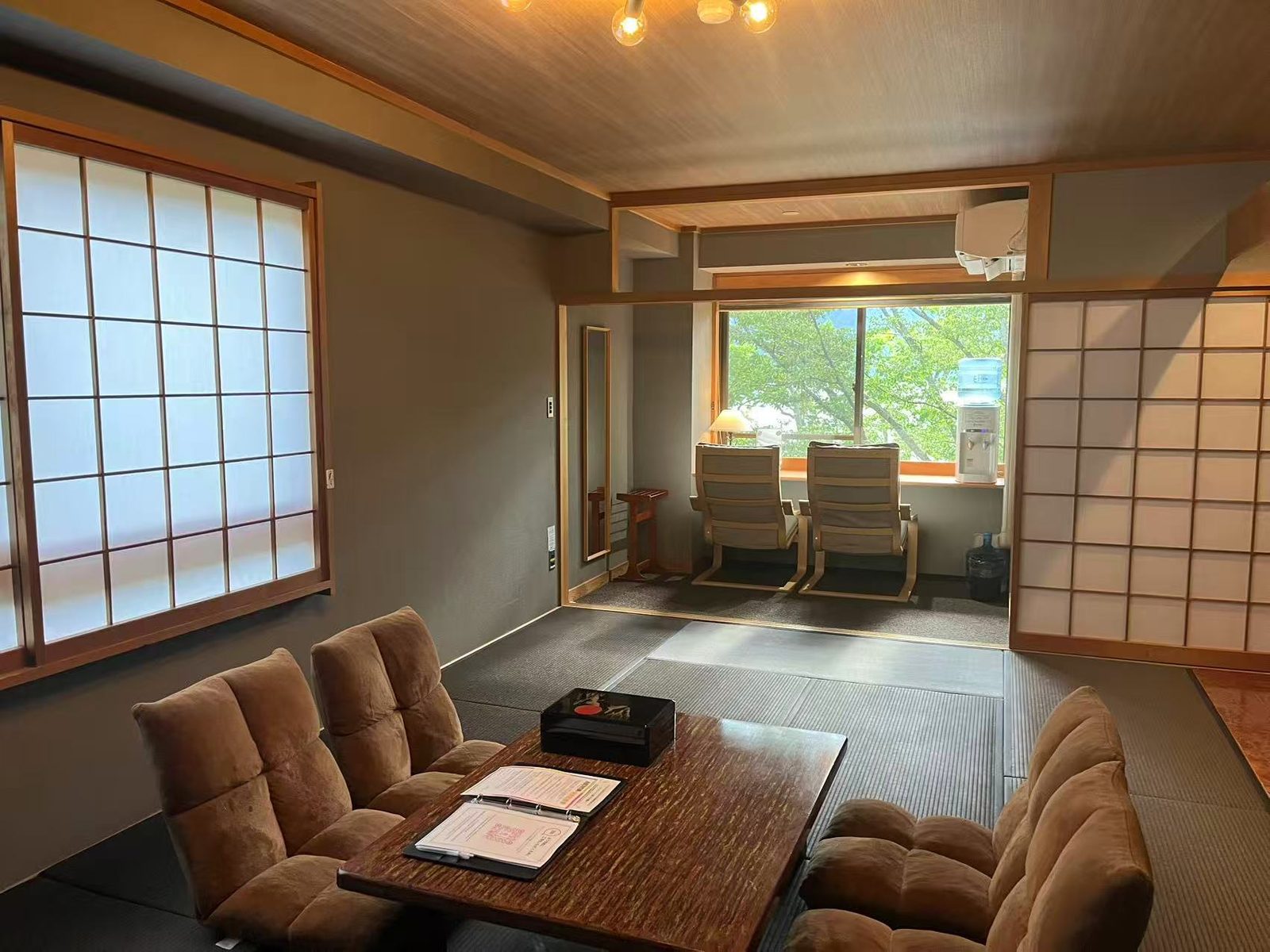
A tatami room in the afternoon.
Two things follow. Your room is not sealed while you’re at dinner, so put away whatever you’d rather not have someone work around. A person has a job to do on that floor and your open suitcase is in the middle of it.
What a Japanese booking form is actually counting when it asks for your headcount is its own article.
And ask about daytime use rather than assuming it. On the japan-guide forum, one answer to a question about napping in the room was simply to ask up front. In the US the room is your territory for the length of the stay. At an inn it is part of a run, and it changes state twice a day.
4. Dinner runs on the kitchen’s schedule, not yours
A traveler posted a discovery. “I thought that they cook and prepare the meals for you in your room. I thought that was part of the entire Ryokan experience.” Then the email came: “Guests with a meal plan will be served meals in the restaurant.”
The replies were blunt. One: “Meals at ryokan are not instant cooking stuff. They take a lot of time to prepare even the broth is cooked with a lot of procedures. No way to do it at guest rooms.”
Both the traveler’s email and the replies hinge on one word. In-room dinner means carried in, plated and served in the room by someone walking it from a kitchen. japan-guide’s dinner page lists the three places it can land: “guests usually dine in either their own guest room, in a separate private dining room or in a communal dining area.” Which one you get is on the plan you booked, and it’s the kind of detail that shows up in the reservation confirmation rather than the photos.
Once you see the meal as a kitchen and a set of carried trays, the fixed start time stops being a rule and turns into arithmetic. On a japan-guide forum thread about changing meal times, one reply spelled out the reason for the fixed start time: “the chefs, kitchen staff and room servers need to wash up and go home for the day, rest, or start getting ingredients for the next meal, they have their fixed time slots.”
The Japan Tourism Agency, a national government agency, publishes an English FAQ for ryokan guests. It says: “Most ryokan have set time periods for meals. Once that period has passed, you may not be able to receive that meal.”
Unlike a hotel restaurant closing, your dinner here is being cooked for that slot whether or not you turn up, so if the train is delayed, call from the train.
5. If there’s something you can’t eat
A poster wrote: “I don’t eat fish, I mean I eat sushi but I don’t eat cooked fish.” And then: “So if I stay at a ryokan I don’t want to offend anyone by not eating the fish.”
At booking. The same japan-guide article says “the ryokan should be consulted in advance if you have any special dietary requests or allergies.” Say it in the reservation, in writing, through whatever channel you booked on. A kitchen buying for a set number of guests can work with that.
At the table when you check in. You’re already being asked about mealtimes, so it costs nothing to say it again while someone is there to hear it. It may be too late by then, but say it anyway.
Handle it at those two moments, while the kitchen can still act.
6. You can prepay the whole stay and still owe money at the desk
The Japan Tourism Agency’s FAQ takes payment directly: “The time that payment is expected depends on the ryokan or the booking site, so confirm this information carefully.” That reads like a dodge, but it is the true answer. Payment timing is set by the property and the plan you bought, so there is no single fact to publish.
I pay online, in advance, before the trip, and the bathing tax still gets paid at the inn, on the day.
Prepaid is not the same as settled. A stay can be fully paid weeks out and still have a line left at the desk. Bathing and lodging tax are set by local government, the prefecture or the city or town, and not by the inn, which is why they sit outside the quoted rate so easily. How they are counted, and why, is in the pricing article, and the city-by-city rates are in Accommodation Tax in Japan: What It Is and What You Pay.
Two checks. From home tonight, see whether money has actually moved or your card is only held as a guarantee. Then ask what gets collected at the property: taxes, drinks ordered at dinner, anything added on arrival. On method of payment, japan-guide’s check-out page says “while most ryokan now accept major credit cards, smaller establishments may not.”
7. Tipping depends on whether the inn accepts it
On a TripAdvisor thread about tipping at a ryokan, the regulars split. One: “I always tip in a ryokan. I feel weird not to,” treating an inn as one of the few exceptions to Japan’s no-tipping habit. Another, writing about inns in Kyushu: “We haven’t left tipping in ryokans in Kyushu for years.”
Another reply added: “Some accommodation do not accept the gratuity as their rule.” At home, tipping is an amount, and the money always lands. Here it is a gesture the other side has to accept, and a refused envelope is a moment you have to manage in a language you may not speak. So the variable isn’t the amount. It’s whether the inn receives it at all.
8. Curfew, and what time you have to leave
The government FAQ again: “Most ryokan do have a curfew. If a ryokan does have a curfew, you can’t enter or leave the building after a certain time of night.”
I have never hit one, but plan around the government’s page, not my stays. On a japan-guide forum thread about ryokan customs, one reply drew the line this way: “Some may have a key/alternate entry. Others will be strict.” Another explained why the door closes at all: at night “the head staff members are asleep, and the room servers are either asleep or gone home.” The building is staffed for a service run, not around the clock.
So if you’re planning a late dinner in town, or a bar, or a night bus, ask at the desk on arrival. The answer decides whether the evening is possible.
The morning edge is check-out, earlier than the American default. The only time that binds you is the one on your inn’s page and in your confirmation.
Don’t fold up your bedding. The check-out page again: “just leave your futon laid out on the floor, although you should try to leave the rest of the room tidy.” SoraNews24 explains: “if you fold up your own futon, the first thing the maid is going to have to do is unfold it to check the sheets.” Sheets come off for washing, and forgotten belongings get found in the process. The instinct to leave the bed made creates work rather than saving it.
9. What you wear, and how far you can walk in it
Inside the inn, the yukata waiting in your room goes to the bath, dinner, breakfast and bed. japan-guide’s dress page adds that “in some onsen resort towns like Kinosaki, Dogo and Kusatsu, it is also common to see guests strolling around town in their yukata,” with geta on your feet. That is only in some towns, so don’t assume it in a city.
The wrapping direction is the one detail worth memorizing, because getting it wrong is legible to everyone who sees you. Right side underneath, left side over it. The outer jacket has ties at chest level, and it may have a pocket for small items like your room key.
Your shoes come off at the entrance, you change into slippers there, and they go away somewhere. From the forum thread on ryokan customs: “They’ll be there when you need them – they’ll put them out ready for you -like magic!” The one that catches people is that the hallway slippers come off at the edge of the tatami, and the separate pair inside the toilet stays inside the toilet.
The short version
1
Check-in is an interview, not a key handoff. A form, tea and a snack, and questions, usually including the dinner time. Decide your answers before you sit down, and have your passport out. The room may be turned over while you are at dinner, so put away anything you’d rather not have someone work around.
2
Dinner runs on the kitchen’s schedule. “In your room” means carried in, not cooked there. For a food you can’t eat, act at booking and again at check-in, while the kitchen can still change the plate. If the train is late, call from the train.
3
Prepaid is not settled. I pay online in advance, and the bathing tax is still paid at the inn on the day. Check whether your card was charged or only held, and ask what gets collected on site. Tipping depends on whether the inn accepts it.
4
Both ends of the day are fixed by the building, not by you. Most ryokan have a curfew. Check-out is earlier than you’re used to, and the only time that binds you is on your inn’s page and in your confirmation. Leave the bedding on the floor unfolded.
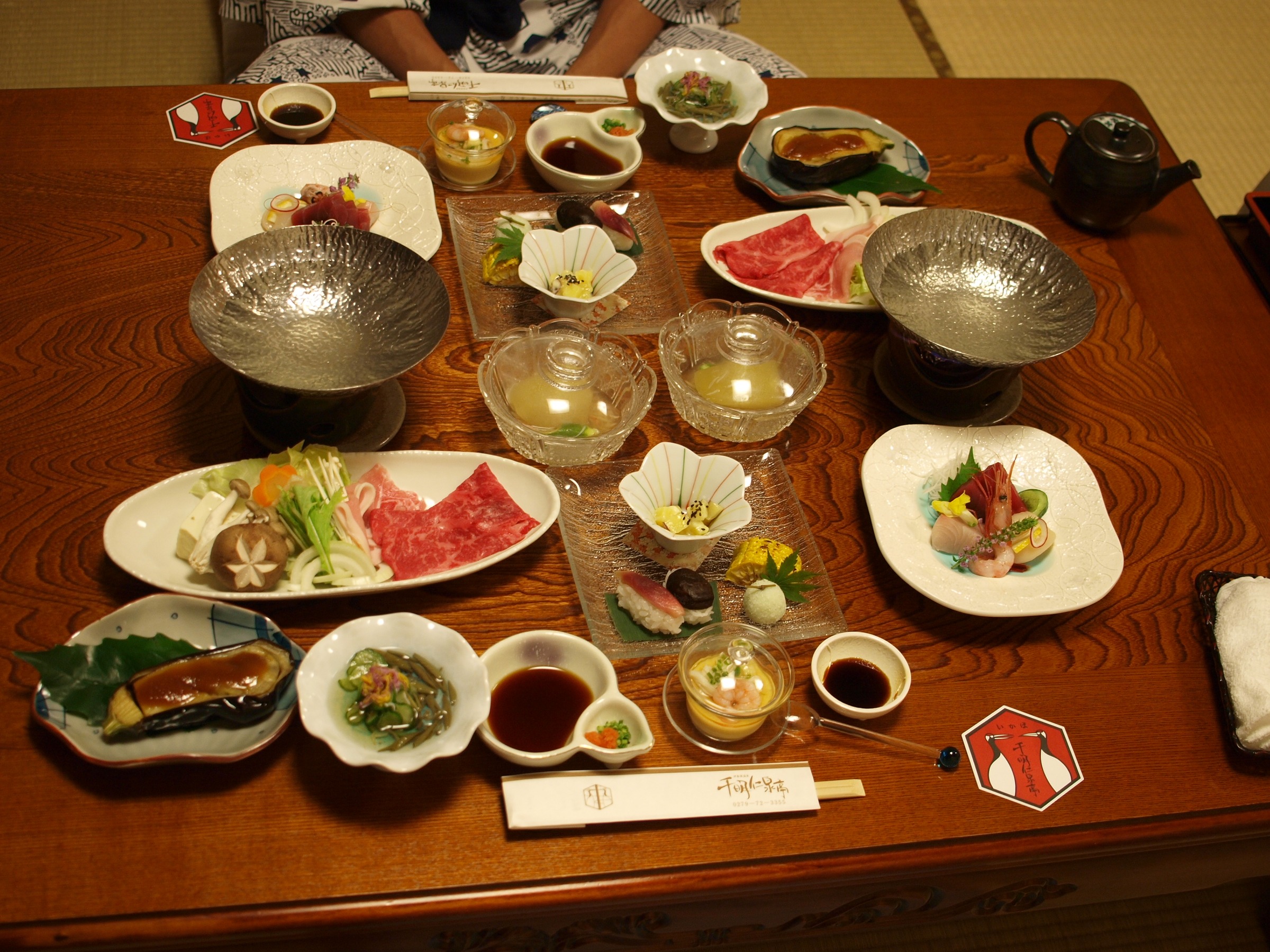
Cover photo: lic-8-ryokan-dinner-table by Tomo, CC BY 2.0, via Wikimedia Commons. It shows a different property from the ones discussed here.
1. Twenty-eight replies later, the person who asked still didn’t know what to do
A traveler posted on the r/JapanTravel forum asking a plain question. Do hotels in Japan charge per person, or per room? Twenty-eight replies came in, and near the end the poster wrote this:
“I’m getting a lot of mixed answers and I’m not really sure what to do.”
The replies had split four ways. Inns need your headcount because they are cooking for you. The per-person habit came out of the inn trade and spread to Western-style hotels. Most hotels land somewhere in the middle. And the same double room costs more with two people in it than with one.
Four answers, four mechanisms, and they can’t all be the top-level rule. What decides the unit isn’t the kind of building. It’s the plan you’re buying and the site you’re buying it through. That is why a single rule keeps failing, and why the same hotel can honestly show up as both.
2. What the number on the screen actually covers
When I look at a price on a Japanese-language booking page, I read it as one person’s share. Even after more than twenty years in Japan, I sometimes can’t tell at a glance whether a number includes tax or is per person when a property lists many plans.
Your resting position is probably the room: a number attached to a room, with the number of people as a ceiling you stay under. Both readings are reasonable. Some booking pages say which one they mean, and many don’t. Two people can look at the identical number, reach opposite conclusions about what it covers, and both feel the page was clear.
Two pricing defaults meet on one screen, so if you’re confused, you’re not reading the page badly.
3. The price is attached to a person plus what that person is handed
The price isn’t really attached to the room. It’s tied to what each guest gets: dinner, breakfast, bedding, and so on.
The clearest version is on an inn’s own rate page. Sukawa Kogen Onsen, a hot-spring inn, prices a child as a share of the adult rate. A child who gets the same meal as the adults plus a set of bedding is 70%. A child’s meal plus bedding is 50%. Bedding and no meal is 30%. A child’s meal with no bedding is a flat ¥4,400, about $29. The page carries no age brackets at all, and none of those four lines is about the room. Which of those boxes to tick for your own child has its own article: Booking for Three, or With Kids.
As of October 2026, from Sukawa Kogen Onsen’s rate page (in Japanese).
My own nights at Japanese inns line up with that. At most of the three or four inns I’ve stayed at, dinner was either a slot I picked from the two or three the inn offered or a time already fixed when I booked, and my bedding was put out on the floor while I was downstairs eating. Both are per-head jobs, and neither is a fixed cost of opening the door to the room.
So “per person” is shorthand for “per person, per service.” A room-only plan has a small per-head component, and a plan with dinner and breakfast has a large one. One property can sell both on the same night, which is the first reason the tidy rule falls apart.
4. What the tax is written on
The lodging tax you’re used to at home is a percentage of the room rate, a line computed off the room. Two Japanese taxes are counted by head instead. The rates by city are in Accommodation Tax in Japan: What It Is and What You Pay.
The lodging tax (shukuhaku-zei, 宿泊税)
Tokyo’s lodging tax is decided on the rate for one person for one night. Where two or more people share a room, a twin for example, the room’s rate is converted to a per-person figure. A per-person nightly rate of ¥10,000 to under ¥15,000 (about $67 to $100) carries ¥100 a person a night, about 70 cents. ¥15,000 and up carries ¥200, about $1.33. Under ¥10,000 carries nothing. The rate the tax looks at is the lodging portion, with meals taken out. From April 1, 2027, the tax becomes 3% of the per-person nightly rate, with nights under ¥13,000 (about $87) exempt.
As of September 2026, from the Tokyo metropolitan tax bureau’s guest page (in Japanese).
The bathing tax (nyūtō-zei, 入湯税)
This one is collected where you soak. In Niseko the rate is ¥150 for a guest staying the night, about a dollar, with an exemption for anyone under 15. The charge tracks the person who got into the water, and the room’s price isn’t in the formula.
As of September 2026, from the town of Niseko’s bathing tax page (in Japanese).
Both are local, so check the rates on your own itinerary. The amounts are small and the unit is the point: a property that wanted to quote one flat room price still has to account for these taxes guest by guest and night by night.
5. “Inns are per person, business hotels are per room” is the wrong line
That sentence is the one you’ll find, because it describes a real tendency. japan-guide.com lists price ranges by accommodation type, and the unit changes as you go down the page:
Business hotel is the domestic class of small, cheap, station-adjacent rooms described in the pillar article. At a round ¥150 to the dollar, that line is roughly $47 to $133 a night. As a summary of tendencies, the table is fair, but as a rule about property types it fails in the situations below.
Same brand, two different rates
In a 2005 FlyerTalk thread about Hyatt properties in Tokyo and Osaka, the opening post said: “Even at Hyatt.com, 2 people in a room increases the rate by 47%.” A reply about a Tokyo property said: “Our corporate rate at the PHT is the same for either 1 or 2 people in the room.” Same brand, same city, and the second guest costs 47% on one rate and nothing on another. What moved was the rate plan.
Same property, two different channels
In the 2018 r/JapanTravel thread from section 1, a poster reported pricing a Hotel Metropolitan property. Agoda listed the room at ¥9,700, about $65. The hotel’s own site gave ¥9,000 per person, about $60 each. That is one poster’s report from 2018, so it shows the shape of the problem, not today’s prices. The unit can depend on the storefront: the plan and the channel predict it better than property type does.
6. The same room, priced for one guest and then for two
One poster in the 2018 thread put the worry plainly: having booked three hotels on Booking.com for two people, they expected to be charged double on arrival. The reports don’t support one multiplier in either direction, since they run from 47% on one Hyatt rate to zero on another. A booking site’s own results make a better test.
Booking.com’s English site was searched twice, for one adult and then for two, with the same night and currency, for Tokyo in January and Kyoto in March. Only properties that showed the identical room both times were kept, because a different room is a different price, not a second-guest charge.
That left twenty-four properties with an identical room name in both searches. Sixteen of the twenty-four cost exactly the same for two people as for one, to the dollar. Of the eight that moved, the largest increase was 10.9%, and one property was 12% cheaper for two than for one. Nothing doubled. This covers the top twenty-five results in two cities on one English-language site, with prices shown before the 10% tax it excludes. These were not ryokan rates. On that channel, on those nights, the unit was the room. The same Tokyo search on Booking.com’s Japanese site, in yen, gave the same answer, so the language of the page did not change it.
Do the Japanese sites do it differently? On Jalan, a Japanese booking site, one Tokyo hotel’s plan table leads with a column labeled per adult, tax included. For one adult, a room read 32,121 yen. The same room, same night, for two adults, read 16,060 yen.
That looks like a 50% discount for a second guest until you multiply: 16,060 times two is 32,120. The room costs the same. Jalan was dividing it by the number of people, and the Booking.com results above, which show the room total, weren’t. Every one of the twenty-seven room types on that page moved by exactly the same factor, which is what dividing looks like.
So on that hotel, on that night, nobody charged anything for the second guest. What changed was the arithmetic printed on the screen. Once meals are attached (section 3), a headcount does move the total, but a per-person number is not, by itself, evidence that anyone is being charged per person.
Open the property’s own page. Price the room you want for one guest. Price the same room, same date, for two. The gap between those two numbers is the answer for that room on that night, and it’s the only answer that governs your reservation. If you get two prices, don’t assume you were shown two different rooms. In Japanese Hotel Rooms Decoded, one property listed its standard room, with the same floor area and the same bed, for one guest and for two.
7. Traveling alone
Single supplement is a package-tour and cruise term at home. It’s the surcharge on a tour price for not having a roommate, and it belongs to a product you booked through an agent months ago. In Japan the same arithmetic can turn up on a one-night independent booking at a small inn, which is not where you’d expect to meet it.
A Japanese trade outlet, Merkmal, published a piece in 2024 asking why solo travelers were not welcomed at inns. The writer’s read on the real reason: the work involved in taking one guest and taking two is not very different, so an inn does better to prioritize parties of two or more. That’s one reporter’s conclusion, not an industry statement. The same article adds an older reason that has nothing to do with money: inns not wanting a woman traveling alone to come to harm on the premises. It is the article’s account of what inns were avoiding, and a solo traveler who meets an odd refusal should know it has a history and isn’t about them.
If a room’s revenue is the per-person rate multiplied by the people in it, a room laid out for four with one guest in it is a quarter sold. The pressure points at not taking the booking at all, not just at a surcharge. So the first question to settle with a small inn is whether it takes a party of one, and the price is the second.
For inn nights, look for plans sold for one guest rather than assuming a two-person plan will be sold to you at half of its price. Where an inn does take a solo guest, compare the per-person figure for one against the figure for two on the same plan, on the property’s own page. Keep your city nights out of this entirely. Rooms sold to one guest are an ordinary product at the business hotel chains.
8. What this does to a two-week budget
A two-week trip has both kinds of night in it, as the pillar article lays out, so the unit is a question you answer fourteen times, not once. Four things to actually do.
Price every candidate twice, at one guest and at two. On the property’s own page. This replaces every rule of thumb on this page, including mine.
On inn nights, look at what plan you’re holding. Meals are the largest per-head component, and a room-only rate shrinks it, though at a traditional inn it also strips out much of what you came for.
Check the property’s own site against the site you’re shopping on, on identical dates. One traveler’s report of a gap is a reason to look, not a promise about which one wins. Which channel to use for what is covered in the booking-sites comparison.
Add the per-head taxes last. Two people for ten nights, if every night landed in Tokyo’s ¥200 band, is ¥4,000, about $27. Bathing tax is a separate charge where it applies, ¥150 a guest a night in Niseko, about a dollar.
One thing not to do, which costs more than all of the above. Don’t book for fewer people than are coming in order to get the lower number. The headcount you enter decides which rooms the site shows you, so a party you understated becomes a room built for the smaller party, and that is settled weeks before you reach the front desk.
The short version
If you read nothing else on this page.
1
The unit is set by the plan and the channel, not by the kind of property. A rate is attached to a person plus what that person is handed: one inn’s rate page prices a child at 70% of the adult rate with the adults’ meal and bedding, 50% with a child’s meal and bedding, and 30% for bedding alone.
2
A per-person number isn’t the same as a per-person charge. In the Booking.com searches, 16 of 24 matched rooms cost the same for two as for one, and Jalan’s per-adult figure was the room price divided by the guests. Price the room for one guest and then for two on the property’s own page.
3
Two of the Japanese taxes are written per head. Tokyo’s lodging tax is decided on the rate for one person for one night, and Niseko’s bathing tax is ¥150 for a staying guest, about a dollar, with under-15s exempt. Local rates differ, so check yours.
4
Solo inn nights are a different problem from solo city nights. Ask a small inn whether it takes a party of one before you ask what it costs. Business hotel chains sell rooms to one guest as an ordinary product.
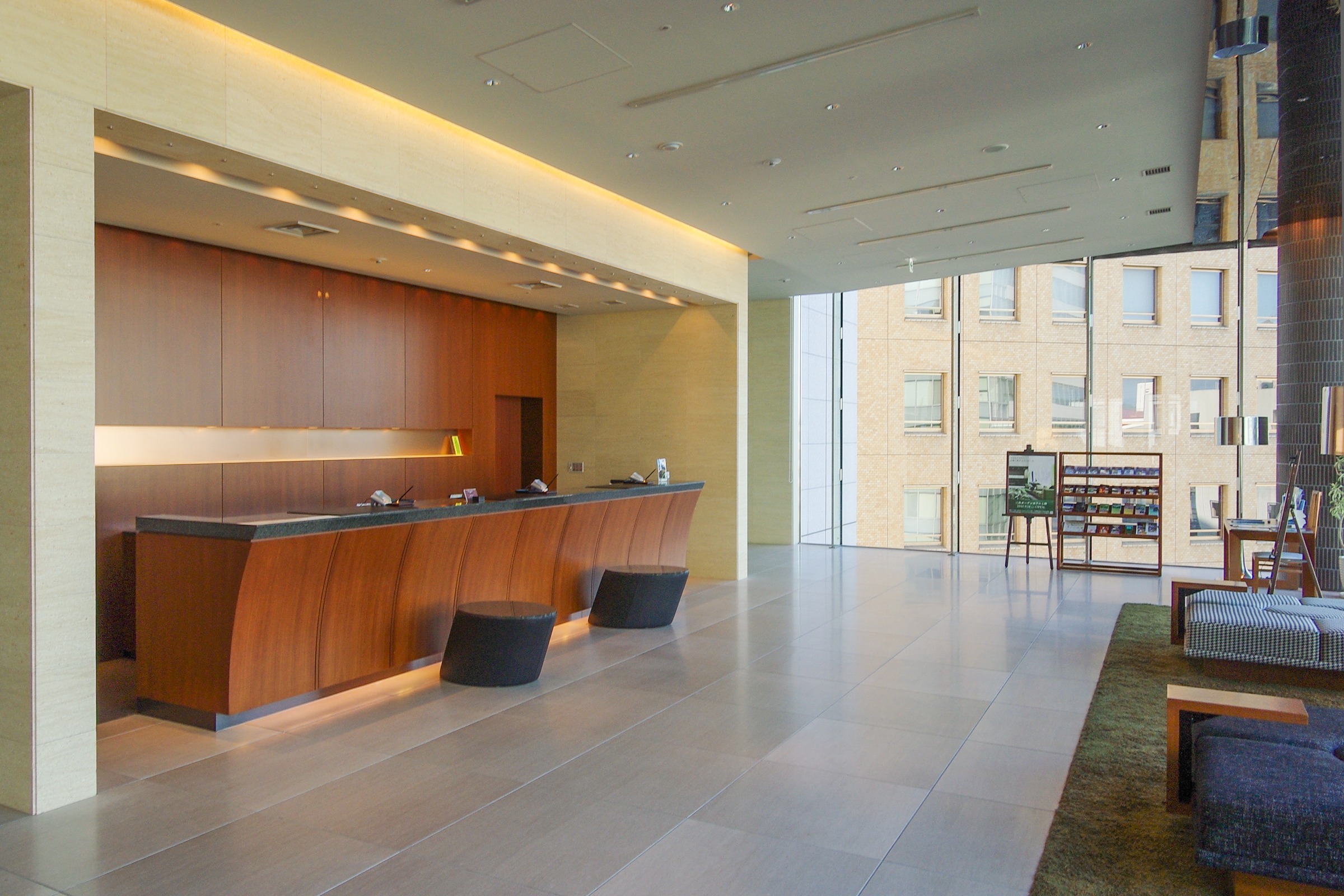
Cover photo: lic-6-hotel-lobby-empty by J o, CC BY-SA 3.0, via Wikimedia Commons. It shows a different property from the ones discussed here.
1. Decide it one night at a time, not one trip at a time
I’ve stayed at three or four Japanese inns. At many of them the inn decided when dinner was, and while I was downstairs eating, my bedding was laid out on the floor of the room I’d been sitting in an hour earlier. That is what an inn sells, and it is worth buying. It is also why an inn makes a poor base for touring. The evening belongs to the building.
On this trip, is your lodging a destination, or is it a place to sleep?
If it’s the destination, you’re going to be at the inn: soaking, then a long dinner you didn’t have to plan. If it’s a place to sleep, you’re out from 8 a.m. to 9 p.m., you want the station close and the shower hot, and you’d rather spend the money on the day. A two-week trip has both kinds of nights.
2. What “onsen” actually means
The bath: two questions, not one
Two separate things get collapsed into the English word “onsen,” and then nothing on a booking page lines up.
How big is the bath?Daiyokujō (大浴場) means a large communal bath: a shared, gender-separated bathing room with a washing area and soaking tubs. That’s a statement about the plumbing.
What is the water?Onsen (温泉) is a statement about the water. It comes up out of the ground and meets the Hot Springs Act’s definition, based on temperature or mineral content. Heated tap water doesn’t qualify, however big the tub is.
Also a big shared bath. Several business hotel chains advertise one. Some describe the water as a treated or artificial hot spring rather than a natural one.
Small or single tub
Still a hot spring
A two-person onsen tub at a small inn.
Your normal bathroom
Bath size and water type are separate questions.
A hotel advertising a daiyokujō may not offer a hot spring, and a genuine hot-spring inn can have a bath only two guests fill. If a booking site confirms only one, find the property’s own Japanese-language page. The shared bath is also a real hurdle: you bathe naked, among strangers of your own gender, after washing at a station first. If that’s a hard no, look for a room with its own bath or a reservable private one. Ryokan, Hour by Hour walks through the sequence, towel and all.
Three words that don’t mean what they look like
Futon. At home, a fold-down sofa frame. In Japan, bedding: a firm pad and quilt laid on the tatami at night and folded into the closet by day.
Business hotel. No equivalent at home: a domestic class of small, usually cheap rooms near a station. Section 6 covers it.
Twin, double, semi-double. The same word means different widths at different chains. Across twelve properties at five Japanese chains, one chain sold a 63-inch bed (160 cm) as a “double” and a 55-inch one (140 cm) as a “semi-double.” All five chains published measurements, so trust those over the label.
3. Three questions pick the category. Price only sorts inside it.
1. What role does this night play? A destination night is a choice between styles of inn. A sleep night is a choice between a business hotel and an international chain, decided by location and bed size.
2. What do you need the bathing to be? Private, spring-fed, large? Any combination is bookable, and you ask for each one separately.
3. How much floor do you need? Two adults with two large checked bags have a much harder constraint than two with carry-ons. Section 5 covers it.
Run these three before a review score breaks a tie.
4. The three kinds, side by side
Ryokan (traditional inn)
Business hotel
International chain
Role
The destination
A place to sleep
A place to sleep, with a hotel bar
Location
Hot-spring towns, often a bus or taxi from the station
At or near a train station
City centers
Meals
Dinner and breakfast often in the rate, at set times
Usually a hot buffet
Western-style breakfast, typically paid extra
Bathing
Communal, private, room bath, or a mix. Check each
Compact unit bath. Some add a communal bath
Western bathroom
Room size
Varies widely
Often 129 to 215 ft² (12 to 20 m²)
Usually the largest
Bed width
Futon on the floor (Section 2)
Singles ran 39 to 63 in (100 to 160 cm) and doubles 55 to 71 in (140 to 180 cm). Read the centimeters (Section 6)
Read the centimeters
Booking friction
Highest: fixed check-in, set meals, early cancellation charges
Low
Low, points bookings possible
Best for
One or two nights where the inn is the point
Efficient city nights
Travelers on points
5. How much floor you actually need
Japanese listings give room size in square meters, which can be hard to picture. Convert it first.
Listed
In ft²
9 m²
~97 ft²
12 m²
~129 ft²
15 m²
~161 ft²
20 m²
~215 ft²
25 m²
~269 ft²
30 m²
~323 ft²
97 ft²
9 m²
129 ft²
12 m²
269 ft²
25 m²
Bed, 55 × 77 in Checked bag, lid open
One scale: the bed stays the same size.Two beds and a desk leave a strip of floor.
Two rooms can list the same figure and be nothing alike, depending on where the bed sits. So use the square footage to sort listings, and when two rooms are close, let the floor plan photo decide.
The suitcase test
My benchmark: to open one large checked suitcase (the 29-inch class) and work out of it comfortably, you want at least 269 ft² (25 m²), and 323 ft² (30 m²) or more for two.
What I do when the room is under that line. I open the bag flat on the floor. Business hotel rooms usually have a luggage rack, but it tends to be small, so with two of us and two bags, one goes on the rack and the other on the floor. In a genuinely small room I’ll often open the bag in the entry passage, the short stretch of floor between the door and the bathroom module.
6. What each one costs you
Ryokan
The schedule belongs to the inn. At the inns I’ve stayed at, check-in was generally from 3 p.m. onward, and dinner was either a choice among roughly three start times beginning around 6 p.m. in half-hour steps, or a time assigned at booking.
“Inn” covers two products: large hotel-style inns with more facilities and a bar but a busier feel, and small traditional inns where the food and the quiet are the whole point. Dinner is often seafood-forward, so say so at booking if someone in your party doesn’t eat fish. Some inns sell a room-only rate, but at a traditional inn that strips out much of what you came for.
Business hotel
The pitch is a small, low-priced room within a short walk of a train station, run by big Japanese chains you’ve almost certainly never heard of.
Open the door and the bathroom is right there: a unit bath, a prefabricated module with toilet, sink and tub-shower in one small space. Past that is the bed. In a room around 215 ft² (20 m²), the walk from the door to the bed is roughly six or seven steps. There is a desk, and it’s big enough to open a laptop on.
Bed size is where the booking goes wrong.
Japan
“Double”
55 × 77 in
US
Full
54 × 75 in
US
Queen
60 × 80 in
A 55 in (140 cm) bed next to a US full and a queen.
Within a hotel, widths often followed room grade, not the chain. At one Tokyo property, the plain single had a 43-inch bed (110 cm), the deluxe single and the double both had 55 inches (140 cm), and the deluxe double had 63 inches (160 cm), all off the same rate page. Others reached 67 or 71 inches (170 or 180 cm) at the top of their range, wider than a US queen’s 60. But at two of the twelve, a higher grade bought floor space and left the bed alone, so open both room pages and compare the centimeters before you pay the difference.
Lengths ran mostly 77 to 79 inches (195 to 200 cm), and one property listed 81 inches (205 cm). Check the length if anyone in your party is tall. The size words property by property get their own article: Japanese Hotel Rooms Decoded.
A business hotel splits its amenities into two piles. A hair dryer, electric kettle, yukata, slippers and refrigerator are typically in the room, and a trouser press turns up commonly. The consumable toiletries are not. They’re typically laid out on a counter near the front desk, and you take what you need on your way up: face wash, toner, a razor, a comb, hair ties, a toothbrush set and the like. Walk into the room first and you’ll find an empty bathroom counter and conclude the hotel provides nothing. So grab yours before you ever see the room.
Breakfast is the other expectation that breaks. There’s no real equivalent of the American continental breakfast at a Japanese business hotel. It’s usually a full hot buffet, Japanese and Western on the same line, and rice, miso soup and nattō (fermented soybeans) turn up almost everywhere.
International chain
The reasons to book one are specific: points to burn, a Western bathroom with a tub you can lie down in, or a lounge and a concierge who works in English at 11 p.m. The bed widths above come from domestic chains, so compare the centimeters on both pages before you pay a brand premium for width.
A club lounge in an international chain.An international-brand room.
The trade-off is that you’re paying for square footage and brand familiarity. That’s a night roughly the same in Osaka as in Chicago, fine for a sleep night and a waste of a destination night.
7. Which one, for five kinds of trip
“We have 10 days and we want to see a lot”
City nights at business hotels near the stations you’re actually using, plus one destination night. Some hot-spring areas need a bus connection or two after the train, so check the last leg on the property’s own access page.
“It’s our anniversary and we want the memorable night”
This is the destination night, and it’s worth spending on. Unless the room’s bath is open-air or spring-fed, I go down to the big bath anyway, so an ordinary in-room tub isn’t worth a premium to me. If the shared bath is a hard no for you, a room bath earns its price whatever kind it is.
The big bath tends to be crowded right before dinner and right after it. Private baths work two ways: you reserve a slot (at one inn I stayed at, the reservation was made at the front desk), or a same-day system hands you a tag or key when the bath is free.
“One night or two at the inn?”
The standard advice that one night at a ryokan is a waste doesn’t survive three questions.
How big is the bath, and what kind? With no spring water, a small bath, or only one kind of bath, one night may be plenty.
How hard is it to reach? The harder the access, the more a second night buys back.
Do you want to eat that dinner twice? It’s a long, expensive multi-course meal, and two nights means two of them.
“We don’t have time for a ryokan at all”
There’s a third option: stay at a business hotel and visit a hot spring for the day. Some bathing facilities, and some inns, admit non-staying visitors for a daytime soak.
Buy a bath towel before you go, because towels are generally sold rather than lent and what’s on sale is usually small and thin. Check the facility’s own page for whether day visitors are accepted and during which hours. Don’t count on high-end inns, which often don’t accept day visitors. Which channel to book through is its own subject: Two Prices for One Room.
“There are three of us”
At home you’d default to a king plus a sofa bed.
One bed and a separate sofa.
The real trap is narrower. Japanese booking sites ask you to classify a child, and one of the options quietly removes their bed. Pick it and the site returns rooms built for two. Classify the child as needing bedding, even if you intend to co-sleep, and settle the arrangement with the property. The headcount box and the fire code are covered in Booking for Three, or With Kids, and per-person pricing in Why Japanese Hotels Price Per Person.
8. The room with no bed in it, and three other mistakes
The room with no bed in it
You check into a traditional-style room in the afternoon. There’s a low table and floor cushions, and nothing you’d recognize as a bed.
A tatami room in the afternoon, no Western bed.
Nothing is wrong. The futon is usually folded away in the room’s closet, and in many inns it gets laid out while you’re at dinner. If you specifically need a Western bed, for a bad back or because floor sleeping is a hard no, filter for it at booking time and confirm with the property.
At some properties guests lay out their own bedding, so an empty room at 10 p.m. is not a mistake.
Reading “large communal bath” as “hot spring”
This is the most expensive misread on this page. Confirm the size and the water separately.
Booking the inn as a base
Leaving at 9 a.m., touring all day and returning at 8 p.m. means you’ve paid a large premium for a room you slept in.
Leaving the destination night until last
Popular inns fill months out, and the inn is the least flexible piece of the itinerary. Lock it first and route the rest of the trip around it.
The cancellation clock starts earlier than you’d expect too. Six inns’ cancellation pages typically begin charging six or seven days out, and one begins at fourteen days. Toyoko Inn lists a fee for individual guests only from noon on the day of check-in. Richmond’s Morioka property says no fee if you cancel by 6 p.m. on the day. Dormy Inn lists 50 percent the day before for one to five guests, as Japanese Hotel Cancellation Policies Explained shows. The inn wants to know a week out. These hotels don’t want to know until the day or the day before.
Two of the six inns didn’t charge until three days before, so open the cancellation table before you pay.
Mark each night as a destination night or a sleep night. For a sleep night, find a business hotel or chain within a short walk of the station you’ll use, and check the bed in centimeters, width and length. For a destination night, do this in order:
Decide the bath on all three axes separately: private or shared, spring water or not, large or small.
Confirm each one on the property’s own Japanese-language page.
Confirm the check-in window and the dinner start times before you build that day’s travel.
Read the cancellation table and note the date charges begin.
Book it first, then build the surrounding days around it.
The short version
If you read nothing else on this page.
1
Decide it one night at a time. No room in the itinerary for an inn? A station-adjacent business hotel plus one afternoon at a day-use bath.
2
“Large communal bath” and “hot spring” are different claims. Confirm the size and the water separately.
3
The room name does not tell you the bed size. Rooms sold as singles ran 39 to 63 inches. Read the centimeters, and the length too.
4
Book the inn first, and read its cancellation table before you do. Inns typically charge from six or seven days out, and the hotels above charge from the day or the day before.
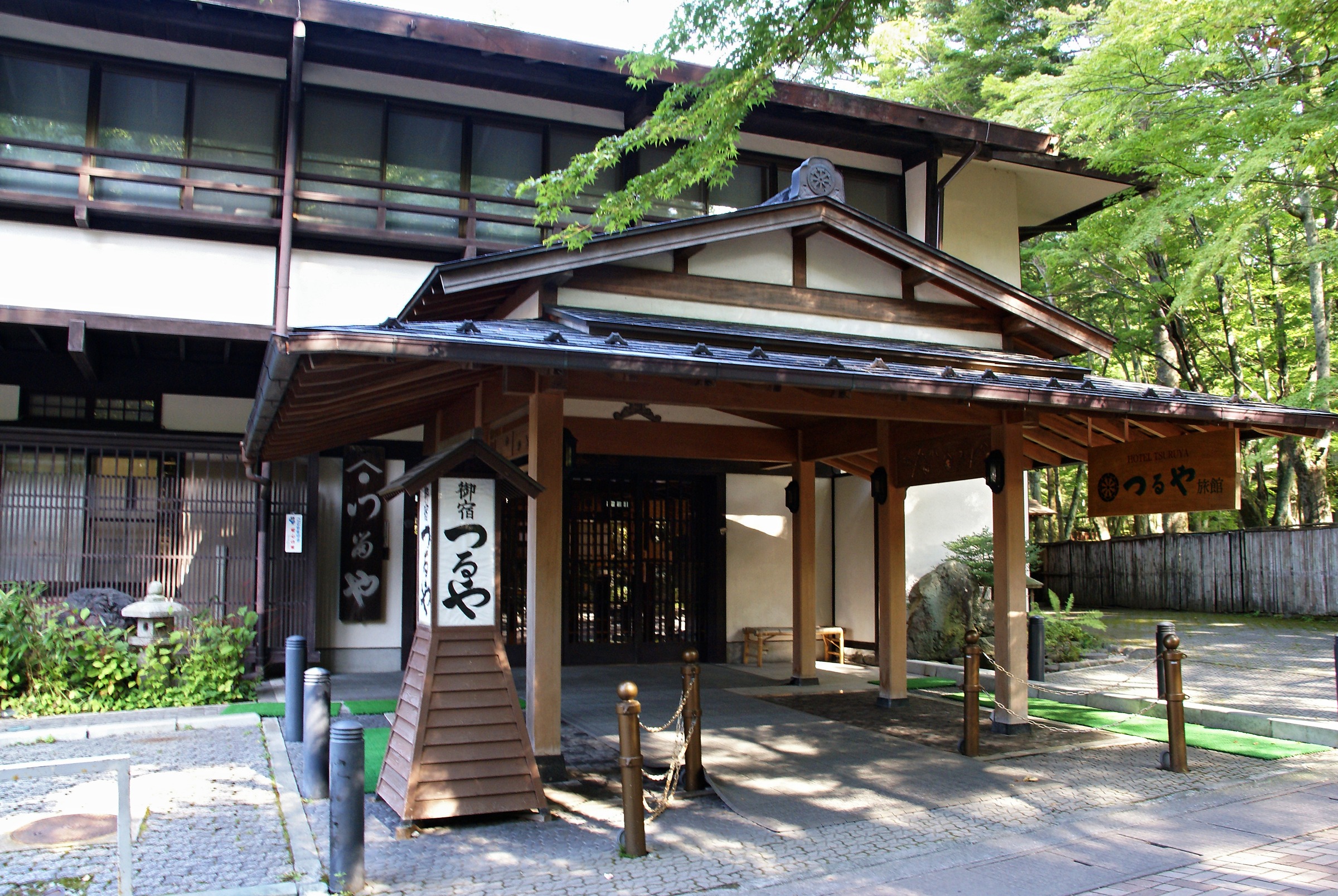
Cover photo: lic-9-ryokan-entrance by 663highland, CC BY 2.5, via Wikimedia Commons. It shows a different property from the ones discussed here.