1. The ryokan you’ve read about, and mine
On a thread on TripAdvisor’s Japan forum, a traveler wrote in ahead of a trip. “We’re trying to print out our train schedules in advance, so we can make our reservations when we arrive at Narita.” Then the question itself: “what time should we expect to eat breakfast at our ryokan?”
It is really a question about whether the inn’s morning and the train’s morning fit inside the same day. Once the inn is booked, most people want the same few things answered: who comes to the room, what gets asked and when, where the food happens, when the building stops letting you in, and when you pay and for what.
Most descriptions of a ryokan stay have a person in them. Someone kneels at your table, pours, disappears, returns. The Japanese ryokan trade association’s own English page describes that work down to the posture. The staff member who serves in the room does it “in a half-sitting posture (chugoshi),” and sits straight “(seiza) when making her initial greetings.” Not every inn works this way.
It also isn’t what my nights looked like. At the three or four inns I’ve stayed at, always with other people, the room got turned over while I was downstairs, and I basically never came face to face with the person who did it.
The second thing is money. I pay for these stays online, before I go, and there is still something to pay at the inn on the day.
2. Check-in is an interview, not a key handoff
At home, checking in is a handoff. Name, card, key, elevator. Nothing is decided.
At an inn, you sit down. japan-guide’s arrival page describes a form for your name, address and phone number, and says that “typically, the form will be offered alongside a cup of tea and a small snack.” It also lists what happens on the way to your room: the public baths and their opening times get pointed out, the location and times of meals get explained, and “your first drink order for dinner may be taken.” The trade association’s English page on the guest room describes the same moment from the attendant’s side: she brings “a serving of tea and sweets,” and then “enter[s] into conversation with you, confirming the time for serving meals and providing local information.”
What I got asked at that table was the dinner time, and at my stays that was the whole of it. A regular on that same TripAdvisor thread put it flatly: “When you check-in, they will ask you what time you would like to have dinner.” On a different thread, a poster asking about having the bedding put away was told that “once you confirm they will tell you when they plan to come and remove your bedding.” What you say about dinner determines when your room gets worked on, and so when you need to be out of it.
How those dinner slots collide with the big bath is worked out in the pillar article.
So decide before you arrive: what time you want to eat, whether anyone can’t eat something, and whether you’re coming back late. If your Japanese is nonexistent and theirs is too, a written note does more work here than a conversation. Foreign guests who don’t live in Japan are asked to show a passport, and the inn photocopies it because it’s required of them. Have it out of the bag before you sit down.
As of September 2026, from japan-guide: arrival page.
3. I basically never met the person who made up the room
A poster on TripAdvisor put the anxiety this way: “Is there generally time your room attendant will come to put your futon away? Is it disrespectful to ask that this not happen?”
A reply told him: “Everything is done discreetly enough so they won’t barge into your room.” That matches my stays. At my inns the room was turned over while I was at dinner, and I came back to the bedding already down where the table had been. At the inns where I saw it, the table and chairs had been pushed to the edge of the room.
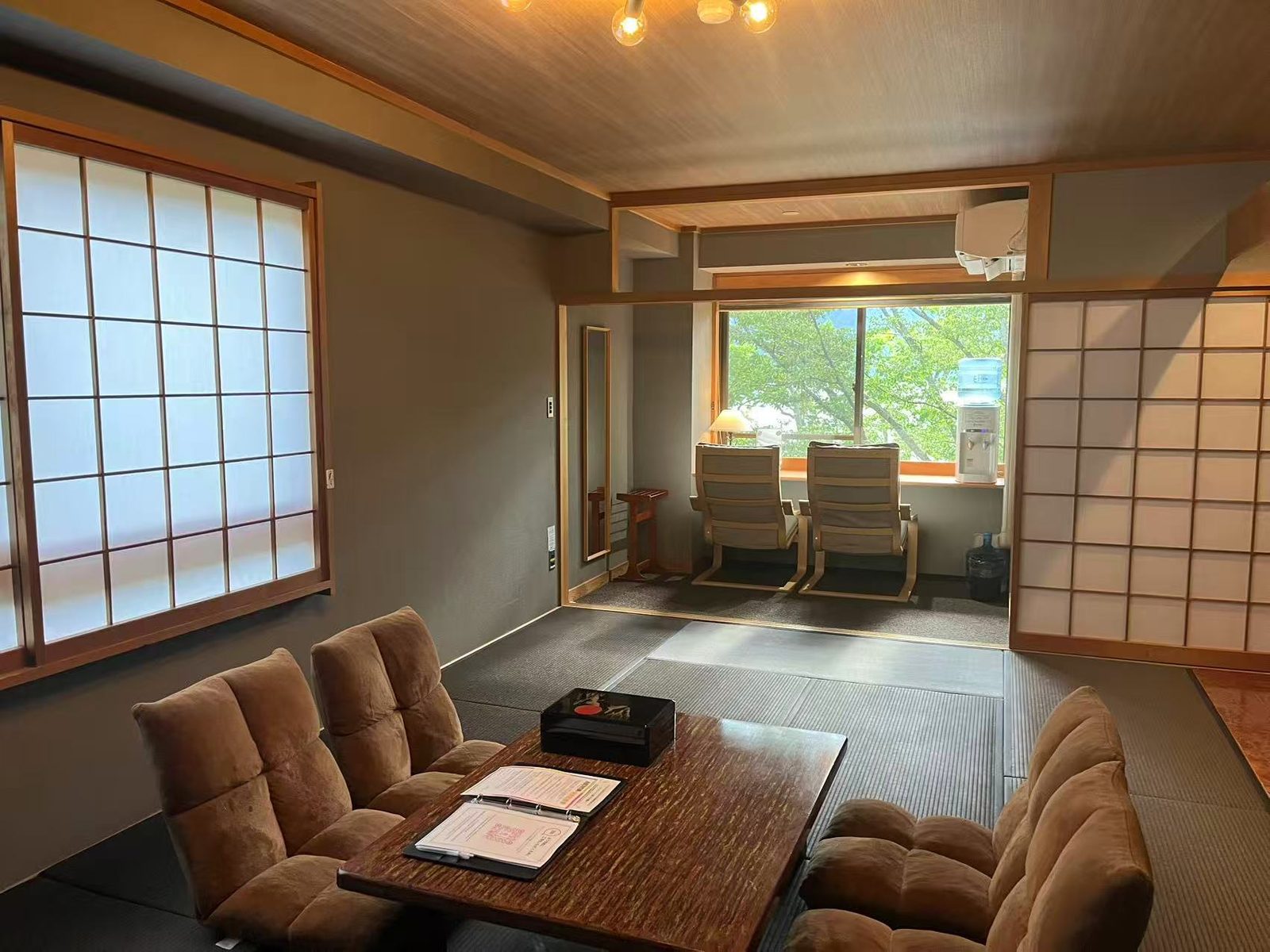
Two things follow. Your room is not sealed while you’re at dinner, so put away whatever you’d rather not have someone work around. A person has a job to do on that floor and your open suitcase is in the middle of it.
What a Japanese booking form is actually counting when it asks for your headcount is its own article.
And ask about daytime use rather than assuming it. On the japan-guide forum, one answer to a question about napping in the room was simply to ask up front. In the US the room is your territory for the length of the stay. At an inn it is part of a run, and it changes state twice a day.
4. Dinner runs on the kitchen’s schedule, not yours
A traveler posted a discovery. “I thought that they cook and prepare the meals for you in your room. I thought that was part of the entire Ryokan experience.” Then the email came: “Guests with a meal plan will be served meals in the restaurant.”
The replies were blunt. One: “Meals at ryokan are not instant cooking stuff. They take a lot of time to prepare even the broth is cooked with a lot of procedures. No way to do it at guest rooms.”
Both the traveler’s email and the replies hinge on one word. In-room dinner means carried in, plated and served in the room by someone walking it from a kitchen. japan-guide’s dinner page lists the three places it can land: “guests usually dine in either their own guest room, in a separate private dining room or in a communal dining area.” Which one you get is on the plan you booked, and it’s the kind of detail that shows up in the reservation confirmation rather than the photos.
Once you see the meal as a kitchen and a set of carried trays, the fixed start time stops being a rule and turns into arithmetic. On a japan-guide forum thread about changing meal times, one reply spelled out the reason for the fixed start time: “the chefs, kitchen staff and room servers need to wash up and go home for the day, rest, or start getting ingredients for the next meal, they have their fixed time slots.”
The Japan Tourism Agency, a national government agency, publishes an English FAQ for ryokan guests. It says: “Most ryokan have set time periods for meals. Once that period has passed, you may not be able to receive that meal.”
Unlike a hotel restaurant closing, your dinner here is being cooked for that slot whether or not you turn up, so if the train is delayed, call from the train.
5. If there’s something you can’t eat
A poster wrote: “I don’t eat fish, I mean I eat sushi but I don’t eat cooked fish.” And then: “So if I stay at a ryokan I don’t want to offend anyone by not eating the fish.”
At booking. The same japan-guide article says “the ryokan should be consulted in advance if you have any special dietary requests or allergies.” Say it in the reservation, in writing, through whatever channel you booked on. A kitchen buying for a set number of guests can work with that.
At the table when you check in. You’re already being asked about mealtimes, so it costs nothing to say it again while someone is there to hear it. It may be too late by then, but say it anyway.
Handle it at those two moments, while the kitchen can still act.
6. You can prepay the whole stay and still owe money at the desk
The Japan Tourism Agency’s FAQ takes payment directly: “The time that payment is expected depends on the ryokan or the booking site, so confirm this information carefully.” That reads like a dodge, but it is the true answer. Payment timing is set by the property and the plan you bought, so there is no single fact to publish.
I pay online, in advance, before the trip, and the bathing tax still gets paid at the inn, on the day.
Prepaid is not the same as settled. A stay can be fully paid weeks out and still have a line left at the desk. Bathing and lodging tax are set by local government, the prefecture or the city or town, and not by the inn, which is why they sit outside the quoted rate so easily. How they are counted, and why, is in the pricing article, and the city-by-city rates are in Accommodation Tax in Japan: What It Is and What You Pay.
Two checks. From home tonight, see whether money has actually moved or your card is only held as a guarantee. Then ask what gets collected at the property: taxes, drinks ordered at dinner, anything added on arrival. On method of payment, japan-guide’s check-out page says “while most ryokan now accept major credit cards, smaller establishments may not.”
7. Tipping depends on whether the inn accepts it
On a TripAdvisor thread about tipping at a ryokan, the regulars split. One: “I always tip in a ryokan. I feel weird not to,” treating an inn as one of the few exceptions to Japan’s no-tipping habit. Another, writing about inns in Kyushu: “We haven’t left tipping in ryokans in Kyushu for years.”
Another reply added: “Some accommodation do not accept the gratuity as their rule.” At home, tipping is an amount, and the money always lands. Here it is a gesture the other side has to accept, and a refused envelope is a moment you have to manage in a language you may not speak. So the variable isn’t the amount. It’s whether the inn receives it at all.
8. Curfew, and what time you have to leave
The government FAQ again: “Most ryokan do have a curfew. If a ryokan does have a curfew, you can’t enter or leave the building after a certain time of night.”
I have never hit one, but plan around the government’s page, not my stays. On a japan-guide forum thread about ryokan customs, one reply drew the line this way: “Some may have a key/alternate entry. Others will be strict.” Another explained why the door closes at all: at night “the head staff members are asleep, and the room servers are either asleep or gone home.” The building is staffed for a service run, not around the clock.
So if you’re planning a late dinner in town, or a bar, or a night bus, ask at the desk on arrival. The answer decides whether the evening is possible.
The morning edge is check-out, earlier than the American default. The only time that binds you is the one on your inn’s page and in your confirmation.
Don’t fold up your bedding. The check-out page again: “just leave your futon laid out on the floor, although you should try to leave the rest of the room tidy.” SoraNews24 explains: “if you fold up your own futon, the first thing the maid is going to have to do is unfold it to check the sheets.” Sheets come off for washing, and forgotten belongings get found in the process. The instinct to leave the bed made creates work rather than saving it.
9. What you wear, and how far you can walk in it
Inside the inn, the yukata waiting in your room goes to the bath, dinner, breakfast and bed. japan-guide’s dress page adds that “in some onsen resort towns like Kinosaki, Dogo and Kusatsu, it is also common to see guests strolling around town in their yukata,” with geta on your feet. That is only in some towns, so don’t assume it in a city.
The wrapping direction is the one detail worth memorizing, because getting it wrong is legible to everyone who sees you. Right side underneath, left side over it. The outer jacket has ties at chest level, and it may have a pocket for small items like your room key.
Your shoes come off at the entrance, you change into slippers there, and they go away somewhere. From the forum thread on ryokan customs: “They’ll be there when you need them – they’ll put them out ready for you -like magic!” The one that catches people is that the hallway slippers come off at the edge of the tatami, and the separate pair inside the toilet stays inside the toilet.
The short version
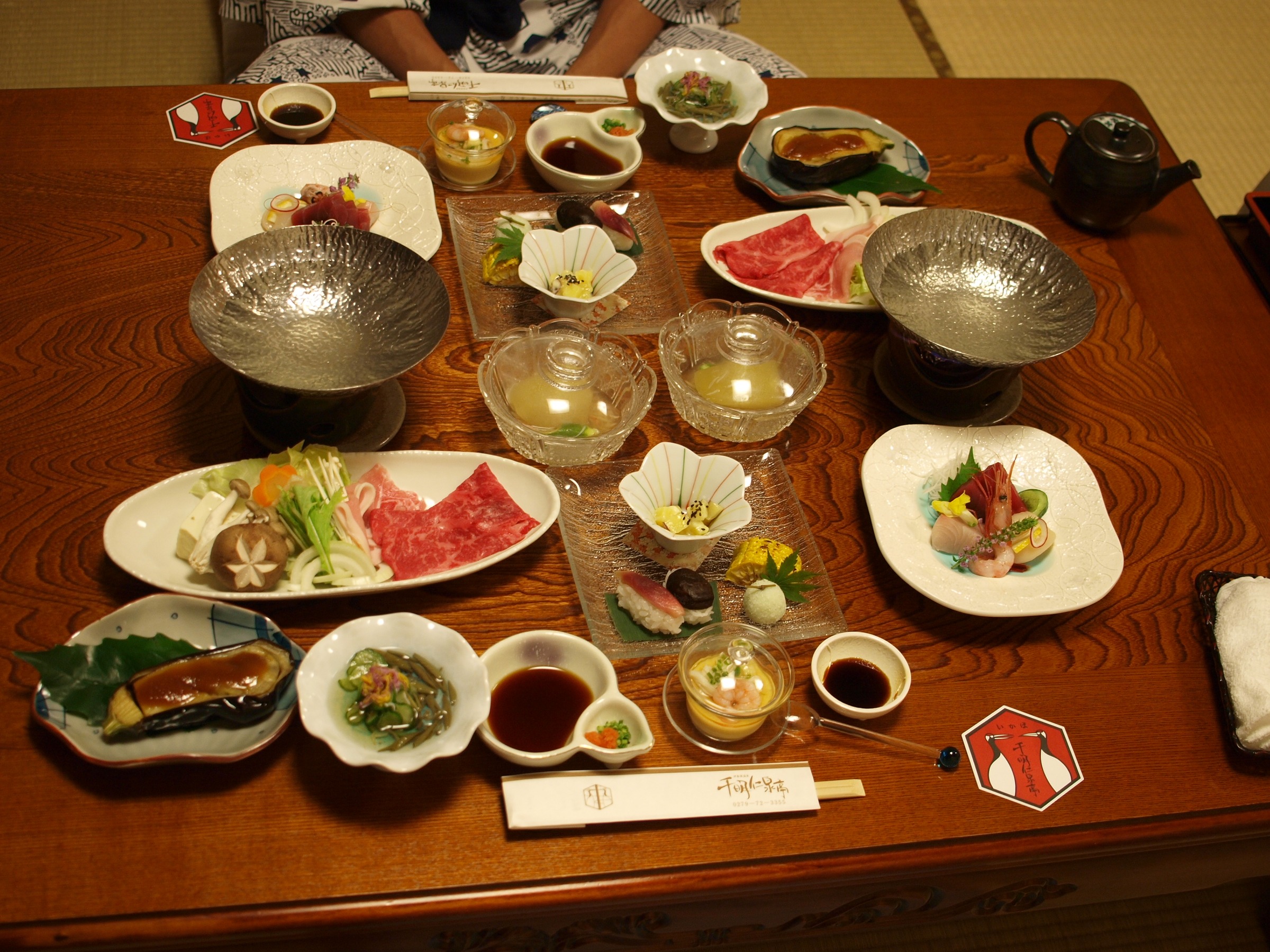
Cover photo: lic-8-ryokan-dinner-table by Tomo, CC BY 2.0, via Wikimedia Commons. It shows a different property from the ones discussed here.
