Contents
- The label names the floor, not the bed
- Where you sleep
- When the futon isn’t there yet
- Walking on tatami
- How many people fit
- Business hotel or ryokan
- The bedding line decides it
- Decision box
- Read these next
- The short version
Last checked: October 2, 2026. Pages in Japanese are marked.
1. The label names the floor, not the bed
At home, the room type on a booking screen tells you the beds: one king, two queens, a sofa bed. In Japan, 和室 (washitsu, “Japanese-style room”) tells you the floor. JTB’s help page on room types defines it in one line, “メインの客室が畳敷きの客室”, a guest room whose main space has a tatami floor. The line says nothing about a bed. Tatami is the thick woven mat flooring, and japan-guide describes the mats as “about one by two meters in size”. Section 5 gives the exact sizes.
As of October 2026, from JTB’s room types help page (in Japanese) and japan-guide’s tatami page.
The same JTB page defines 和洋室 (wayoshitsu, “Japanese-Western room”) as a room with a Japanese part and a Western part, where “それぞれで寝ることができるのが一般的です。(施設によって異なります)”, meaning you can generally sleep in either part, though it differs by facility. The usual layout is a bedroom with beds plus a living area floored with tatami. 洋室 (yoshitsu) is the plain Western-style room, the one you already know.
As of October 2026, from Japan Hotel School (in Japanese): glossary.
The Japan Tourism Agency’s FAQ for ryokan guests puts it this way: “Traditionally at a ryokan, you do not sleep on a bed. You use a futon, a type of bedding that you lay right on the tatami flooring.” In recent years, it adds, there are more ryokan with “Japanese-style rooms with beds,” mixed Japanese/Western rooms, and completely Western-style rooms. “Japanese-style rooms with beds” is easy to skim past in a list. A business hotel page shows what it looks like.
Hotel Route Inn Ise lists three rooms called 和室: a single, a semi-double and a twin. Each carries the same sentence, “畳敷きのお部屋ですがベッドを設置しております。お部屋の入り口で靴をぬいでご入室ください。” In English, it is a tatami room with beds installed, and you take your shoes off at the room’s entrance. The single and the semi-double list a 51 × 79 in (130 × 200 cm) bed in 118 ft² (11 m²). The twin lists 43 × 79 in (110 × 200 cm) beds in 161 ft² (15 m²).
As of October 2026, from Route Inn (in Japanese): Ise rooms and prices.
Someone who read 和室 and pictured a futon would be wrong at this hotel. Someone who pictured a bed would be wrong at Hotel Banso in section 5, where every tatami room lists futon bedding.
2. Where you sleep
Three layouts sit behind these labels, and the booking page seldom says which one you are getting.
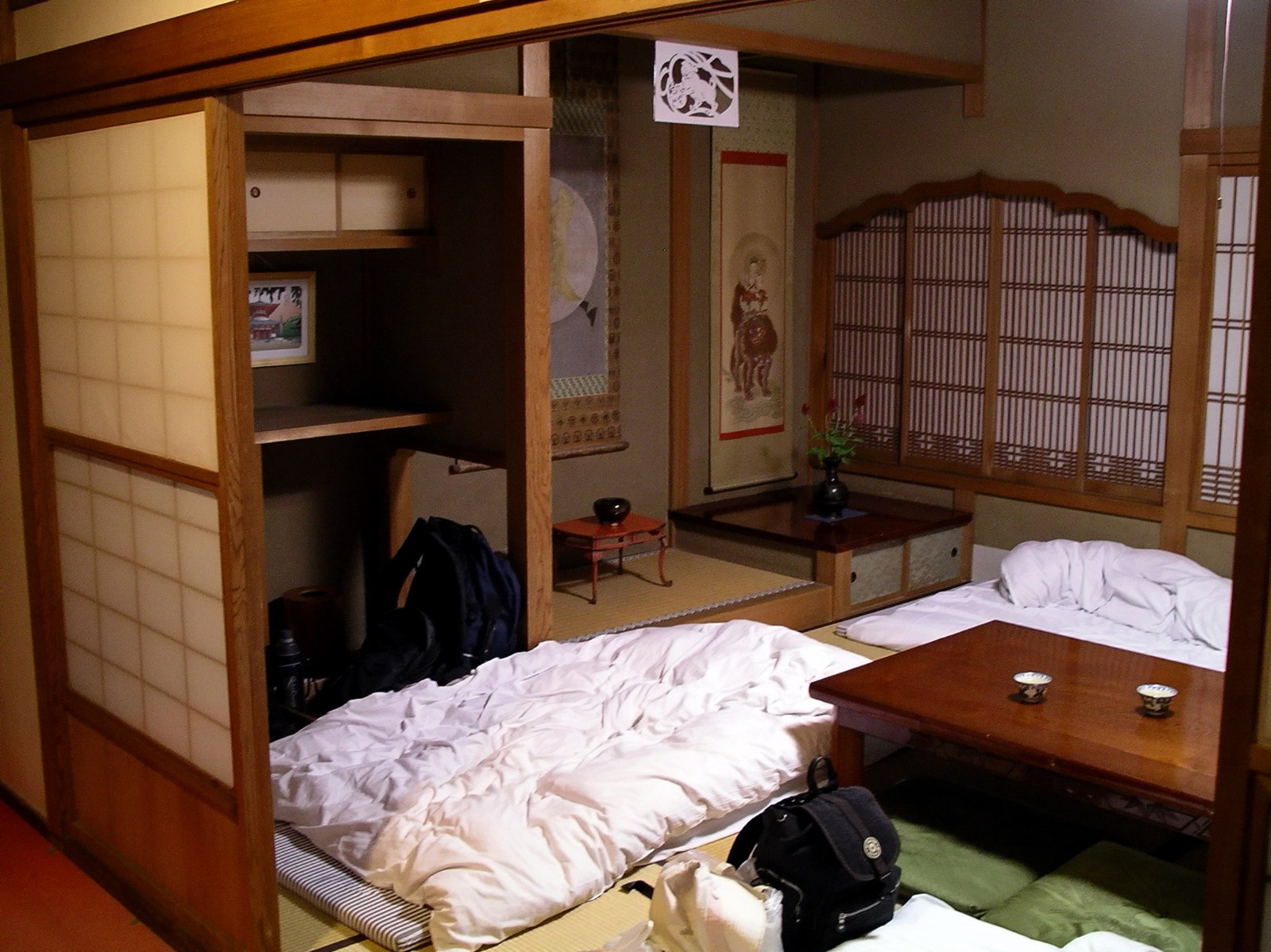
Futon on tatami. Here “futon” means the Japanese bedding, a thin mattress pad and a quilt. The US word names a fold-down sofa frame. japan-guide’s tatami page says futon “are kept folded in the closet during the day and set out in the evening after dinner.” A single mattress pad is 39 × 83 in (100 × 210 cm), about as wide as a US twin (38 inches). The Japan Ryokan Association’s guestroom page adds that in a washitsu the bedding is “usually directly placed on the tatami, but low beds are used in the place of futon at some ryokans.”
As of October 2026, from a futon retailer’s size table (in Japanese) and Amerisleep’s size guide.
In the photo, the quilts lie straight on the mats and there is no bed frame anywhere. The low table is still in the room, squeezed between the two sets of bedding, and the sliding doors at the left are the kind of closet where the bedding sits during the day.
Beds on tatami. This is the Route Inn Ise layout. Dormy Inn Premium Ginza says its 12th-floor rooms are “畳敷きの和風フロア”, a tatami-floored Japanese-style floor, and asks guests to take off their footwear. Its Japanese-style Standard Room lists 2 guests, 283 to 291 ft² (26.3 to 27.0 m²) and two Serta beds at 43 × 77 in (110 × 195 cm). The beds are ordinary hotel beds and the tatami is the floor around them.
As of October 2026, from Dormy Inn (in Japanese): Premium Ginza rooms.
A bed area and a tatami area. Dormy Inn Kanazawa lists 和洋室 types for 4 and 5 guests, each with two beds plus “和布団”, Japanese futon. Miyako Hotel Gifu Nagaragawa’s 和洋室 gives the clearest count: 807 ft² (75 m²), a Western bedroom with two beds of 48 × 80 in (122 × 203 cm), an 8-mat tatami room, and 5 guests. The hotel can prepare three futon for sleeping (“お休みの際には、ふかふかのお布団を3つご用意させていただけます”), and this is its only 和洋室. Two beds and three futon make five sleepers.
As of October 2026, from Dormy Inn and Miyako Hotels (in Japanese): Kanazawa rooms and the Nagaragawa 和洋室 page.
3. When the futon isn’t there yet
You open the door and there is a low table, floor cushions and no bed. That is normal. japan-guide’s ryokan room page says it directly: “The futon will not be laid out when you first enter the room. Instead, they are kept in the closet during the day to be set out in the evening and put away again in the morning by the ryokan staff.”
As of October 2026, from japan-guide’s ryokan room page and the Japan Ryokan Association’s page on sleeping.
At the three or four inns I’ve stayed at, the futon often went down while I was at dinner. What the room looks like when you come back, and how the timing gets set at check-in, is in the ryokan day article.
Some places hand the job to you. Sixth Diary Kahoku’s notice opens with “和室にご宿泊いただく際、お布団敷きはセルフサービスとなります.” Staff used to enter the room and lay the bedding out, but the hotel changed this for privacy, so staff do not normally come into the room now. You lay out the futon whenever you like after check-in, and staff take it up after check-out, so you leave it down. That is one hotel’s notice and says nothing about how common this is.
As of October 2026, from Sixth Diary Kahoku (in Japanese): notice.
I have laid out a futon myself. If you book a 和室, check whether staff lay it out or you do, and if the hotel doesn’t say, ask at the front desk. JNTO’s etiquette page also tells ryokan guests, “If in doubt, simply ask.” A sentence like お布団は自分で敷きますか? (“Do I lay out the futon myself?”) is enough, in person or in the booking site’s message box.
4. Walking on tatami
At an inn the sequence is shoes off at the entrance, slippers in the corridor, and slippers off again at the edge of the mats. As japan-guide puts it: “Footwear – even slippers – should be removed before stepping onto tatami.”
As of October 2026, from Kashiwaya Ryokan: etiquette page.
The business hotels that sell tatami rooms write the rule on the page. Route Inn Ise says to take your shoes off at the room’s entrance, and Dormy Inn Premium Ginza says to take off your footwear on its tatami floor.
What goes on your feet instead depends on the setting. For visiting a home, japan-guide tells visitors to carry a fresh pair of socks, since entering barefoot is not considered well mannered, though it is acceptable in informal situations. Kashiwaya Ryokan describes relaxing barefoot in a tatami room.
As of October 2026, from japan-guide: indoor etiquette page.
5. How many people fit
The size in a tatami room’s name is a count of mats (畳, jo). japan-guide says room size in Japan is “commonly measured by the number of mats that would fit it, e.g. an 8-mat room.” A mat is not one fixed size. The rental site chintai.net lists four standards, from 15.6 ft² (1.45 m²) for the danchi mat to 19.6 ft² (1.82 m²) for the Kyoto mat, with the Edo mat at 16.6 ft² (1.55 m²). The real estate advertising rule counts a listed mat as at least 1.62 m² (17.4 ft²), which is above the Edo mat, so the figures below use 1.62 m². At that size 6 mats is about 105 ft² (9.7 m²), 8 mats about 140 ft² (13 m²) and 10 mats about 174 ft² (16.2 m²). The hotels don’t say which mat they count, so these estimates run high if a hotel counts Edo mats.
As of October 2026, from chintai.net (in Japanese): mat sizes.
Hotel Banso lists three tatami rooms, all with futon bedding: 7.5 mats for 1 to 3 guests, 8 mats for 2 to 4, and “42㎡(15畳)” for 2 to 6. At the top of each range that is 2 to 2.5 mats per guest, about 35 to 44 ft² (3.2 to 4 m²) at 1.62 m² a mat. The 15-mat room also shows that mats and square meters measure different things. Fifteen mats is about 262 ft² (24.3 m²), but the hotel gives 452 ft² (42 m²), so that figure counts a good deal besides the mats. Miyako Hotel Gifu Nagaragawa’s Japanese-style room pairs a 6-mat and an 8-mat room in 807 ft² (75 m²) and lists 5 guests, with futon bedding. japan-guide’s ryokan room page says “Rooms are typically designed for two to four occupants, although larger groups can sometimes be accommodated as well.”
As of October 2026, from Hotel Banso’s tatami rooms (in Japanese), the Nagaragawa Japanese-style room (in Japanese) and japan-guide’s ryokan room page.
The number that governs your booking is the guest count on the plan page. How that count turns into rooms and bedding, including a child’s extra futon and the fire-code arithmetic that counts tatami rooms by floor area, is in the headcount article.
6. Business hotel or ryokan
Dormy Inn Ikebukuro, Richmond Hotel Tokyo Shiba and Hotel Route Inn Kato list no 和室, 和洋室 or tatami room on their Japanese room pages. Tatami rooms exist only at some properties of the same chains, such as Route Inn Ise, Dormy Inn Premium Ginza and Dormy Inn Kanazawa. JTB’s page of APA hotel Japanese-room plans lists four APA properties with rooms of 8 to 10 mats, one of them marked “布団式”, futon style.
As of October 2026, from JTB (in Japanese): APA Japanese-room plans.
| Ryokan or Japanese-style inn | Business hotel with tatami rooms | |
|---|---|---|
| How it is sold | Tatami and futon are the traditional room, per the Japan Tourism Agency | Some rooms at some properties, as on the pages above |
| Bedding | Futon on the mats, or low beds at some inns | Beds set on the tatami at Route Inn Ise and Dormy Inn Premium Ginza, futon at the one APA room marked 布団式 |
| Who lays it out | Often staff in the evening, at the inns I’ve stayed at, or you at self-service places | Check the plan and ask if it says nothing |
| What else is in the price | Meals are often in the rate, depending on the plan | A room rate, with breakfast as a separate line or a free extra, depending on the chain |
The last row is covered in three articles: what a ryokan rate bundles, the ryokan day and hotel breakfast. For choosing between the two kinds of place in the first place, start with where to stay in Japan.
7. The bedding line decides it
The same room name can hide a futon, a bed or both. Read these lines on the plan page, in this order.
- The bedding word. 布団 or 和布団 means futon on the floor. ベッド means a bed. Both words in one listing means a bed area plus a futon, as at Miyako. Confirm the details in the plan’s “お部屋詳細” box. JTB says “詳細は、必ずプラン詳細画面の「お部屋詳細」欄にてご確認ください”.
- Mats and square meters. The 畳 count is the tatami area and the ㎡ figure is the room, and Banso shows they can be far apart (section 5).
- The guest count and how it splits. Read ご利用人数 or 定員 and then the beds and futon lines. At Miyako it was two beds and three futon for five guests.
- Who lays out the futon. Look for セルフサービス, the word the Sixth Diary notice uses, in the plan text or a notice. If neither says, ask.
- An either-or listing. Anjuan, a nine-room inn, sells two of its room types as “和室または和洋室”. The rooms are nearly identical and differ in “お布団をご用意するかベッドが付いているかという違い”, whether futon are prepared or beds are installed. Each exists once, so the inn sells either-or. With no preference, three guests of the same sex usually get the 和室, so nobody is the only one on a futon while two use beds. A preference entered on the inn’s own site is honored first while rooms are free, but requests are first come and not guaranteed, so the inn recommends its own site if you need one or the other.
- The floor itself. If getting down to a futon and up from it is hard, a tatami room with beds or a 和洋室 avoids it. The JTA FAQ adds that some ryokan offer Western-style tables and chairs for guests who would rather not sit on the floor.
As of October 2026, from Anjuan (in Japanese): news page.
The checks for the rest of the screen, from cancellation to payment, are in the fourteen-check article.
Decision box
| Your situation | Go ahead if | Look elsewhere, or ask first, if |
|---|---|---|
| You want to sleep on a futon | The bedding line says 布団 and the guest count matches your party | The line says ベッド設置 or lists beds only |
| You want tatami and a bed | The hotel lists beds on tatami, as at Route Inn Ise, or a 和洋室 with beds | The listing is “和室または和洋室” and you cannot confirm which you get |
| Getting down to the floor and up again is hard | The room has beds on tatami, low beds, or a 和洋室 with beds | The hotel shows futon only |
| Three or more guests | Everyone is fine on futon and the guest count covers the party | Some of you want beds, so look for a 和洋室 with beds and futon, as at Miyako |
| You would rather not have staff enter during dinner | The plan or a notice says self-service | The hotel does not say, so ask before you book |
| Children are in the party | The headcount includes every child, with bedding | Read the headcount article first |
Read these next
In the order you will probably need them.
Which kind of place?
- Where to Stay in Japan: Ryokan, Business Hotel, or International Chain
- Ryokan vs Hotel: What Are You Actually Paying For?
What happens in the room?
Who is sleeping there?
- Booking a Japanese Hotel for Three, or With Kids
- Japanese Hotel Rooms Decoded
- Can Two Adults Sleep Comfortably on a 140 cm Bed?
Before you pay
The short version
- 和室 names a tatami floor, and the bedding is a separate line. Route Inn Ise sells three 和室 types with beds installed, and a 和洋室 has a Japanese part and a Western part.
- At a traditional inn the futon is kept in the closet and set out in the evening, and one hotel’s notice makes it self-service. Check whether staff lay it out or you do, and if the hotel doesn’t say, ask at the front desk.
- Slippers come off at the edge of the tatami. The mat count and the square meters measure different things: Hotel Banso lists a 15-mat room as 452 ft² (42 m²) for 2 to 6 guests.
- A “和室または和洋室” listing at one inn meant the inn decides which you get, so confirm the bedding line before you pay.
Cover photo: a Japanese-style room at a youth hostel by Blue Lotus, CC BY 2.0, via Wikimedia Commons. It shows a different place from the ones discussed.
