In the US, the price on a hotel screen is for the room. Food is a separate decision, taxes show up later, and nobody asks how many people are staying until you check in. A ryokan rate breaks all three habits at once. The number is usually per person. Meals are usually inside it, dinner and breakfast on some plans and dinner only on others. Whether tax and service charge are inside too depends on the inn.
So a ¥50,000 ryokan rate and a room-only hotel rate are not the same kind of number.
What one rate bundles
At the inns I’ve stayed at, check-in was generally from 3 p.m. Dinner is typically a time slot the inn offers or assigns at booking, and at many inns the futon goes down during dinner. A per-person rate plausibly covers a meal for each guest, bedding for each guest, and staff time spent turning the room over. Neither inn’s page says so.
The article on per-person pricing covers why the unit is the guest. What matters here: the number on screen contains goods and services, not just a room. A fair comparison with a hotel has to add the hotel’s meals back in. For how dinner timing gets set, see the hour-by-hour article.
Neither inn splits its rate into room, dinner and service. The inns do show where the price moves.
The fine print under the table
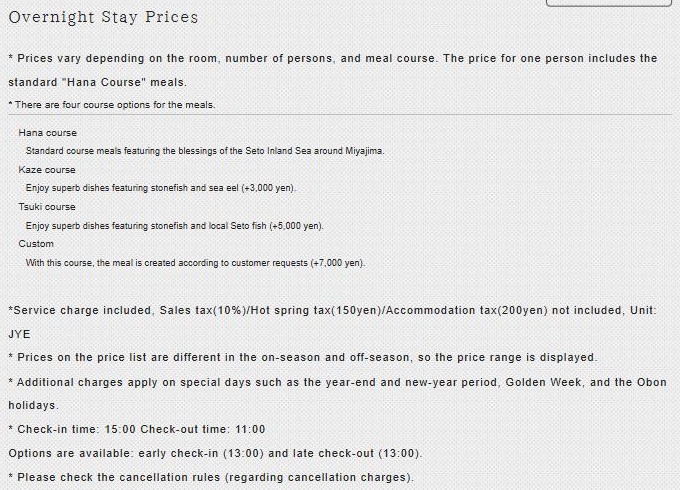
SEKITEI, an inn in Hiroshima Prefecture, prints these notes under the price table. The first line says “The price for one person includes the standard ‘Hana Course’ meals,” so the unit and the food come before any number. Next it lists three upgrade courses at +¥3,000, +¥5,000 and +¥7,000, so the meal is a choice inside the rate. Then the line that matters most for your budget: “Service charge included, Sales tax(10%)/Hot spring tax(150yen)/Accommodation tax(200yen) not included.”
Then the calendar. Prices differ between on-season and off-season, extra charges apply around year-end, Golden Week and Obon, check-in is 15:00 and check-out is 11:00, and early check-in (13:00) and late check-out (13:00) are offered as options. The page ends by pointing to the cancellation rules.
As of September 2026, from SEKITEI: English rate page.
Two inns, two meanings of “included”
Hakone Ginyu puts it in one sentence: “The rates shown are for one person per night with two meals (including service charge, tax, and bath tax).” It lists rate categories A to E by season and sends you to a calendar for the amounts. Its stated cancellation fees are 30% from three to two days before arrival, 50% the day before, and 100% on the day.
SEKITEI includes service charge but leaves out the 10% sales tax, the hot spring tax and the accommodation tax. Ginyu says its rate includes service charge, tax and bath tax. At the inns I’ve stayed at, service charge or tipping never showed up as a separate line on my bill, which fits SEKITEI’s “Service charge included.” The same word “included” covered different things on each page, so two ¥50,000 rates are not comparable until you read the sentence under each.
As of September 2026, from Hakone Ginyu: English reservation page.
Taxes that arrive separately
The hot spring tax (入湯税, nyuto-zei) is 150 yen per person per day as the standard under the law, with each municipality setting its own rate. The facility operator pays it to the municipality on behalf of guests. When I’ve paid these taxes, it was at check-in at some inns and at check-out at others.
As of September 2026, from the Ministry of Finance (in Japanese): hot spring tax explainer.
SEKITEI lists an accommodation tax of 200 yen without saying whether it is per person or per room. Assume 150 yen per person for the hot spring tax (the Ministry’s description) and 200 yen per person for the accommodation tax. SEKITEI lists the room Anan, which sleeps two, at ¥52,000~ per person on weekdays, so two guests is ¥104,000 before tax. Add 10% sales tax (¥10,400), ¥300 of hot spring tax and ¥400 of accommodation tax, and the total is about ¥115,100, roughly 10.7% on top of a listed price that ends in a tilde. This shows the shape of the gap, not a quote.
Price levers
SEKITEI’s table lists twelve rooms per person with half board, service charge included. Three things move the price on this page.
Room. Weekday prices are listed from ¥39,000~ (Koseki, which sleeps three) to ¥52,000~ (Taikan, which sleeps eight, and Anan, which sleeps two).
Day of the week. For the same room, the Saturday and day-before-holiday price is ¥10,000 to ¥17,000 higher per person across the twelve rooms. Yusen goes from ¥51,000~ to ¥66,000~.
Meal course. The upgrades are +¥3,000, +¥5,000 and +¥7,000, in the table’s unit.
On this page the meal course is the smallest of the three levers, though the inn doesn’t say whether the upgrade is per person.
Room bath
Some plans add a private bath in the room, usually at a higher rate. At the inns I’ve stayed at, I go to the large bath even when the room has a bath, unless the room bath is open-air or hot spring. Check what kind of bath the plan actually includes before paying the difference.
The hotel side
Dormy Inn Ikebukuro lists no prices.
As of September 2026, from Dormy Inn (in Japanese): Ikebukuro rooms page.
The hotel number you’re used to is tied to the room, with meals as a separate line. A ryokan’s number is tied to the guest and arrives with the meals. To compare, build the hotel’s equivalent: the room, plus dinner somewhere, plus breakfast, plus tax. For which type fits your trip, start with the where-to-stay article.
Booking-page checklist
Check these five things on the page before you decide:
- The unit. “Per person” or “per room,” and whether the table assumes two guests sharing.
- The meals. Which course the base price includes, and what the upgrades cost.
- The tax and service line. Which of service charge, sales tax, hot spring tax and accommodation tax are inside the number.
- The calendar. Weekday against Saturday, and the named high-season dates.
- The clock. Check-in and check-out times, and whether early or late options cost extra.
Cancellation rules sit next to these. SEKITEI links to them and Ginyu states them on the page. Read them before you pay, because the meals are part of what you’d be cancelling.
The short version
A ryokan rate is a per-guest figure that bundles the room, meals and service, while a hotel rate is typically a room figure with meals on a separate line. Read the note block under the table first, because it tells you whether service charge and taxes are inside. At SEKITEI, Saturday and day-before-holiday add ¥10,000 to ¥17,000 per person, the course upgrades add ¥3,000 to ¥7,000, and weekday rooms differ by up to ¥13,000.