Author: Japan Primer

  • Accommodation Tax in Japan: What It Is and What You Pay

    Accommodation Tax in Japan: What It Is and What You Pay

    “Tax included” reads like a promise that the number is the total. On a Japanese booking page it usually covers one tax. Rakuten Travel says the amount shown for a domestic stay includes consumption tax and service charge, and that the hot-spring tax and, by region, the lodging tax can be due separately at the property. On the lodging tax it says it in one line: 「国内宿泊単品の予約金額へは、当該価格は含まれておりませんので、別途現地でご精算ください」. That means the tax is not in the reservation amount for a stand-alone domestic stay, so settle it separately on site.

    As of October 2026, from Rakuten Travel (in Japanese): extra charges help and lodging tax help.

    A room can therefore be paid in full online and still leave a line to pay at the desk. The amount depends on the prefecture, city or town, on the room-only price per person, and in some places on who is staying. The table below covers 15 places. Other municipalities charge too, and more are scheduled.

    Last checked: October 5, 2026. Rates change, so the municipality’s own page for your dates outranks anything here.

    “Tax included” covers the national tax, not the local ones

    Four charges can land on one stay, and they are treated differently.

    Charge Set by On the Rakuten Travel and JTB pages (stand-alone stays)
    Consumption tax (消費税) National government Included in the displayed price
    Service charge (サービス料) The property Included in the displayed price
    Lodging tax (宿泊税) Prefecture, city or town Not included. Settle on site
    Hot-spring tax (入湯税) City or town Not included. Settle on site

    Consumption tax is the national one. The standard rate is 10 percent, of which 2.2 points is local consumption tax, and a business that shows prices to consumers in advance must show the price including consumption tax. Booking pages generally do this with the room price, though one storefront covered in Two Prices for One Room listed the room with 10% consumption tax excluded. There are still times I can’t tell at a glance whether a figure includes tax.

    As of October 2026, from the National Tax Agency (in Japanese): standard rate page and price display page.

    Service charge is the property’s own line. Rakuten and JTB both say their displayed price includes it, and the lodging-tax pages count it toward the base. Kyoto City’s page defines the lodging charge as 「素泊まり料金(室料及びサービス料)」, the room-only charge (room and service charge), and leaves out meals and consumption tax.

    As of October 2026, from Kyoto City (in Japanese): lodging tax page.

    The other two are local taxes. The hot-spring tax is a municipal tax, and some local governments, Tokyo among them, have introduced a lodging tax of their own. JTB’s displayed price for hotels and ryokan includes consumption tax and service charge, but not 「入湯税、宿泊税が課税される地域における宿泊税などの諸税は含まれておりません」: the hot-spring tax and, where it is levied, the lodging tax. Package tours differ. JTB says a package tour includes the hot-spring tax in the tour price for stays through March 31, 2027, and from April 1, 2027 it is paid at the accommodation.

    As of October 2026, from the Ministry of Finance (in Japanese): Q&A. From JTB (in Japanese): FAQ on hotel and ryokan prices and package tour page.
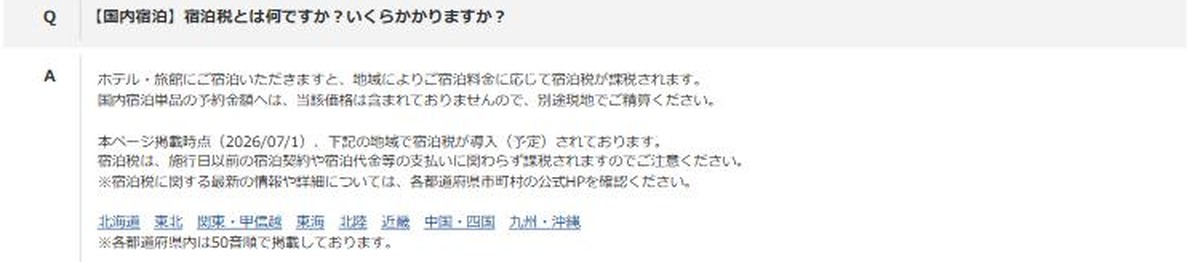
    Screenshot of a Rakuten Travel help page in Japanese about the accommodation tax. It says that depending on the region a lodging tax is charged according to the room rate, that the price is not included in the reservation amount for a stand-alone domestic stay and is to be settled separately on site. It also says the tax is charged whatever the contract date or payment, and that the page was current as of July 1, 2026.
    Rakuten Travel help page on the accommodation tax (in Japanese). Screenshot.

    What the accommodation tax is

    It is a tax each local government decides for itself. The rules fall into three types: one flat amount, tiered amounts by room price, or a percentage. Many places exempt school trips, and the inn collects the tax from the guest and remits it.

    As of October 2026, from the House of Councillors secretariat (in Japanese): research paper.

    The base is the room-only price per person per night. Kyoto City and Nasu Town both define it as the room-only charge with its service charge, excluding meals and consumption tax. Kanazawa and Hiroshima state their thresholds on prices excluding consumption tax. So the band follows the room part of a plan, not the headline price of a plan with dinner. The per-person unit is the same one the room price uses, which the per-person pricing article explains.

    A prefecture and a town can both tax the same stay. Hokkaido adds its amount to the town’s, with Kutchan folding both into one 3% rate, and Fukuoka Prefecture cut its own share to ¥50 inside Fukuoka City and Kitakyushu. In the table, Sapporo and Niseko show the two amounts already added together.

    Rates by place

    Bands are per person per night. Tokyo’s page names only the accommodation charge.

    Place Rate per person per night Exemptions on the page Source
    Tokyo Under ¥10,000: none. ¥10,000 to under ¥15,000: ¥100. ¥15,000 and up: ¥200 None listed beyond the threshold Tokyo Bureau of Taxation (in Japanese)
    Kyoto City From March 1, 2026: under ¥6,000: ¥200. ¥6,000 to under ¥20,000: ¥400. ¥20,000 to under ¥50,000: ¥1,000. ¥50,000 to under ¥100,000: ¥4,000. ¥100,000 and up: ¥10,000 School trips and school events (universities excluded). The guest FAQ says the tax applies regardless of age when a room charge arises Kyoto City and guest FAQ (in Japanese)
    Osaka Prefecture From September 1, 2025: under ¥5,000: none. ¥5,000 to under ¥15,000: ¥200. ¥15,000 to under ¥20,000: ¥400. ¥20,000 and up: ¥500 School trip students and chaperones Osaka guest page and rates page (in Japanese)
    Fukuoka Prefecture ¥200 flat, outside Fukuoka City and Kitakyushu None listed. The tax applies regardless of age when a lodging charge arises Fukuoka Prefecture (in Japanese)
    Fukuoka City Under ¥20,000: ¥200. ¥20,000 and up: ¥500. Both include ¥50 for the prefecture None listed. A child is taxed only if a lodging charge is collected Fukuoka City and FAQ (in Japanese)
    Kitakyushu ¥200 (¥150 city plus ¥50 prefecture) None listed Kitakyushu (in Japanese)
    Kanazawa Under ¥5,000: none. ¥5,000 to under ¥20,000: ¥200. ¥20,000 and up: ¥500. Prices excluding consumption tax None listed. The tax applies to every guest regardless of age who stays with a room charge Kanazawa and Q&A (in Japanese)
    Nagasaki City Under ¥10,000: ¥100. ¥10,000 to under ¥20,000: ¥200. ¥20,000 and up: ¥500. New bands from April 2027, see below School trips and school events, and others the mayor approves Nagasaki City (in Japanese)
    Hokkaido (prefecture) From April 1, 2026: under ¥20,000: ¥100. ¥20,000 to under ¥50,000: ¥200. ¥50,000 and up: ¥500 School trips and school events Hokkaido tax page (in Japanese)
    Sapporo From April 1, 2026, city and Hokkaido tax together: under ¥20,000: ¥300. ¥20,000 to under ¥50,000: ¥600. ¥50,000 and up: ¥1,000 School trips and school events Sapporo (in Japanese)
    Kutchan 3% of the room charge, Hokkaido’s tax included. It was 2% until March 31, 2026 School trips and school events (universities excluded), and students on work experience in the town Kutchan rates and exemptions (in Japanese)
    Niseko Until October 31, 2026, town and Hokkaido tax together: under ¥5,001: ¥200. ¥5,001 to under ¥20,000: ¥300. ¥20,000 to under ¥50,000: ¥700. ¥50,000 to under ¥100,000: ¥1,500. ¥100,000 and up: ¥2,500. From November 1, 2026: 3% of the room charge School trips and school events, others the mayor approves Niseko flyer, from April 2026 and flyer on the 3% change (in Japanese, English)
    Hiroshima Prefecture From April 1, 2026: ¥200 when the room charge is ¥6,000 or more, excluding consumption tax. Nothing below School trips and school events (universities excluded) Hiroshima Prefecture (in Japanese)
    Nasu (Tochigi) From October 1, 2026: under ¥10,000: ¥100. ¥10,000 to under ¥20,000: ¥300. ¥20,000 to under ¥30,000: ¥500. ¥30,000 to under ¥50,000: ¥800. ¥50,000 to under ¥100,000: ¥1,500. ¥100,000 and up: ¥3,000 Anyone under 12. School trips and school events Nasu Town (in Japanese)
    Tokoname (Aichi) ¥200, no threshold, since January 6, 2025 None listed Tokoname (in Japanese)

    The inn is the collector. The guest pays the inn, which remits the tax to the prefecture, city or town.

    Where the tax starts varies: Tokyo at ¥10,000, Hiroshima at ¥6,000, Osaka and Kanazawa at ¥5,000. Fukuoka Prefecture, Kitakyushu and Tokoname charge a flat ¥200. At the top, Kyoto charges ¥10,000 a person once the room-only price reaches ¥100,000, ahead of Nasu’s ¥3,000 and Niseko’s ¥2,500 (until October 31). Kutchan’s rate now and Niseko’s from November are percentages, which scale with the price.
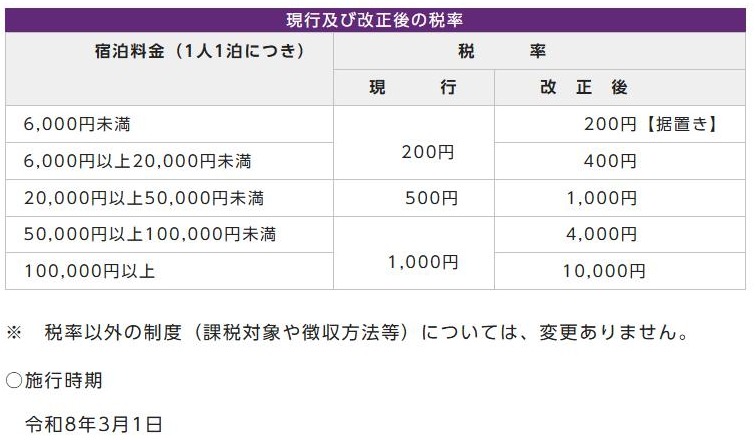
    Screenshot of the Kyoto City accommodation tax page in Japanese showing the five price bands that apply from March 1, 2026: under 6,000 yen is 200 yen, 6,000 to under 20,000 yen is 400 yen, 20,000 to under 50,000 yen is 1,000 yen, 50,000 to under 100,000 yen is 4,000 yen, and 100,000 yen and over is 10,000 yen. A second column lists the previous rates.
    Kyoto City accommodation tax page, rates from March 1, 2026 (in Japanese). Screenshot.

    Kyoto’s old top band was ¥1,000 for ¥50,000 and up. Now ¥50,000 to under ¥100,000 is ¥4,000 and ¥100,000 and up is ¥10,000. The stay date decides which table applies. Kyoto’s guest FAQ says 「令和8年3月1日(宿泊税額改正)以降の宿泊の際は、改正後の宿泊税額が適用されます」, so stays from March 1, 2026 use the new amounts even if booked earlier. Sapporo says the same about its April 1, 2026 start: 「令和8年4月1日より前に予約がされた場合でも課税の対象となります」.

    As of October 2026, from Kyoto City (in Japanese): guest FAQ.

    Changes already on the calendar

    Treat each of these as a reason to check the page again for your dates.

    • Niseko, November 1, 2026. The town moves from tiers to 3% of the room charge, with Hokkaido’s share included. The change applies to stays from that date.
    • Okinawa Prefecture, February 1, 2027. The prefecture sets 2% of the room-only charge with a ¥2,000 cap, and its own example rounds the price down to the nearest ¥1,000 first: ¥8,500 becomes ¥8,000, and ¥8,000 times 2% is ¥160. Where a municipality also taxes, the split is 0.8% for the prefecture (cap ¥800) and 1.2% for the municipality (cap ¥1,200).
    • Tokyo, April 1, 2027. The tax becomes 3% of the accommodation charge per person per night, with nights under ¥13,000 not taxed, and simple lodgings and private rentals are added. Tokyo doesn’t say how meals or service charge are treated. A ¥20,000 per-person charge carries ¥200 today and would be ¥600 under 3%.
    • Nagasaki City, April 2027. The city’s council papers from February 2026 set the new bands at ¥100 under ¥6,000, ¥300 from ¥6,000 to under ¥20,000 and ¥500 from ¥20,000. The Nagasaki Shimbun reported on October 5, 2026 that the minister consented on September 30.

    As of October 2026, from Okinawa Prefecture (in Japanese and English): flyer. From the Tokyo Bureau of Taxation (in Japanese): tax page. From Nagasaki (in Japanese): council papers and Nagasaki Shimbun report.

    Exemptions are written for school groups, not for families

    Exemptions are mostly for students and chaperones on school trips and school events. Kyoto’s wording excludes universities, and Kutchan adds students on work experience in the town.

    For a child traveling with family, the pages mostly follow the room charge, not the age. Kyoto, Fukuoka Prefecture and Kanazawa each say the tax applies regardless of age when a room charge arises. Fukuoka City puts it for families: a child is taxed if a lodging charge is collected, and not if none arises, with free co-sleeping as its example (「添い寝無料などにより、宿泊料金が発生しない場合は課税対象となりません」). Nasu Town is the outright age exemption in the table: anyone under 12 (「年齢12歳未満の者」). So the question for a family is whether the plan puts a room charge on the child, which the per-person pricing article covers.

    The hot-spring tax is a different tax

    The hot-spring tax (入湯税, nyūtō-zei) is charged for bathing, not for sleeping. When you go to a bathing facility that uses a hot spring and enter the spring, the hot-spring tax applies, and the operator pays it to the town on your behalf. The law’s standard is ¥150 per person per day, each municipality can set a different amount, and the amount can differ between overnight and day guests. A one-night stay is generally treated as one day.

    As of October 2026, from the Ministry of Finance (in Japanese): Q&A. From the Ministry of Internal Affairs (in Japanese): local tax page. The one-day rule and the Fukuoka City hot-spring figures below are from the House of Councillors paper.

    Two towns show how the amounts vary. Niseko charges ¥150 for an overnight guest and ¥100 for a day-bath visit, and exempts anyone under 15. Hakone charges ¥150 per person per night and ¥50 for a day visit, and exempts anyone under 12.

    As of October 2026, from Niseko and Hakone (in Japanese): Niseko hot-spring tax, Hakone hot-spring tax.

    It follows the bath. Rakuten says it arises when you use accommodation with a hot-spring bath (「鉱泉浴場(温泉浴場)を備える宿泊施設をご利用の際に発生いたします」). A large shared bath and a hot spring are not the same thing, a split that Where to Stay in Japan covers.

    Both taxes can land on one bill. The two aren’t treated as double taxation because they tax different acts, a stay and a bath, but a guest at a hot-spring inn owes both. Fukuoka City cut the hot-spring tax for overnight guests from ¥150 to ¥50 for as long as its lodging tax applies. The ryokan day, with this payment in it, is in What Actually Happens During a Ryokan Stay.

    Paid online, with a line still left at the desk

    Municipal pages say the tax is paid at the property. Osaka Prefecture says 「宿泊料金と合わせて宿泊施設へお支払いください」, pay the inn together with the room charge, and warns that 「宿泊予約サイト等で事前決済していただいた料金の中に、宿泊税が含まれていない場合がございます」, an advance payment on a booking site may not include the tax. Tokyo says you may pay at the hotel or ryokan front desk, separate from the travel price. Okinawa’s flyer says: “Please pay the accommodation tax to the accommodation provider with the method used to pay for your accommodation.”
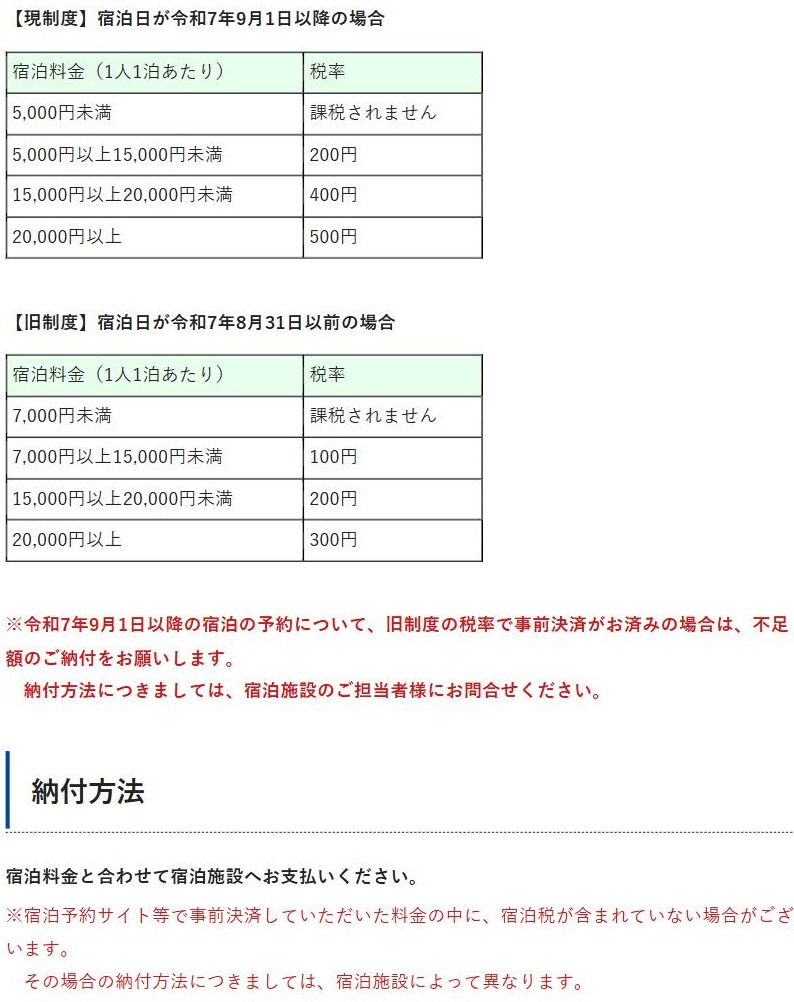
    Screenshot of the Osaka Prefecture guest page in Japanese. It says to pay the accommodation tax to the facility together with the room charge, lists the current tax by price band from September 1, 2025 and the previous bands, and notes that an advance payment made on a booking site may not include the tax.
    Osaka Prefecture guest page, payment note (in Japanese). Screenshot.

    Some properties do fold the tax into the rate. A Sotetsu Hotels notice dated November 4, 2025 (cited in Two Prices for One Room) says that from March 1, 2026 the lodging tax at its Tokyo, Osaka Prefecture and Kyoto City properties moves from inside the displayed price to on top of it.

    What I did: on my ryokan stays I paid online, and the hot-spring tax was paid on the day. At hotels and ryokan alike, I paid either tax at check-in at some places and at check-out at others. When I paid the hot-spring tax at a ryokan, card and electronic payment both worked. Which methods an inn takes depends on the inn and the plan, so check before you count on one.

    Working out your own bill

    1. Find the place that taxes your stay. It may be a prefecture, a city, a town, or two of them at once. Use the table above and the municipality’s own page.
    2. Take the room-only price per person per night. Leave out meals and consumption tax, as the Kyoto and Nasu pages define it.
    3. Match it to the band, then multiply by people and nights. Kyoto City at ¥12,000 room-only per person for 2 adults and 3 nights is ¥400 times 2 times 3, or ¥2,400. At ¥25,000 it is ¥1,000 times 6, or ¥6,000.
    4. Add the hot-spring tax if the inn has a hot-spring bath. At ¥150 per person per night, 2 adults for 2 nights is ¥600, less for anyone the town exempts by age.

    Before I press the book button I check the total with tax and service charge included. The two local taxes are the part of the bill that total can leave out.

    The short version

    • On a stand-alone booking, “tax included” covers consumption tax and service charge. The lodging tax and hot-spring tax are settled on site even on a prepaid room.
    • Look up the municipality’s rate on the room-only price per person per night, multiply by people and nights, and add the hot-spring tax if the inn has a spring bath.
    • A child follows the room charge unless the place has an age rule, as Nasu does for under 12.
    • Check the municipality’s page for your dates, then keep a card or cash for the desk.

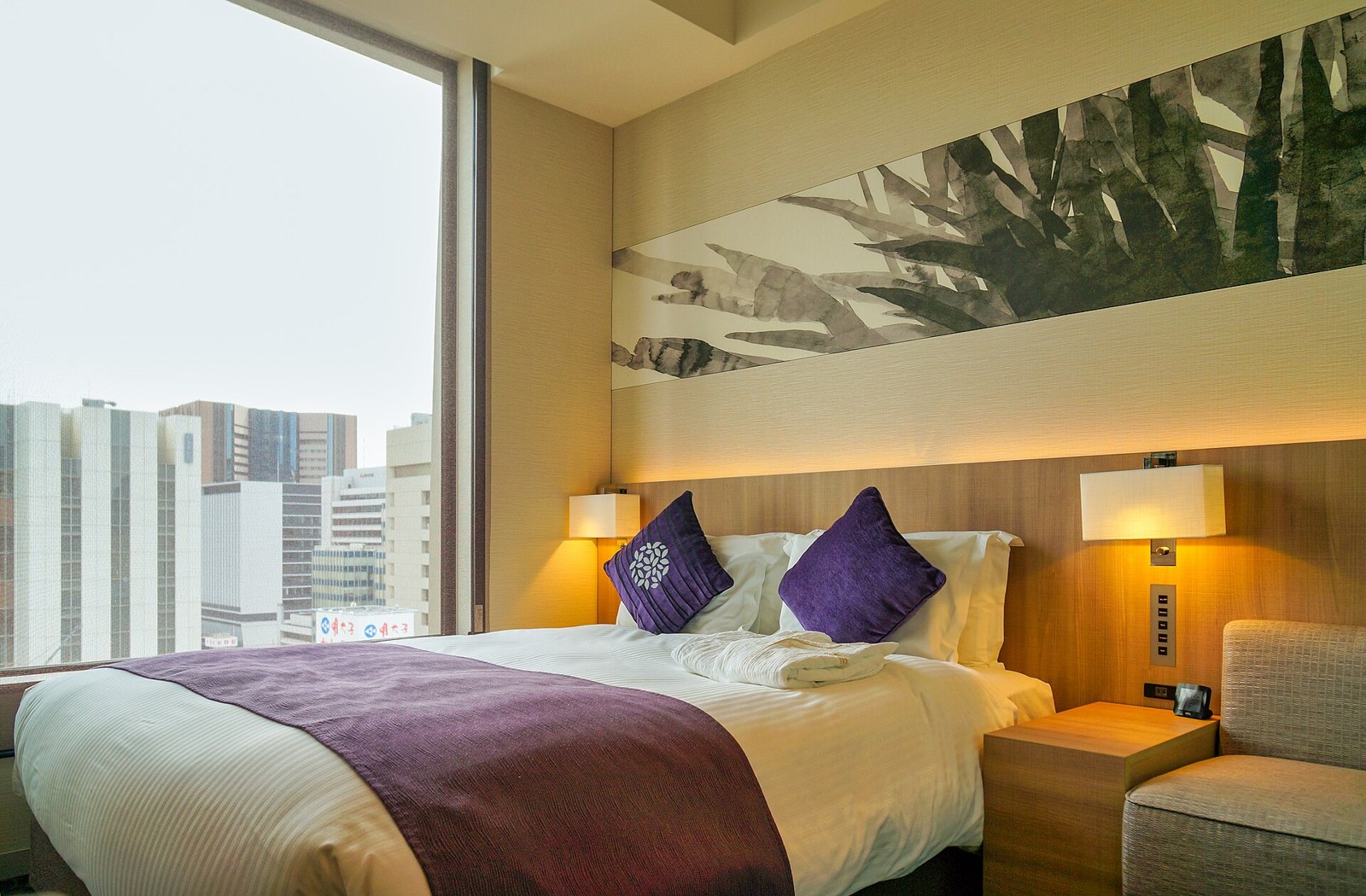
    Cover photo: a double room at Millennium Mitsui Garden Hotel Tokyo by J o, CC BY-SA 4.0, via Wikimedia Commons. It shows a different hotel from the places discussed.
  • Checking In Late at a Japanese Hotel

    Checking In Late at a Japanese Hotel

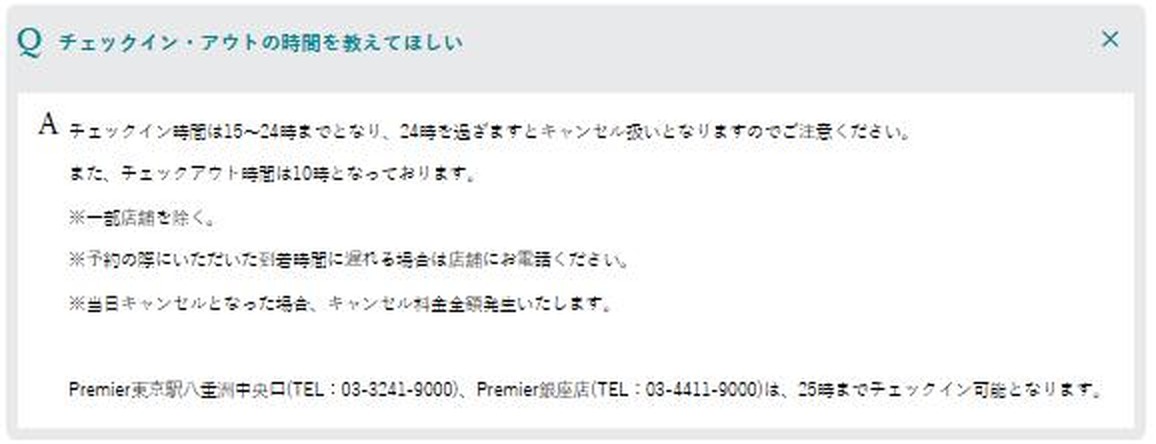
    Check-in time reads like a start time. The room is yours from 3 p.m., and if you walk in at 1 a.m. the hotel still has your booking and your card. Super Hotel’s English FAQ reads differently: “check-in time is from 15:00 to 24:00, and your reservation will be canceled after 24:00”. Richmond Hotels’ terms put the line at 10 p.m. (22:00) if you gave no arrival time. Tokyu Stay’s front desk is staffed 24 hours, and its FAQ still asks for contact by midnight and says the booking may be canceled without it.

    As of October 2026, from Super Hotel: FAQ.

    Screenshot of the Super Hotel FAQ in Japanese. The answer to the check-in and check-out question says check-in is from 15:00 to 24:00, that the booking is treated as canceled after 24:00, that a guest who will be late for the arrival time given at booking should phone the hotel, that a same-day cancellation incurs the full fee, and that two Premier hotels allow check-in until 25:00.
    Super Hotel FAQ, check-in and check-out answer (in Japanese). Screenshot.

    These rules come from hotel, ryokan and booking-site pages. They show what a rule can look like, not how many hotels follow it.

    Last checked: October 4, 2026. Hotel policies change, so the hotel’s own page on the day you book outranks anything here.

    The arrival time you pick is also a deadline

    Super Hotel’s terms word the rule more precisely. Article 5 says the hotel may treat the contract as canceled if the guest “does not appear without any advance notice by midnight on the accommodation date (or 2 hours after the estimated time of arrival if such estimated time was expressly informed beforehand)”. A guest who gave 6 p.m. and has not been in touch could be treated as canceled at 8 p.m. instead of midnight. For a stated time after 10 p.m. the FAQ and the terms differ, so ask.

    As of October 2026, from Super Hotel: terms.

    The lines differ by chain.

    Chain When the terms say a booking may be canceled What it asks you to do
    Toyoko Inn The expected time of arrival passes with no advance notice (terms, Article 6, revised September 29, 2026) Contact the hotel in advance if you’ll be later than planned (guide). The FAQ asks for a phone call if arrival will be after 24:00 (FAQ, in Japanese)
    Super Hotel After 24:00 if you haven’t told the hotel (FAQ), or 2 hours after the stated arrival time (terms, Article 5) Call the hotel if you’ll be significantly late for the time you filled in at booking
    Richmond Hotels 10 p.m., or 2 hours after the stated arrival time (terms, Article 6, in Japanese) Contact the hotel. The clause covers a guest who neither arrives nor makes contact
    Route Inn The arrival time on the day passes with no contact (terms, Article 5, in Japanese, applied from October 1, 2015) Contact the hotel
    Tokyu Stay No word by 24:00 that day (FAQ, in Japanese) Call the front desk if arrival will be after 22:00. Midnight is the deadline for that contact

    The table shows three different clocks. Toyoko Inn and Route Inn use the time you gave. Super Hotel and Richmond add two hours to it and keep a fixed backstop for guests who gave none, midnight at one and 10 p.m. at the other. Tokyu Stay names midnight. The verb in all five is “may”, and Sotetsu Hotels’ English guide suggests the door isn’t always shut: “If you are late and unable to contact us in advance, please explain the situation to the front desk upon arrival.” The same guide says “The latest check-in time varies from hotel to hotel. Some hotels accept check-ins until midnight, or even 24 hours a day, while others may cancel your reservation if you arrive after a certain time”.

    As of October 2026, from Sotetsu Hotels: English guide.

    Check-in starts at 15:00 at Toyoko Inn, Super Hotel, Tokyu Stay, Dormy Inn and one Route Inn hotel. Dormy Inn gives 15:00 and 11:00 for check-out and adds that a facility’s or plan’s own times can differ. The last check-in is 23:00 or 24:00 at most hotels, according to Jalan’s news column. That fits the chains above, with Richmond’s 22:00 at the early end.

    As of October 2026, from Dormy Inn (in Japanese): FAQ. From Jalan News (in Japanese): column.

    Who is at the desk after midnight

    A staffed desk and a check-in deadline are separate facts. Tokyu Stay’s answer says 「フロントは24時間営業しております」, the front desk is open 24 hours, in the same paragraph as the midnight line. Toyoko Inn’s English guide says “The hotel operates 24 hours a day”. One Route Inn hotel’s facilities page lists 「24時間フロント常駐」, a front desk staffed around the clock.

    Other pages close the counter. Super Hotel’s FAQ has a question about “the hours when the front desk is closed (0:00 to 7:00)” and answers that in an emergency you use the intercom next to the elevator or phone a call center at night. The Japanese FAQ adds that after 24:00 you enter the building by unlocking it with the passcode for your room. That fits the 24:00 check-in line: you check in while the counter is open, and the passcode handles the door afterward.

    As of October 2026, from Route Inn and Super Hotel (in Japanese): Route Inn facilities page, Super Hotel FAQ.

    Richmond sits between the two. A notice from one Richmond hotel says staff are there 24 hours and that the entrance is locked after 1 a.m. for security, so you ring the intercom. It also asks guests to tell the hotel in advance when their arrival time changes.

    As of October 2026, from Richmond Hotel Musashi-Kosugi (in Japanese): notice.

    I have checked in at Japanese hotels both between 10 p.m. and midnight and after midnight. In my experience, at hotels and ryokan alike, after 10 p.m. or after midnight you mostly need your room’s card key to get through the lobby door.

    Machines, passcodes and hotels with no desk

    A machine at a staffed hotel changes who hands you the key. Toyoko Inn’s guide says “Please check-in either at the reception or by using our self-check-in machine”, on the same page as its late-arrival rule.

    Dormy Inn’s 快速チェックイン (quick check-in) lets you register in the hotel’s app and hold a QR code to a machine at the hotel to get your key. Pre-registration opens at 6:00 a.m. on the day of the stay, late-night use varies by facility, and same-day or changed bookings can’t use it. Those go to the staffed front counter. For a late arrival, check your hotel’s page first, and expect the counter if you book on the road the same day.

    As of October 2026, from Dormy Inn (in Japanese): quick check-in page.

    Two pages describe the fully unmanned kind. Hotel Watari says “Our hotel is completely unmanned.” Check-in is done on your own phone from 4 p.m., after you arrive, using a pre-check-in link from the confirmation email, and a 4-digit passcode is displayed for the smart lock on the front door. If you haven’t completed the advance procedure, you’ll enter your guest information on the spot, and a phone number is listed for questions. At a place like that, the confirmation email with the link is what to have open when you reach the door.

    Hotel B4T Iwaki uses a different design: a Suica card touched at a kiosk on arrival, at the security entrance and at the room door, with staff reachable around the clock by text or video chat, except for cabin-type rooms.

    As of October 2026, from Hotel Watari: self check-in page. From Japan Today: unmanned hotel in Iwaki.

    Ryokan: dinner is the deadline

    At a ryokan, a traditional inn, the clock that matters is the kitchen’s. The Japan Tourism Agency says “You can usually check in starting at 15:00 or 16:00” and “dinner is usually served during a set time window, and if you arrive too late, you may miss it. If it does seem like you’ll arrive significantly later than the designated check-in time, let the ryokan know”. Here are the hours at four inns.

    As of October 2026, from the Japan Tourism Agency: ryokan page.

    Page What it says about arriving late
    Kishigon Ryokan (FAQ, in Japanese) Dinner plans: last check-in 18:00. Without dinner: 20:00. Dinner starts at 18:00 or 18:30, last start 19:00. No contact may mean cancellation
    Satoyama Jujo (guest information, in Japanese) Check-in from 15:00. Last check-in for dinner guests is 18:30
    Tanabe Ryokan (FAQ, in Japanese) Check-in 15:00 to 18:00, with a call asked for if you’ll be after 18:00. Dinner may not be served if you’re well behind, and it says there is no refund for dinner not served. No curfew, but from 23:00 to 7:00 you open and close the automatic front door by hand
    Ryokan Matsushima (FAQ, in Japanese) Earliest dinner 18:30. After 20:00 dinner may not be prepared. A call is requested if you’ll be well past the planned time
    Screenshot of a ryokan FAQ in Japanese. Check-in is 15:00 to 18:00, guests arriving after 18:00 are asked to phone ahead, dinner may not be served if the guest is far behind the planned check-in time with no refund for it, and between 23:00 and 7:00 the automatic front door has to be opened and closed by hand.
    Tanabe Ryokan FAQ, check-in and curfew answer (in Japanese). Screenshot.

    At Kishigon, dropping dinner moves the last check-in from 18:00 to 20:00. A family-run inn’s blog asks guests arriving after 5 p.m. to call that day, even from the road, because dinner starts at a set time.

    As of October 2026, from Kadoya (in Japanese): blog post.

    Three English-language terms sheets put the no-show line in numbers. Nishimuraya Honkan’s terms say the inn may treat the stay as canceled if the guest “does not appear by 7:00 pm of the accommodation date (or, two hours after the expected arrival time if the Ryokan has been notified)”, and the cancellation table that follows Article 11 lists a no-show at 100% of the reservation rate. Yunokuni Tensyo and Hotel Iyaonsen use the same form with 8 p.m.

    As of October 2026, from the inns’ English terms: Nishimuraya Honkan, Article 5, Yunokuni Tensyo, Article 6 and Hotel Iyaonsen, Article 6.

    The door is its own question. The Japan Tourism Agency says “Most ryokan do have a curfew”, with some inns that have none, some that keep staff at the desk after curfew, and some that hand you a key. Tanabe’s answer shows what “no curfew” can mean in practice. If you’ll arrive after 18:00, ask the inn before you book, including about the door.

    As of October 2026, from the Japan Tourism Agency: curfew page.

    What the booking sites say about arrival times

    The hotel’s terms set the clock, and the booking site is the way you reach the hotel. Each site draws its line in a different place.

    Rakuten Travel. Its help page on same-day changes says: 「原則、予約時に指定したチェックイン時間を厳守してください」, keep to the check-in time you specified when booking. If you can’t, contact the number the hotel shows, quickly. After the check-in time the hotel may treat the booking as canceled. If you hadn’t contacted the hotel by then and couldn’t stay, Rakuten Travel takes no responsibility and sends you to the hotel about the fee. Rakuten doesn’t pass requests to accommodations, domestic or overseas, and the hotel’s phone number is on the reservation confirmation page.

    As of October 2026, from Rakuten Travel (in Japanese): same-day change help and help on contacting the hotel.

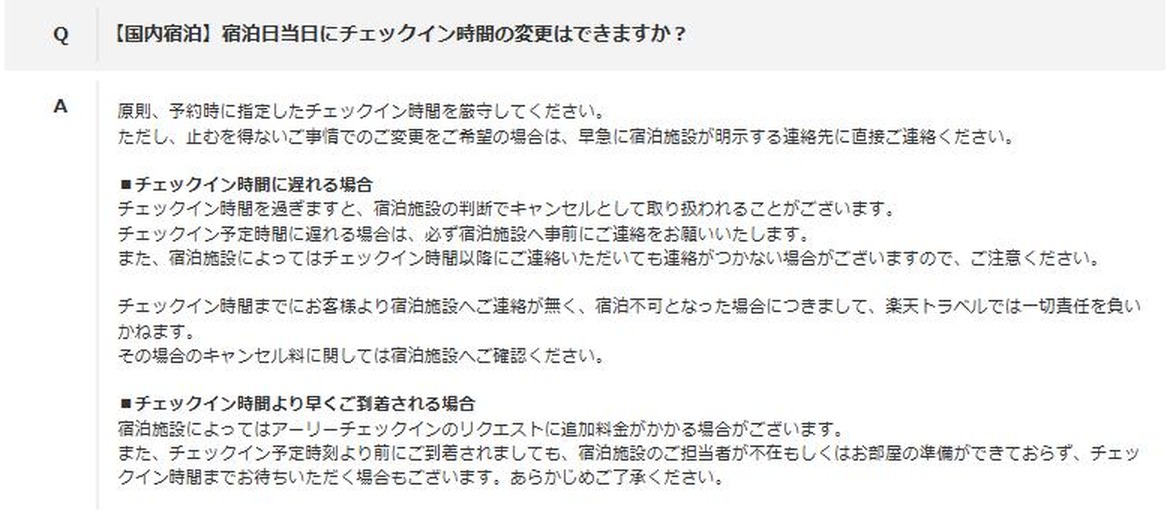
    Screenshot of a Rakuten Travel help page in Japanese about changing the check-in time on the day of the stay. It says to keep to the check-in time given at booking, that the hotel may treat the booking as canceled after the check-in time, and that Rakuten Travel takes no responsibility if the guest did not contact the hotel by the check-in time.
    Rakuten Travel help page on same-day check-in changes (in Japanese). Screenshot.

    Jalan. Its reservation help lists the check-in time, planned check-in time included, among the items you can change on the reservation page, and says the phone number on the booking confirmation page reaches the property. Jalan’s news column adds that a large delay can be treated as a cancellation under a hotel’s terms, and that with a meal plan you should call even for a small delay because the kitchen prepares for your arrival time.

    As of October 2026, from Jalan (in Japanese): reservation help.

    Booking.com. Its FAQ has a question titled “I will be arriving earlier/later than the stated check-in time. Can I still check in?” and answers “This depends on the property who will do their best to meet your needs but can’t guarantee your request.” It lists three routes: give your expected arrival time while booking, manage the reservation online to ask for check-in outside the standard hours, or contact the property with the details in your confirmation email. Its terms add “If you think you’re not going to arrive on time, contact your Service Provider and tell them when they can expect you”.

    As of October 2026, from Booking.com: FAQ and terms, section A9.

    Agoda. A hotel can report a no-show “if your guest doesn’t arrive by midnight on the check-in date” and should first check whether the guest sent a “Late Check-in” request or made direct arrangements. That midnight is the point for reporting to Agoda, and a hotel’s own terms can set an earlier line, as Richmond’s 10 p.m. does. Special requests are by default “not confirmed and are subject to availability at the property upon arrival”.

    As of October 2026, from Agoda Partner Hub: no-show page and special requests page.

    For how the sites differ on price, see Two Prices for One Room: How Japanese Booking Sites Build the Number They Show You.

    What a no-show costs

    Toyoko Inn’s cancellation table lists a no-show at 100% of the basic accommodation charge, regardless of guest type or booking size. Super Hotel’s Japanese FAQ says a same-day cancellation incurs the full cancellation fee. Tanabe’s FAQ says dinner that couldn’t be served because of a big delay isn’t refunded.

    Two pages carry relief. Toyoko Inn’s FAQ says that if you booked with online card payment, you needn’t call about arriving past your planned time, but you do need to tell the hotel if you won’t come at all. Super Hotel’s terms, Article 5 paragraph 3, say the fee “shall not be charged” if “it is proven that the Guest failed to arrive by midnight on the accommodation date (or 2 hours after the estimated time of arrival if such estimated time was informed beforehand) or to provide an advance notice thereof to the Hotel due to the delay of railway, airline or any other public transportation, or other circumstances not attributable to the Guest”. The wording is “if it is proven”, so a delay notice or ticket record is worth keeping.

    As of October 2026, from Toyoko Inn: terms and FAQ (in Japanese). From Super Hotel: terms, and the FAQ (in Japanese).

    Rakuten’s wording above leaves the fee to the hotel. Booking.com’s terms say “It’s your responsibility to ensure you’re on time, and if you aren’t, we aren’t responsible for any associated costs (e.g. the cancellation of your booking, or any fees the Service Provider may charge).” For the fee ladder before the day of stay, see Japanese Hotel Cancellation Policies Explained.

    How to tell the hotel

    1. Enter the time you can really make. Under the Super Hotel and Richmond wording the stated time starts a two-hour clock, and under Toyoko Inn’s and Route Inn’s it is the line, so an optimistic entry shortens your margin. I enter the time I actually expect to arrive.
    2. Change it on the site if the site lets you. Jalan’s reservation help lists the planned check-in time among the changeable items, and Booking.com’s FAQ describes managing the reservation online to ask for later check-in.
    3. Phone for anything after midnight, or close to the hotel’s line. The hotel’s phone number is on the booking confirmation page.
    4. If you can’t reach anyone, explain at the desk. Treat that as a fallback, since the terms above still give hotels the right to cancel.

    A short line like this works for email or a booking-site message, not for a phone call. The English is for your own reference:

    〇月〇日に予約しております(お名前)です。到着が予定より遅れ、〇時ごろになりそうです。予約番号は〇〇です。よろしくお願いいたします。

    This is (your name), booked for (date). My arrival will be later than planned, around (time). My reservation number is (number). Thank you.

    When the train is already late

    If the delay has already happened and the night is still ahead of you, these can help.

    • Same-night booking on Rakuten Travel. Members can book a same-night stay until 29:00, which means 5 a.m., by picking the previous day’s date as the check-in date and a time of 24:00 or later. A hotel may not yet have registered a last-minute booking, so show the booking screen and say it came through Rakuten Travel.
    • Plans that take check-in after midnight. Jalan marks such plans with 「24時〜もOK」 and describes arrival and check-in after 24:00, up to 29:00. Each plan page carries its own terms.
    • Hotels that run later than the usual line. Super Hotel’s Japanese FAQ lists Premier Tokyo Station Yaesu Central Exit and Premier Ginza as taking check-in until 25:00, which is 1 a.m.
    • A transport delay as the cause. Keep the proof. Super Hotel’s Article 5 paragraph 3, quoted above, ties the fee waiver to it.

    As of October 2026, from Rakuten Travel and Jalan (in Japanese): Rakuten same-night booking help, Jalan help on late check-in plans.

    The short version

    • The time you give a Japanese hotel is also a deadline if you haven’t told the hotel. It is the stated time itself at Toyoko Inn and Route Inn, two hours after it at Super Hotel and Richmond, and midnight as the contact deadline at Tokyu Stay.
    • Without a stated time, Richmond’s line is 10 p.m. and Super Hotel’s is midnight. A machine, a passcode door or a 24-hour desk sits beside that line and does not remove it.
    • Ryokan with dinner are earlier: last check-in is 18:00 at Kishigon and 18:30 at Satoyama Jujo, and the terms sheets put the no-show line at 7 or 8 p.m.
    • Tell the hotel by phone, or through the booking site if it has a message tool, whenever you’ll be later than the time you entered.

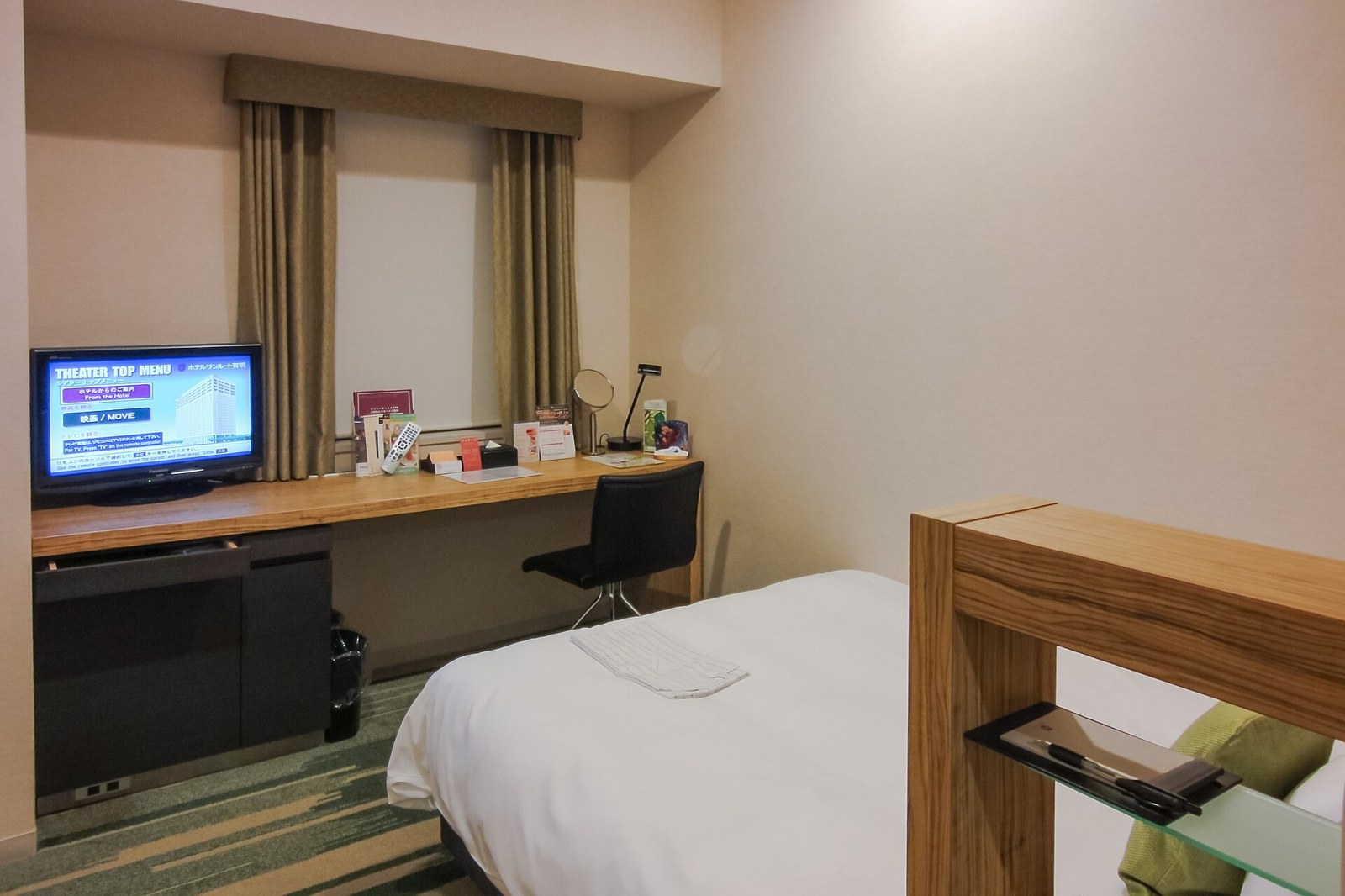
    Cover photo: a single room at Hotel Sunroute Ariake by J o, CC BY-SA 4.0, via Wikimedia Commons. It shows a different hotel from the ones discussed.

  • How to Avoid a Smoking Room in a Japanese Hotel

    How to Avoid a Smoking Room in a Japanese Hotel

    Dormy Inn Ikebukuro says 全室禁煙, all rooms non-smoking, with smoking booths on two floors. Dormy Inn Niigata says 4F喫煙フロア、他禁煙フロア: the 4th floor is a smoking floor and the others are non-smoking. So a chain name doesn’t give you the label. Japan’s indoor smoking rules took full effect on April 1, 2020, but they don’t cover hotel guest rooms. Whether a room allows smoking is the hotel’s decision, and on a booking page it shows up as a Japanese label on the room or the plan.

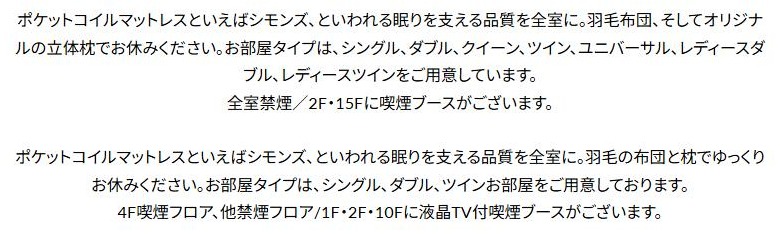
    Screenshot of two Dormy Inn room pages in Japanese. The top line, from Ikebukuro, reads all rooms non-smoking with smoking booths on the 2nd and 15th floors. The bottom line, from Niigata, reads 4th floor smoking floor, other floors non-smoking, with smoking booths on the 1st, 2nd and 10th floors.
    Top: Dormy Inn Ikebukuro. Bottom: Dormy Inn Niigata (room pages, in Japanese). Screenshot.

    Last checked: October 4, 2026. Hotel policies change, so the hotel’s own page on the day you book outranks anything here.

    The law left guest rooms out

    Under the amended law, facilities many people use, passenger ships and trains, and restaurants are non-smoking indoors in principle, in full effect from April 1, 2020. Shared areas such as a lobby or restaurant fall on that side of the principle.

    Guest rooms are treated differently. Hotel and inn guest rooms are exempt, next to private residences and sleeping rooms on trains and ships. Tokyo’s health center puts it in one line: 「(注)人の居住する場所、ホテルや旅館の客室は規制対象外です。」, which translates roughly as “places where people live, and hotel and inn guest rooms, are outside the regulation”.

    The law also uses its own smoking-room terms. 喫煙専用室 is one of four kinds of smoking room a facility can set up if it meets the conditions. A 喫煙ルーム on a hotel’s booking page is something else, a guest room the hotel sells for smoking.

    A hotel can also go further than the law. Sunshine City Prince Hotel banned all smoking, e-cigarettes included, in all guest rooms and other facilities, with one designated smoking area in the lobby. Other hotels use the room exemption and sell smoking rooms.

    As of October 2026, from MHLW’s amended law page and smoking room page (both in Japanese), the Kanagawa health page (in Japanese), the Tokyo health center page (in Japanese) and the Prince Hotels notice.

    The labels you will see

    The English is approximate.

    Label Reads as Where it appears
    禁煙 / 禁煙ルーム non-smoking / non-smoking room Richmond Hotel Tokyo Suidobashi’s room page has a booking button labeled 禁煙ルーム for each room it sells that way
    喫煙 / 喫煙ルーム smoking / smoking room The same page, as a second button labeled 喫煙ルーム beside the first
    全室禁煙 all rooms non-smoking Dormy Inn Ikebukuro’s room page, with smoking booths on the 2nd and 15th floors
    全館禁煙 whole building non-smoking Tokyu Stay’s FAQ page, which pairs it with 全室禁煙 and mentions a booth in a shared space. Dormy Inn Nagoya Sakae uses it in a notice
    喫煙フロア smoking floor Dormy Inn Niigata’s room page: the 4th floor, with the rest non-smoking
    喫煙ブース / 喫煙所 smoking booth / smoking area, outside the rooms The Dormy and Tokyu Stay pages above. Richmond Hotel Narita separates a 喫煙室 you reserve from a 喫煙所 on the first floor
    加熱式たばこ専用 heated tobacco only Route Inn Uozu’s room page, covered in the heated tobacco section

    Two points come out of that. A 全館禁煙 or 全室禁煙 page can still direct you to a booth, so the label describes your room and the building, and a booth is a separate fact. And the same word can sit at different levels: 喫煙フロア describes a floor, 喫煙ルーム a single room, 喫煙所 a place that isn’t a room at all.

    What 14 hotel pages say about themselves

    Nine of 14 hotel pages say their rooms or building are non-smoking. Five sell smoking floors, smoking rooms or heated-tobacco rooms. Business-hotel chains dominate the 14, and older notices carry their dates because a policy from 2018 or 2020 may not be the policy now.

    Pages that say rooms are non-smoking

    Property or page What the hotel says
    Tokyu Stay (FAQ page, in Japanese) 全館・全室禁煙, booth in a shared space
    Dormy Inn Ikebukuro (in Japanese) 全室禁煙, booths on 2F and 15F
    Dormy Inn Nagoya Sakae (notice, in Japanese) 全館禁煙 from February 10, 2025, booths on 1F and 6F (notice of February 7, 2025)
    Super Hotel JR Shin-Osaka Higashiguchi (notice, in Japanese) all guest rooms non-smoking from October 1, 2025, and no smoking area on or off the premises (notice of May 2, 2025)
    Hotel Monterey group (notice, in Japanese) all guest rooms of the group’s hotels non-smoking
    MIMARU (FAQ) “All MIMARU rooms are non-smoking.”
    Agora Tsuki (FAQ) “All rooms at our hotel are non-smoking,” with an outdoor smoking area
    Sunshine City Prince Hotel (notice) all smoking banned in all guest rooms, lobby smoking area (notice of April 1, 2020)
    Hotel Nikko Kansai Airport (notice) all guest rooms non-smoking from September 25, 2018

    Pages that sell smoking floors, smoking rooms or heated-tobacco rooms

    Property or page What the hotel says
    Dormy Inn Niigata (in Japanese) 4F is a 喫煙フロア and the other floors are non-smoking, with booths on 1F, 2F and 10F
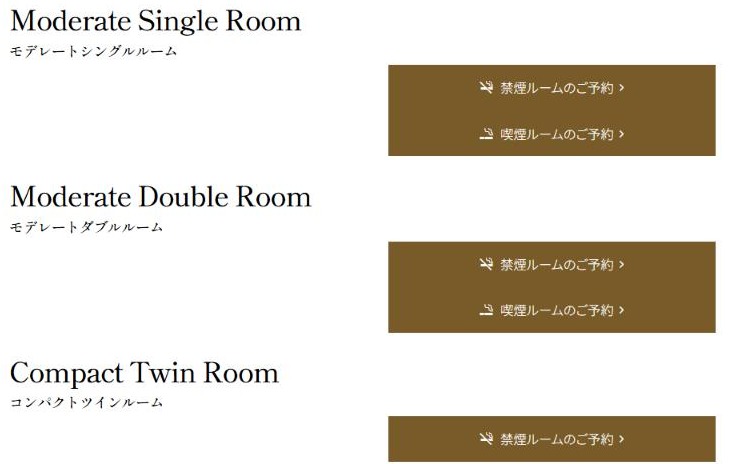
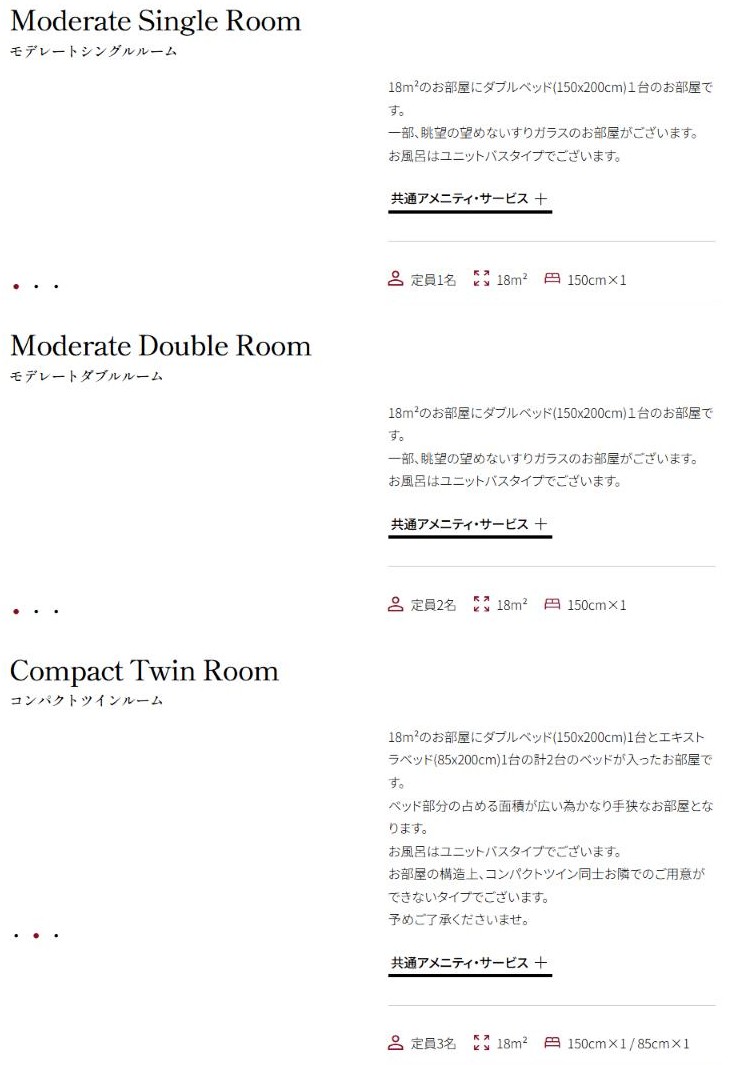
    Richmond Hotel Tokyo Suidobashi (in Japanese) Moderate Single and Moderate Double each have both a 禁煙ルーム and a 喫煙ルーム button. The four twin types show only 禁煙ルーム
    Richmond Hotel Narita (notice, in Japanese) smoking products only in a smoking room or the 1st-floor smoking area, and guests who want to smoke are told to reserve a 喫煙室
    Route Inn Hon-Hachinohe (in Japanese) both 禁煙室 and 喫煙室 exist. Non-smoking rooms have humidifying air purifiers and smoking rooms have a ceiling-mounted nanoe generator
    Route Inn Uozu (in Japanese) each room type lists a count of smoking rooms and a count of non-smoking rooms, with the heated-tobacco-only share

    Dormy Inn is the clearest case against reading the chain name as a policy. Ikebukuro and Nagoya Sakae say no smoking in rooms, and Niigata keeps a smoking floor. Read the page for the property you’re booking.

    Screenshot of the Richmond Hotel Tokyo Suidobashi room page in Japanese. The Moderate Single and Moderate Double rooms each have a non-smoking room booking button and a smoking room booking button. The Compact Twin has only the non-smoking button.
    Richmond Hotel Tokyo Suidobashi, booking buttons (in Japanese). Screenshot.

    Booking sites and the special-requests box

    Rakuten Travel. Rakuten, for domestic and overseas bookings alike, does not accept requests to accommodations, so contact goes directly to the hotel. If you got the smoking or non-smoking choice wrong, a change that doesn’t alter the price may be possible at the hotel, so ask the hotel directly.

    As of October 2026, from Rakuten Travel (in Japanese): request help page and plan-change help page.

    Jalan. It runs nationwide index pages by prefecture, one for hotels with 禁煙 plans and one for hotels with 喫煙 plans. They are organized by plan, so the label you’re checking belongs to the plan you pay for.

    As of October 2026, from Jalan (in Japanese): non-smoking plan index and smoking plan index.

    Booking.com. Its FAQ says: “If there are no rooms listed as ‘smoking rooms,’ it means that the hotel does not allow smoking in rooms”.

    As of October 2026, from Booking.com: FAQ.

    Agoda. Agoda tells hotels that special requests are by default “not confirmed and are subject to availability at the property upon arrival”.

    As of October 2026, from Agoda: Partner Hub article.

    A hotel’s own words show what that means in practice. Toya Kohantei’s FAQ, asked whether you can have a non-smoking room, answers “We are sorry, we are not able to promise it definitely. However, we try to arrange to meet your requests as much as possible”.

    As of October 2026, from Toya Kohantei: FAQ.

    When a listing shows only one kind

    A listing with one label shows what that page sells, not what the hotel sells elsewhere. Richmond Suidobashi’s twin rooms show only 禁煙ルーム. Sotetsu Hotels’ column for guests names two ways people end up in a smoking room: no non-smoking room was free when they booked, or they booked a 喫煙ルーム by mistake.

    As of October 2026, from Sotetsu Hotels (in Japanese): guest column.

    A page that shows only 喫煙 for your dates therefore doesn’t tell you whether a non-smoking version exists or is sold out. Richmond shows that an official page can sell both versions of one room type as separate buttons, so compare the booking-site listing with the hotel’s own page.

    Heated tobacco has its own rooms

    Hotels don’t treat heated tobacco devices such as IQOS, glo and Ploom as “no smoke, so fine.” Seven hotel pages speak to them or to electronic cigarettes:

    • Super Hotel’s FAQ says an e-cigarette such as IQOS can’t be used in a non-smoking room and asks guests to use the store’s designated smoking place.
    • Hotel Monterey’s notice names IQOS, Ploom Tech and glo and says they can’t be used in non-smoking rooms or non-smoking areas.
    • Richmond Hotel Narita lists heated tobacco, cigarettes, cigars, pipes, vapes and more as smoking products allowed only in a smoking room or the first-floor smoking area.
    • Richmond Hotel Sapporo, in a notice of May 13, 2019, asks guests not to use electronic cigarettes in non-smoking rooms after cleaners found butts in the bins.
    • Hotel Nikko Kansai Airport’s 2018 notice says smoking includes an electric cigarette.
    • Sunshine City Prince Hotel banned e-cigarettes along with all other smoking in its guest rooms.
    • Route Inn Uozu counts 加熱式たばこ専用 rooms within its smoking rooms, covered next.

    As of October 2026, from Super Hotel’s FAQ and Richmond Hotel Sapporo’s notice (both in Japanese).

    MHLW makes the same split in the law’s vocabulary. It lists 加熱式たばこ専用喫煙室 as its own kind of smoking room, limited to heated tobacco and apart from the kind that allows cigarettes.

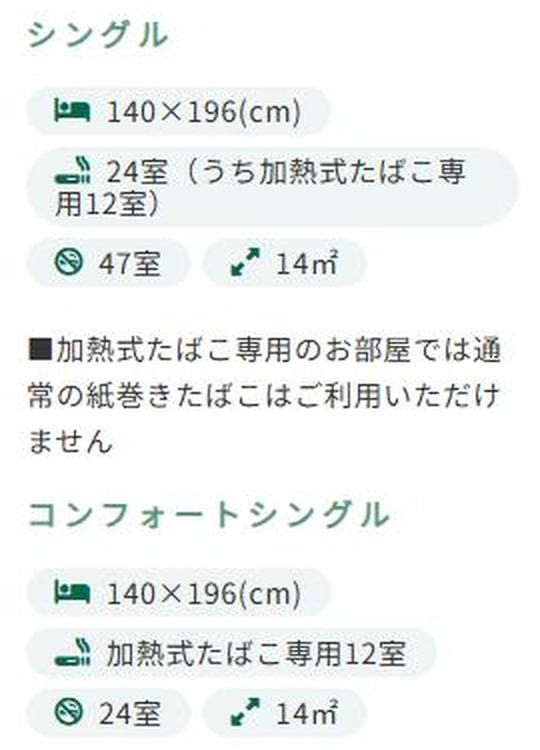
    Route Inn Uozu shows two counts for every room type: 喫煙室数 (smoking rooms) and 禁煙室数 (non-smoking rooms). The シングル type shows 「24室(うち加熱式たばこ専用12室)」 for smoking rooms and 「47室」 for non-smoking rooms, so one room type is sold in three kinds. The コンフォートシングル type shows 「加熱式たばこ専用12室」 and 「24室」. Route Inn also states that regular paper cigarettes can’t be used in the heated-tobacco-only rooms.

    Screenshot of the Route Inn Uozu room page in Japanese. The Single type shows 24 smoking rooms including 12 heated-tobacco-only rooms and 47 non-smoking rooms. The Comfort Single shows 12 heated-tobacco-only rooms and 24 non-smoking rooms. A note says regular paper cigarettes cannot be used in heated-tobacco-only rooms.
    Route Inn Uozu, room counts for two types (in Japanese). Screenshot.

    When the room smells anyway

    Sotetsu Hotels’ column says you may open the door of the room you booked and notice tobacco at once. It says hotels commonly answer with air purifiers and deodorizing spray, and that some of its Sotetsu Fresa Inn hotels use an ozone deodorizer.

    For a guest in that room, the column suggests two things:

    • Ask at check-in whether a non-smoking room has come free. If cancellations have opened one, a swap may be possible.
    • Ask for the room with the least smell. A polite request at the front desk may get consideration.

    I have seen a guest make that kind of request at a front desk. Both depend on a free room. Room-type changes after booking are subject to availability and should go through the official website or the agency you booked with, Agora Tsuki’s FAQ says. Toya Kohantei’s FAQ adds that when it can’t give a non-smoking room, it works to remove the smoke smell from the room it does give.

    Hotels also write the non-smoking label into their rules. Hotel New Otani Tokyo’s say that if a non-smoking room is found to have been smoked in, the hotel will seek compensation from the guest for the lost sales while the room can’t be sold.

    As of October 2026, from Hotel New Otani Tokyo: rules page.

    Before you book

    I check the smoking label every time I book a business hotel.

    1. Pick the label, not a request. Choose a room or plan marked 禁煙 or “non-smoking,” and don’t rely on a note in a free-text box. Requests are unconfirmed.
    2. Read the room name and the plan name. The smoking choice is tied to the plan, so check the plan you’re actually paying for.
    3. Open the hotel’s own page for the same room. A booking-site listing with one label doesn’t tell you the hotel sells only one.
    4. Look for 全室禁煙 or 全館禁煙 on the page for the property you’re booking, and check the date. Hotels in one chain can differ, and several of the notices above are from 2018, 2019 or 2020.
    5. Reserve, then confirm. Toya Kohantei’s FAQ suggests choosing the non-smoking option when you reserve and emailing the hotel after booking to reconfirm. If the confirmation doesn’t carry the 禁煙 label, ask before you travel.
    6. If you want no tobacco at all, skip 加熱式たばこ専用. It is a tobacco room, and Route Inn says only that paper cigarettes aren’t allowed in it.
    7. If the room smells at check-in, ask then. Ask whether a non-smoking room has opened, or for the room with the least smell. Both are the hotel’s call.

    The short version

    Each hotel decides whether its guest rooms allow smoking, so two hotels of one chain can differ. The label that counts is the 禁煙 or 喫煙 on the room or plan you book. A request box isn’t a promise, a heated-tobacco-only room is still a tobacco room, and if the room smells, ask the front desk at check-in whether a non-smoking one has opened up.

    Cover photo: a twin room at Hotel La Raison Osaka by J o, CC BY-SA 4.0, via Wikimedia Commons. It shows a different hotel from the ones discussed.

  • Arriving Before Check-In in Japan: What to Do With Your Luggage

    Arriving Before Check-In in Japan: What to Do With Your Luggage

    In the US, arriving at 10 a.m. with a suitcase is a small problem. Most hotels set check-in around 3 or 4 p.m., and if your room isn’t ready, “many hotels can hold your luggage,” so you can go out without your bags. You hand the bag over, you get on with the day.

    As of October 2026, from WoodSpring Suites: check-in and check-out times explained.

    Japan runs on the same afternoon clock. The surprises are around it: some hotels attach conditions to holding a bag, early check-in is often a paid add-on, and the check-out time on one booking page can be an hour different from the next.

    The times on the page, and the line under them

    Screenshot of the Service Provision Period section of Toyoko Inn's English transaction page, stating the standard check-in and check-out times and that they may differ by plan
    Toyoko Inn, English page. Screenshot.

    Toyoko Inn says “The standard check-in time is from 15:00 and check-out is until 10:00.” The next sentence matters more: “Check-in and check-out times may differ based on your chosen plan so please check the information displayed on each accommodation plan details page and reservation page.”

    So the default is 15:00 in, 10:00 out, and the real answer is on the plan details page, then the reservation page.

    Dormy Inn’s FAQ says “基本的にチェックイン15:00・チェックアウト11:00となります”, basically check-in at 15:00 and check-out at 11:00, and adds that stay hours may differ by facility or plan. SEKITEI’s English site lists check-in 15:00 and check-out 11:00. At the three or four ryokan I’ve stayed at, check-in was generally from 3 p.m. or later.

    As of October 2026: Dormy Inn FAQ (in Japanese), SEKITEI rates page.

    Japanese pages use the 24-hour clock, so 15:00 is 3 p.m. A 10:00 check-out is an hour earlier than an 11:00 one, which matters on the way out. These three chains use 15:00 as the default, which doesn’t mean every hotel does.

    Ask the front desk, but ask first

    The cheapest fix is the one you expect from home: ask the front desk. Hotels answer it differently.

    Dormy Inn’s FAQ answers both “チェックイン前に荷物を預かってもらえますか?” (can you hold my luggage before check-in?) and the same question for leaving bags after check-out to sightsee with: “当ホテルが事前に了解した物に限り、責任を持って荷物を保管致します” (the hotel stores luggage it has agreed to in advance and takes responsibility for it). The hotel isn’t responsible for loss or damage to luggage it didn’t know about, and it can’t hold fragile items or valuables. The hotel doesn’t say what “agreed in advance” means for a suitcase at the desk, so ask before you fly. A short message with your landing time and the number of bags is a reasonable form of asking.

    Hotel Super Tomari’s FAQ answers a question about holding luggage with “お荷物はチェックイン前、チェックアウト後でもフロントにてお預りしております”, meaning bags are held at the front desk before check-in and after check-out. It states no time limit, fee or advance approval.

    As of October 2026, from Dormy Inn and Hotel Super Tomari (in Japanese): Dormy Inn FAQ, Super Tomari FAQ.

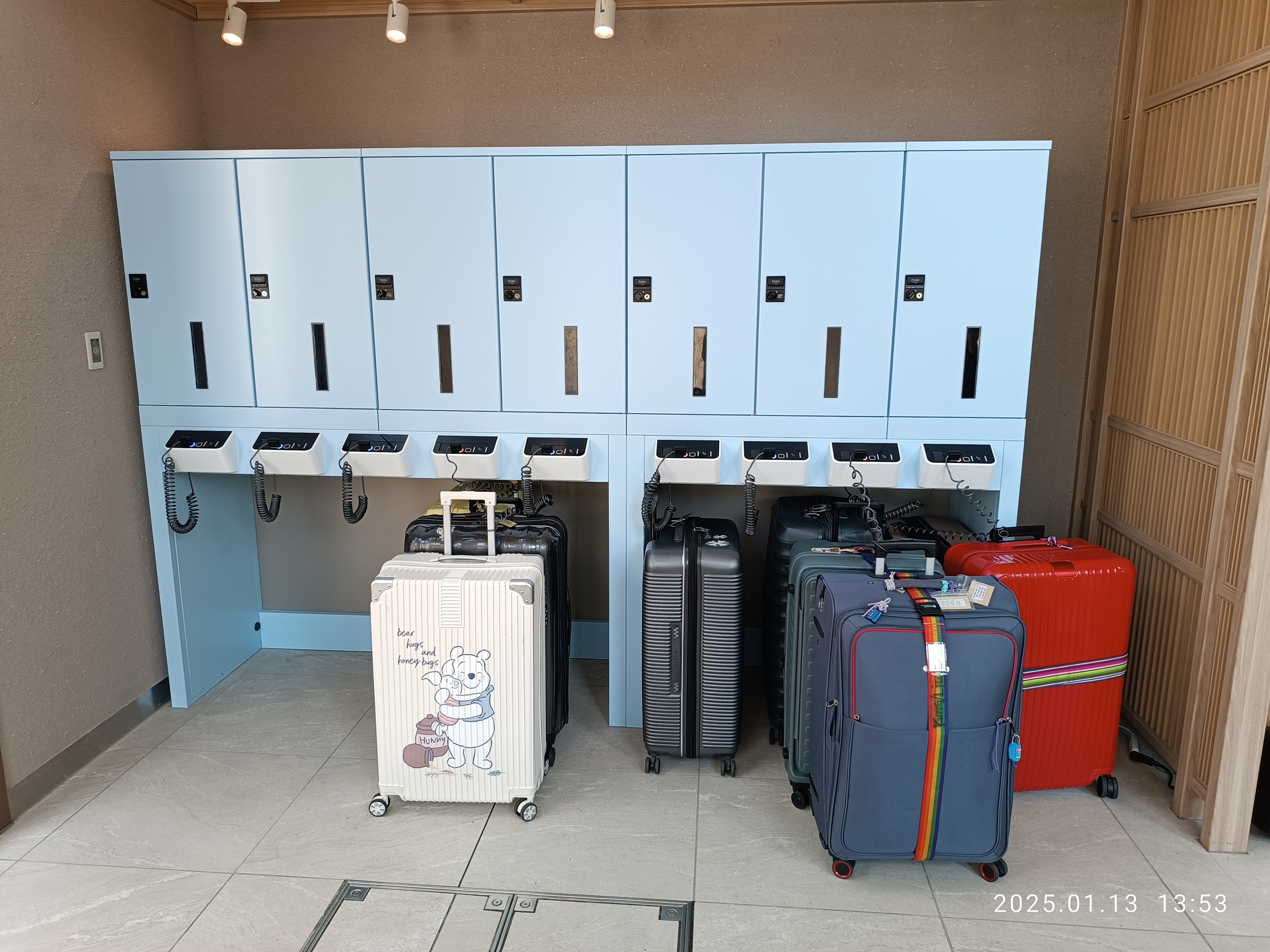
    One chain asks for an agreement and the other states a plain yes, so which one you’re booked into decides what to do. When I’ve arrived early, the front desk has held my bags. At a Tokyo hotel I stayed at recently, the form was different: I put the bag in a luggage area myself and locked it, with no one taking it from my hands.

    A hotel luggage storage area: blue lockers with charging cradles above, and seven suitcases of different colors standing in front.
    Hotel luggage storage. Photo: Naha Mama Pavilionz / Wikimedia Commons / CC0.

    Paying to walk in early

    Some hotels sell the hours. SEKITEI lists an early check-in option at 13:00 and a late check-out option at 13:00, against standard times of 15:00 and 11:00.

    Dormy Inn does. An FAQ item titled “チェックイン・チェックアウトの早着・延長料金は?” (what are the fees for early arrival and extension?) answers: “原則、1時間につきお一人様1,000円いただいています。但し、最大延長14:00まで。” It adds an example, “1部屋2名なら1時間2,000円”, so two people in one room pay ¥2,000 per hour.

    The item covers early arrival and extension together, and the hotel doesn’t say which direction the 14:00 cap applies to. If the same rate applies to early arrival, a couple arriving two hours early would pay ¥4,000. Whether the room is ready by then is a separate matter.

    As of October 2026, from SEKITEI (English) and Dormy Inn (in Japanese): SEKITEI rates page, Dormy Inn FAQ.

    A bag that gets there before you do

    Yamato Transport runs the black-cat TA-Q-BIN parcel service, and its English FAQ covers sending parcels to a hotel or ryokan. Send them “before the cut-off time at least 2 days before your check-in date,” with “3 days may be necessary depending on the distance.” Delivery times can’t be specified, and hotels may restrict where and when they take parcels, so confirm with the accommodation.

    From the airport itself, Yamato’s Airport TA-Q-BIN FAQ describes shipping luggage from airport counters to your home or hotel. It lists a ¥660 counter usage fee at Narita and Haneda, and says cash on delivery isn’t available when sending to a hotel. Confirm delivery timing and the shipping rate for that direction at the counter.

    JAL ABC’s English site lists a hotel luggage delivery service that sends bags “from the airport to hotels (or vice versa) for delivery on the same day,” at Narita, the Haneda international terminal and Kansai. Check cut-off times and fees with JAL ABC before counting on a 3 p.m. check-in. I’ve used JAL ABC to send luggage from an airport to a hotel or home, and to an airport. What I paid depended on a credit-card perk, from free to about ¥500.

    As of October 2026, from Yamato Transport and JAL ABC (English pages): parcels to a hotel FAQ, Airport TA-Q-BIN FAQ, JAL ABC hands-free travel page.

    The same problem, backwards

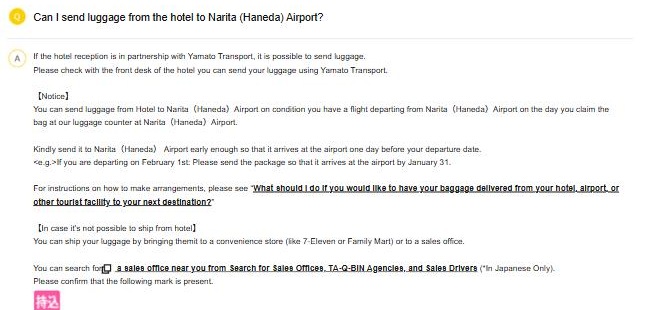
    Screenshot of Yamato Transport's English FAQ answering whether luggage can be sent from the hotel to Narita or Haneda Airport, showing the partner-hotel condition and the one-day-early arrival rule
    Yamato Transport, English FAQ. Screenshot.

    A 10:00 or 11:00 check-out against an evening flight leaves the same bag and the same gap. The answer starts “If the hotel reception is in partnership with Yamato Transport, it is possible to send luggage.” You also need a flight departing from that same airport on the day you collect the bag, and you must send the bag so that it “arrives at the airport one day before your departure date,” with a February 1 departure meaning arrival by January 31.

    So this is not a way to drop a bag at noon and collect it at 6 p.m. The bag goes a day early, to the airport you leave from, through a partner hotel. If your hotel isn’t a partner, the hotel says you can take the bag to a convenience store (it names 7-Eleven and FamilyMart) or a Yamato sales office.

    For the gap after check-out, the front desk hold is the simpler tool, and both FAQs above cover storage after check-out. The airport service suits a bag you’re willing to part with a day early. Ask at check-in whether your hotel is a partner.

    Station lockers have a clock too

    JR East’s locker operator lists sizes in its English FAQ. The largest, LL, is 13.5 to 18.1 inches wide (342 to 461 mm), 22.6 to 26.1 inches deep (575 to 663 mm) and 41.3 to 69.4 inches high (1,049 to 1,762 mm). These are ranges, not one fixed size. Measure your suitcase’s width against the 13.5 to 18.1 inch range before heading to the station. For how the bag then fits in the room, see how much luggage fits in a Japanese hotel room.

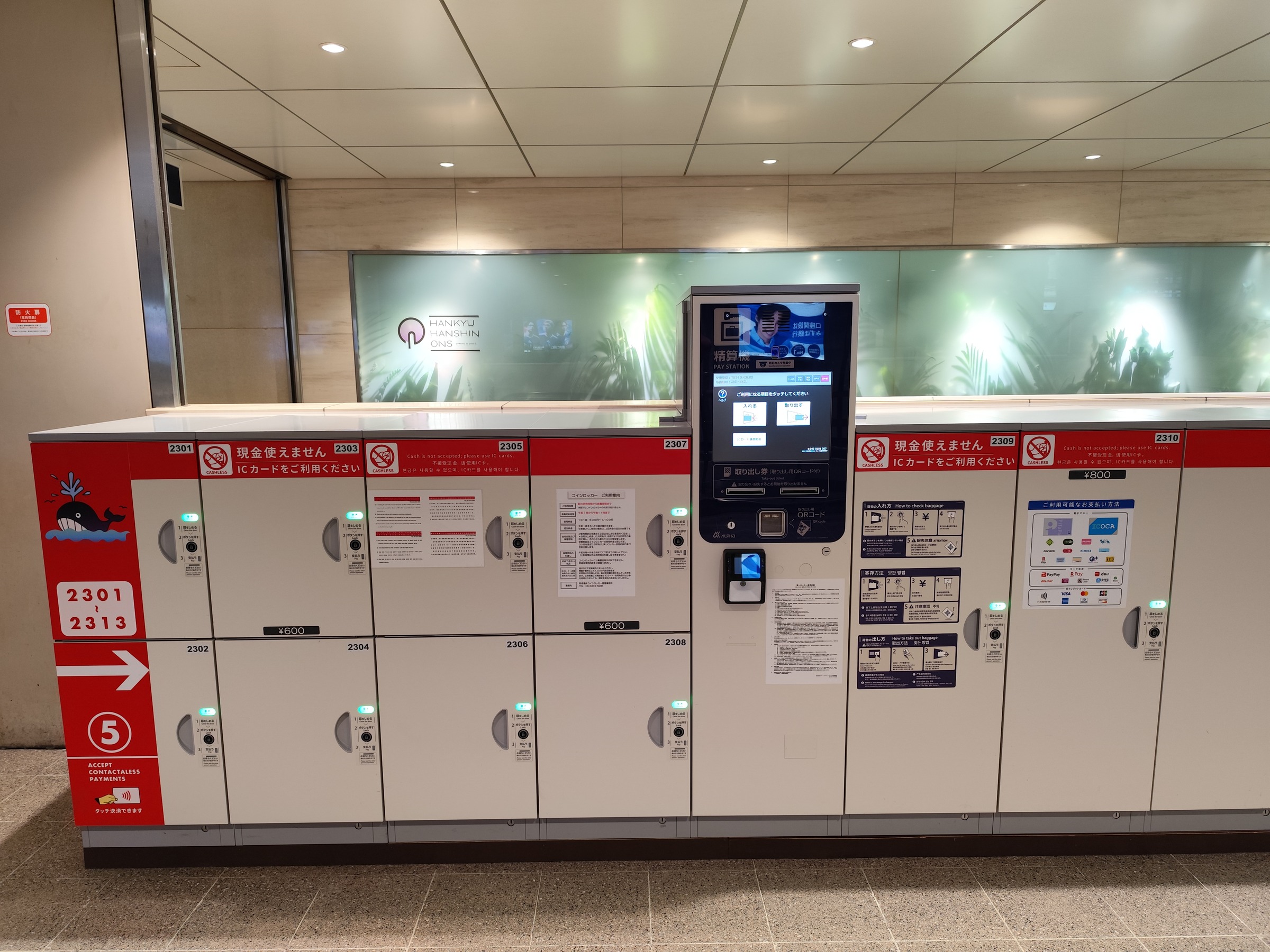
    A bank of white coin lockers with red headers and a payment machine in a Japanese station.
    Station coin lockers. Photo: TKdows / Wikimedia Commons / CC0.

    The rules matter more than the sizes. The FAQ says “The maximum rental period is three days from the start date,” that rates are calculated daily, and that the date changes at 2 a.m. After the limit, the operator “unlock[s] the locker, inspect[s] the luggage and transfer[s] it to our designated storage facility, where we will keep it for up to 30 days,” after which the luggage “is considered discarded.” Stored luggage is charged at the same daily rate.

    As of October 2026, from JR East’s locker operator (English): Station Locker FAQ.

    A locker suits a few hours between a train and a hotel that won’t take bags. It is a poor fit for a bag you want to forget for three days.

    If neither the hotel nor a locker works, ask the hotel about a Yamato parcel.

    The short version

    • Standard check-in is 15:00 and check-out is 10:00 or 11:00, but each hotel adds a plan or facility caveat. Read the plan details page and the reservation page for your booking.
    • Hotel Super Tomari’s FAQ says bags are held at the front desk, with no condition stated. Dormy Inn holds items it has agreed to in advance and won’t take fragile items or valuables. Ask before you fly.
    • Dormy Inn lists, in principle, ¥1,000 per person per hour for early check-in, and SEKITEI lists a 13:00 option. Yamato parcels to a hotel go at least 2 days before check-in, sometimes 3.
    • JR East lockers cap at three days, then the bag moves to storage. Hotel-to-airport shipping needs a partner hotel and arrival one day before departure.
    • Arriving late instead of early has its own rules, covered in Checking In Late at a Japanese Hotel.

    Cover photo: Suitcase in train station (Unsplash) by Israel Sundseth, CC0, via Wikimedia Commons. It shows a different place from the ones discussed here.

  • Ryokan vs Hotel: What Are You Actually Paying For?

    Ryokan vs Hotel: What Are You Actually Paying For?

    In the US, the price on a hotel screen is for the room. Food is a separate decision, taxes show up later, and nobody asks how many people are staying until you check in. A ryokan rate breaks all three habits at once. The number is usually per person. Meals are usually inside it, dinner and breakfast on some plans and dinner only on others. Whether tax and service charge are inside too depends on the inn.

    So a ¥50,000 ryokan rate and a room-only hotel rate are not the same kind of number.

    What one rate bundles

    At the inns I’ve stayed at, check-in was generally from 3 p.m. Dinner is typically a time slot the inn offers or assigns at booking, and at many inns the futon goes down during dinner. A per-person rate plausibly covers a meal for each guest, bedding for each guest, and staff time spent turning the room over. Neither inn’s page says so.

    The article on per-person pricing covers why the unit is the guest. What matters here: the number on screen contains goods and services, not just a room. A fair comparison with a hotel has to add the hotel’s meals back in. For how dinner timing gets set, see the hour-by-hour article.

    Neither inn splits its rate into room, dinner and service. The inns do show where the price moves.

    The fine print under the table

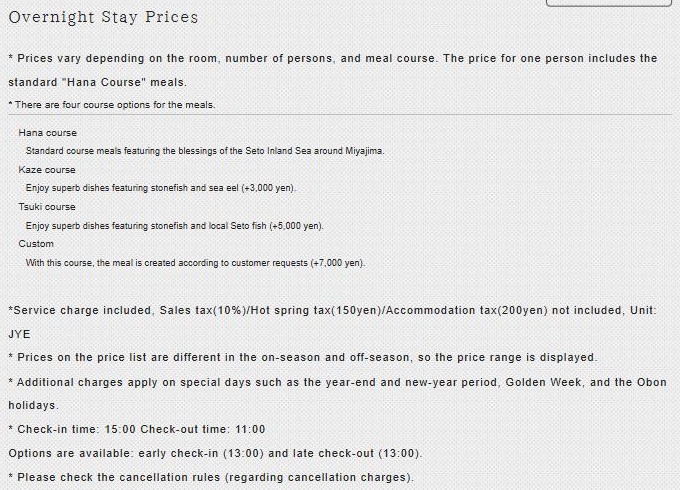
    SEKITEI English rate page, notes under "Overnight Stay Prices," captured September 30, 2026
    SEKITEI English rate page, notes under the price table.

    SEKITEI, an inn in Hiroshima Prefecture, prints these notes under the price table. The first line says “The price for one person includes the standard ‘Hana Course’ meals,” so the unit and the food come before any number. Next it lists three upgrade courses at +¥3,000, +¥5,000 and +¥7,000, so the meal is a choice inside the rate. Then the line that matters most for your budget: “Service charge included, Sales tax(10%)/Hot spring tax(150yen)/Accommodation tax(200yen) not included.”

    Then the calendar. Prices differ between on-season and off-season, extra charges apply around year-end, Golden Week and Obon, check-in is 15:00 and check-out is 11:00, and early check-in (13:00) and late check-out (13:00) are offered as options. The page ends by pointing to the cancellation rules.

    As of September 2026, from SEKITEI: English rate page.

    Two inns, two meanings of “included”

    Hakone Ginyu puts it in one sentence: “The rates shown are for one person per night with two meals (including service charge, tax, and bath tax).” It lists rate categories A to E by season and sends you to a calendar for the amounts. Its stated cancellation fees are 30% from three to two days before arrival, 50% the day before, and 100% on the day.

    SEKITEI includes service charge but leaves out the 10% sales tax, the hot spring tax and the accommodation tax. Ginyu says its rate includes service charge, tax and bath tax. At the inns I’ve stayed at, service charge or tipping never showed up as a separate line on my bill, which fits SEKITEI’s “Service charge included.” The same word “included” covered different things on each page, so two ¥50,000 rates are not comparable until you read the sentence under each.

    As of September 2026, from Hakone Ginyu: English reservation page.

    Taxes that arrive separately

    The hot spring tax (入湯税, nyuto-zei) is 150 yen per person per day as the standard under the law, with each municipality setting its own rate. The facility operator pays it to the municipality on behalf of guests. When I’ve paid these taxes, it was at check-in at some inns and at check-out at others.

    As of September 2026, from the Ministry of Finance (in Japanese): hot spring tax explainer.

    SEKITEI lists an accommodation tax of 200 yen without saying whether it is per person or per room. Assume 150 yen per person for the hot spring tax (the Ministry’s description) and 200 yen per person for the accommodation tax. SEKITEI lists the room Anan, which sleeps two, at ¥52,000~ per person on weekdays, so two guests is ¥104,000 before tax. Add 10% sales tax (¥10,400), ¥300 of hot spring tax and ¥400 of accommodation tax, and the total is about ¥115,100, roughly 10.7% on top of a listed price that ends in a tilde. This shows the shape of the gap, not a quote.

    Price levers

    SEKITEI’s table lists twelve rooms per person with half board, service charge included. Three things move the price on this page.

    Room. Weekday prices are listed from ¥39,000~ (Koseki, which sleeps three) to ¥52,000~ (Taikan, which sleeps eight, and Anan, which sleeps two).

    Day of the week. For the same room, the Saturday and day-before-holiday price is ¥10,000 to ¥17,000 higher per person across the twelve rooms. Yusen goes from ¥51,000~ to ¥66,000~.

    Meal course. The upgrades are +¥3,000, +¥5,000 and +¥7,000, in the table’s unit.

    On this page the meal course is the smallest of the three levers, though the inn doesn’t say whether the upgrade is per person.

    Room bath

    Some plans add a private bath in the room, usually at a higher rate. At the inns I’ve stayed at, I go to the large bath even when the room has a bath, unless the room bath is open-air or hot spring. Check what kind of bath the plan actually includes before paying the difference.

    The hotel side

    Dormy Inn Ikebukuro lists no prices.

    As of September 2026, from Dormy Inn (in Japanese): Ikebukuro rooms page.

    The hotel number you’re used to is tied to the room, with meals as a separate line. A ryokan’s number is tied to the guest and arrives with the meals. To compare, build the hotel’s equivalent: the room, plus dinner somewhere, plus breakfast, plus tax. For which type fits your trip, start with the where-to-stay article.

    Booking-page checklist

    Check these five things on the page before you decide:

    1. The unit. “Per person” or “per room,” and whether the table assumes two guests sharing.
    2. The meals. Which course the base price includes, and what the upgrades cost.
    3. The tax and service line. Which of service charge, sales tax, hot spring tax and accommodation tax are inside the number.
    4. The calendar. Weekday against Saturday, and the named high-season dates.
    5. The clock. Check-in and check-out times, and whether early or late options cost extra.

    Cancellation rules sit next to these. SEKITEI links to them and Ginyu states them on the page. Read them before you pay, because the meals are part of what you’d be cancelling.

    The short version

    A ryokan rate is a per-guest figure that bundles the room, meals and service, while a hotel rate is typically a room figure with meals on a separate line. Read the note block under the table first, because it tells you whether service charge and taxes are inside. At SEKITEI, Saturday and day-before-holiday add ¥10,000 to ¥17,000 per person, the course upgrades add ¥3,000 to ¥7,000, and weekday rooms differ by up to ¥13,000.

  • Hotel Breakfast in Japan: What It Costs, What You Get and Whether to Add It

    Hotel Breakfast in Japan: What It Costs, What You Get and Whether to Add It

    At home, hotel breakfast follows a pattern you can predict. The cheap places set out coffee, a waffle iron and a basket of muffins, and a nicer hotel charges extra for a sit-down meal. It is natural to expect Japan to run the same way, with the business hotel handing you a muffin and the city hotel selling the real thing.

    The budget end doesn’t work like that. Toyoko Inn and Hotel Route Inn say breakfast is free, and so do two Super Hotel pages. What they offer is a buffet, rice balls or sandwiches. The paid breakfasts below start near $9 and climb past $40, and every figure is per person, so a two-person room doubles it.

    Prices below are converted at about ¥158 to the dollar (Trading Economics), so check the day’s rate.

    Three chains that say free

    Toyoko Inn’s English site says “Start the day right with healthy and locally-sourced original menus, all provided free of charge.” Its breakfast page names three styles: a “classic buffet-style breakfast,” “Stuffed Rice Ball Style” and “Assorted Sandwich Style,” and lists a daily selection of soups. Guests may carry the food up to their rooms, and children sharing a bed eat at no additional charge.

    As of October 2026, from Toyoko Inn: English home page and breakfast page.

    Super Hotel’s Shiba and Shinbashi pages both describe a free breakfast buffet with organic vegetable salad and baked bread. It runs 6:30 to 9:00 at Shiba. At Shinbashi it runs 6:30 to 9:00 Monday to Saturday and 6:30 to 9:30 on Sundays and holidays. The chain’s home page carries the line “オーガニックな健康朝食。無料でも妥協しません,” an organic, healthy breakfast that doesn’t compromise even though it’s free. Those are two hotels and a slogan, so check the page of the one you book.

    As of October 2026, from Super Hotel (in Japanese): Shiba, Shinbashi and the home page.

    Hotel Route Inn says guests get a free buffet breakfast with 30 or more items on the menu. The free offer has conditions. The chain says it applies at Hotel Route Inn, Court included, while Hotel Route Inn Grand, Route Inn Grantia and Arc Hotel get it free with a booking made on the official site. That is one of the plan differences between booking channels, which the booking sites comparison lays out.

    As of October 2026, from Hotel Route Inn: breakfast page (in Japanese).

    What the paid buffets charge

    Prices are per adult. Dormy Inn, Mets, Henn na and the Imperial label theirs as tax included, and the two Richmond hotels give no tax note. Children’s prices are listed separately, for example ¥1,200 for ages 3 through elementary school at Dormy Inn Ikebukuro and ¥1,000 for elementary-school children at Richmond Kinshicho.

    Hotel page Adult price Hours Style
    Dormy Inn Niigata (in Japanese) ¥2,000 ($12.70) 6:15 to 9:30 Japanese and Western buffet
    Dormy Inn Ikebukuro (in Japanese) ¥2,500 ($15.80) 6:30 to 10:00 Japanese and Western buffet
    Keisei Richmond Hotel Tokyo Kinshicho (in Japanese) ¥2,000 ($12.70) 6:30 to 10:00 Buffet
    Richmond Hotel Premier Kyoto Ekimae (in Japanese) ¥3,500 ($22) 6:30 to 11:00 Buffet with Kyoto dishes
    JR East Hotel Mets Shibuya (in Japanese) ¥1,980 ($12.50) 6:30 to 10:30 Japanese and Western buffet
    Henn na Hotel Komatsu Ekimae (in Japanese, February 2, 2025 notice) ¥1,400 booked by the day before, ¥1,500 same day ($9 to $9.50) 6:30 to 10:00 Set meals, Japanese or Western
    Imperial Hotel Tokyo, Imperial Viking Sal ¥6,800 ($43) 7:00 weekdays, 6:30 weekends, to 10:00 Buffet

    Where a last order is listed, it falls 30 minutes before the closing time in the table. The Imperial adds that its prices “are inclusive of consumption tax and service charge,” so nothing more goes on top. Its Tokyo Nadaman restaurant sells a Japanese breakfast at ¥5,800 ($37).

    Outside the Imperial, the paid prices cluster around ¥2,000, so five mornings for two comes to ¥20,000, about $127. Nothing in the table opens before 6:15, so an early train means a breakfast you’ve paid for or been given and can’t eat.

    Mostly buffets, and some set meals

    Most are buffets. The exception is the Henn na Hotel, which lists two set breakfasts. The Japanese one is grilled fish, miso soup, pickles, two side dishes, salad, a raw egg and nori. The Western one is a hamburger steak with a roll, a boiled egg and salad, and a choice of coffee, apple juice or orange juice. The Imperial runs both styles, with the buffet above and a set Japanese breakfast at Nadaman where you choose grilled fish or chilled roast beef.

    Most of the buffets put Japanese and Western food side by side. The Mets FAQ says guests pick Japanese or Western by mood that day, and Dormy Inn calls theirs 和洋バイキング, a Japanese and Western buffet. Rice, miso soup and nattō are usually part of the Japanese side, and Super Hotel’s English site lists all three. There is no real equivalent of the American continental breakfast as a tier of its own. The lightest version is Toyoko Inn’s rice ball style.

    As of October 2026, from Super Hotel: English breakfast page.

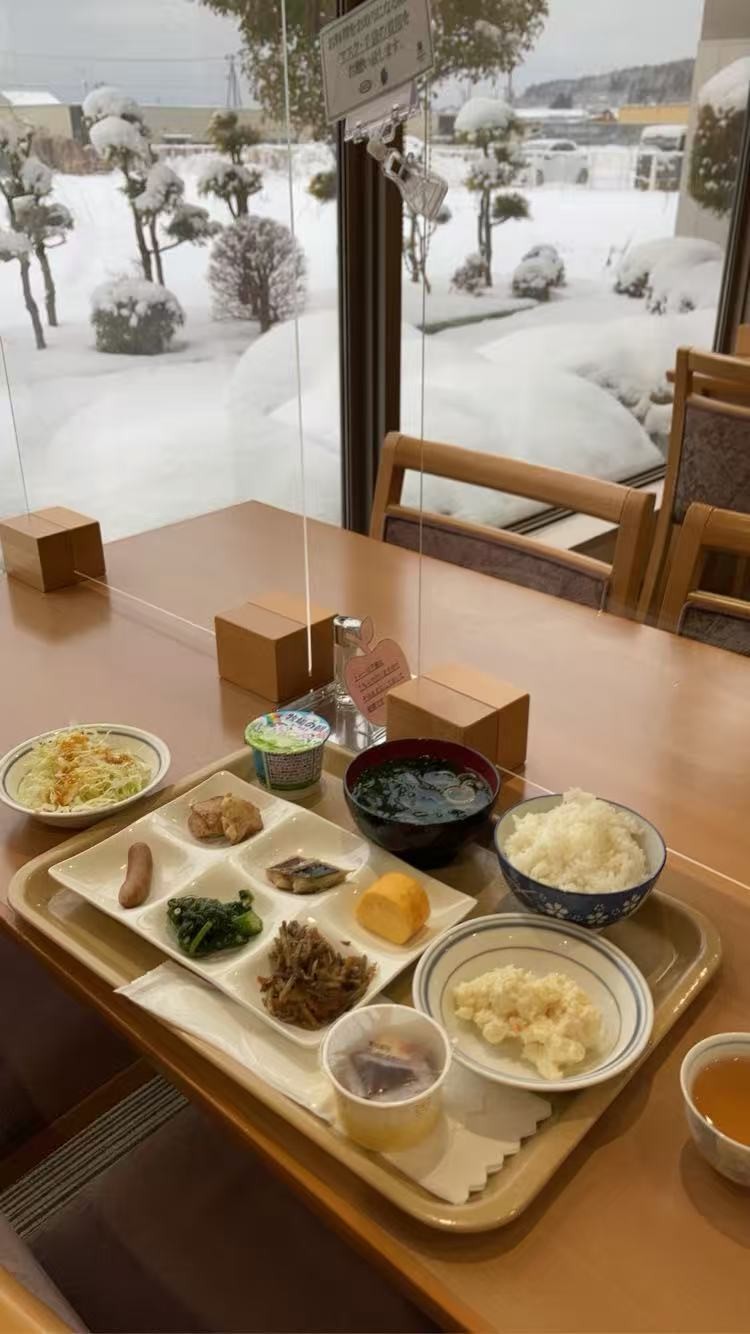
    A hotel breakfast on a tray by a window with snow outside: rice, miso soup, grilled fish, spinach, a sausage, rolled egg, salad and potato salad.
    A hotel breakfast tray, my photo.

    Reading the booking page

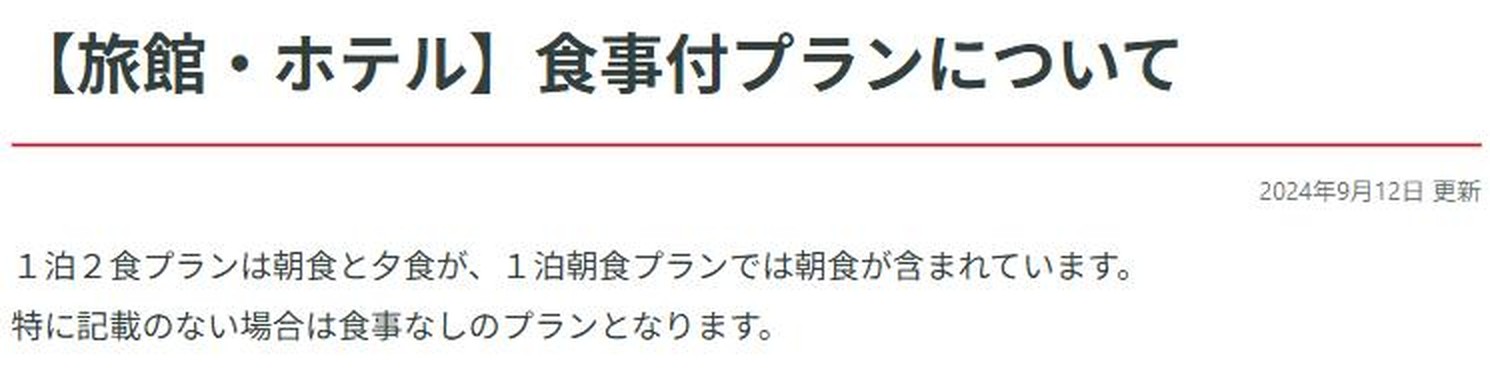
    Three labels cover most of what you’ll see. 朝食付き or 1泊朝食 means breakfast is in the price. 素泊まり (sudomari) or 食事なし means room only, which JTB defines as lodging without meals, at a lower rate. 1泊2食 is the ryokan-style bundle of dinner and breakfast. On JTB’s site, a plan with no meal mentioned is a no-meal plan.

    As of October 2026, from JTB (in Japanese): FAQ on meal plans and room-only page.

    JTB FAQ on meal plans: two-meal plans include dinner and breakfast, breakfast plans include breakfast, and a plan with no meal mentioned is a no-meal plan.
    JTB, FAQ on meal plans (in Japanese). Screenshot.

    That is JTB’s wording, and other sites lay it out differently. Booking.com’s FAQ says “Each room or accommodation you can book has its own breakfast policy. If breakfast is included, you’ll see it listed on the property page when you compare different options to book.” Two rooms in the same hotel can carry different breakfast terms, so read the line on the plan you pick and not the one on the hotel.

    You don’t always have to decide at booking. At Dormy Inn, guests on a no-breakfast plan can sign up at check-in and pay the breakfast price separately, with the price set by each hotel. A different hotel, the Henn na above, lists ¥1,500 for same-day sign-up against ¥1,400 booked by the day before.

    As of October 2026, from Booking.com: FAQ. From Dormy Inn: FAQ (in Japanese).

    Breakfast prices are per person, the same logic as in the per-person pricing article.

    If you have an allergy, ask before you book

    The Dormy Inn FAQ answers the allergy question directly: “当ホテルのお食事はバイキング形式でのご提供となるため、アレルギーに特化した個別メニューの作成や、特定食材を個別に除去したお料理の提供は行っておりません.” In English, because the meals are a buffet, the hotel does not make separate allergy menus or remove a specific ingredient from a dish. Dormy Inn Ikebukuro adds that the kitchen uses the same equipment and oil for nine allergens it names: egg, wheat, shrimp, dairy, crab, buckwheat, peanuts, walnuts and cashews.

    Compare that list with the FDA’s nine: “milk, eggs, fish, Crustacean shellfish, tree nuts, peanuts, wheat, soybeans, and sesame.” Dormy’s notice names buckwheat, which is not on the FDA’s list. It does not name fish, soybeans or sesame, and for tree nuts it names only walnuts and cashews. That does not mean those foods are absent. The notice is not a map of your allergy, so ask the hotel directly if yours isn’t on it.

    Dietary rules have the same problem. The tourism office’s vegetarian guide says to “say no meats, seafoods, or animal products including dashi or stocks” and warns of “hidden ingredients such as meat or bonito flakes.” It also says the sauce packed with ready-to-eat nattō is “often dashi (fish stock),” which matters if you plan to pick nattō up at a convenience store instead. For a strict allergy or diet, a room-only plan and packaged food may be the safer route. Japan’s Consumer Affairs Agency says mandatory allergen labeling applies to packaged processed foods, and it lists restaurant and prepared food in a separate section.

    As of October 2026, from Dormy Inn: Ikebukuro breakfast page (in Japanese). From the FDA: food allergies page. From the Japan National Tourism Organization: vegetarian guide. From the Consumer Affairs Agency: allergy labeling page (in Japanese).

    The convenience store alternative

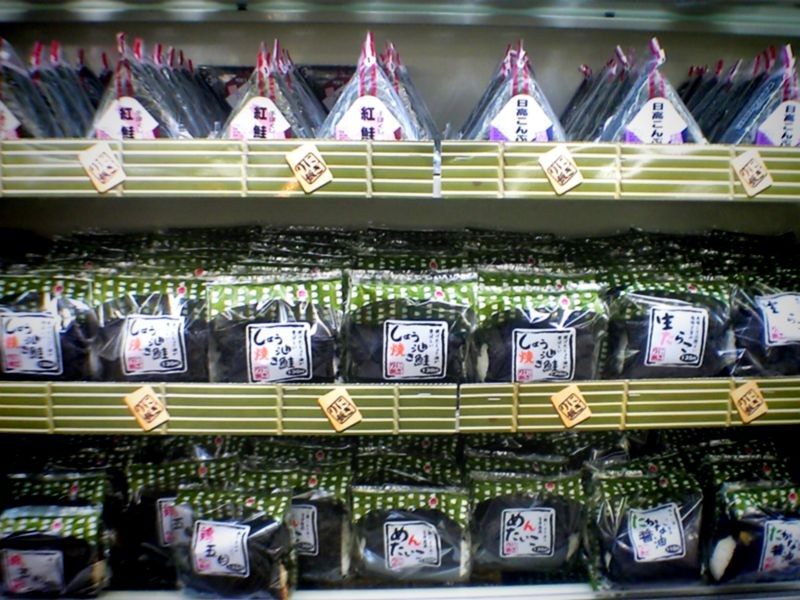
    Shelves of packaged rice balls in a Japanese convenience store.
    Rice balls on a convenience store shelf. Photo: typester / Wikimedia Commons / CC BY-SA 2.0.

    A 7-Eleven hand-rolled tuna mayo onigiri is ¥182 before tax (¥196.56 with tax). A hot Seven Café coffee in the R size is ¥130 (¥140.40 with tax). Together that is ¥337, about $2.10, and it is the floor: one rice ball and a coffee. A second hand-rolled onigiri adds ¥182 to ¥198 before tax at the standard price.

    For two people at the floor, that’s ¥674 ($4.30) against ¥5,000 ($32) at ¥2,500 a head, a gap of about $27 a morning.

    As of October 2026, from 7-Eleven Japan (in Japanese): tuna mayo onigiri, Seven Café and the September 24, 2026 price release.

    When breakfast earns its price

    If the hotel says it’s free, eat it. Check the start time first. A free breakfast you can’t reach before a 6 a.m. train gets you nothing.

    If it costs ¥1,400 to ¥2,000 ($9 to $13), you’re paying for a full buffet and for not having to hunt for food, against roughly $2 at the convenience store floor. That is a fair purchase if you value the time. At ¥2,500 and up, the buffet costs more than seven times the floor. On a company business trip I add breakfast. On my own trips I skip it when it costs extra and buy something at a convenience store.

    If you’re unsure, ask whether the hotel lets you add breakfast on arrival, which Dormy Inn’s FAQ says it does for no-breakfast bookings. With an allergy or a strict diet, get the answer from the hotel before you add it.

    The short version

    • Toyoko Inn and Hotel Route Inn say breakfast is free, as do two Super Hotel pages, and Route Inn’s Grand, Grantia and Arc hotels make it free with an official-site booking.
    • The paid buffets in the table run ¥1,400 to ¥3,500 per person ($9 to $22), and the Imperial Hotel Tokyo charges ¥5,800 to ¥6,800 ($37 to $43) with service charge included.
    • 朝食付き is breakfast in the price and 素泊まり is room only. Dormy Inn says its buffet can’t make allergy menus or remove an ingredient, so ask the hotel before you book.
    • One onigiri and a coffee at 7-Eleven is about $2.10, so a paid buffet buys variety and time.

    Cover photo: a Japanese-style breakfast at Hotel Niwa Tokyo by J o, CC BY-SA 4.0, via Wikimedia Commons, cropped.

  • Sending Your Luggage From the Airport to Your Hotel in Japan: JAL ABC and Credit Card Perks

    Sending Your Luggage From the Airport to Your Hotel in Japan: JAL ABC and Credit Card Perks

    If you’re used to landing, collecting your bags, and dragging them onto a train or into a taxi, Japan offers a different routine. Counters in the arrivals area will take your suitcase and deliver it to your hotel front desk, usually the next day or later. You get on the train with a carry-on and a coffee. The catch is that “next day” is the earliest standard date, so this works for some itineraries and fails for others.

    How the service works

    JAL ABC covers Narita (T1 and T2), Haneda (T2 and T3), Kansai, and Chubu, with the counter “located in the arrivals lobby.” You fill in the delivery details at the counter, and the bag goes by truck.

    For a hotel, you give the postal code, the address, a phone number, and the recipient’s name. The phone field reads “Telephone number of delivery location (telephone number within Japan)”. That means the hotel’s number, not yours, so a US phone plan doesn’t get in the way. The bag is received at the destination, which for a hotel means the front desk, and the front desk will ask for your check-in date. If you reach the hotel before check-in, Arriving Before Check-In in Japan covers holding bags at the front desk, early check-in fees and station lockers.

    As of October 2026, from JAL ABC (English): from-the-airport page.

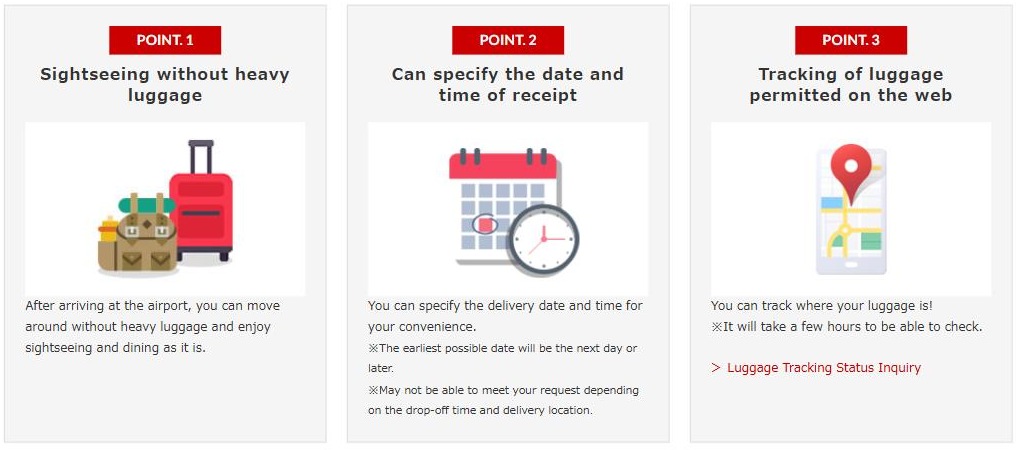
    JAL ABC English page, "Merits of using Delivery Service": sightseeing without heavy luggage, choosing a receiving date and time, and tracking your luggage
    JAL ABC English page, “Merits of using Delivery Service.”

    Look at the second item. You can choose the receiving date and time, but the earliest is the next day or later, and JAL ABC says your request may not always be met. The third item is tracking, and it comes with a delay: the bag can be checked only after a few hours.

    What it costs

    The charge depends on the size and weight of each bag. In JAL ABC’s size table, Size 140 means 140 cm (about 55 inches) or less in the sum of three sides and up to 25 kg (about 55 lb). Size 160 allows 30 kg (about 66 lb). From Size 180 up, the limit is 50 kg (about 110 lb).

    These are the Kanto rows, for Narita or Haneda to an address in the Kanto region (Tokyo, Kanagawa, Chiba, Saitama, Gunma, Tochigi, Ibaraki, Yamanashi). Prices are in yen, per bag.

    Size class Narita or Haneda to Kanto
    140 ¥2,430
    160 ¥2,820
    180 ¥4,240
    240 ¥7,000

    A large checked suitcase often lands in the 160 class or near it, but measure yours. Add the three sides in centimeters. A bag 75 cm tall, 50 cm wide, and 30 cm deep comes to 155 cm, which is Size 160.

    JAL ABC English page, Delivery Charge notes: maximum 240 cm and 50 kg per item, golf bags and ski gear priced as Size 160, and an extra 500 yen when you pick a carrier at Narita or Haneda
    JAL ABC English page, delivery charge notes.

    The notes set the maximum for one piece at 240 cm in total dimensions and 50 kg. Golf bags, skis, and snowboards are priced at the 160 rate. If you ask for a specific delivery company from Narita or Haneda, JAL ABC adds ¥500 (tax included) per piece to the normal fee. Most travelers have no reason to pay it.

    Dates and tracking

    The earliest delivery date is the next day or later, so the question to ask is when you need the bag, not when you land. Arrive Tuesday and check in Tuesday, and the bag reaches the front desk Wednesday at the earliest. That suits a stay of several nights and does nothing for tonight’s dinner. Keep a day of clothes and any medication in your carry-on.

    JAL ABC also has a separate Hotel Luggage Delivery Service page, which advertises “delivery on the same day”. It states a 14:00 deadline for sending to a hotel and lists Haneda to Bay Area hotels and Kansai to Osaka and Kyoto city hotels. But it says “This service will resume at some hotels on February 1, 2022”, and a page that old doesn’t tell you the service is running now. If same-day delivery matters to your plan, confirm with JAL ABC first.

    As of October 2026, from JAL ABC (English): Hotel Luggage Delivery Service page.

    The entrance to a baggage storage and baggage delivery service in a Japanese railway station, with pink signs and suitcases visible inside.
    A baggage counter at a Japanese station. Photo: Mr.ちゅらさん / Wikimedia Commons / CC BY-SA 3.0, cropped.

    What they won’t take

    The list on the page includes fragile items, perishables, hazardous materials, bags containing liquids, precision instruments, badly packed bags, musical instruments, and paintings. Because bags sometimes travel by air, anything restricted on aircraft is excluded too.

    Sending bags to the airport

    The other direction needs a reservation. A reservation by telephone or on the Internet is required in advance, and the phone line is staffed 10:00 to 17:00, so don’t wait for the last evening. A driver collects the bag on the date and time you choose and hands you a delivery slip. At the airport you show a copy of that slip and pick the bag up. The bag arrives at the airport on your specified pick-up date. Narita Terminal 2’s counter is open 7:00 to 21:00.

    This direction has its own price table, and the figures are not the same as the airport-to-hotel ones. For the Kanto region, going to Narita or Haneda, the rows are ¥2,700 for 120 cm, ¥3,580 for 160 cm, and ¥5,130 for 200 cm. Compare the 160 rows: ¥2,820 from the airport and ¥3,580 to it, so a round trip is not the same price twice. Size classes are also listed separately for each direction, so check your bag’s class on the right page.

    As of October 2026, from JAL ABC (English): to-the-airport page.

    Credit card perks

    Card perks can cut the price a lot, and they depend on who issued your card.

    Cards issued in Japan

    My card is the ANA VISA Platinum Premium card, a Japan-issued card. As I understand it, it is issued only to people who live in Japan, though SMBC lists only age and income conditions.

    I’ve used the card perk for deliveries to hotels as well as home. It has cost nothing or about ¥500, depending on the trip. The card pages below say “home” or “home or similar” and don’t say whether a hotel front desk is accepted, so confirm that with your card company.

    The ¥500 matches the price table on Visa Japan’s Visa Platinum Airport Delivery (return) page. You show your Visa Platinum card on the return leg, which for a visitor to Japan means the airport delivery to your accommodation or home. The table reads 500 yen for the 1st, 2nd, and 3rd bags, then “3個目以降” at 20% off the standard rate. The column headings make the third bag hard to read, so check the original. Other terms from that page:

    • The benefit period is April 1, 2026 to March 31, 2027, counted by the date you hand the bag over at the airport counter.
    • It covers Narita, Haneda Terminal 2 (international), Haneda Terminal 3, Chubu, and Kansai.
    • Bags can be up to 160 cm in total dimensions and 30 kg, or 25 kg at Haneda Terminal 2 (international), which Yamato handles.
    • From November 1, arrival delivery from Narita and Haneda Terminal 3 ships by Sagawa or Japan Post. If you name Yamato, JAL ABC adds 500 yen per bag (tax included).
    • Fragile items, perishables, valuables, hazardous items, liquids (including alcohol and seasonings), precision instruments, and badly packed bags are refused.
    • You tell the JAL ABC arrival counter you’re using the Visa Platinum Airport Delivery benefit, show the card, and pay with it. Booking online on JAL ABC’s website isn’t covered, and the offer can’t be combined with other perks or coupons.

    SMBC also lists “international baggage delivery”: up to two bags per direction at ¥500 each (tax included) and a 20% discount from the third bag, but it is labeled for Mastercard members.

    Sumitomo Mitsui Card’s own airport delivery page is a separate offer. It states “通常料金より15%OFF”, 15% off the standard rate. It splits members by brand. Visa Infinite, Visa Platinum, Platinum Preferred, and Gold members are pointed to the service that Visa Worldwide provides, which SMBC says has a higher discount rate. Mastercard Platinum and Gold members go to Mastercard’s service. SMBC also says that from April 1, 2026, arrival and round-trip deliveries at Haneda Terminal 2 International carry a counter fee of ¥500 (tax included) per bag.

    As of October 2026, from SMBC and Visa Japan (in Japanese): SMBC basic information page, Visa Platinum Airport Delivery (return), Sumitomo Mitsui Card airport delivery page.

    American Express Japan describes free delivery of a suitcase or golf bag between your home and the airport at departure and return, one piece. It lists Narita, Haneda, Kansai, and Chubu, with a limit of 160 cm in total dimensions and 30 kg. The outbound leg needs a reservation 7 days before departure through a domestic toll-free number (0120-989-509, 9:00 to 17:00), which may not work from abroad. The return leg needs no reservation. You must present the physical card in your own name. American Express Japan says the Green Card stopped getting the benefit on February 28, 2023.

    JAL ABC’s explainer on card perks, updated January 30, 2024, describes Amex Japan’s ANA and Delta SkyMiles cards as arrival delivery only, one piece, at Narita, Chubu, and Kansai, excluding Haneda. The Amex Japan page names Haneda and covers both directions. Follow your card company’s page.

    TRUST CLUB gives one departure bag and one arrival bag, but you choose two of three services (departure delivery, arrival delivery, or coat storage), and non-member companions aren’t covered.

    As of October 2026, from American Express Japan, JAL ABC and TRUST CLUB (in Japanese): Amex Japan delivery page, JAL ABC card explainer, TRUST CLUB Platinum Visa page.

    Cards issued in the US

    Visa Japan’s terms for the Visa Platinum offer say, in the original, “本特典は、日本国内で発行されたVisa クラシックカード、Visaゴールドカード、Visaプラチナカード、Visa Infiniteカードが対象です。” That translates as “This benefit applies to Visa Classic, Gold, Platinum, and Infinite cards issued in Japan.” It also covers the member and family card members. A US-issued Visa Platinum isn’t covered by that offer.

    That is one offer. The benefits pages for The Platinum Card from American Express, Chase Sapphire Reserve, and Capital One Venture X don’t list luggage delivery. Chase lists lost luggage reimbursement (up to $3,000 per traveler) and baggage delay insurance, which pay after a problem and don’t move a bag. Amex’s UK site has a Luggage Free benefit for UK Platinum members, with 15% off door-to-door worldwide shipping. Amex UK doesn’t mention airports in Japan. These pages can’t tell you about other cards, so ask your issuer in writing and keep the reply.

    As of October 2026, from American Express, Chase, Capital One and Amex UK.

    A discount for any visitor

    MATCHA, a travel site, lists a JAL ABC coupon for ¥200 off per bag at the Narita, Haneda, Chubu, and Kansai counters. On arrival you show the coupon or give code 4047 at the arrival counter. MATCHA says it can’t be combined with other campaigns or coupons and shows an expiry of March 31, 2027. JAL ABC’s own English homepage doesn’t list the coupon, so it’s a third-party listing. If you plan to use it, ask at the counter.

    As of October 2026, from MATCHA (English): coupon page.

    Yamato’s airport service

    Yamato’s Airport TA-Q-BIN is a service for sending heavy suitcases and other bulky luggage to airports in Japan. It works both ways: to an airport, or from an airport counter to your home or hotel. Yamato lists a handling fee of ¥660 (tax included) at Kansai, Narita, and Haneda. It also lists a separate counter-use fee of ¥660 that takes effect at Narita on June 1, 2025 and at Haneda on July 1, 2025. Those are two fees. Yamato doesn’t give sizes or the full delivery price. It says cash on delivery isn’t available when sending to hotels, and that a round trip can’t start from an airport.

    As of October 2026, from Yamato Transport (English): Airport TA-Q-BIN FAQ.

    Price both services for your bag’s size and route.

    The short version

    JAL ABC will deliver a bag from a Japanese airport to your hotel, next day at the earliest, and will carry bags back to the airport if you reserve ahead. Measure the bag, because the price steps up after the 160 class. Don’t ship liquids or anything you need on arrival night. Visa’s Platinum offer is limited to cards issued in Japan, so ask your US card issuer before you count on a perk.

    Cover photo: Tokyo-International-Airport T2 Baggage-claim by MaedaAkihiko, CC BY-SA 4.0, via Wikimedia Commons. It shows a different terminal from the ones discussed here.

  • Do You Tip at Japanese Hotels and Ryokan?

    Do You Tip at Japanese Hotels and Ryokan?

    At home, thanking a hotel employee means cash. A few dollars for the person who carries the bag, something left for housekeeping, a bit extra when someone fixes a problem. It is easy to land in Japan with that reflex loaded and spend the first night looking for the right moment to use it.

    At some Japanese hotels there is no such moment, because the thanks is a percentage on your bill. Two Tokyo hotels’ own terms say they decline tips on top of it. At traditional inns the envelope of cash does exist, with its own name and its own etiquette. The tourism office treats it as optional, and Hoshino Resorts says it doesn’t accept it.

    What the tourism office says

    The Japan National Tourism Organization says “it’s not common to tip for services such as those provided in bars, cafes, restaurants, taxis, and hotels.”

    JNTO mentions a custom called kokorozuke, “coming from the heart.” It says a private guide or interpreter accustomed to overseas practices may accept a tip, but that tipping “is not expected and should be done discreetly, even in these cases.” It adds that a gratuity is customarily put in an envelope, sold at convenience stores, stationery stores and 100 yen stores. None of this is about hotels or ryokan, and the hotel gives no amount.

    As of October 2026, from JNTO: tipping page.

    Don’t add a tip to a service charge

    At Okura Tokyo, the room charge carries a line reading “Service Charge (①×15%),” and the 10% consumption tax is figured on the room charge plus that service charge. Food and drink get their own 15%. Then the hotel says: “Since a 15% service charge is added to your bill in addition to taxes required by law, it is our policy to decline tips and other gratuities.”

    The Okura Tokyo accommodation contract, item 7: since a 15% service charge is added to your bill in addition to taxes required by law, it is the hotel policy to decline tips and other gratuities.
    Okura Tokyo, accommodation contract, item 7. Screenshot.

    On a ¥30,000 base room charge, 15% service makes ¥34,500 and 10% tax on that makes ¥37,950, about 26.5% more. At roughly ¥158 to the dollar, that is about $240 for a room that looked like $190.

    The Imperial Hotel Tokyo’s terms have a matching rule in its house regulations, under Settlement of Accounts: “Individual tipping is not accepted in lieu of the standard 10% Service Charge added to bills in addition to government taxes.” Its Addendum Table No. 1 for lodging lists “Service Charges (1×15%).” The hotel gives both numbers and does not say which applies to a room. A guide’s general “10 to 15%” can’t tell you which one you will be charged, so read the hotel’s own page.

    As of October 2026, from the Okura Tokyo: accommodation terms. From the Imperial Hotel Tokyo: terms page. Dollar figures calculated at about ¥158 to the dollar from Trading Economics.

    How the price label reads

    On a Japanese booking page the label decides what you will pay at the desk. JTB’s FAQ on displayed rates describes two labels. One is “税込・サービス料込,” meaning consumption tax and service charge are in the displayed price. The other is “税込・サービス料無,” meaning tax is in and the lodging says “サービス料はいただきません,” roughly “we do not take a service charge.” The same FAQ says bathing tax and accommodation tax are not in the displayed rate.

    Two ryokan pages use the first label. Takinoya’s listing on the Japan Ryokan & Hotel Association’s English site says “The standard charge above is including the consumption tax and the service charge.” Houshi Ryokan’s FAQ says its displayed rates are “消費税込み・サービス料込み,” tax and service charge included, and that bathing tax is separate at ¥150 per adult, about $0.95.

    As of October 2026, from JTB: FAQ on displayed rates (in Japanese). From the Japan Ryokan & Hotel Association: Takinoya listing. From Houshi Ryokan: FAQ (in Japanese).

    Page Service charge Tips
    Okura Tokyo, accommodation terms Added, 15% on room and on food and drink “Our policy to decline tips”
    Imperial Hotel Tokyo, terms Added, 15% in the billing table, 10% in the house regulations “Individual tipping is not accepted”
    Hoshino Resorts, FAQ and regulations Not stated on those pages Not accepted, staff not permitted to accept gratuities
    Takinoya, ryokan listing Included in the listed rate, no percentage Not mentioned
    Houshi Ryokan, FAQ (in Japanese) Included in the displayed rate, no percentage Not mentioned

    Sotetsu Hotels’ English column calls the standard hotel charge “around 10 to 15 percent of the basic rate.”

    At the three or four inns I’ve stayed at, no service charge or tip appeared as a separate line on the bill.

    Sotetsu calls the service charge “the equivalent of a ‘tip’ in the West,” introduced instead of one. A hotel-business consultancy’s note says the opposite: “サービス料=チップ” is a common misconception, and the charge is really “接客・清掃・設備維持のための運営費,” operating costs for service, cleaning and upkeep.

    As of October 2026, from Sotetsu Hotels: column. From a hotel-business consultancy: note (in Japanese).

    What you may still pay at the desk is tax. Tokyo’s accommodation tax is per person per night: free under ¥10,000, ¥100 from ¥10,000 to ¥14,999 (about $0.63) and ¥200 from ¥15,000 (about $1.27). From April 1, 2027, Tokyo moves to a 3% rate on room rates above ¥13,000. At the inns I’ve stayed at, I paid bathing or accommodation tax at check-in at some and at check-out at others. The ryokan hour-by-hour article covers that desk payment and who you actually meet during a stay.

    As of October 2026, from the Okura Tokyo terms linked above and LoyaltyLobby.

    The envelope at the ryokan

    Kokorozuke (心づけ) is the one custom here with real history behind it. You Times, a travel media site, says it is wrapped in a small envelope and usually handed over when you are shown to your room. It also says: “断られても失礼ではなく、施設の規則だと考えてかまいません,” roughly “if it is refused, that is not rude, and you can take it as the facility’s rule.”

    As of October 2026, from You Times (in Japanese): kokorozuke article.

    How many inns decline depends on who you ask. A hotel-industry column from Omotenashi HR says: “ただし現在は、心付けを辞退するポリシーを設けている旅館が大半を占めています,” roughly “today, however, most ryokan have a policy of declining kokorozuke.” The sentence cites no count. Hoshino Resorts, which runs ryokan under its KAI brand, answers the question “Are tips required at hotels?” in its FAQ with “Tipping is not accepted at Hoshino Resorts in Japan. We appreciate your understanding.” Its hotel regulations say “The Hotel staff are not permitted to accept gratuities.” In the English-language forum thread quoted in the ryokan article, regulars say they always tip at inns, and one reply says some inns don’t accept it as a rule.

    As of October 2026, from Omotenashi HR: column (in Japanese). From Hoshino Resorts: KAI brand, FAQ and hotel regulations.

    Two Japanese columns treat kokorozuke as thanks for a special favor, such as caring for babies or small children, allergy handling, special pick-ups, room upgrades, older guests or anniversary requests, not a routine. Both put the guideline near a tenth of the stay’s cost, and Diamond adds that no amount is fixed and that skipping it does not lower your service. Neither says whether the tenth applies to the whole party’s bill or to one guest’s rate. On a ¥40,000 bill for the room, a tenth is ¥4,000, about $25. Many Japanese plans are priced per person, which changes what “the bill” means, as the per-person pricing article explains.

    As of October 2026, from Diamond Online and All About (both in Japanese). The ¥4,000 is calculated.

    If you decide to give one, put it in an envelope, as is customary. Whether a particular inn takes it, only that inn’s own pages or staff can say.

    Bell staff, housekeeping and room service

    Bell staff: the three hotels above all decline tips. The Imperial’s FAQ says “We shall be pleased to take care of your luggage at the Bell Captain’s Desk,” and the hotel lists no fee for it.

    Room service: the Imperial says “Prices are inclusive of consumption tax and service charge.”

    Housekeeping: none of the hotels cited asks for a tip.

    Budget chains: Dormy Inn’s Japanese FAQ has no tipping or service-charge entry. For business hotels in general, the tourism office’s line that tipping is not common in hotels is the rule to go by.

    As of October 2026, from the Imperial Hotel Tokyo: FAQ and room service page. From Dormy Inn: FAQ index (in Japanese).

    Thanks that doesn’t involve cash

    If someone was kind to you and you want it to count, the Japanese media pages point to the same few things. You Times suggests telling the front desk the staff member’s name at checkout, leaving a note, and writing specifics in the review on your booking site. The Omotenashi HR column lists spoken thanks at checkout and online reviews that name staff members. At the inns I’ve stayed at, I never handed over kokorozuke, and when I want to thank staff I say it out loud.

    The short version

    • No tipping is expected at Japanese hotels or ryokan. Okura Tokyo, the Imperial and Hoshino Resorts each say they decline or don’t accept tips.
    • Service charges appear as a percentage on the bill or already inside the rate: 15% at Okura Tokyo, and both 10% and 15% on the Imperial’s page.
    • Kokorozuke at a ryokan is optional, usually given in an envelope when you are shown to your room, and some inns refuse it.
    • Read the price label for “サービス料込,” and budget for bathing or accommodation tax at the desk, which is a tax and not a tip.

    Cover photo: the entrance of a ryokan in Minamisoma, Japan, by Hajime NAKANO, CC BY 2.0, via Wikimedia Commons, cropped.

  • The Unit Bath in a Japanese Business Hotel: What It Is and How It Works

    The Unit Bath in a Japanese Business Hotel: What It Is and How It Works

    30-second answer

    A unit bath (yunitto basu) puts the tub, sink and toilet in one small, wet room. You shower inside the tub with the curtain tucked in, and you hang the curtain outside the tub if you fill it to soak. In my experience the tub is deeper than an American one but shorter. Smaller business hotel rooms often have one, and larger room types at some chains have a separate toilet, so the wording on the booking page matters.

    The tub, the sink and the toilet share one wet room

    An American hotel bathroom is usually a room with a tub or shower and a toilet in it, and nobody thinks much about where the water goes. A Japanese unit bath is the same idea made smaller, with a rule attached: the curtain goes in one place for showering and another for soaking. Get it wrong and the floor, which is also the toilet floor, is wet.

    Toyoko Inn’s English site describes its bathroom as one that “consists of bathtub, shower, sink and toilet in a single unit,” and says some hotels in the chain have rain showers installed within the tubs. TOTO, the bath maker, sells a hotel line it calls 洋風ユニット and describes as トイレ洗面付き3点タイプ, a “three-fixture type with toilet and washbasin.”

    As of October 2026: Toyoko Inn rooms page, TOTO hotel line (in Japanese).

    The same unit bath comes in several sizes. As with the beds in our guide to Japanese hotel rooms, the room type decides what you get.

    The shower curtain: in to shower, out to soak

    Toyoko Inn’s guidance says to put the curtain inside the tub when you wash, so water does not splash around the bathroom, and outside the tub when you fill it to soak, so the hem stays out of the water and off your body. The article adds that the chain rounds the center of its tubs to keep the curtain off you.

    Super Hotel and APA give the same advice: curtain inside the tub when you wash, outside when you soak.

    As of October 2026, from Japanese sites (in Japanese): Grapee article, Otonanswer write-up.

    So the working rule is: curtain inside to shower, outside to soak.

    Tub size

    Hotels rarely publish tub dimensions. TOTO’s catalog lists a 1620-size unit with a tub floor length of 1180 mm (about 46 in), described as roomy at the feet, but that is a product spec, not any hotel’s tub.

    Toyoko Inn’s Japanese site describes the bath as バスタブがゆったりと深いユニットバス, “a unit bath with a roomy, deep tub,” and says some hotels have a rain shower inside the tub. That is marketing, not a measurement.

    As of October 2026, from TOTO and Toyoko Inn (in Japanese): TOTO press release, room-features page.

    Toyoko Inn Japanese room-features page: the rain shower is installed in the tub at some hotels, and the bath and toilet is a unit bath with a roomy, deep tub.
    Toyoko Inn, Japanese room-features page. Screenshot.

    A 2015 fan blog says Toyoko Inn’s newest tub type kept the width but lost depth, while the older type was deep enough for two children, so tubs may vary between hotels.

    As of October 2026, from a fan blog (in Japanese): Toyoko Inn tub post.

    In my experience, these tubs are deeper than an American bathtub but shorter. A smaller person can sit in one and soak. At 6 ft (183 cm), I basically don’t. If a deep soak matters to you, a hotel with a 大浴場 (large public bath) is the safer plan than counting on the tub in the room.

    Soaking and washing

    Super Hotel’s TikTok account recommends soaking first to warm up, then washing while the water drains, which it says saves time compared with showering and then filling the tub. A separate item reports the same account’s advice to tuck the curtain inside and let the shower spray stick it to the tub wall.

    As of October 2026, from Japanese sites (in Japanese): Maidona News, ITmedia Nlab.

    If you do not want to soak, shower inside the tub with the curtain tucked in. That is what I do. The floor has still gotten wet on me, and the curtain has clung to me.

    Rooms without one

    A unit bath is common in business hotels, but chains also sell rooms without it, and the difference is written into the room type.

    At Richmond Hotel Suidobashi, the Moderate Single and Moderate Double are 18 ㎡ (about 194 ft²) and the Moderate Twin is 24 ㎡ (about 258 ft²). All three say お風呂はユニットバスタイプでございます, “the bath is the unit bath type.” The Superior Twin at 27.4 ㎡ (about 295 ft²) says バス・トイレが分立しています, “bath and toilet are separate,” and the Premium Twin at 31.2 ㎡ (about 336 ft²) lists a bath with a washing area, a toilet and a washbasin all apart. The Asakusa branch uses the same vocabulary: its 29 ㎡ twin says バス・トイレ別、2点セパレートタイプ, and its 36 ㎡ comfort twin says 三点分離式, “three-point separated.” At these two branches, the bigger rooms are the ones with the separate toilet. For how small the small ones get, see the 12 ㎡ room article.

    Dormy Inn Korakuen adds a variation. Its Economy Double line reads ベッドサイズ:シモンズ社製ベッド(1400×1950 1台)※シャワーブースなし, “no shower booth.” The note sits inside the bed-size line, so it is easy to skip past.

    As of October 2026, from Richmond Hotel and Dormy Inn (in Japanese): Suidobashi rooms, Asakusa rooms, Korakuen rooms.

    Booking-page wording

    Words to look for before you pay:

    • ユニットバス (unit bath). Tub, sink and toilet in one room.
    • バス・トイレ別 (separate bath and toilet). The toilet is its own room. Richmond also writes 2点セパレート.
    • 三点分離 (three-point separated). Bath, toilet and washbasin each independent.
    • 洗い場付 (with washing area). A place to wash outside the tub.
    • シャワーブース (shower booth). A shower with no tub, as in the Dormy Inn note above.
    Richmond Hotel Suidobashi room page for the Moderate Single Room: 18 square meters, and the line saying the bath is the unit bath type.
    Richmond Hotel Suidobashi, Moderate Single Room. Screenshot.

    If a listing says only “private bathroom,” that phrase does not tell you the layout. The hotel’s own room page is where the wording appears. If you are sharing a room, remember that a unit bath is one small room, so one person uses it at a time.

    The short version

    • Tuck the curtain inside the tub to shower and hang it outside to soak.
    • Tub size is rarely published, so plan a deep soak around a 大浴場.
    • For a separate toilet, look for バス・トイレ別 in the room description. Expect it mostly in larger room types.

    Cover photo: a hotel bathroom at Hotel Forza Kyoto Shijo Kawaramachi by HAGAT hOMSZE, CC0, via Wikimedia Commons, cropped. It shows a bath with a washing area, not a unit bath.

  • How Big Is an 18㎡ Japanese Hotel Room?

    How Big Is an 18㎡ Japanese Hotel Room?

    Richmond Hotel Tokyo Suidobashi lists three rooms of 18 m² (194 ft²), each with one 59-inch (150 cm) double bed. One is sold to one guest, one to two guests, and the third, with an extra bed, to three. The number doesn’t tell you who the room is for.

    Last checked: October 3, 2026. The hotel pages below are in Japanese.

    194 ft² and what it counts

    18 m² is 194 ft², about a 10 by 19 foot rectangle. Sources differ on what a room size counts. Mews’s hotel blog says “Some properties include bathroom square footage in published dimensions; others report bedroom area,” and that “economy rooms run 160 to 230 sq ft, midscale rooms 230 to 350 sq ft”. As a rough frame, 194 ft² sits near the middle of the economy band.

    As of October 2026, from Mews’s blog.

    The 12 m² single in the 12㎡ article is 129 ft². Eighteen is half again as much floor, 65 ft² (6 m²) more, and the number alone doesn’t say how many people the room is for.

    One size, three guest counts

    The table has 15 rows from 10 hotels in seven cities, all rooms between 17.6 and 18.8 m² (189 to 202 ft²). It is not a census of Japan.

    Hotel Room Size Bed Guests
    Richmond Hotel Tokyo Suidobashi (in Japanese) Moderate Single 18 m² / 194 ft² one 150 x 200 cm (59 x 79 in) 1
    same page Moderate Double 18 m² / 194 ft² one 150 x 200 cm 2
    same page Compact Twin 18 m² / 194 ft² 150 x 200 cm plus extra bed 85 x 200 cm (33 x 79 in) 3
    Tokyu Stay Suidobashi (in Japanese) Residential Double 18 m² / 194 ft² 160 cm (63 in) 2
    Hotel Keihan Sapporo (in Japanese) Superior Double 18 m² / 194 ft² one 180 x 200 cm (71 x 79 in) 2
    same page Casual Twin 18 m² / 194 ft² two 105 x 200 to 206 cm (41 in wide) 2
    Oriental Hotel Universal City (in Japanese) Moderate Double 18.0 m² / 194 ft² one 140 x 200 cm (55 x 79 in) up to 2
    Hotel Oriental Express Fukuoka Tenjin (in Japanese) Corner Double 18 m² / 194 ft² one 140 x 195 cm (55 x 77 in) 2
    Route Inn Uozu (in Japanese) Double 18 m² / 194 ft² one 160 x 196 cm (63 x 77 in) 2
    same page Deluxe Single 18 m² / 194 ft² one 120 x 196 cm (47 x 77 in) 1
    Shinjuku Washington Hotel (in Japanese) Standard Double 18.0 m² / 194 ft² 150 cm (59 in) none printed
    Dormy Inn Hiroshima (in Japanese) Twin 18.8 m² / 202 ft² two 110 x 195 cm (43 x 77 in) 2
    Hotel Vista Tokyo Tsukiji (in Japanese) Moderate Double about 17.6 m² / 189 ft² one 160 cm (63 in) 1 to 2
    same page Moderate Twin B about 18.8 m² / 202 ft² two 98 cm (39 in) 1 to 2
    Richmond Hotel Kagoshima Tenmonkan (in Japanese) Single / Standard Double 17.81 m² / 192 ft² one 140 cm (55 in) 1

    Start with the three Richmond Suidobashi rows. The Moderate Single and the Moderate Double share one sentence, 「18m²のお部屋にダブルベッド(150x200cm)1台のお部屋です。」, roughly “a room of 18 m² with one double bed (150 x 200 cm)”, yet the single lists a capacity of 1 and the double 2. The Compact Twin is the same 18 m² with that 150 cm bed plus an 「エキストラベッド」, an extra bed at 85 x 200 cm, and its capacity is 3. The hotel itself calls this room “quite cramped”.

    Screenshot of the Richmond Hotel Tokyo Suidobashi room page in Japanese. The Moderate Single, Moderate Double and Compact Twin each list 18 square meters. Their guest counts are 1, 2 and 3, and their bed lines are 150 cm x 1, 150 cm x 1, and 150 cm x 1 plus 85 cm x 1. Each says the bath is a unit bath.
    Richmond Hotel Tokyo Suidobashi, three 18 m² rooms (in Japanese). Screenshot.

    Read the capacity line first. Fourteen of the 15 rows print a guest count: three say 1, eight say 2 (Universal City says up to 2), two say 1 to 2, and one says 3. Shinjuku Washington prints none. So if a search for two returns an 18 m² room, the page still has to say 2. The 140 cm article shows the same looseness at another hotel, where one 16 m² room with a 140 cm bed is sold as both a single and a double.

    The beds vary as much. Among the eight rooms with “double” in the name, the one bed is 55 in (140 cm) at two hotels, 59 in (150 cm) at two, 63 in (160 cm) at three and 71 in (180 cm) at one. Japanese Hotel Rooms Decoded goes through why the name doesn’t give you the width.

    Floor left after the bed

    What remains after the bed is everything else: the bath, the entry, the desk, the closet, the walkway and the guests. The Keihan twin uses 200 cm, the shorter of the two lengths its page prints.

    Room Size Bed area Share of room Floor left Per guest
    Richmond Suidobashi Moderate Double 194 ft² (18 m²) 32 ft² (3.0 m²) 17% 161 ft² (15.0 m²) 81 ft² (7.5 m²), 2 guests
    Oriental Universal City Moderate Double 194 ft² (18.0 m²) 30 ft² (2.8 m²) 16% 164 ft² (15.2 m²) 82 ft² (7.6 m²), 2 guests
    Route Inn Uozu Double 194 ft² (18 m²) 34 ft² (3.14 m²) 17% 160 ft² (14.9 m²) 80 ft² (7.4 m²), 2 guests
    Keihan Sapporo Superior Double 194 ft² (18 m²) 39 ft² (3.6 m²) 20% 155 ft² (14.4 m²) 78 ft² (7.2 m²), 2 guests
    Dormy Hiroshima Twin 202 ft² (18.8 m²) 46 ft² (4.29 m²) 23% 156 ft² (14.5 m²) 78 ft² (7.3 m²), 2 guests
    Keihan Sapporo Casual Twin 194 ft² (18 m²) 45 ft² (4.2 m²) 23% 149 ft² (13.8 m²) 74 ft² (6.9 m²), 2 guests
    Richmond Suidobashi Compact Twin 194 ft² (18 m²) 51 ft² (4.7 m²) 26% 143 ft² (13.3 m²) 48 ft² (4.4 m²), 3 guests
    For comparison: Dormy Ikebukuro Economy Single 129 ft² (12.0 m²) 25 ft² (2.34 m²) 20% 104 ft² (9.7 m²) 104 ft² (9.7 m²), 1 guest
    For comparison: Keihan Sapporo Superior Twin 280 ft² (26 m²) 52 ft² (4.87 m²) 19% 227 ft² (21.1 m²) 114 ft² (10.6 m²), 2 guests

    The Dormy Ikebukuro single comes from the 12㎡ article, and the Keihan superior twin is two 120 x 203 cm beds on the same Keihan page.

    As of October 2026, from the hotel pages in the table above (in Japanese).

    On the six rows listed for two, the bed takes 16 to 23 percent of the room, against 16 to 32 percent for the eight rooms in the 12㎡ article. The per-guest column is the one to read: two guests in an 18 m² double or twin have 74 to 82 ft² (6.9 to 7.6 m²) each, against 104 ft² (9.7 m²) for one guest in a 12 m² single, with the bath inside all of these figures.

    The 26 m² twin gives each guest 114 ft² (10.6 m²), a little more than the 12 m² single gives one. Per person, then, 18 m² for two is tighter than either 12 m² for one or 26 m² for two. The three guests in the Compact Twin each get 48 ft² (4.4 m²).

    Double, wide bed or twin

    The hotels give sizes and beds, not floor plans.

    One double bed, 55 to 59 in (140 to 150 cm). The bed covers 30 to 32 ft² (2.8 to 3.0 m²), 16 to 17 percent of the room. Some of the leftover floor goes to furniture the hotel chose. Hotel Oriental Express Fukuoka Tenjin has two versions of its 18 m² Corner Double with a 140 cm bed, and the hotel says of the sofa version 「備え付けのソファでゆっくり寛げます」, “you can relax on the built-in sofa”. The 140 cm article goes through whether that width is enough for two.

    One wide bed, 63 to 71 in (160 to 180 cm). A wider bed costs little floor. Route Inn’s 160 x 196 cm bed covers about 4 ft² (0.34 m²) more than a 140 x 200 cm one, and Keihan’s 180 x 200 cm bed about 9 ft² (0.8 m²) more. When two rooms of about the same size are on the screen and one has the 160 cm bed, I take the wider bed for two people, even over a 140 cm bed with a built-in sofa.

    Screenshot of the Hotel Keihan Sapporo room page in Japanese. The Superior Double lists 18 square meters, 2 guests and a 180 cm by 200 cm bed. The Casual Twin lists 18 square meters, 2 guests and two 105 cm by 200 to 206 cm beds. The Standard Twin lists 22 square meters and the Superior Twin 26 square meters.
    Hotel Keihan Sapporo, Superior Double and Casual Twin (in Japanese). Screenshot.

    Look at those two lines side by side. Both are 18 m² and both list two guests, and the twin spends about 6 ft² (0.6 m²) more floor on beds.

    Two single beds, 39 to 43 in (98 to 110 cm). Two beds cover 45 to 46 ft² (4.2 to 4.3 m²), 15 to 16 ft² (1.4 to 1.5 m²) more than one 140 cm bed, which leaves 149 to 156 ft² (13.8 to 14.5 m²) of floor.

    Three guests. Richmond’s Compact Twin puts a 59-inch (150 cm) bed and a 33-inch (85 cm) extra bed in 18 m², which leaves 48 ft² (4.4 m²) of non-bed floor per guest. The hotel’s own description of the room reads 「ベッド部分の占める面積が広い為かなり手狭なお部屋となります。」, “quite cramped because the bed area is large.”

    The bath is in there somewhere

    At least four of the ten hotels state a bath type. Richmond Suidobashi’s Moderate Twin reads 「お風呂はユニットバスタイプでございます」, and its three 18 m² rooms are listed as unit bath type. Shinjuku Washington’s double rooms are listed with a unit bath, and Route Inn Uozu lists ユニットバス in an amenity list that covers its rooms. A unit bath is a prefabricated pod with tub, sink and toilet in one wet room.

    Hotel Vista Tokyo Tsukiji describes a different arrangement at the same size. Its 17.6 m² (189 ft²) Moderate Double reads 「2点独立型(バス/トイレ・洗面)」 and its 18.8 m² (202 ft²) Moderate Twin B reads 「3点独立型(バス/トイレ/洗面)」. The parentheses show the grouping: bath | toilet and washbasin in the first, bath | toilet | washbasin in the second.

    Screenshot of the Hotel Vista Tokyo Tsukiji room page in Japanese. The Moderate Double lists about 17.6 square meters, a 160 cm wide bed, 1 to 2 guests and a two-point separated bath.
    Hotel Vista Tokyo Tsukiji, Moderate Double (in Japanese). Screenshot.

    Bath type doesn’t follow size. Vista separates the bath at 17.6 m². Richmond Suidobashi keeps a unit bath at 24 m² (258 ft²), and its 27.4 m² (295 ft²) Superior Twin reads 「バス・トイレが分立しています」.

    TOTO’s hotel unit baths come in the 1014 and 1216 sizes. The 1216 is 1,200 by 1,600 mm, about 21 ft² (1.92 m²), and the 1014, by the same code, is an estimated 1.0 by 1.4 m², about 15 ft² (1.4 m²). The hotels don’t say which size any of these hotels fitted. If a pod of 15 to 21 ft² is inside an 18 m² figure, it is 8 to 11 percent of it.

    As of October 2026, from TOTO and a retailer (in Japanese): TOTO’s size guide, the 1014 unit bath and the 1216 unit bath.

    No page in this sample says whether the bath is inside the listed size. One hotel does print a footnote on how area is counted. Mitsui Garden Hotel Prana Tokyo Bay reads 「本客室の面積はPS(パイプスペース)を含む壁芯で計算し、小数点第2位以下を切り捨てた概算の表示です。」 That says the area is figured to the centers of the walls with the pipe space included, with figures from the second decimal place down dropped, and is approximate. A listed number can therefore run ahead of the floor you walk on at that hotel.

    As of October 2026, from Mitsui Garden Hotels (in Japanese): Prana Tokyo Bay room page.

    Every per-guest figure above has the bath still inside. Take a 15 to 21 ft² (1.4 to 1.92 m²) pod off the 12 m² single and off each 18 m² room, then divide the 18 m² floor between two guests, and the gap narrows from 22 to 29 percent to about 14 to 25 percent.

    One open bag at a time

    The luggage article works out about 8 ft² (0.75 m²) of clear floor for a 29-inch (74 cm) bag opened flat. A long-time Japan resident’s rough guess there is about 25 m² (269 ft²) to open one large bag comfortably and about 30 m² for two, a guess and not a rule.

    Area alone isn’t the limit here. Two open bags would take about 16 ft² of the 143 to 164 ft² left after the bed in an 18 m² room. What decides it is whether a clear patch of about 29 by 40 inches (74 by 102 cm) exists, and the listing photo from the door shows that where the number doesn’t. In a small room I often open my bag in the entrance corridor, and a closed second bag goes there too. In a twin, each bed is also a surface to open a bag on, as the luggage article describes. If the price gap is small, I’ll pay for a bigger room.

    Could two of you stay a few nights?

    Eight of the 15 rows list their room for two, and two more list 1 to 2. The bed gives each of two guests 27.5 inches (70 cm) at 140 cm and 31.5 inches (80 cm) at 160 cm, and the 140 cm article covers that choice. The floor gives each guest 74 to 82 ft² (6.9 to 7.6 m²) with the bath still inside. The bags take 8 ft² each when open, which is why only one fits open at a time.

    A second checked bag stays closed, and a day spent working in the room is spent on the same 74 to 82 ft². A twin or a 160 cm double changes the bed side of that arithmetic, and it costs 15 to 16 ft² (twin) or about 4 ft² (160 cm) of floor.

    The step to 18 often buys a wider bed

    Against the 12 m² single, 18 m² adds 65 ft² (6 m²). On these pages that mostly buys a wider bed or a different bed layout, and it doesn’t always buy more room per person.

    Hotel Smaller room The 18 m² room What changed
    Hotel Oriental Express Fukuoka Tenjin Standard Queen, 14.5 m² / 156 ft², 160 cm Corner Double, 18 m² / 194 ft², 140 cm +38 ft² (3.5 m²) and a bed 8 in (20 cm) narrower, with a sofa in one version
    Route Inn Uozu Semi-Double, 14 m² / 151 ft², 140 cm, 2 guests Double, 18 m² / 194 ft², 160 cm, 2 guests +43 ft² (4 m²) and a bed 8 in (20 cm) wider
    Tokyu Stay Suidobashi Moderate, 15 m² / 161 ft², 140 cm, 1 to 2 guests Residential Double, 18 m² / 194 ft², 160 cm, 2 guests +32 ft² (3 m²), a bed 8 in (20 cm) wider, and a mini kitchen the hotel lists
    Hotel Keihan Sapporo Double, 16 m² / 172 ft², 152 cm Superior Double, 18 m² / 194 ft², 180 cm +22 ft² (2 m²) and a bed 11 in (28 cm) wider
    Shinjuku Washington Hotel Casual Double, 13.0 m² / 140 ft², 140 cm Standard Double, 18.0 m² / 194 ft², 150 cm +54 ft² (5 m²) and a bed 4 in (10 cm) wider
    Dormy Inn Hiroshima Queen, 16.1 to 16.3 m² / 173 to 175 ft², 160 cm Twin, 18.8 m² / 202 ft², two 110 cm +27 to 29 ft² (2.5 to 2.7 m²), one wide bed becomes two narrow ones

    In four of the six pairs the bed got wider, in one it got narrower, and in one it became two beds. At Fukuoka the 14.5 m² queen has a wider bed than the 18 m² corner double.

    Going up from 18 m², the rooms around 22 to 27 m² are mostly twins. Keihan’s 22 m² (237 ft²) Standard Twin has two 105 x 203 cm beds for 2 guests, and its 26 m² Superior Twin has two 120 x 203 cm beds for 2. The 23 m² twins are listed for more people. Dormy Inn Hiroshima’s Studio Twin (two 120 cm beds) and Tokyu Stay Suidobashi’s Superior Twin (120 cm beds) are listed for 3, and Fukuoka Tenjin’s Superior Twin (two 110 cm beds plus extra beds) for up to 4. Richmond Suidobashi’s 27.4 m² Superior Twin is listed for 2 to 3.

    Take the Dormy Hiroshima Studio Twin: 23.0 m² with 4.68 m² of beds leaves 197 ft² (18.3 m²), or 66 ft² (6.1 m²) for each of three guests, less than the 80 ft² (7.4 m²) each in Route Inn’s 18 m² double for two. Past 22 m², check what the hotel did with the floor.

    Before you book

    Bed width and room size are among the things I check right before I press the book button, and for a room under 20 m² I always look at the bath type. At 18 m² there are four lines to read together:

    1. The guest count printed beside the size. The same 18 m² is sold for 1, 2 or 3.
    2. The bed count and width. A double at this size ranged from 55 to 71 in (140 to 180 cm), and a wider bed cost about 4 to 9 ft² (0.34 to 0.8 m²) of floor.
    3. The bath wording. 「ユニットバス」 is a pod, and 「バス・トイレ別」 or 「独立型」 means the rooms are apart. Where a page doesn’t say what its number counts, subtract a pod of 15 to 21 ft² (1.4 to 1.92 m²) before you decide.
    4. A photo from the door. Find the shot that shows the floor between the bed and the desk, and whether the entry and the bath door share a strip.

    If you plan on two big bags, look at a twin in the 22 m² range or above, or accept one open bag and one closed.

    The short version

    An 18 m² room is 194 ft² and is sold for one, two or three guests, with bed widths from 39 to 71 inches (98 to 180 cm). With the bath inside the figure, two guests have 74 to 82 ft² of non-bed floor each. Read the guest count and bed width first, treat the bath as inside the number unless the hotel says otherwise, and plan on one open 29-inch bag at a time.

    Cover photo: a twin room at Cross Hotel Osaka by J o, CC BY-SA 4.0, via Wikimedia Commons. It shows a different hotel from the ones discussed.