In many countries, a family of four means a room with two queen beds and “sleeps 4” on the booking page. Japanese pages break that picture in three ways. Of the rooms listed for four in the table below, all from Japanese operators, six list a bed width, and none is wider than 43 inches (110 cm), so a two-queen room is not what these hotels show. The words “family room” promise little, because the Family Twin at Dormy Inn Ikebukuro is listed for three. And a child may use up one of the four places or none, depending on the child’s age and the operator. International brands are not covered here.
The headcount box on booking sites, and what it does to the rooms you are shown, is in Booking a Japanese Hotel for Three, or With Kids. Strollers, cribs and the floor space four bags need are in How Much Luggage Fits in a Japanese Hotel Room?. The hotel names below are examples, not recommendations.
As of October 2026. Dollar figures use about ¥158 to the dollar (Trading Economics), so check the day’s rate.
Six ways to sleep four
A room sold for four can be built six ways, and the booking page doesn’t always say which one you are getting.
- Four beds. Villa Fontaine Grand Haneda Airport’s Family Room lists four beds and a maximum of 4. It is the nearest thing to the quad room you know from home.
- A twin plus something added. Shinagawa Prince Hotel’s N Tower Large Twin Room says “Rooms can accommodate up to 4 people with the use of a sofa bed.” Tokyu Stay Yotsuya’s English page says its Residential Family “comfortably sleeps up to 3 guests, with a studio bed available to accommodate up to 4.”
- A Japanese-Western room (和洋室). Beds plus futon in one room, so read both lines. Villa Fontaine’s Japanese-Western room lists “2 beds + 2 futons.” Dormy Inn Kanazawa (in Japanese) lists “和布団” (Japanese futon) with no count. Miyako Hotel Gifu Nagaragawa’s room (in Japanese) prints one: two beds, an 8-mat tatami room and three futon for 5 guests, in 807 ft² (75 m²). The label is explained in What Does a Japanese-Style Room Mean?
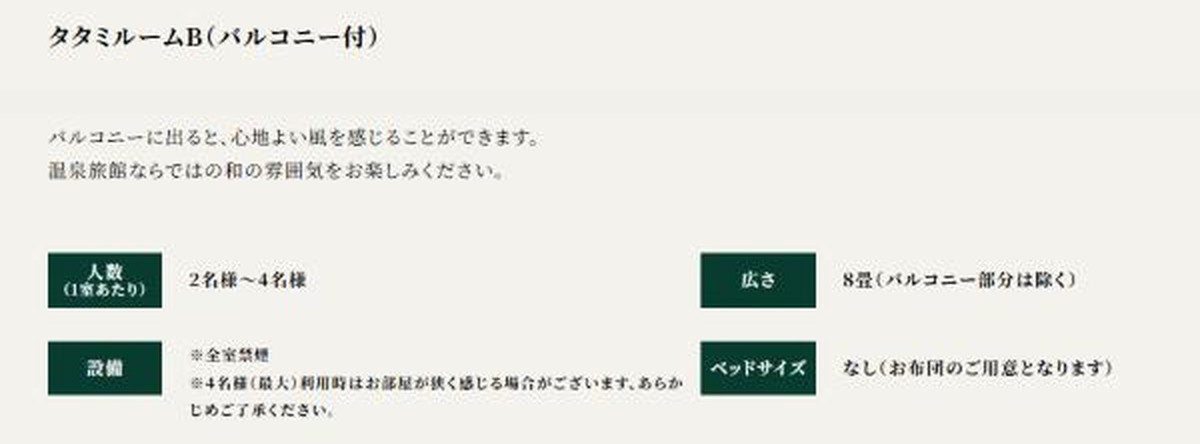
- A tatami room with futon only. Hotel Banso’s Tatami Room B (in Japanese) is 8 mats for 2 to 4 guests. A note on the page, “※4名様(最大)利用時はお部屋が狭く感じる場合がございます”, says that at four guests, the maximum, the room may feel narrow. Tatami rooms are counted by floor rather than beds, as the headcount article explains.
- Apartment style. MIMARU Ueno Inaricho’s page says “Each of our rooms is equipped with a completely furnished kitchen and dining area.” Its two apartments list 4 adults plus up to 2 children, so they sit apart from the other rooms here. Tokyu Stay Yotsuya’s Residential Family lists a washer/dryer and a kitchenette on its English page. Where hotels keep their machines is covered in Laundry at Japanese Hotels: Coin Machines, Prices and How to Find Them.
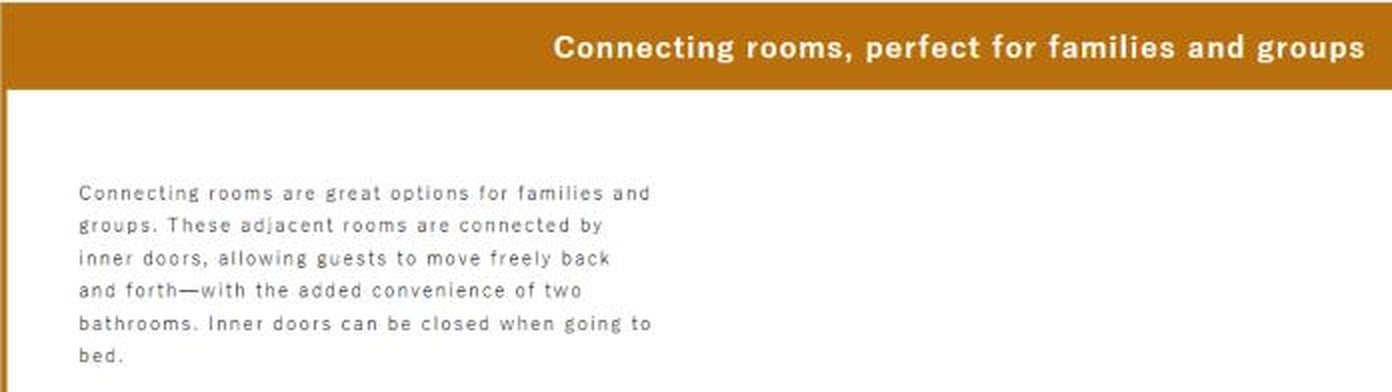
- Two rooms, joined or near. At karaksa, the concept page describes rooms “connected by inner doors” that “can be closed when going to bed,” and the pair has “the added convenience of two bathrooms.” New Otani’s Garden Tower lists a Standard Connecting Room (in Japanese) at 588 ft² (54.6 m²) for the two rooms together, up to 4 guests. ANA InterContinental Tokyo’s FAQ says “some room categories have connecting rooms, but the number of rooms are limited,” and MIMARU’s FAQ says some locations offer a “Connecting Room” type.
Rooms that are only near each other are a different thing. Dormy Inn says it can note a request for rooms close together if you send the second booking’s name, number and date, and that depending on the booking situation it may not be possible.
As of October 2026, from Dormy Inn (in Japanese): FAQ.
Eleven rooms, side by side
| Property | Room | Size | Beds | Max |
|---|---|---|---|---|
| Villa Fontaine Grand Haneda | Family Room | 388 ft² (36 m²) | 4 beds, “1,000 × 2,030” with no unit printed, about 39 × 80 in (100 × 203 cm) | 4 |
| same hotel | Japanese-Western | 312 ft² (29 m²) | 2 beds + 2 futons | 4 |
| Tokyu Stay Yotsuya (in Japanese) | Residential Family | 398 ft² (37 m²) | Bed width 43 in (1,100 mm), count not listed. English page: “studio bed available” for the fourth | 4 |
| MIMARU Ueno Inaricho | Apartment (Sofa-Bed) | 409 ft² (38 m²) | 2 single beds, 2 sofa beds | 4 adults + up to 2 children |
| same page | Japanese Apartment | 431 ft² (40 m²) | 2 single beds, 2 futon | 4 adults + up to 2 children |
| Shinagawa Prince N Tower | Large Twin (15F) | 355 ft² (33.0 m²) | 2 beds, 79 × 43 in (200 × 110 cm), 2 sofa beds, 72 × 38 in (182 × 97 cm) | 4 |
| Dormy Inn Kanazawa (in Japanese) | Japanese-Western | 269 ft² (25 m²) | 2 beds, 39 × 77 in (100 × 195 cm), plus 和布団, count not listed | 4 |
| karaksa hotel Sapporo | Family Comfort with Bunk Bed | 269 ft² (25 m²) | 2 single beds, 39 × 79 in (100 × 200 cm), plus a bunk bed of two 35 × 79 in (90 × 200 cm) | 4 |
| Hotel Banso (in Japanese) | Tatami Room B | 8 mats, m² not listed | Futon only | 2 to 4 |
| New Otani Garden Tower (in Japanese) | Standard Connecting | 588 ft² (54.6 m²) for two rooms | Bed width 43 in (1,100 mm), count not listed | 4 |
| Dormy Inn Ikebukuro (in Japanese) | Family Twin | 260 ft² (24.2 m²) | 47 × 77 in (120 × 195 cm) and 55 × 77 in (140 × 195 cm) | 3 |
As of October 2026, from the pages linked in the table. Square feet and inches are converted from the listed figures.
MIMARU’s apartments, at 409 and 431 ft², list four adults plus children and no bed width. Six of the rooms listed for four list a bed width, and none is above 43 inches (110 cm), against 38 inches for a US twin according to What Does Twin Mean in a Japanese Hotel Room?. Larger rooms differ, since Miyako’s five-guest room has 48-inch (122 cm) beds.
The label is not the count. Dormy Inn Ikebukuro’s Family Twin takes 3, and no room at that hotel lists a capacity above 3, a point Japanese Hotel Rooms Decoded makes about room names in general. For scale, four closed 29-inch bags take about 6.7 ft² (0.6 m²) of any of these floors, according to the luggage article.
Do the kids need their own bed?
The free line depends on the operator, and it is drawn by school status or by a number. Elementary school in Japan starts on the April 1 after a child turns six, so “preschool” can include a six-year-old. Here are seven operators:
- Tokyu Stay (FAQ, in Japanese). Preschool children share free, one per regular bed. Elementary school and up pay the adult price. For a co-sleeping preschooler, the FAQ says to enter only the adults when booking.
- Dormy Inn (FAQ, in Japanese). Ages 0 to 2 are free, one per bed. Ages 3 to elementary school are $19 (¥3,000) per child sharing a bed, and the add-a-child entry says per child per night. Junior high and up, and any child who needs a separate futon or bed, pay the adult rate. A room booked for two adults can take up to two children, depending on room type.
- MIMARU (FAQ). Up to 2 children aged 6 or under at check-in share a bed with an adult and don’t count toward adult capacity. The FAQ lists no fee, and the booking form counts guests aged 7 and up as adults.
- Villa Fontaine Grand Haneda (FAQ). Children under elementary school age sharing existing beds are free, and elementary school and above are treated as adults. On room limits the FAQ says “Please contact the hotel regarding the maximum number of guests allowed in each room.”
- Shinagawa Prince N Tower (this plan page, not a hotel-wide rule). “Children age 6 and below stay free in existing room bedding,” yet the same page allows one child “under 6” per bed, so ask about a 6-year-old. Breakfast carries a fee for children 4 and older (the hotel also says “over 4”).
- karaksa (room page). Ages 6 and under share free, one child per adult per bed and two children per room. The family page offers free sharing for 12 and under when you book on the official website.
- ANA InterContinental Tokyo (FAQ). A child up to 12 in the parents’ bed has no room charge, age 13 and above is treated as an adult, and a shared child’s meals aren’t covered by a meal plan.
Take a 4-year-old and a 9-year-old sharing beds with two parents. At ANA InterContinental that costs nothing extra for the bed. At Dormy Inn it is $19 (¥3,000) per child. At Tokyu Stay the 9-year-old pays the adult price and the 4-year-old is free. The same family costs three different amounts.
The four operators that give a per-bed rule (Tokyu Stay, Dormy Inn, Prince and karaksa) allow one child per bed, so two adults and two small children means two beds, each shared by a parent and a child. Operators also disagree on whether the free child is counted. MIMARU says up to two small children aren’t, Tokyu Stay says to leave a preschooler out of the count, and Super Hotel says the sharing child still counts toward capacity, a contrast the headcount article covers.
As of October 2026, from Super Hotel (in Japanese): family page.
Extra beds and futon: what the pages print
None of three business operators lists an extra-bed amount. Tokyu Stay’s FAQ lists a “twin room + extra bed” for three guests at many locations. Villa Fontaine’s chain FAQ says extra beds are available for a fee in some rooms at five of its hotels. Dormy Inn’s FAQ has no extra-bed entry, only the adult rate for a child who needs a separate bed or futon.
City hotels list numbers. ANA InterContinental Tokyo’s FAQ says “Any extra bed will be sent to your room with an additional fee of 9,488 yen,” about $60, without saying whether that is per night. Hotel Chinzanso Tokyo’s notice, effective June 1, 2026, says extra beds for children are “now subject to an additional charge regardless of age,” at about $80 (¥12,650) per bed including tax and service charge. The notice doesn’t say whether that is per night. It adds that baby cots remain free up to 12 months and that extra beds are limited.
As of October 2026, from Villa Fontaine: chain FAQ. From Hotel Chinzanso Tokyo: notice.
At the inns I’ve stayed at, the plan page sometimes listed how many futon I would get. At some inns the extra place is a futon priced as a share of the adult rate: Sukawa Kogen Onsen lists a child’s futon with no meal (布団のみ) at 30% of the adult rate.
As of October 2026, from Sukawa Kogen Onsen (in Japanese): rate page.
Sofa beds and “studio beds” are the third kind, and the Prince and Tokyu Stay pages count them toward the maximum of 4. Ask whether the fourth place is a full bed and how wide it is before you count it as a place for an adult.
Two rooms win when anyone wants a real bed
When I’ve booked for a group that included children, the rooms were small enough that it usually came to one room for the adults and one for the children.
- The room’s cap is 3. Dormy Inn Ikebukuro’s Family Twin is listed for 3, so four people there means two rooms.
- Everyone counts as an adult. Tokyu Stay and Villa Fontaine treat elementary school and above as adults, Dormy Inn does the same from junior high, and ANA InterContinental from 13. With four adult-rate guests, a room for four has no child discount to offer, so put it and two twins on the same screen and compare the totals. Why Japanese Hotels Price Per Person explains how the per-head number is built.
- A parent wants a wide bed. No width listed for a room for four in the table is above 43 inches (110 cm). Dormy Inn Ikebukuro’s Standard Double is a 140 × 195 cm bed (55 × 77 in) for 2, and whether two adults sleep well on 140 cm is the subject of Can Two Adults Sleep Comfortably on a 140 cm Bed?
- A second bathroom would help. karaksa’s connecting rooms are the only pair in the article that lists two bathrooms.
As of October 2026, from Dormy Inn (in Japanese): Ikebukuro rooms.
One room is the better build when the children are under the free line, you want one key and one set of luggage space, or you want a kitchen, which MIMARU and Tokyu Stay’s Residential Family have. The smallest room listed for four here is 269 ft² (25 m²).
If you plan two rooms, ask whether the hotel treats them as one reservation or two, because the cancellation rules sit on the plan. Japanese Hotel Cancellation Policies Explained shows how they are written.
Check the maximum printed on the room
Before I press the book button, I check the cancellation deadline and fee, the total with tax and service charge, and the bed width and room size. With four people, also check these:
- The maximum, and what it includes. Find 定員 (capacity) or the English “Max.” Check whether the figure counts a sofa bed, a “studio bed”, an extra bed or futon, as the Prince and Tokyu Stay pages do.
- The sleeping places, with widths. Count beds, sofa beds and futon separately. A futon with no number, as at Dormy Inn Kanazawa, is a question for the hotel.
- Your children’s ages on the check-in day. Match each to the operator’s line above. Words to find: 未就学児 (preschool), 小学生 (elementary school), 添い寝 (sleeping with a parent). If a child is exactly 6, ask, since Prince’s plan page words the line two ways. Then follow that operator’s rule on whether the child goes in the headcount.
- Breakfast for each child. Prince’s plan page charges children 4 and older, and ANA InterContinental’s FAQ says a shared child’s meals aren’t covered by a meal plan. A plan that includes breakfast for two adults hasn’t bought it for the children.
- The total with tax and service charge. Add what sits outside the plan price. Dormy Inn’s FAQ says the $19 (¥3,000) for a child added to an adult booking is paid at check-in, and extra beds are priced separately where they exist.
- The cancellation line. It sits on the plan, and the cancellation article shows how to read it.
Decision box
| Your party | Start with | Watch for |
|---|---|---|
| Two adults, two children under about 6 | A room listed for 4, or a twin where the operator allows one child per bed | One child per bed at Dormy Inn, Tokyu Stay, Prince and karaksa. Beds of 43 inches (110 cm) or less in the rooms listed here |
| Two adults, one child aged 7 to 12 and one younger | A room listed for 4 | Elementary-school children pay the adult price at Tokyu Stay and Villa Fontaine |
| Two adults, two teenagers | A room for 4 against two twins, priced as four adults | Dormy Inn charges junior high and up as adults, ANA InterContinental 13 and up |
| A parent wants a double bed or a bathroom | Two rooms, or a connecting pair | Connecting rooms are limited, and “near each other” is only a request |
| You want tatami | A 和洋室, or a tatami room with futon | Who lays out the futon (Japanese-style room article), and notes like Banso’s |
| You want a kitchen or a washer | Apartment style, such as MIMARU or Tokyu Stay’s Residential Family | The fourth place may be a sofa bed or studio bed |
| A baby is coming | The room’s maximum, plus the hotel’s crib rule | Cribs and strollers are in the luggage article |
What to ask the hotel
A short email in English is usually workable, as the headcount article notes. Send it before you pay, and keep the reply.
Hello. I would like to book [room name] from [check-in date] to [check-out date]. We are two adults and two children, aged [age] and [age] on the day of check-in.
- Does the maximum of 4 for this room include the children?
- How many beds, sofa beds and futon are in the room, and how wide is each? Will each child have a place to sleep?
- Do the children’s ages change the room rate or the breakfast price?
- Is an extra bed available for this room type? What is the fee per night?
- If we book two rooms, can you place them next to each other or on the same floor? Do you have connecting rooms?
- Can a stroller stay in the room?
Thank you.
The short version
- The fourth place is often a sofa bed, a studio bed or a futon. Tokyu Stay and Prince count them in the 4, and Dormy Inn Kanazawa doesn’t list a futon count.
- From elementary school several operators charge the adult price, and operators disagree on whether a free child goes in the headcount. Follow the operator’s own rule.
- Extra beds were unpriced at three business operators and about $60 to $80 (¥9,488 to ¥12,650) at two city hotels.
- Choose two rooms, or a connecting pair, if the cap is 3, if all four count as adults, or if anyone wants a real bed or a bathroom.
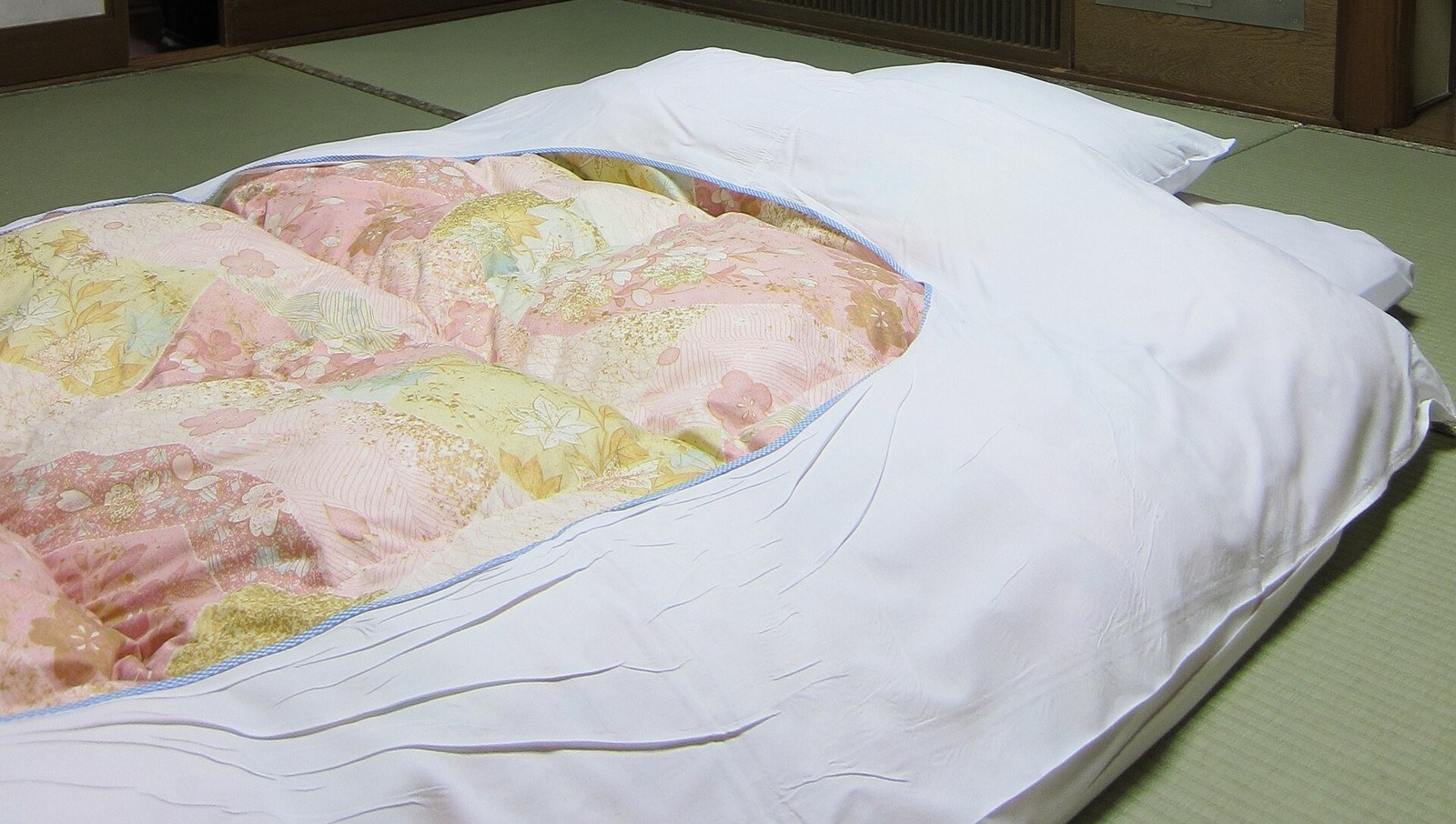
Cover photo: a futon laid out on tatami in a Japanese inn room by hslo, cropped, CC BY-SA 2.0, via Wikimedia Commons.
