Most advice about where to stay in Tokyo ranks neighborhoods, and a booking form can’t use a ranking. It wants a night, a head count and a room. What decides whether an area works is plainer: which airport you land at, when you reach the hotel, how many people and bags come along, and which station your first morning starts from.
The airports come first because they differ so much. From Haneda, Shinagawa Station is 11 to 20 minutes away by train. From Narita, the Skyliner reaches Keisei Ueno in as little as 41 minutes, while the Narita Express takes about 90 minutes to Shinjuku. For a bed near the airport itself, Hotels Near Haneda Airport and Hotels Near Narita Airport compare the options, and Shinjuku Hotels Compared covers the station area. Which kind of lodging to book, ryokan or business hotel, is a different question, and Where to Stay in Japan answers it. The hotel names below are examples, not recommendations.
As of October 2026, from GO TOKYO: Haneda access and Narita access. From Keisei: Skyliner page.
Dollar figures use about ¥158 to the dollar (Trading Economics, October 2026), so check the day’s rate.
Some links on this page are affiliate links. If you book through one, I earn a commission at no extra cost to you.
What the airport rides actually take
Which airport I land at depends on the fare and on whether the route needs a connection, so I use both Haneda and Narita. Narita has three rail routes into town, and each ends at a different station.
- Narita Express (JR East). The ride is about 60 minutes to Tokyo Station and about 90 to Shinjuku, with Shinagawa and Shibuya also served.
- Skyliner (Keisei). Keisei says “in as little as 41 minutes” to Keisei Ueno, and all seats on it must be reserved.
- Access Express (Keisei, continuing onto Toei’s Asakusa Line). Keisei lists Asakusa at 50 minutes, and Toei says “You can go directly to Asakusa or Ginza without any transfer.”
As of October 2026, from GO TOKYO: Narita access. From JR East: Narita Express 48 timetable. From Keisei: Skyliner page and Asakusa directions. From Toei: airport access page.
Haneda has the Keikyu Line and the Tokyo Monorail, both directly connected to the terminals. It takes about 15 minutes to Shinagawa, about 20 to Hamamatsucho and about 30 to Tokyo Station. From Terminal 3 it is 11 minutes to Shinagawa on a Rapid Express (about 20 on a Limited Express or Express), or 13 minutes on the Monorail to Hamamatsucho, then 7 more on the Yamanote Line to Tokyo Station. By bus, it is about 35 minutes to Tokyo Station, 35 to Shinjuku Station’s West Exit, 40 to Shibuya (Mark City) and 55 to Ikebukuro’s West Exit, with some other stops marked suspended.
As of October 2026, from Tokyo Haneda Airport: train page and bus page. From GO TOKYO: Haneda access.
The minutes depend on train type and terminal, so the timetable for your date settles them.
Narita Express tickets from $22 can be bought below ↓
Landing at 7 a.m., checking in at 3 p.m.
Early arrivals meet the hotel’s own clock. Villa Fontaine Grand Haneda Airport, a hotel connected to Terminal 3, sets check-in at 3:00 PM and check-out at 11:00 AM. Early check-in from 12:00 and late check-out until 14:00 cost “3,300 yen per room per hour,” tax included (about $21). “A full night’s charge will apply for check-ins before 12:00 and check-outs after 15:00.” A 7 a.m. arrival that wants the room at once is therefore buying the night before, and one arriving between 12:00 and 15:00 pays the hourly rate. Bags arriving before check-in are kept at the front desk, but after check-out they are held only for same-day collection.
As of October 2026, from Villa Fontaine: Grand Haneda Airport FAQ and group FAQ.
What to check: the plan’s check-in time, the hourly early check-in fee, and who handles bags before 15:00. Arriving Before Check-In in Japan covers holding bags, early check-in fees and station lockers.
On the first night I usually go straight to a hotel in the city or straight on to another city.
After midnight: what is running
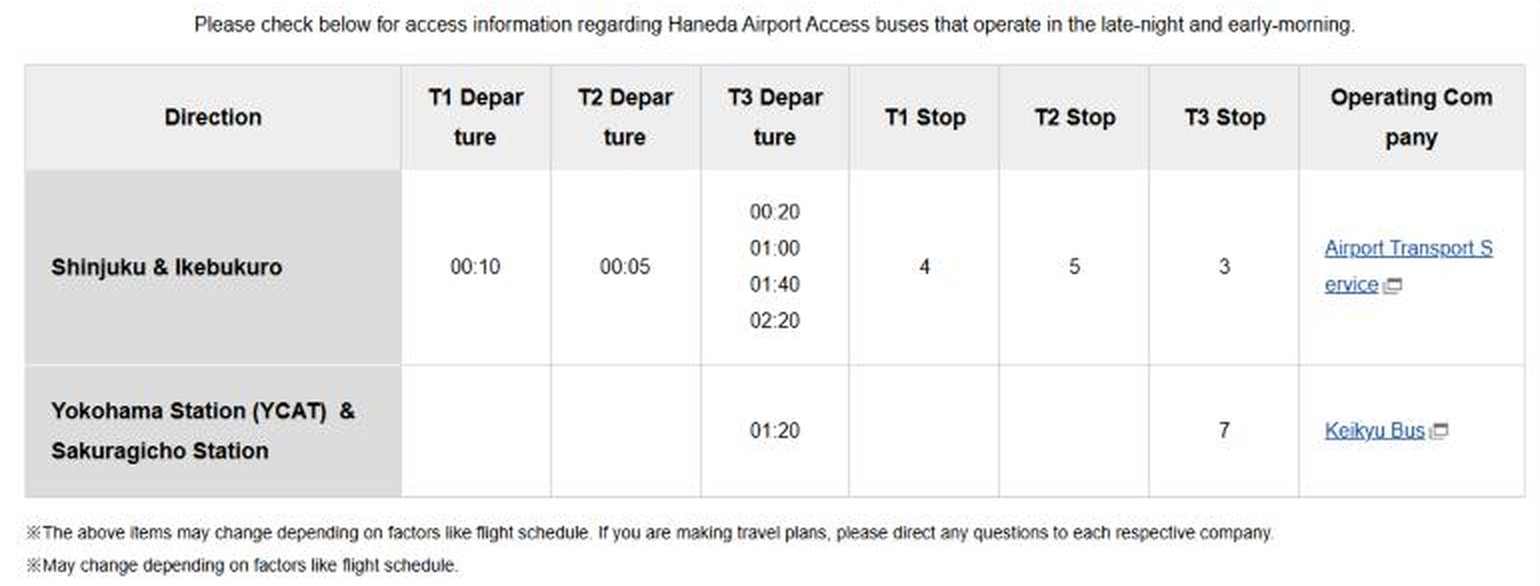
At Haneda, buses are the documented late option, and the terminal you land at changes the times. The airport lists a late-night and early-morning bus to Shinjuku and Ikebukuro at 00:10 from Terminal 1, 00:05 from Terminal 2, and 00:20, 01:00, 01:40 and 02:20 from Terminal 3, and says times may change with flight schedules. The airport’s FAQ says “Terminal 3 is open 24 hours a day.” The domestic areas of Terminals 1 and 2 are generally open 5:00 to 24:00 and close at midnight, and at Terminal 3 “only those who have used or are planning to use international flights can stay inside the terminal overnight.” Check the railway operators’ sites for last trains. GO TOKYO adds that taxi fares usually carry a surcharge between 22:00 and 5:00, with expressway tolls extra. Villa Fontaine Grand, connected to Terminal 3, is one example of a hotel that needs no ride, if the plan allows late check-in.
As of October 2026, from Tokyo Haneda Airport: bus page, terminal FAQ and access FAQ. From GO TOKYO: Haneda access.
At Narita, Terminal 1 is open 05:00 to 24:00 in most areas, with its international arrivals floor open 24 hours, and Terminals 2 and 3 have 24-hour arrivals floors. A capsule hotel in Parking P-2 is “directly connected to the terminal,” and the airport recommends booking ahead because it may be full on your flight day. A Terminal 2 café and refreshment space has hourly rates and no reservation. Check the railway operators’ sites for Narita’s last trains too.
The TYO-NRT bus to Tokyo Station takes about 68 minutes for ¥1,500 (about $9.50), and late-night and early-morning rides cost ¥3,000 (about $19).
For hotels outside the terminal, the airport’s hotel bus list gives 5 to 10 minutes from Terminal 1 and 10 to 15 from Terminal 2 for Narita Tobu Hotel Airport and Hotel Nikko Narita, and warns that “Bus operations to some hotels are subject to change or cancellation.”
As of October 2026, from Narita Airport: late-night page and hotel bus list. From GO TOKYO: Narita access.
The hotel can set a limit as well. Super Hotel’s English FAQ says “check-in time is from 15:00 to 24:00, and your reservation will be canceled after 24:00,” asks you to call “if you will be significantly late for the arrival time you filled in at the time of booking,” and says that for emergencies while the front desk is closed (0:00 to 7:00) there is an intercom next to the elevator. Other chains draw the line elsewhere, so read the terms on the plan you book.
As of October 2026, from Super Hotel: FAQ.
For a first trip by train, choose the station before the district
If you are covering Tokyo by rail, the useful fact about an area is what leaves from its station. Three examples:
- Tokyo. The Tokaido-Sanyo Shinkansen (Kyoto and Osaka), five more Shinkansen lines, the Narita Express and the Yamanote Line.
- Ueno. The northbound Shinkansen (Tohoku, Akita, Yamagata, Joetsu, Hokuriku) and the Yamanote Line. The Skyliner ends at Keisei Ueno, which carries its own station name, so check the walk from there to the hotel.
- Shinagawa. Served by four JR lines, one Keikyu line and the Tokaido Shinkansen, with coin lockers “of various sizes.”
As of October 2026, from JR East: Tokyo station page and Ueno station page. From GO TOKYO: Shinagawa and Tennozu.
Write down the two or three trains you will ride most, then choose the area where they meet with the fewest changes. Kyoto and Osaka trains leave from Tokyo and Shinagawa, and the northern lines to Nagano and Kanazawa leave from Tokyo and Ueno. Then open the hotel’s access page and note the exit and the walking time, as MIMARU’s does below.
Four people usually means two rooms or four beds
Capacity is where area and hotel type meet. Dormy Inn Ikebukuro lists its Family Twin at 24.2 m² (260 ft²) with a 120 cm and a 140 cm bed (47 and 55 inches) and a capacity of 3. No room on that page has a capacity above 3, so four people there means two rooms.
As of October 2026, from Dormy Inn (in Japanese): Ikebukuro room page.
Some hotels do list one room for four. Villa Fontaine Grand Haneda Airport lists a Family Room at 36 m² (388 ft²) with four beds and a maximum of 4 people, each bed about 39 × 80 inches (100 × 203 cm). Its Japanese-Western Room is 29 m² (312 ft²) with two beds and two futons for up to four. The operator’s FAQ says children under elementary school age stay free when sharing an existing bed.
In Ueno, MIMARU Ueno Inaricho lists a 38 m² (409 ft²) room for up to 4 adults and 2 children aged 6 and under, a kitchen with an IH stove and microwave, and no in-room washer. The hotel puts the Ginza Line’s Inaricho Station Exit 3 at a 3-minute walk and JR Ueno’s Iriya Exit at 5. That chain’s crib and family-room rules are in How Much Luggage Fits in a Japanese Hotel Room?.
As of October 2026, from Villa Fontaine Grand Haneda Airport: Family Room and Japanese-Western Room. From MIMARU: Ueno Inaricho page.
Central Shinjuku looks different. Across 44 properties within about 0.6 miles (1 km) of Shinjuku Station with availability for three adults on one night in October 2026 (a Rakuten search, described in Booking a Japanese Hotel for Three, or With Kids), quad rooms came back 7 times and Japanese-Western rooms 3 times.
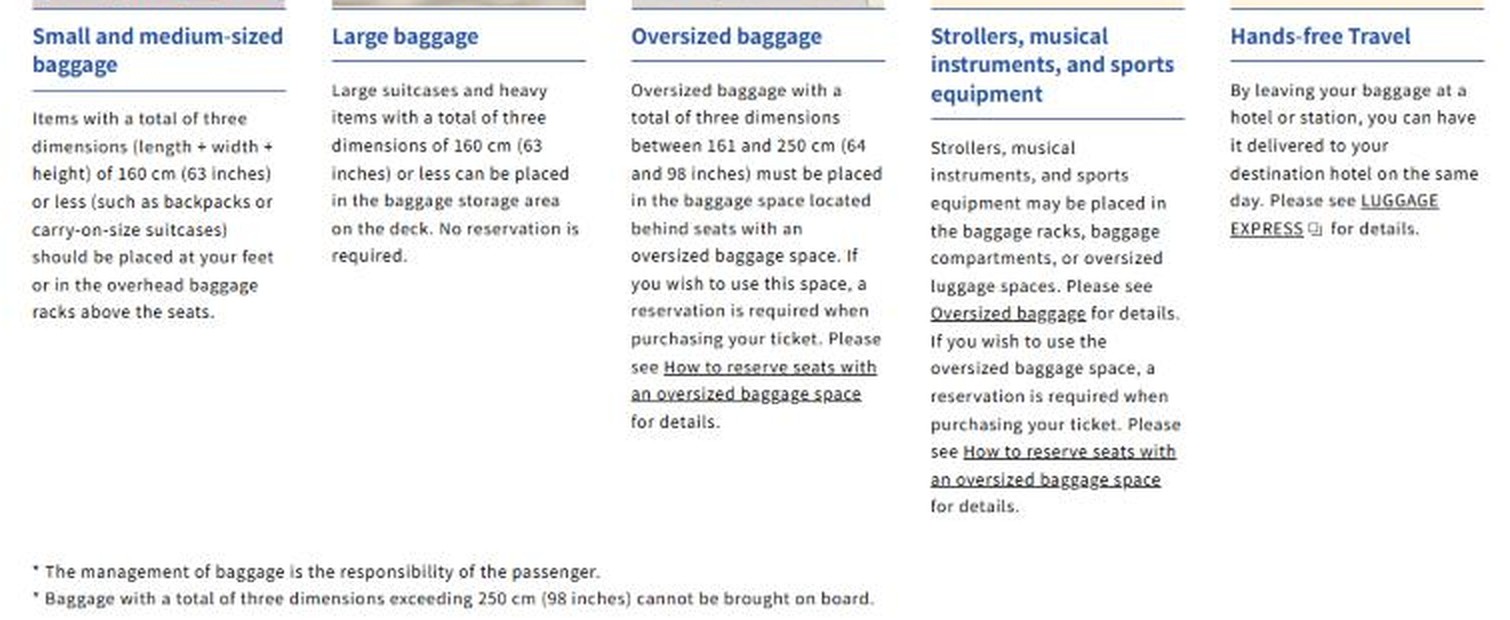
Strollers. Tokyo Metro asks you to take the child out and fold the stroller on escalators. On the Shinkansen, JR Central says its oversized-baggage rules “do not apply to strollers”, though you need a reservation to use the oversized-baggage space itself.
As of October 2026, from Tokyo Metro: FAQ. From JR Central: oversized baggage page.
What to check: the capacity printed for the room, and not the bed count. How children are counted is the subject of the headcount article above.
Business trip: a hub, a bed that fits the bag, and a receipt
For a short trip, my base is usually near Tokyo or Shinagawa Station, or near the station of my first stop, depending on the purpose.
Shinagawa and Tokyo fit when the trip involves a Shinkansen or Haneda. Shinagawa has the Tokaido Shinkansen and Haneda 11 to 20 minutes away, and Tokyo Station adds the Chuo Line and the other Shinkansen lines on JR East’s list.
A business-hotel single is small. Dormy Inn Ikebukuro lists an Economy Single at 12.0 m² (129 ft²) and a Single at 15.4 m² (166 ft²), both with a 120 cm bed. At Shinagawa Prince Hotel’s Annex Tower, the Double Room is 219.5 ft² (20.4 m²) with one 160 × 195 cm bed (63 × 77 inches) and a maximum of 2. What a typical business hotel room holds is covered in Where to Stay in Japan.
As of October 2026, from Dormy Inn: Ikebukuro rooms (in Japanese). From Prince Hotels: Shinagawa Double Room.
Receipts depend on how you paid. Super Hotel’s FAQ says that if you pay at the front desk, the hotel you stayed at issues the receipt. If you prepaid on the official site, the receipt is issued in the JTB Book&Pay reservation screen, and the front desk cannot issue one for a prepaid card payment. Dormy Inn’s FAQ gives the same split between a front-desk receipt and a Book&Pay one, and says the amount on it has any points you used deducted. The cancellation article has a section on receipts and invoices.
As of October 2026, from Super Hotel and Dormy Inn (in Japanese): Super Hotel FAQ, Dormy Inn FAQ.
When the bags are the trip
The ride. The no-transfer options are the ones in the first section. Toei says of its airport trains: “It is convenient particularly for those who carry suitcases or heavy luggage.” For Kyoto or Osaka afterward, JR Central’s rule is that baggage totaling 160 to 250 cm (63 to 98 inches) on its three sides “requires a reservation” for a seat with an oversized-baggage area on the Tokaido, Sanyo and Kyushu Shinkansen. Taking it without one costs ¥1,000 (about $6), and over 250 cm cannot be brought aboard. Tokyo and Shinagawa are the Tokyo stops for those trains, so a hotel at either keeps the big bags off a subway transfer.
As of October 2026, from Toei: airport access page. From JR Central: oversized baggage page.
The courier. Narita has three same-day delivery services: Yamato (06:30 to 10:30, or 09:50 at Terminal 3), and Sagawa Express and JAL ABC (to 14:00). Sagawa covers only 10 Tokyo wards and selected Urayasu hotels, and JAL ABC’s is hotel delivery. Yamato adds that it may decline same-day delivery for a one-night stay. Those cutoffs suit a morning arrival, and a bag handed over after them falls outside the same-day services listed. I have used JAL ABC to send bags from an airport to a hotel or home, and to an airport. The airport luggage delivery article has the prices and the next-day rule.
As of October 2026, from Narita Airport: baggage delivery page. From Yamato: same-day delivery FAQ.
The room. A 29-inch bag opened flat needs about 8 ft² (0.75 m²) of clear floor, according to the luggage article. Before booking, add the three sides of your own bag in centimeters and compare the total with JR’s 160 cm line.
Stopovers: a few hours or one night
For a gap of a few hours, the question is whether leaving the airport pays. The Narita Express takes about 60 minutes to Tokyo Station, so a round trip spends about two hours on the train before you see anything. Haneda Airport’s site puts Tokyo Station at about 30 minutes and Shinagawa at about 15, so a shorter gap can still include an outing.
For a night between flights, sleeping at the airport is simpler. At Narita, the capsule hotel in Parking P-2 and the Terminal 2 café are options, and the hotel-bus list above covers hotels at 5 to 15 minutes. At Haneda, Villa Fontaine Grand is directly connected to Terminal 3. Which terminal your flight leaves from is the check, because the Terminal 1 and 2 areas close at midnight and the Terminal 3 overnight rule applies to international passengers only.
As of October 2026, from Narita Airport: late-night page. From Villa Fontaine: Grand Haneda Airport page.
The short version
- Pick the station where your airport train ends, because the ride with no transfer is the one that suits bags and a first night.
- After midnight, check which terminal you land at and read the hotel’s last check-in time.
- A family of four needs a room listed for four or two rooms. For a first trip by rail, pick the station where your main trains meet.
- For bags, add the three sides and note Narita’s same-day courier cutoffs, 10:30 and 14:00. For a business trip, ask how the receipt is issued before you prepay.
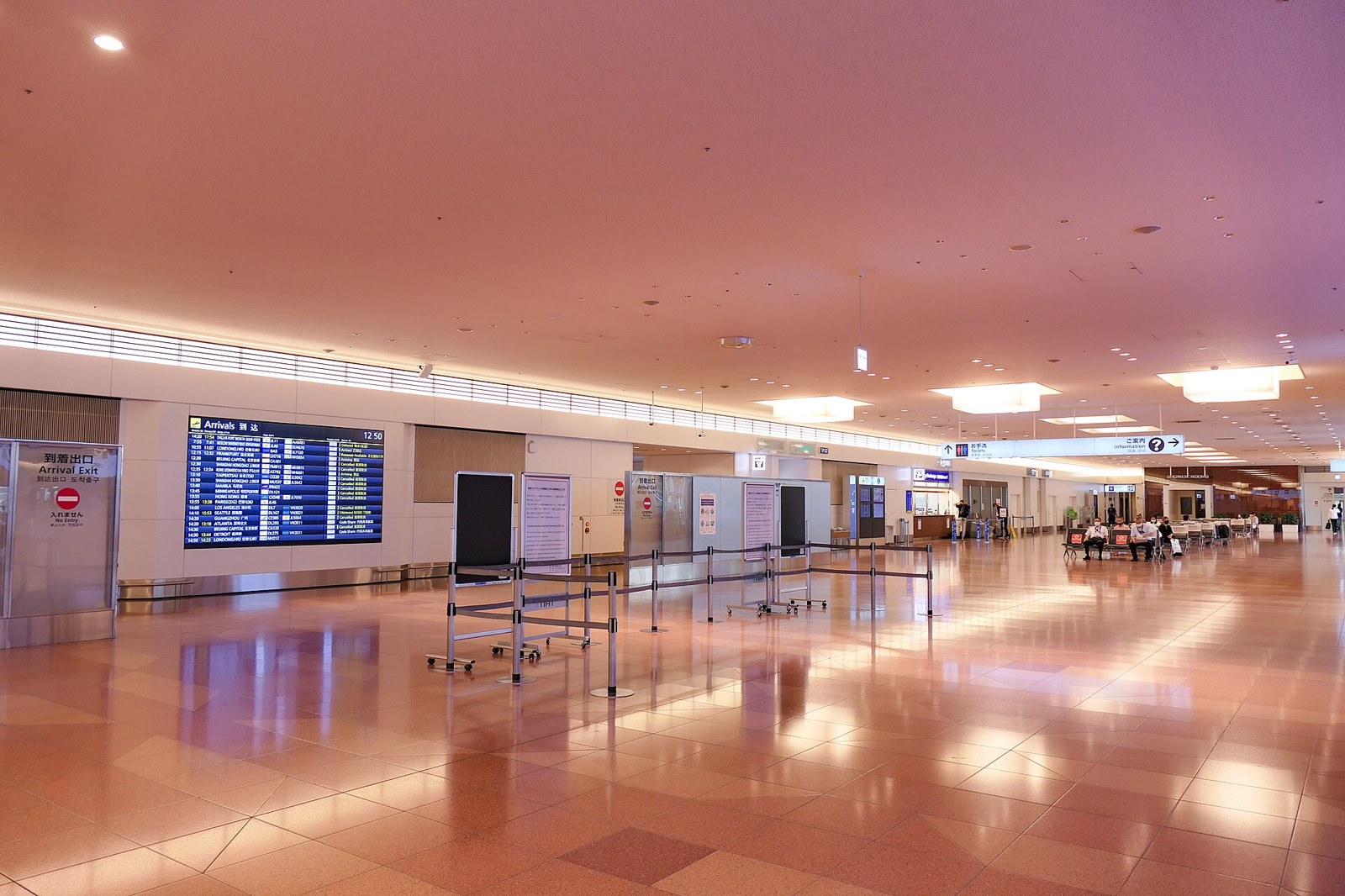
Cover photo: the arrival lobby of Terminal 3 at Haneda Airport by MaedaAkihiko, CC BY-SA 4.0, via Wikimedia Commons.
